
Glossary
Safety SOP
 ChatGPT
 Perplexity
 Gemini
 Claude
What is a safety SOP?
A safety SOP is a standard operating procedure for performing a specific task safely and consistently. It names the hazards, controls, required steps, and stop conditions workers should use when the normal process becomes unsafe.
Safety SOPs belong wherever unclear instructions can cause injury, exposure, damaged equipment, property loss, or an unsafe field or customer-site situation. They are practical documentation guidance, not legal advice; safety-critical procedures should be reviewed against the actual workplace, hazards, industry rules, and applicable requirements.
Why safety SOPs matter
A standard SOP tells people how to do work consistently. A safety SOP has a stricter job: it has to connect the steps to the risks that matter.
That means the procedure cannot just say "be careful." It needs to answer operational questions: what can go wrong, what controls are required, who is authorized, which warning signs stop the job, and what to do when today's conditions do not match the written process.
OSHA's recommended practices for safety and health programs emphasize proactive safety management, including leadership, worker participation, hazard identification, hazard prevention and control, training, evaluation, and coordination across employers where relevant.1 A safety SOP is one practical artifact inside that larger safety system.
What a safety SOP includes
A useful safety SOP is specific enough for a trained worker to follow and clear enough for a supervisor to use in training or review.
Most safety SOPs need:
- Purpose, scope, and owner
- Required training or authorization
- Known hazards and risk factors
- Required controls, including equipment, setup, and PPE
- Tools, materials, and safety equipment
- Step-by-step safe work procedure
- Pre-task inspection or readiness checks
- Stop-work conditions
- Emergency, shutdown, or evacuation steps
- Incident, near-miss, and hazard reporting path
- Cleanup, storage, disposal, records, and review cadence
NIOSH's hierarchy of controls is a useful reference when choosing controls because it ranks elimination and substitution above engineering controls, administrative controls, and PPE.2
The most important section is often not the step list. It is the stop condition: the point where the worker should pause, escalate, or refuse to continue because the environment no longer matches the safe procedure.
Safety SOP examples
A safety SOP is useful when work is repeated, risk is meaningful, and people need the same safe method every time.
Common examples include:
- Lockout/tagout procedure
- Chemical handling procedure
- Forklift operation procedure
- Confined space entry procedure
- Machine startup and shutdown procedure
- Spill response procedure
- Heat illness prevention procedure
- Emergency evacuation procedure
- Incident reporting procedure
The right procedure library depends on the workplace. A warehouse, lab, clinic, restaurant, construction crew, and field service team will not need the same safety SOPs. Good safety documentation starts with the actual worksite and the actual hazards, not a generic folder of policies. OSHA's lockout/tagout guidance is a good example of why some safety SOPs need task-specific steps, training, and controls for serious hazards.3
Safety SOP vs. safety manual
A safety SOP is narrower than a safety manual. The manual explains the safety program: policies, responsibilities, training expectations, reporting systems, and references. The SOP explains how to perform one task or workflow safely.
For example, a safety manual might require approved PPE and hazard reporting. A chemical-handling SOP would name the task, required PPE, storage rules, spill response, disposal instructions, and reporting path.
The manual gives the program structure. The SOP gives the task-level instructions.
How to write a safety SOP
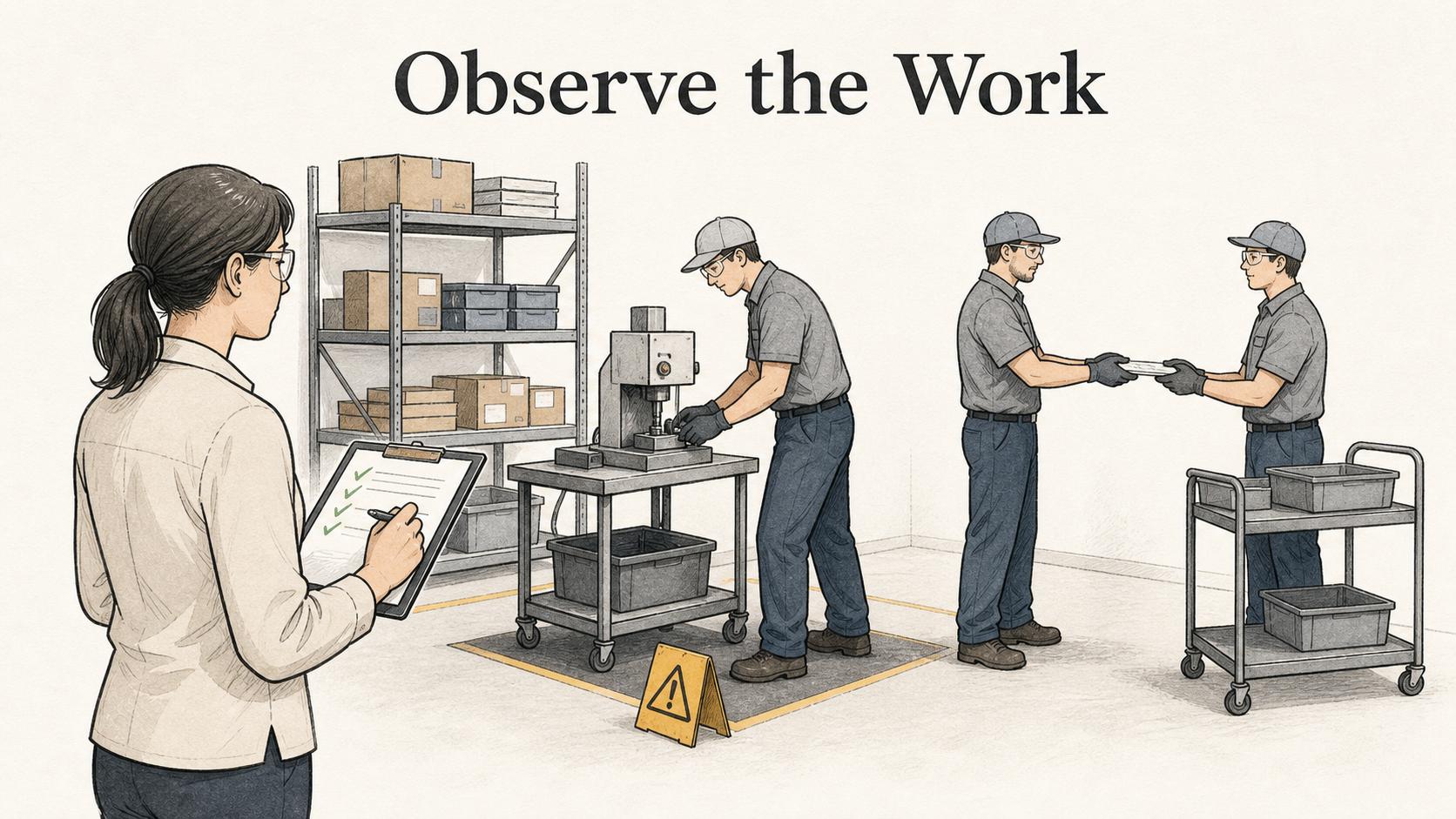
Start by observing the work. A safety SOP written only from memory can miss the awkward parts of the task: the step where someone reaches across moving equipment, the cramped storage area, the shortcut employees use during busy periods, or the confusing handoff between shifts. OSHA's job hazard analysis guidance uses the same practical pattern: break a job into steps, identify hazards, and recommend safer procedures.4
Talk with people who perform the work, review incidents and near misses, check equipment instructions and relevant requirements, then write the procedure in the order the task actually happens.
Use this compact template:
## Safety SOP Template

**Glossary term:** Safety SOP
**Source:** Trails Glossary — trails.so/glossary/safety-sop

---

### 01. Draft a safety SOP

"Title: [task, equipment, or activity]
Purpose: [why this SOP exists]
Scope: [who, where, when, and what it covers]
Owner: [role responsible for keeping it current]
Required training: [training or authorization needed]
Hazards: [what could go wrong]
Controls: [engineering, administrative, PPE, and safe work controls]
Before starting: [inspection, setup, and readiness checks]
Procedure: [step-by-step safe work method]
Stop-work conditions: [when to pause or escalate]
Emergency steps: [what to do if conditions become unsafe]
Reporting: [how to report incidents, injuries, hazards, or near misses]
Records: [forms, logs, inspections, or training records]
Review cadence: [when and how the SOP is reviewed]"
The strongest safety SOPs make the invisible judgment visible. They do not just say, "Use caution." They name the specific condition that changes the work: damaged equipment, missing guard, expired material, blocked exit, unusual odor, unreadable label, missing spotter, failed inspection, or weather that makes the task unsafe.
Common mistakes
- Burying critical instructions in policy language. Workers need the exact precautions, sequence, equipment, stop conditions, and reporting path.
- Copying a generic procedure. A safety SOP should reflect the equipment, layout, materials, roles, and hazards in front of the worker.
- Leaving review to chance. Incidents, near misses, new equipment, layout changes, material changes, staffing changes, and new requirements should trigger review.
Documentation takeaway
A safety SOP documents the safe way to perform a specific task. It should connect hazards, controls, training, task steps, emergency actions, reporting, records, and ownership in one usable procedure.
The useful version is not just a compliance artifact. It helps workers see what safe work looks like, helps supervisors train consistently, and gives the team a shared reference for improving the process before something goes wrong.
How Trails helps
Trails helps teams capture repeatable workflows and turn them into step-by-step guides. For safety SOPs, that can support clearer documentation of task steps, checks, roles, screenshots, photos, and review notes. Safety-critical procedures still need appropriate safety, legal, or compliance review before they become official instructions.
Sources
- 1
Occupational Safety and Health Administration. Recommended Practices for Safety and Health Programs. OSHA. www.osha.gov/safety-management. Accessed July 9, 2026.
- 2
National Institute for Occupational Safety and Health. Hierarchy of Controls. CDC/NIOSH. www.cdc.gov/niosh/hierarchy-of-controls/about/index.html. Accessed July 9, 2026.
- 3
Occupational Safety and Health Administration. Control of Hazardous Energy. OSHA. www.osha.gov/control-hazardous-energy. Accessed July 9, 2026.
- 4
Occupational Safety and Health Administration. Job Hazard Analysis. OSHA. www.osha.gov/sites/default/files/publications/OSHA3071.pdf. Accessed July 9, 2026.