
Glossary
Knowledge Transfer
 ChatGPT
 Perplexity
 Gemini
 Claude
What is knowledge transfer?
Knowledge transfer is the process of making one person's or team's knowledge usable by another person, team, role, or organization. Organizational research treats transfer as a change in the recipient's knowledge or performance, not just exposure to information. \[1\] It shows up during onboarding, role changes, process updates, customer handoffs, mergers, training programs, and exits by subject matter experts.
Strong knowledge transfer turns experience into usable context: what to do, why it matters, where judgment is required, and what usually goes wrong.
Why knowledge transfer matters
Teams feel weak knowledge transfer when work slows down after a person changes roles, leaves the company, or becomes a bottleneck. The obvious loss is information. The deeper loss is judgment: shortcuts, edge cases, warning signs, customer context, and the small decisions experienced people make without narrating them.
A single handoff meeting rarely holds up. The expert may explain the process clearly, but the learner still has to reconstruct the sequence later, usually under pressure. Effective transfer leaves behind artifacts the recipient can revisit: a process guide, checklist, decision rule, sample, recording, annotated example, or troubleshooting note. Research also emphasizes that knowledge is embedded in tools, tasks, and relationships, not only in individual people. \[2\]
How knowledge transfer works
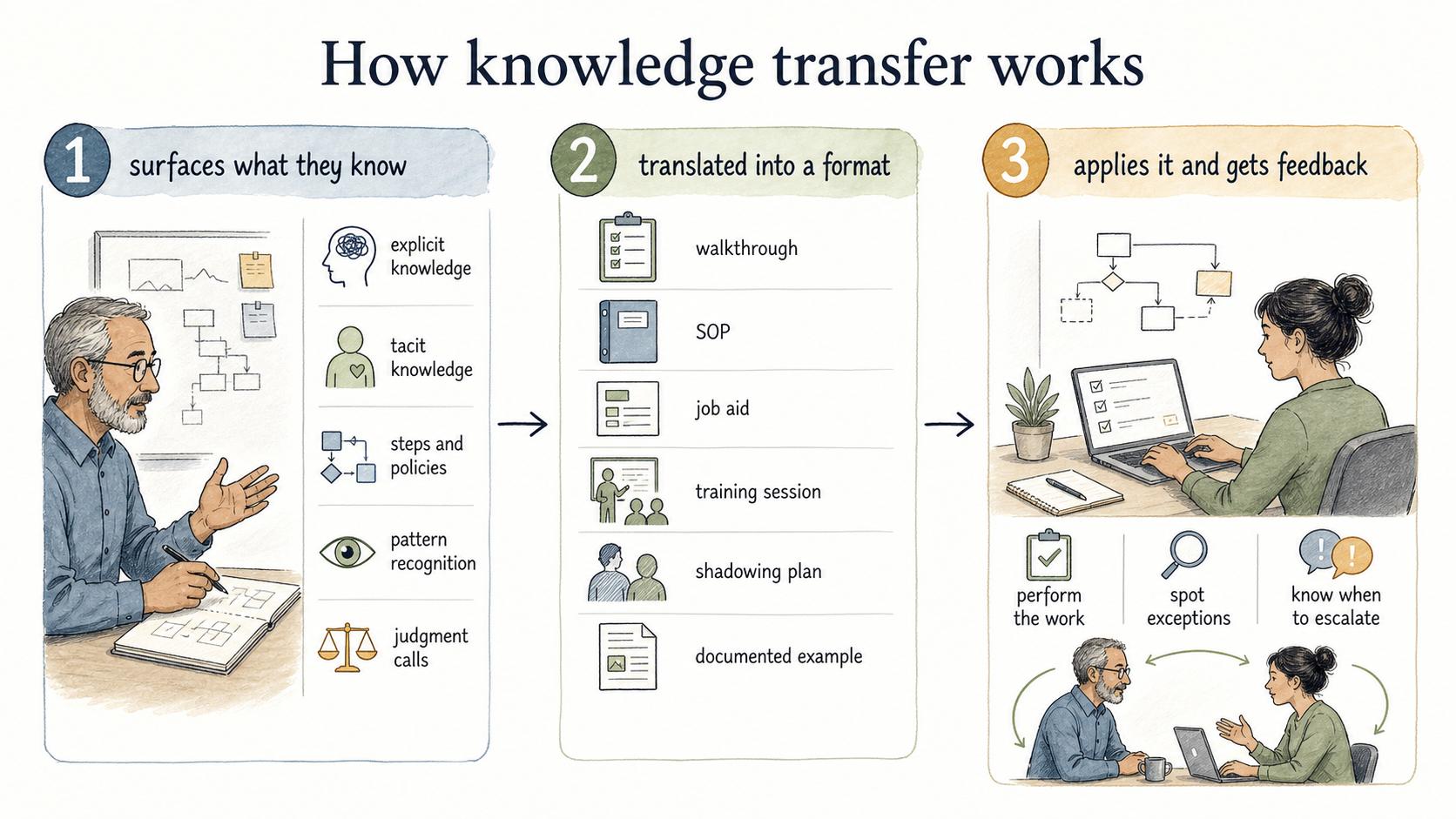
Knowledge transfer usually moves through three layers.
First, the expert surfaces what they know. This includes explicit knowledge, such as steps and policies, and tacit knowledge, such as pattern recognition and judgment calls. Nonaka's knowledge-creation model is useful here because it describes organizational knowledge as developing through interaction between tacit and explicit knowledge. \[3\]
Second, the knowledge is translated into a format another person can use. That might be a walkthrough, SOP, job aid, training session, shadowing plan, or documented example.
Third, the recipient applies it and gets feedback. Teams skip this layer most often. A handoff is complete only when the new owner can perform the work, spot exceptions, and know when to escalate.
Knowledge transfer vs knowledge sharing
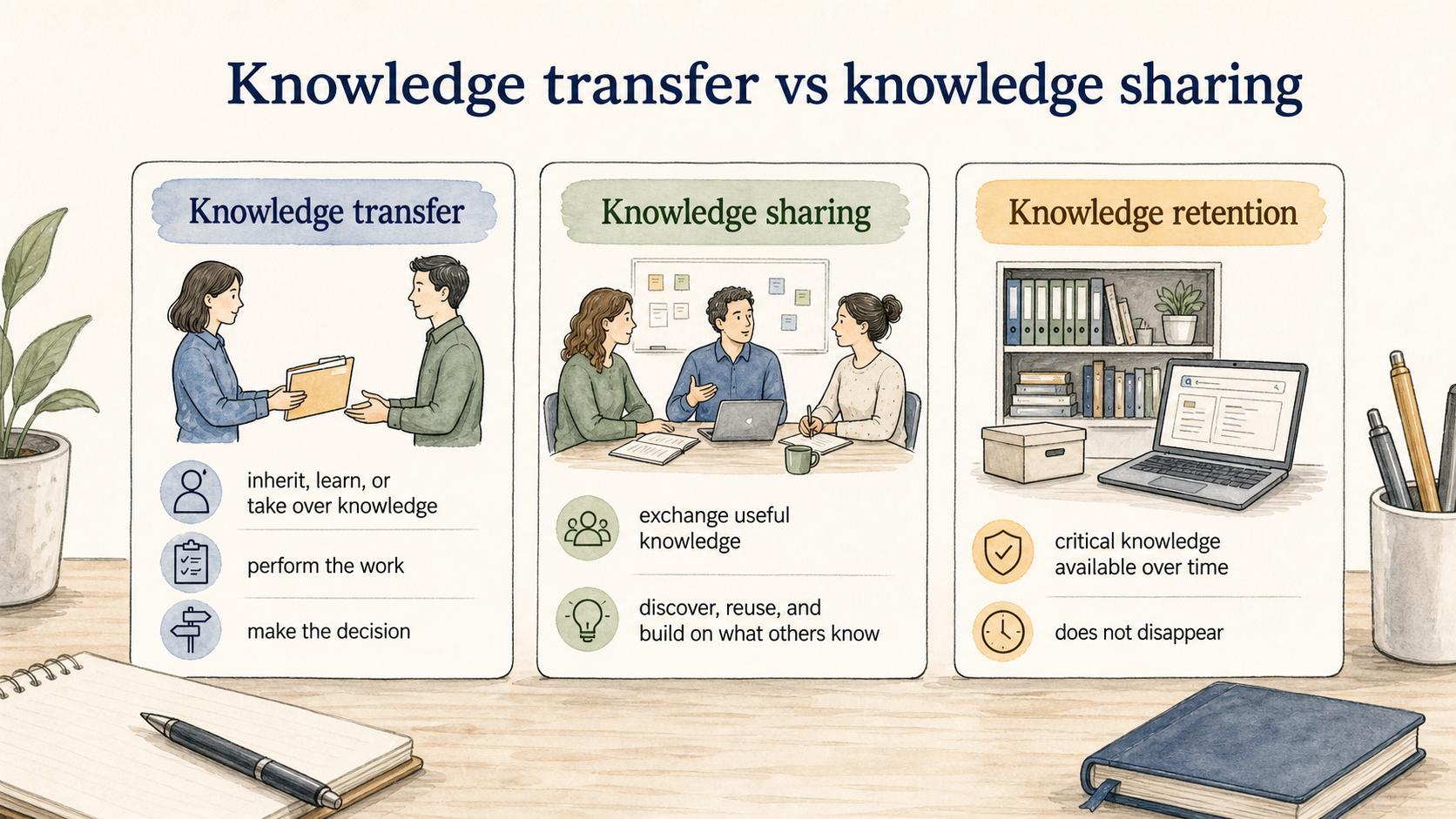
Knowledge transfer and knowledge sharing overlap, but they are not identical.
| Term | Best use | What success looks like |
|---|---|---|
| Knowledge transfer | A specific person or group needs to inherit, learn, or take over knowledge | The recipient can perform the work or make the decision without relying on the original expert |
| Knowledge sharing | People exchange useful knowledge across a team or organization | More people can discover, reuse, and build on what others know |
| Knowledge retention | The organization keeps critical knowledge available over time | Important know-how does not disappear when people leave or systems change |
</table>
A team can share knowledge widely and still fail at transfer. A wiki page may be visible to everyone, but if it does not explain the judgment behind a customer escalation process, the next support lead may still be unprepared.
What should be captured during knowledge transfer?
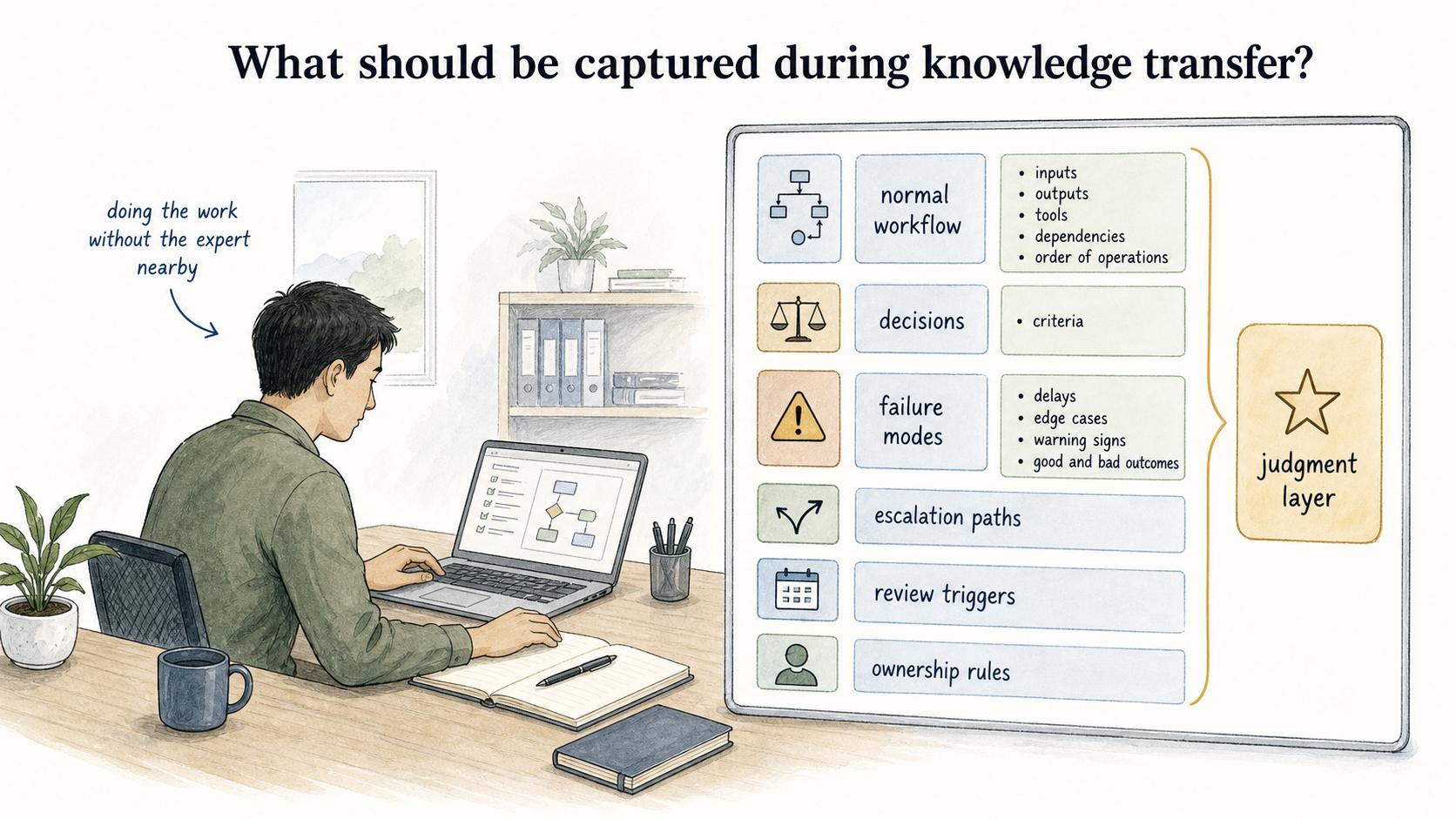
The useful question is not "What does the expert know?" That question is too broad. Ask what the next person will need when they are doing the work without the expert nearby.
Strong knowledge transfer captures:
- The normal workflow, including inputs, outputs, tools, dependencies, and order of operations
- The decisions the owner has to make, plus the criteria behind those decisions
- The failure modes, delays, edge cases, and warning signs that do not appear in the happy path
- Examples of good and bad outcomes, such as completed work, tickets, customer cases, reports, or reviewed deliverables
- Escalation paths, review triggers, and ownership rules for keeping the material current
The judgment layer is the most valuable part. If the document only explains the happy path, the new owner will still need the expert the first time reality gets messy.
A practical knowledge transfer template
Use this when an employee is handing off a process, account, system, or recurring responsibility:
## A practical knowledge transfer template

**Glossary term:** knowledge transfer
**Source:** Trails Glossary — trails.so/glossary/knowledge-transfer

---

### 01. A practical knowledge transfer template

"Knowledge transfer brief for [process/responsibility]
Current owner: [name]
New owner or audience: [name/team]
Business purpose: [why this work matters]
Normal workflow: [main steps in order]
Key tools and locations: [systems, folders, dashboards, docs]
Critical decisions: [choices the owner must make and how to decide]
Common exceptions: [what breaks, stalls, or needs escalation]
Examples: [links to completed work, tickets, customer cases, reports]
People to contact: [SMEs, approvers, downstream teams]
Review trigger: [when this brief should be updated]
Open risks: [what the new owner should watch closely]"
A template is useful because it forces the expert to expose assumptions. The goal is a reliable starting point for someone who has to take action, not a perfect document.
Common knowledge transfer mistakes
The first mistake is waiting until the last week. By then, the expert is rushing, the recipient is overloaded, and the team captures whatever is easiest to say rather than what is hardest to replace.
The second mistake is treating knowledge transfer as a storage project. A folder of documents only helps when the next person can find the right item, understand when to use it, and trust that it reflects the current process.
The third mistake is skipping practice. For high-stakes work, the new owner should perform the process while the expert is still available. That is where missing context surfaces: unclear approvals, undocumented exceptions, outdated screenshots, and decisions that were never written down.
Documentation takeaway
Knowledge transfer works best when documentation is built from the work itself. A strong transfer artifact should be specific enough to guide action, but not so brittle that it becomes obsolete after one small process change.
The most durable approach is to capture workflows, decisions, and examples while the work is happening, then assign ownership for keeping the material current. Treat knowledge transfer as an operating habit for making critical know-how portable.
How Trails helps
Trails helps teams capture a workflow as someone performs it, then turn that workflow into a polished step-by-step guide. Teams can also create an AI-narrated video version for training or sharing.
That makes knowledge transfer easier when expertise lives in repeated processes: tool walkthroughs, onboarding tasks, support escalations, operations routines, or handoffs from a subject matter expert to a new owner.
Sources
1. [Argote and Ingram, Knowledge Transfer: A Basis for Competitive Advantage in Firms](https://www.columbia.edu/~pi17/2893a.pdf) - Supports the definition of transfer as knowledge moving in a way the recipient can use.
2. [Annual Review of Psychology on knowledge transfer within organizations](https://www.annualreviews.org/doi/pdf/10.1146/annurev-psych-022123-105424) - Supports the point that knowledge is embedded in members, tools, tasks, and networks.
3. [Nonaka, A Dynamic Theory of Organizational Knowledge Creation](https://josephmahoney.web.illinois.edu/BA504_Fall%202008/Uploaded%20in%20Nov%202007/Nonaka%20%281994%29.pdf) - Supports the tacit/explicit knowledge framing.
- Knowledge Sharing
- Knowledge Retention
- Tacit Knowledge
- Explicit Knowledge
- Institutional Knowledge
- Tribal Knowledge
- Subject Matter Expert
- Training Documentation
Sources
- 1
Argote and Ingram. Knowledge Transfer: A Basis for Competitive Advantage in Firms. www.columbia.edu/~pi17/2893a.pdf.
- 2
Annual Review of Psychology on knowledge transfer within organizations. Annual Review of Psychology on knowledge transfer within organizations. www.annualreviews.org/doi/pdf/10.1146/annurev-psych-022123-105424.
- 3
Nonaka. A Dynamic Theory of Organizational Knowledge Creation. josephmahoney.web.illinois.edu/BA504_Fall%202008/Uploaded%20in%20Nov%202007/Nonaka%20%281994%29.pdf.