
Glossary
Training Manager
 ChatGPT
 Perplexity
 Gemini
 Claude
What is a training manager?
A training manager plans, manages, improves, and measures training programs. The role connects business needs, learner needs, subject matter expertise, training materials, delivery methods, and training metrics.1
A strong training manager does more than schedule courses. They build the operating system around training: what gets taught, why it matters, how people practice, how managers reinforce it, and how the team knows whether the work improved.
What a training manager does
Training managers often sit between learning and development, HR, operations, enablement, department leaders, and subject matter experts. Their scope may include new hire onboarding, role-based training, compliance refreshers, product training, process training, customer support training, leadership development, and training platform administration.
In a smaller company, the training manager may write materials, facilitate sessions, track completion, and update guides. In a larger organization, they may lead instructional designers, trainers, coordinators, platform admins, and program owners.
The central responsibility is ownership. Training requests arrive from many directions. The training manager turns those requests into a coherent program with priorities, standards, materials, delivery plans, and feedback loops.
Training manager responsibilities
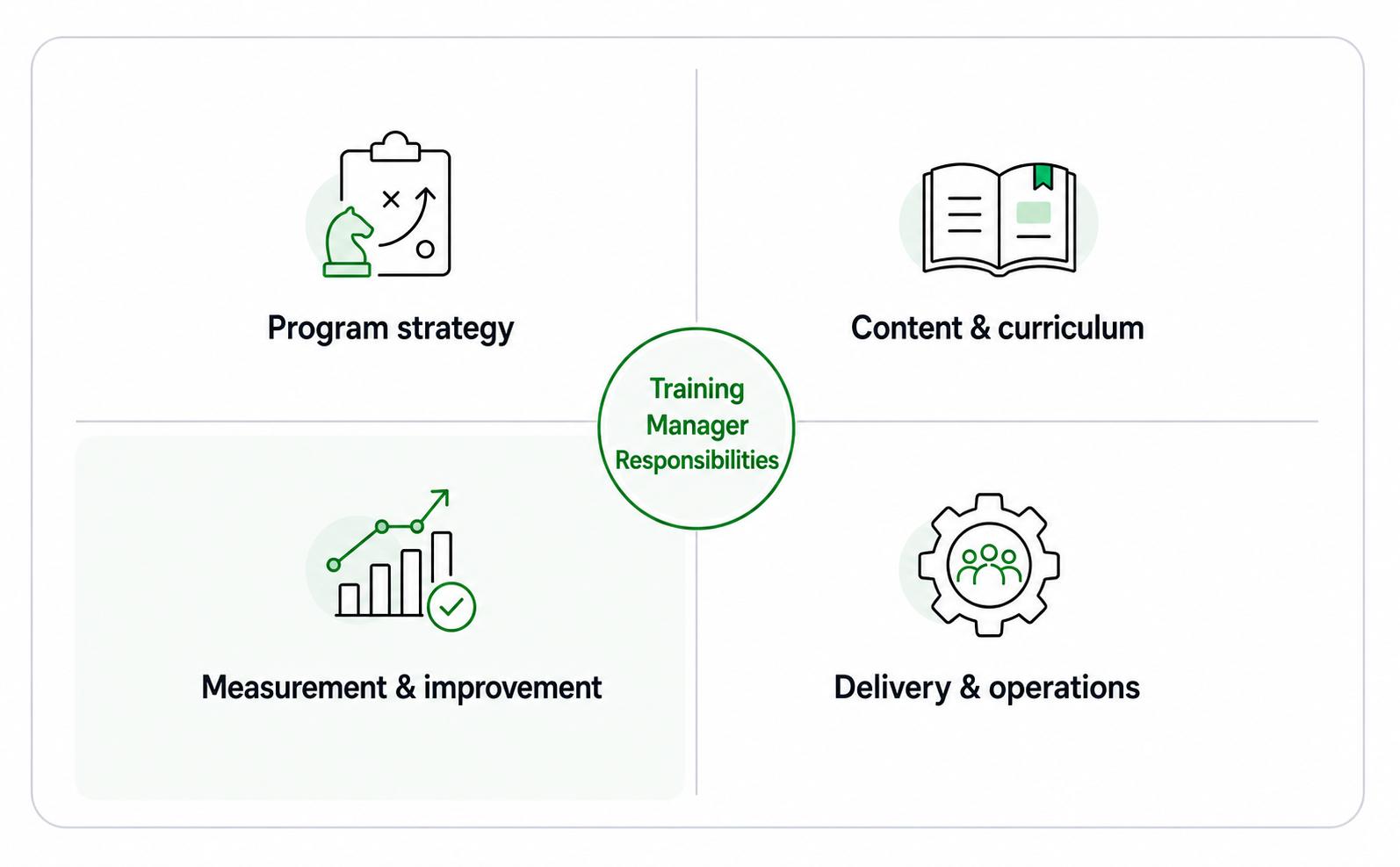
A training manager's work usually spans four areas.
Program strategy: Identify the capability gaps that matter most, connect them to business outcomes, and decide which programs deserve time and budget. This includes asking whether training is actually the right solution. Sometimes the real issue is a broken process, unclear documentation, poor tooling, or inconsistent management.2
Content and curriculum: Work with subject matter experts to turn knowledge into usable materials: courses, manuals, guides, videos, exercises, assessments, checklists, and coaching notes. The manager may create the material directly or coordinate the people who do.
Delivery and operations: Make sure training reaches the right audience at the right time. This includes schedules, assignments, facilitation, platform setup, manager communication, learner support, and coordination with business calendars.
Measurement and improvement: Track whether training was completed, understood, applied, and connected to better work. The point is to improve the program, not just prove activity happened.3
Training manager vs. trainer
A trainer usually delivers instruction. A training manager owns the broader training system.
The same person can play both roles, especially on smaller teams. But the distinction matters. A trainer might teach a session on a new customer support workflow. A training manager decides who needs that training, what materials support it, how readiness will be checked, how managers will reinforce it, and when the materials must be updated.
When the manager role is missing, training becomes event-driven. Someone asks for a session, the session happens, and everyone moves on without checking whether the work changed.
Training manager vs. training coordinator
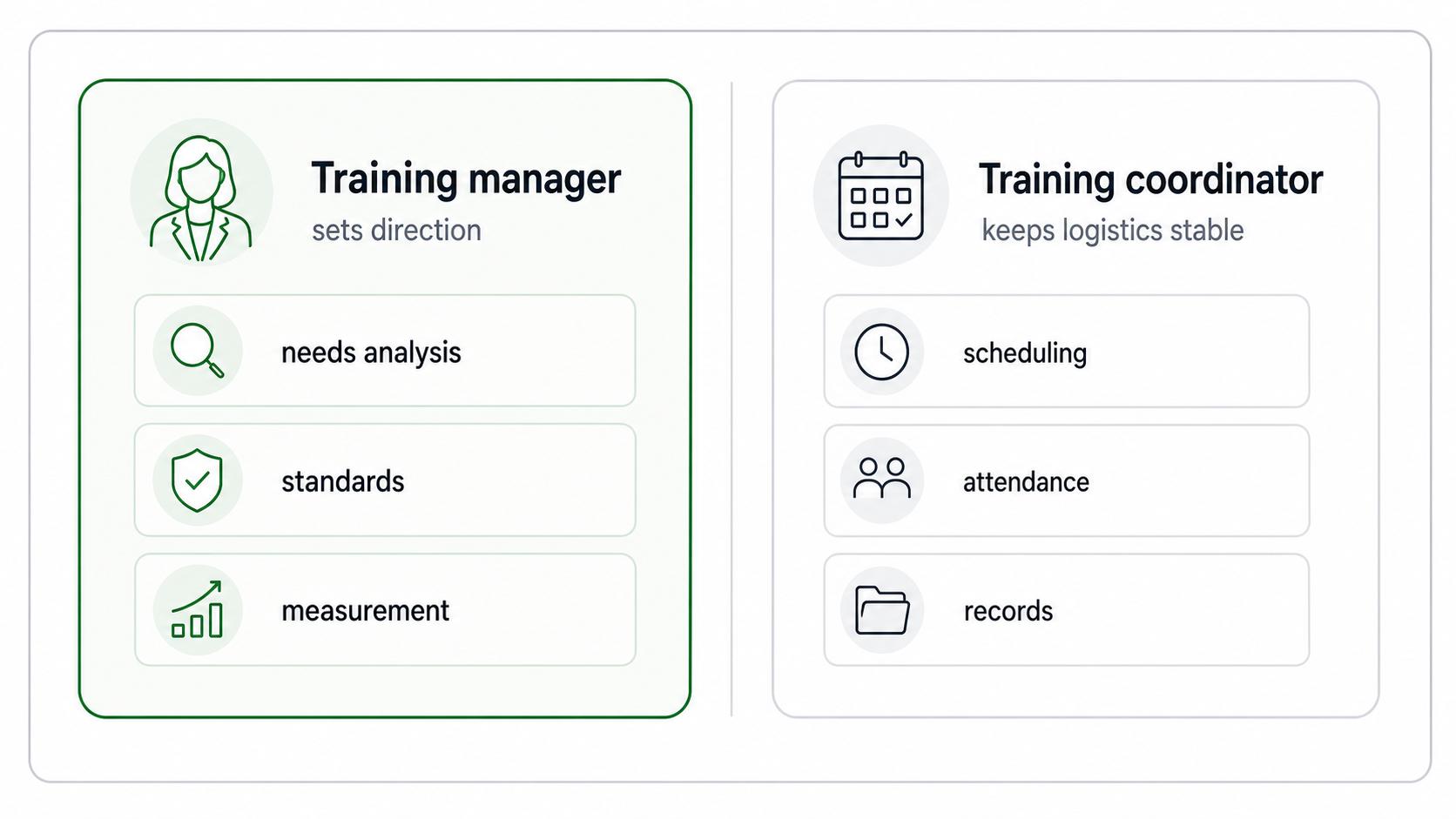
A training coordinator usually handles the logistics that keep a program running: scheduling sessions, managing invites, preparing materials, tracking attendance, supporting learners, and keeping records organized.
A training manager usually owns program direction: needs analysis, design choices, stakeholder alignment, quality standards, measurement, and prioritization.
The two roles should work closely. A training manager defines the operating model. A training coordinator keeps the moving parts stable enough for learners, trainers, and managers to use it.
Skills training managers need
Training managers need more than facilitation skill. The role rewards people who can understand work, organize messy information, and turn learning into practical behavior. Useful skills include needs analysis, program design, instructional writing, process documentation judgment, facilitation, project management, platform administration, metric design, change management, and subject matter expert collaboration.4
The underrated skill is knowing when not to build a course. If employees need a quick decision rule, a job aid may beat a module. If the process is unclear, a training manager may need to fix the workflow documentation before designing instruction.
Common mistakes
The first mistake is treating the training manager as a scheduler. Schedules matter, but the role should influence what gets taught, how it is supported, and how success is measured.
The second mistake is letting every department maintain training differently with no shared standard. Local expertise matters, but without common naming, templates, ownership, and review habits, training assets become hard to find and hard to trust.
The third mistake is measuring only attendance. Attendance shows exposure. It does not prove someone can perform the job. A training manager should connect participation to assessment, behavior, manager observation, and operational outcomes where appropriate.
A practical training manager checklist
Use this checklist when launching or improving a training program:
- What business problem or capability gap is the training meant to address?
- Who is the audience, and what do they already know?
- What should learners be able to do after training?
- Is training the right solution, or is the process itself unclear?
- Which format fits the work: course, guide, video, checklist, practice, or blended path?
- What documentation will learners use after training?
- How will managers reinforce the behavior?
- What metrics will show whether the program worked?
- Who owns updates when the work changes?
The final question is where training programs often weaken. If nobody owns maintenance, training quality declines while completion records keep looking normal.
Documentation takeaway
Training managers need documentation discipline because training depends on current source material. When process guides, job aids, and manuals are clear, training is easier to design and update. When documentation is scattered or stale, training managers spend too much time reconstructing the work from interviews and old slides.
How Trails helps
Trails helps training managers create practical training documentation from real workflows. A team member can capture a process as they perform it, turn that capture into a polished step-by-step guide, and create an AI-narrated video version for training or sharing. That helps keep training grounded in how the work actually happens.
Sources
- 1
U.S. Bureau of Labor Statistics. Training and Development Managers. Occupational Outlook Handbook. www.bls.gov/ooh/management/training-and-development-managers.htm. Accessed June 30, 2026.
- 2
Centers for Disease Control and Prevention. Conducting a Training Needs Analysis. CDC. www.cdc.gov/training-development/php/about/assess-training-needs-conducting-needs-analysis.html. Accessed June 30, 2026.
- 3
Centers for Disease Control and Prevention. Measuring Training Effectiveness. CDC. www.cdc.gov/training-development/php/about/evaluate-training-measuring-effectiveness.html. Accessed June 30, 2026.
- 4
Association for Talent Development. Talent Development Capability Model. ATD. www.td.org/capability-model. Accessed June 30, 2026.