
Glossary
Logistics SOP
 ChatGPT
 Perplexity
 Gemini
 Claude
What is a logistics SOP?
A logistics SOP is a standard operating procedure for a repeatable logistics workflow, such as receiving inventory, picking orders, preparing shipments, processing returns, or handing work off to a carrier. It tells the team what should happen, who owns each step, what systems or records must be updated, and what to do when the shipment, item, or request doesn't follow the normal path. 1
The useful version isn't just a tidy list of warehouse tasks. A good logistics SOP makes physical movement, system updates, and accountability line up so the operation can recover from exceptions without relying on one experienced person's memory.
Why a logistics SOP matters
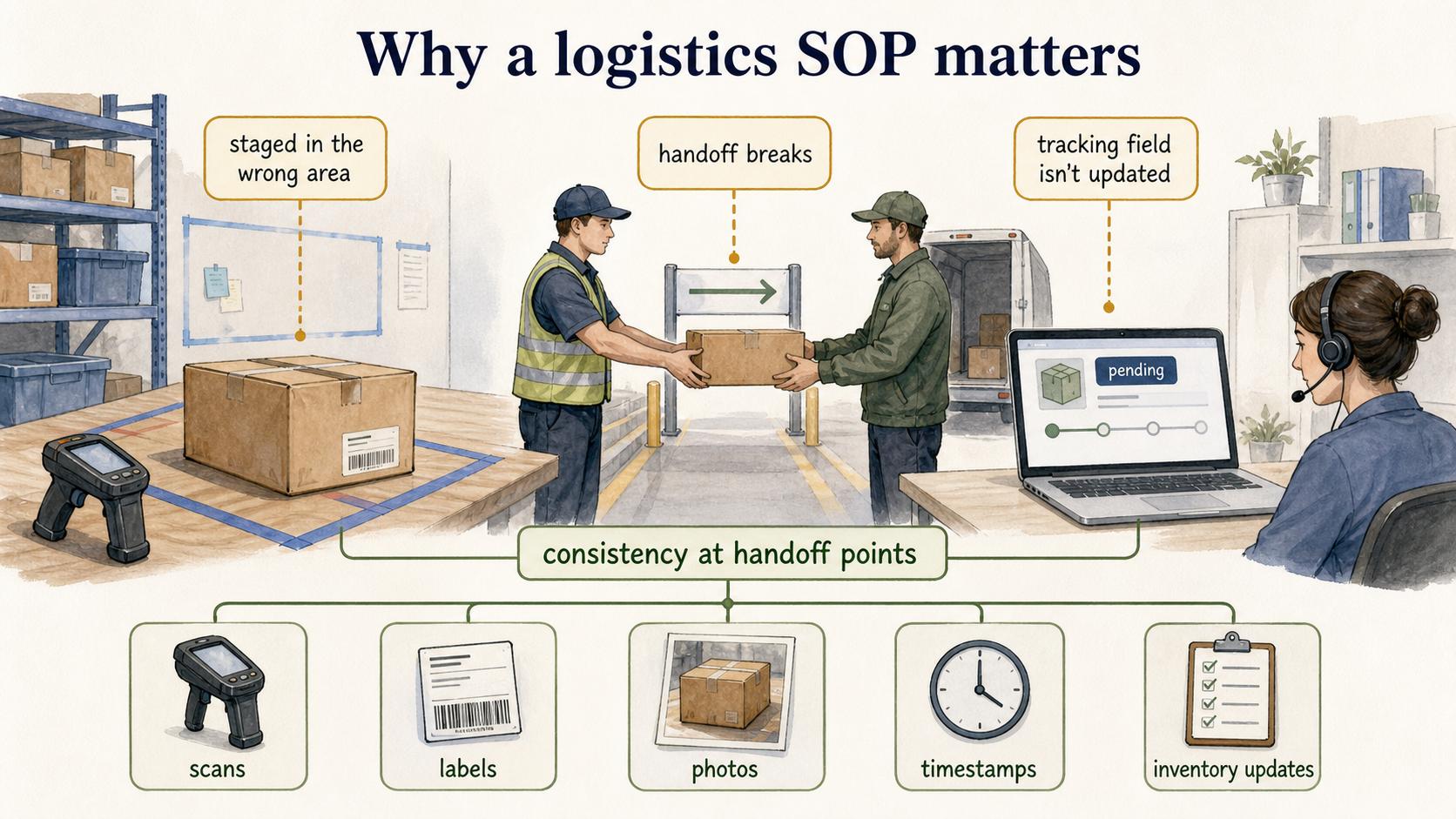
Logistics work looks straightforward until a handoff breaks. A package is staged in the wrong area. A damaged inbound item is accepted without photos. A carrier pickup happens, but the tracking field isn't updated. Customer service sees the order as pending even though the warehouse believes it has shipped.
A logistics SOP reduces those gaps by turning repeated operational judgment into a shared standard. It gives new employees a clear way to learn the workflow, gives managers a way to audit execution, and gives cross-functional teams a common reference when something goes wrong.
The main value is consistency at handoff points. Traceable logistics work depends on connecting products, locations, events, and supply-chain handoffs, not just completing isolated tasks. 2 The proof of completion matters as much as the step itself: scans, labels, photos, forms, timestamps, approvals, and inventory updates.
What a logistics SOP should include
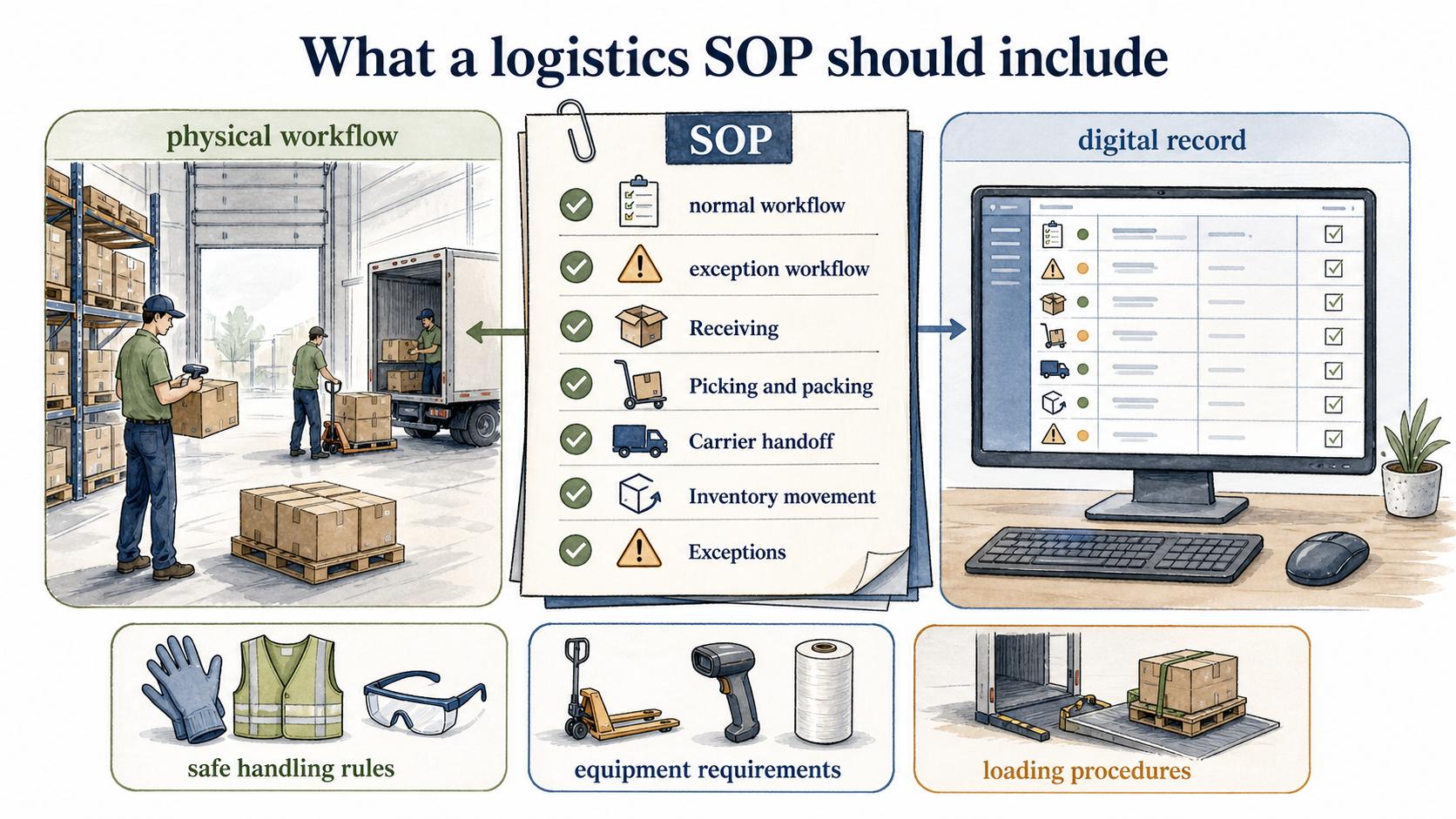
A logistics SOP should cover the normal workflow and the exception workflow. If it only explains what happens when everything goes right, it will be least useful on the days when the team needs it most.
| SOP area | What the SOP should make explicit | Common failure signal |
|---|---|---|
| Receiving | Who checks quantity, condition, purchase order match, and system receipt | Inventory appears available before it is inspected |
| Picking and packing | How items are selected, verified, packed, labeled, and staged | Orders ship with missing items or wrong packaging |
| Carrier handoff | When responsibility shifts from internal team to carrier | Shipment leaves the building without a recorded pickup or tracking update |
| Inventory movement | Which system step must happen when goods move physically | Stock is in the warehouse but missing or duplicated in the system |
| Exceptions | Who approves damaged, short, late, or incomplete shipments | Teams resolve issues informally and inconsistently |
Where employees lift, load, stage, or move materials, the SOP should also name the safe handling rules, equipment requirements, and loading procedures that apply. 3
This is where logistics SOPs differ from generic process documentation. They have to connect the physical workflow to the digital record. If the item moved but the system didn't, the process isn't complete.
Examples of logistics SOPs
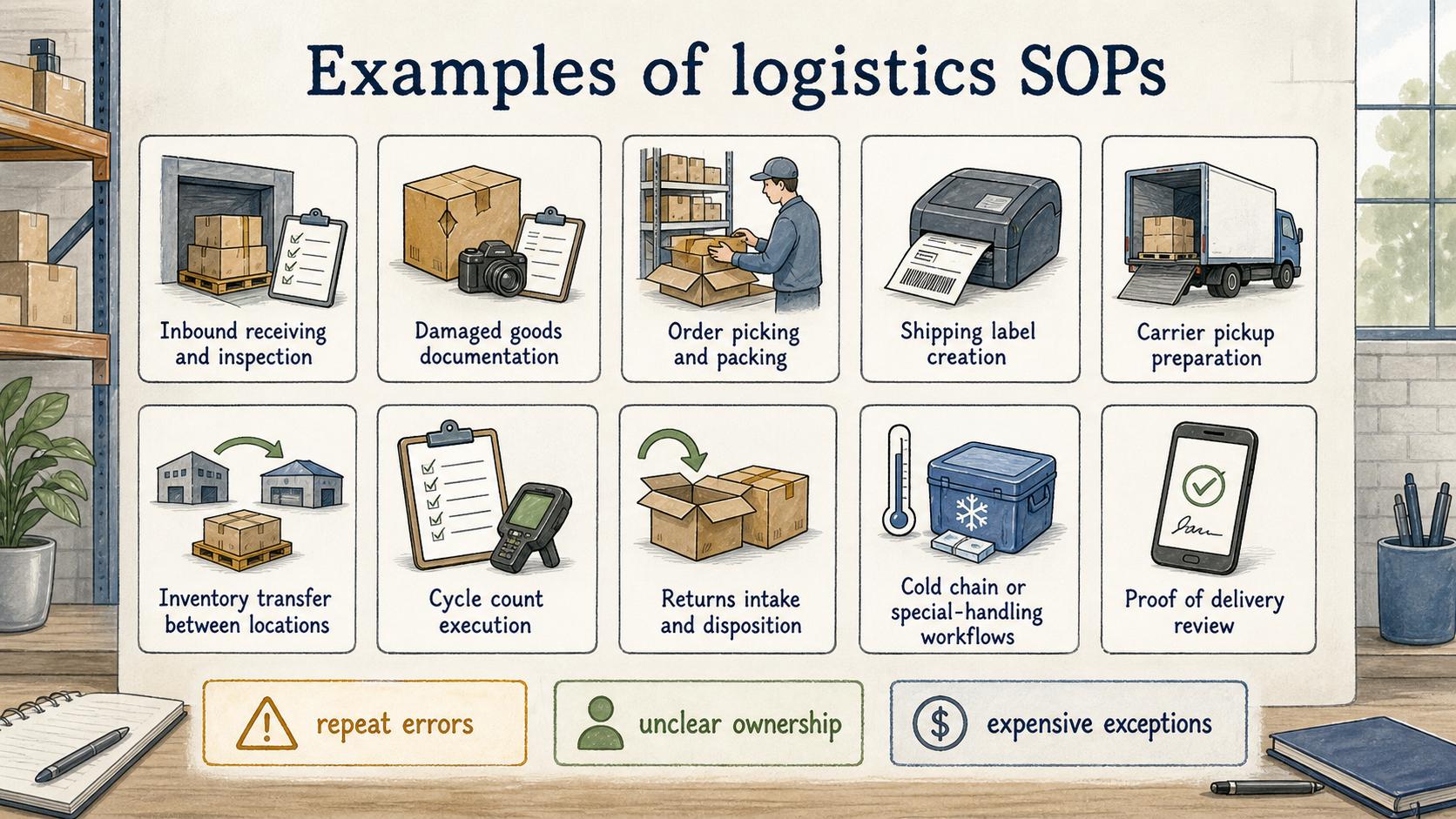
Common logistics SOP examples include:
- Inbound receiving and inspection.
- Damaged goods documentation.
- Order picking and packing.
- Shipping label creation.
- Carrier pickup preparation.
- Inventory transfer between locations.
- Cycle count execution.
- Returns intake and disposition.
- Cold chain or special-handling workflows.
- Proof of delivery review.
The best candidate for a logistics SOP is usually not the biggest process. It's the process with repeat errors, unclear ownership, or expensive exceptions. Inventory accuracy affects downstream logistics performance, including order fill rate, expedited orders, and carrying cost, so inventory movement is often a good place to start. 4
A two-page SOP for damaged inbound goods can be more valuable than a long operations manual if it prevents repeated disputes with vendors and customers.
Logistics SOP vs checklist
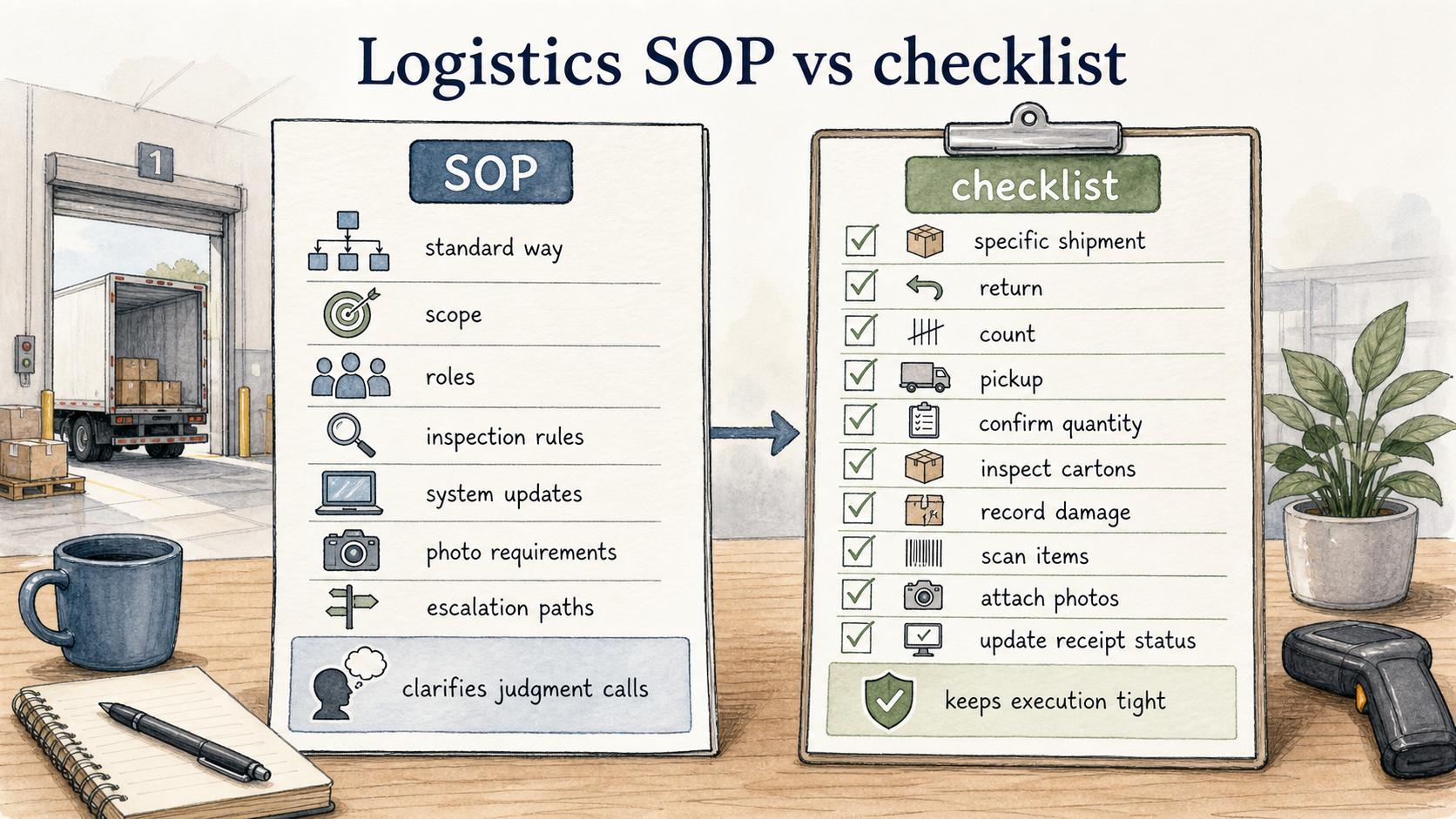
A logistics SOP explains the standard way a workflow should be done. A checklist helps someone confirm that a specific shipment, return, count, or pickup followed that standard.
For example, the SOP for inbound receiving might explain scope, roles, inspection rules, system updates, photo requirements, and escalation paths. The checklist for one delivery might ask the employee to confirm quantity, inspect cartons, record damage, scan items, attach photos, and update receipt status.
Teams often need both. The SOP teaches the process and clarifies judgment calls. The checklist keeps execution tight when the floor is busy.
Common mistakes when writing logistics SOPs
The most common mistake is documenting the happy path and leaving exceptions to tribal knowledge. Logistics teams don't need a long paragraph telling them to receive a shipment carefully. They need to know what counts as a mismatch, which photos prove damage, who can approve a partial receipt, and when customer service or purchasing should be notified.
Another mistake is separating the warehouse step from the system step. If the SOP says to stage the order but doesn't say when to update the shipping status, the team has documented only half the workflow.
A third mistake is writing SOPs away from the work. Logistics procedures should reflect the real sequence employees follow: where they stand, what device or screen they use, what label they print, what they check before moving to the next step, and what proof shows the step is done.
AI-ready logistics SOP template
Use this prompt to turn a messy logistics workflow into a first draft:
## Logistics SOP template

**Glossary term:** Logistics SOP
**Source:** Trails Glossary — trails.so/glossary/logistics-sop

---

### 01. Create a logistics SOP

"Create a logistics SOP for [workflow] used by [team/location]. Include purpose, scope, roles, required systems, required equipment or materials, step-by-step procedure, system updates, records or proof required, quality checks, handoffs, exception rules, escalation path, completion criteria, and review owner. Write it for employees who need to perform the workflow accurately during a normal shift."
After generating the draft, have the process owner walk through it against one real shipment, return, or inventory movement. That test usually reveals the missing fields, approvals, screenshots, or handoff details.
How Trails helps
Trails helps teams capture logistics workflows as they are performed, then turn them into polished step-by-step guides. That is useful when the process involves both physical work and software steps, such as checking a shipment, updating inventory, taking photos, and recording a carrier handoff.
Teams can also create an AI-narrated video version for training or sharing, which helps new employees understand the sequence without shadowing the same experienced teammate every time.
For the software steps behind inventory updates and shipment handoffs, compare SOP software for capturing procedures and keeping the instructions accessible to the next shift.
Sources
- 1
APQC. Understanding Logistics Processes. www.apqc.org/resource-library/resource/understanding-logistics-processes.
- 2
GS1. GS1 Global Traceability Standard. www.gs1.org/standards/gs1-global-traceability-standard/current-standard.
- 3
OSHA. Warehousing: Hazards and Solutions. www.osha.gov/warehousing/hazards-solutions.
- 4
APQC. Inventory Accuracy Improves Performance in Logistics Metrics. www.apqc.org/resource-library/resource-listing/inventory-accuracy-improves-performance-logistics-metrics.