
Glossary
Procurement SOP
 ChatGPT
 Perplexity
 Gemini
 Claude
What is Procurement SOP?
A procurement SOP is a standard operating procedure that explains how a team requests, evaluates, approves, buys from, and manages suppliers. It turns procurement from side conversations into a repeatable process with clear roles, controls, records, and exception rules.1
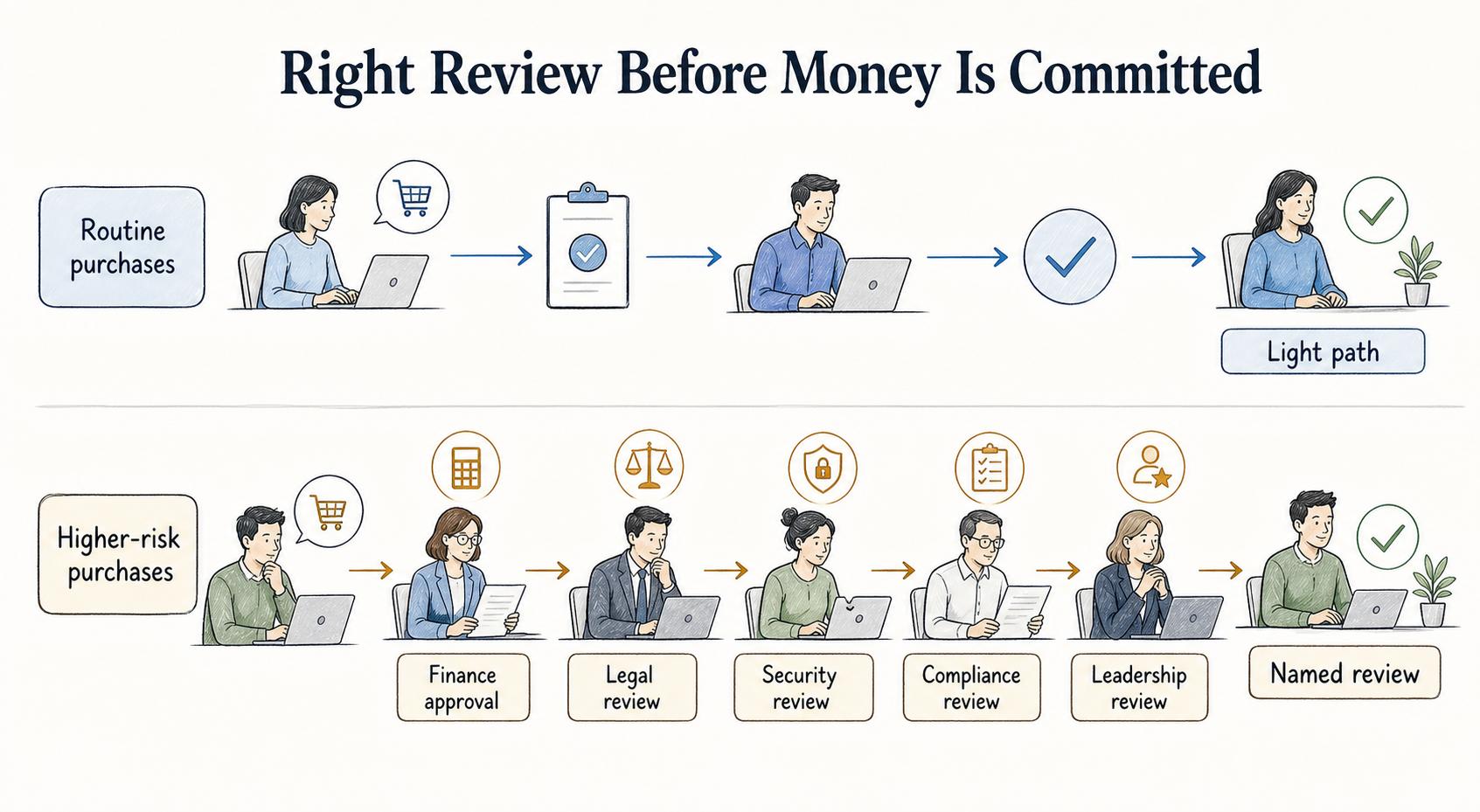
A useful procurement SOP does more than list purchasing steps. It helps employees get what they need while protecting budget, contract, security, compliance, and supplier-quality checks.2 Routine purchases should move quickly; higher-risk purchases should get the right review before money is committed.
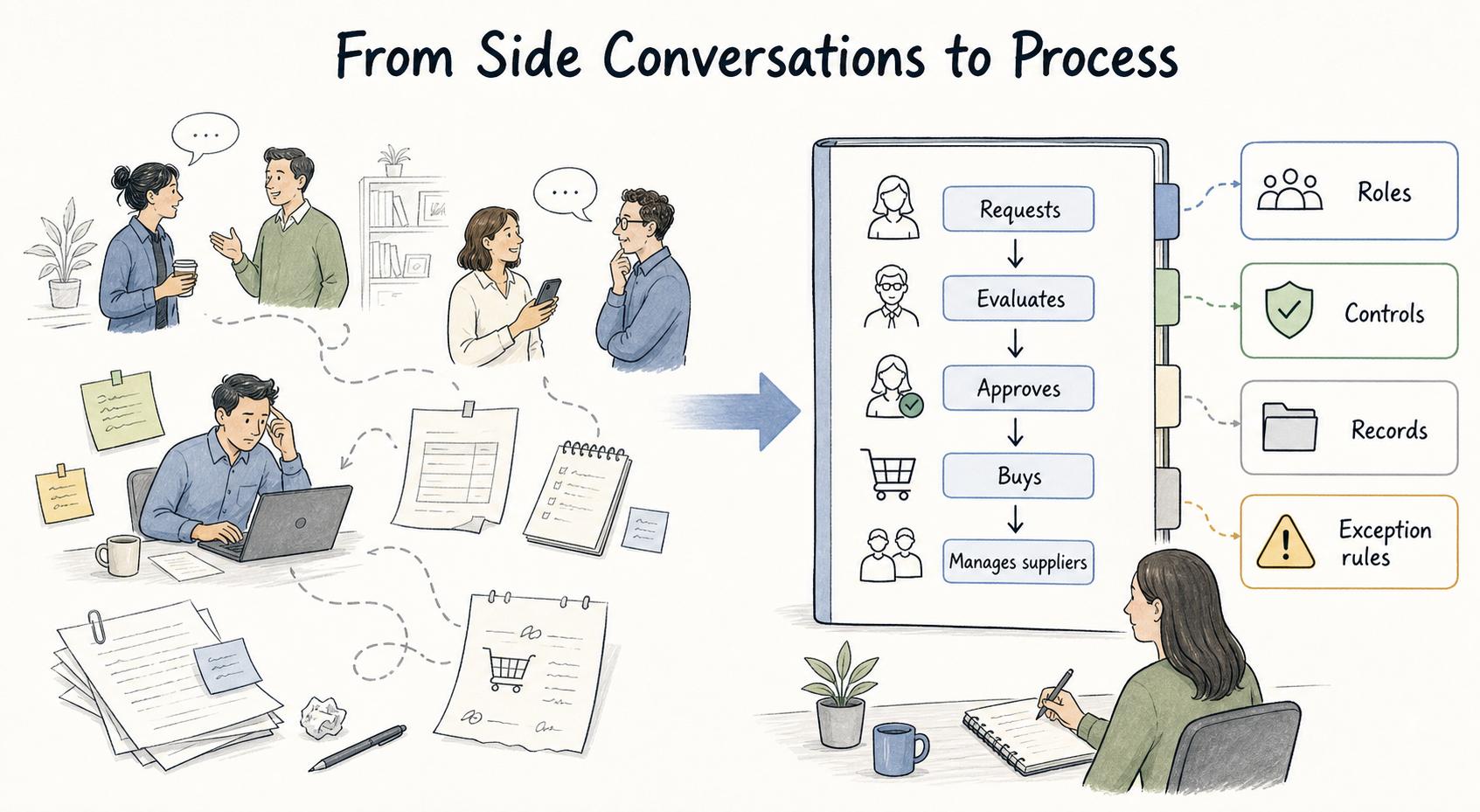
What a procurement SOP covers
A procurement SOP usually starts when someone identifies a business need and ends when the supplier relationship, records, or renewal path is under control. The exact scope depends on company size and risk level, but the document should answer a few practical questions:
- Who can request a purchase or new vendor?
- What information must be submitted before review starts?
- When are quotes, bids, or supplier comparisons required?
- Who approves spend, contract terms, risk, and exceptions?
- How are purchase orders, invoices, receipts, and supplier records handled?
- Who owns supplier performance, renewals, and offboarding after the purchase?
The strongest procurement SOPs make the default path easy to follow while keeping departments from inventing separate buying processes.
Procurement SOP vs. purchasing SOP
Procurement and purchasing are related, but the terms are not interchangeable. Procurement covers the broader decision system around suppliers. Purchasing is the transaction path once the organization is ready to buy.
| Document | Primary focus | Typical owner | What it prevents |
|---|---|---|---|
| Procurement SOP | How suppliers are sourced, approved, managed, and reviewed | Procurement, operations, or finance | Unvetted vendors, unclear approvals, weak supplier accountability |
| Purchasing SOP | How approved purchases are requested, ordered, received, and handed to finance | Purchasing or finance | Missed purchase orders, informal buying, payment delays |
| Accounts payable SOP | How invoices are matched, approved, and paid | Finance or accounting | Duplicate payments, missing records, invoice disputes |
Small businesses may combine these into one document. Larger teams often separate them because supplier selection, buying, and payment each need different controls.
What to include before you write steps
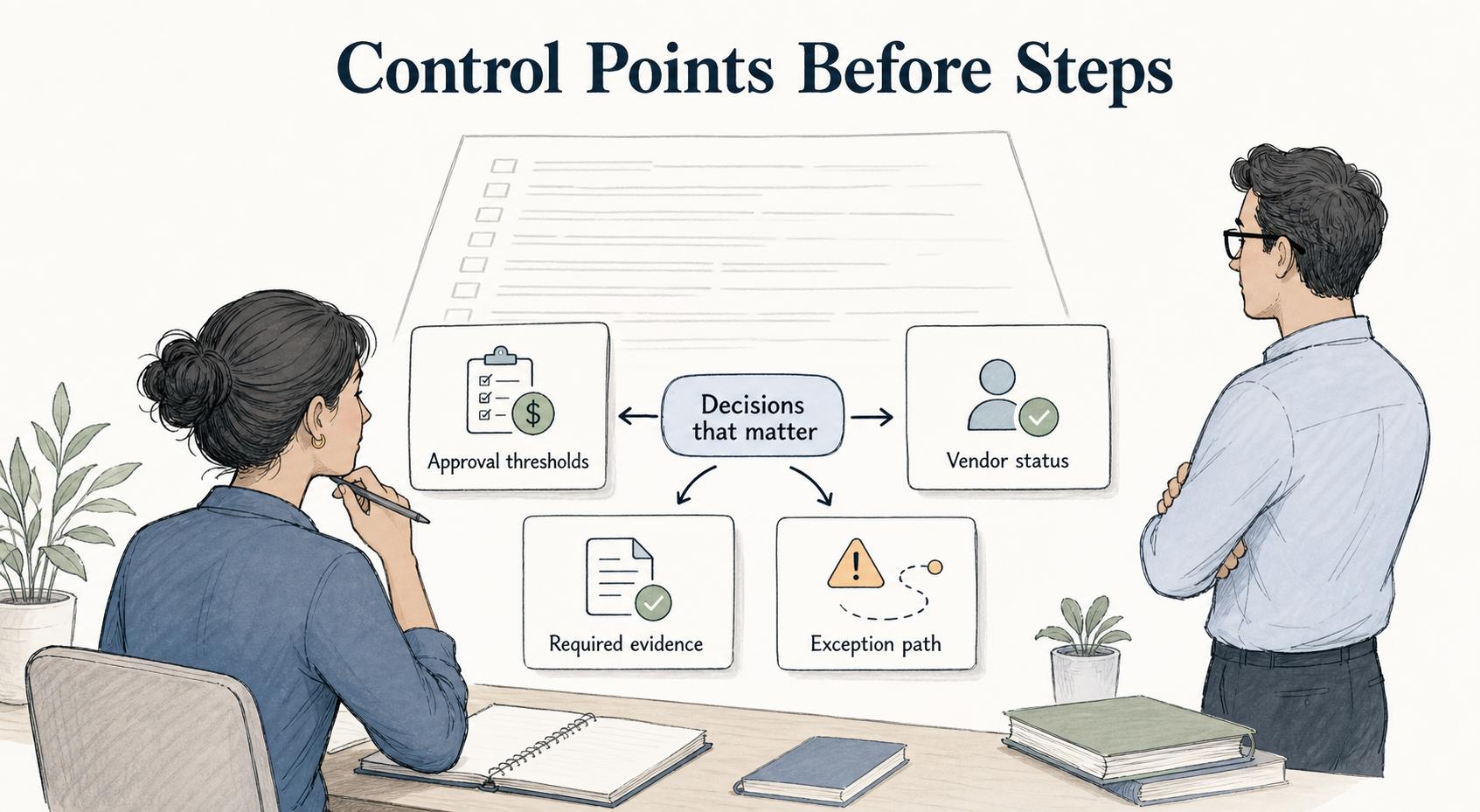
A common mistake is opening the SOP with a long step list before defining the decisions that matter. Start with the control points.
Approval thresholds. Define when a purchase needs manager approval, finance approval, leadership approval, legal review, security review, or a competitive quote. A dollar amount alone isn't enough. A low-cost tool that touches customer data may need more review than an expensive but routine office order.
Vendor status. Make it clear when employees must use an approved vendor, when a new vendor can be considered, and who decides whether the supplier is acceptable. Without this, teams keep re-solving the same sourcing question.
Required evidence. Name the records the process must produce: request form, quote comparison, budget approval, contract, purchase order, receipt, invoice, supplier review notes, and renewal owner. The record is how the process proves it happened.3
Exception path. Urgent purchases happen. The SOP should define who can approve an exception, what must be documented afterward, and which exceptions are never allowed. Hidden exceptions create more risk than documented ones.
Example procurement workflow
A practical procurement workflow might look like this:
- The requester describes the business need, timeline, budget, preferred supplier, and risk considerations.
- The procurement or operations owner checks whether an approved supplier already exists.
- The team gathers quotes, supplier details, or comparison criteria when the purchase requires it.
- Finance confirms budget and approval requirements.
- Legal, security, compliance, or leadership review the request when the vendor, contract, data, or spend level calls for it.4
- The supplier is approved, rejected, or sent back for missing information.
- Purchasing creates the purchase order or approved buying path.
- The goods or services are received and accepted by the requester or business owner.
- Accounts payable receives the invoice with the records needed for payment.
- The supplier owner tracks renewal dates, performance issues, and offboarding needs.
The sequence should scale. A replacement keyboard can use a light path. A payroll vendor, contract manufacturer, logistics provider, or customer-data platform needs a slower path with named review.
Procurement SOP template
Use this prompt to create a first draft, then tighten it against the real approval rules and tools your team uses.
## Procurement SOP Template

**Glossary term:** Procurement SOP
**Source:** Trails Glossary — trails.so/glossary/procurement-sop

---

### 01. Procurement SOP Template

"Create a procurement SOP for [company/team].

Context:
- Company size: [size]
- Teams covered: [teams]
- Purchase categories: [software, equipment, services, materials, contractors, etc.]
- Procurement tools: [forms, spreadsheets, ERP, finance system, contract tool]
- Key risks: [budget, security, compliance, delivery, supplier quality]

Include:
1. Purpose and scope
2. Roles and responsibilities for requester, manager, procurement owner, finance, legal/security, supplier owner, and accounts payable
3. Intake requirements for a procurement request
4. Vendor selection and approved-vendor rules
5. Quote, bid, or comparison requirements
6. Approval thresholds by spend level, risk, category, and contract length
7. Contract review and purchase order rules
8. Receiving, acceptance, and invoice handoff
9. Supplier performance, renewal, and offboarding ownership
10. Exception handling and required records

Make the SOP practical for employees, not just auditors. Flag places where the team must insert its exact policy thresholds."
Common mistakes
The first mistake is treating procurement as a finance-only gate. Finance approval matters, but procurement also protects delivery, quality, security, compliance, and continuity. If the SOP only asks "Can we afford this?" it misses most supplier risk.
The second mistake is dropping ownership after the purchase. Someone should own the supplier relationship, renewal date, performance issues, and cancellation path. Otherwise, the organization may keep paying for tools or services nobody actively manages.
The third mistake is making the SOP too heavy for low-risk purchases. Good procurement documentation creates lanes: routine, pre-approved purchases move quickly; unusual, expensive, contractual, or sensitive purchases slow down enough for judgment.
How Trails helps
Trails helps teams document the exact procurement workflows employees need to follow: submitting a request, reviewing a supplier, creating a purchase order, checking approval status, or completing a renewal review. A process owner can capture the workflow as it happens, turn it into a polished step-by-step guide, and create an AI-narrated video version for training or sharing.
That matters because procurement SOPs often fail at the handoff between policy and actual tools. Trails helps the written SOP connect to the real screens, forms, and decisions employees use.
For the finance handoff, see how teams document finance and accounting workflows, including the repeatable system steps behind approvals and reconciliation.
Sources
- 1
Committee of Sponsoring Organizations of the Treadway Commission. COSO Internal Control - Integrated Framework. COSO. www.coso.org/guidance-on-ic. Accessed July 24, 2026.
- 2
Deloitte. Deloitte 2025 Global Chief Procurement Officer Survey. Deloitte, 2025. www.deloitte.com/us/en/services/consulting/articles/2025-global-chief-procurement-officer-survey.html. Accessed July 24, 2026.
- 3
U.S. Office of Management and Budget. 2 CFR Part 200 procurement standards. Electronic Code of Federal Regulations. www.ecfr.gov/current/title-2/subtitle-A/chapter-II/part-200/subpart-D/subject-group-ECFR45ddd4419ad436d. Accessed July 24, 2026.
- 4
National Institute of Standards and Technology. NIST SP 800-161 Rev. 1. NIST. csrc.nist.gov/pubs/sp/800/161/r1/final. Accessed July 24, 2026.