
Glossary
Warehouse SOP
 ChatGPT
 Perplexity
 Gemini
 Claude
What is a warehouse SOP?
A warehouse SOP is a standard operating procedure for a repeatable warehouse task, such as receiving inventory, picking orders, packing shipments, replenishing bins, cycle counting, or processing returns. It explains what to do, in what order, what correct work looks like, and when to stop or escalate.
The best warehouse SOPs are not long policy documents. They are floor-ready instructions for a high-motion environment where unclear steps turn into delays, rework, safety issues, inventory errors, and inconsistent customer experiences.1
Why warehouse SOPs matter
Warehouse work is full of small decisions that seem obvious until they are not: where to stage a damaged pallet, how to record a short pick, when to print a replacement label, or who approves an exception. If every associate answers those questions differently, the process becomes tribal knowledge.
A warehouse SOP gives the team a shared operating baseline. It helps new hires ramp faster, gives supervisors a fair standard for coaching, and makes the process less dependent on whoever happens to be on shift.
The tradeoff is maintenance. Layouts change, scanners get updated, carrier rules move, and peak-season workarounds can become permanent. A warehouse SOP is useful only if the team treats it as a living operating document, not a binder exercise.
What a warehouse SOP should include
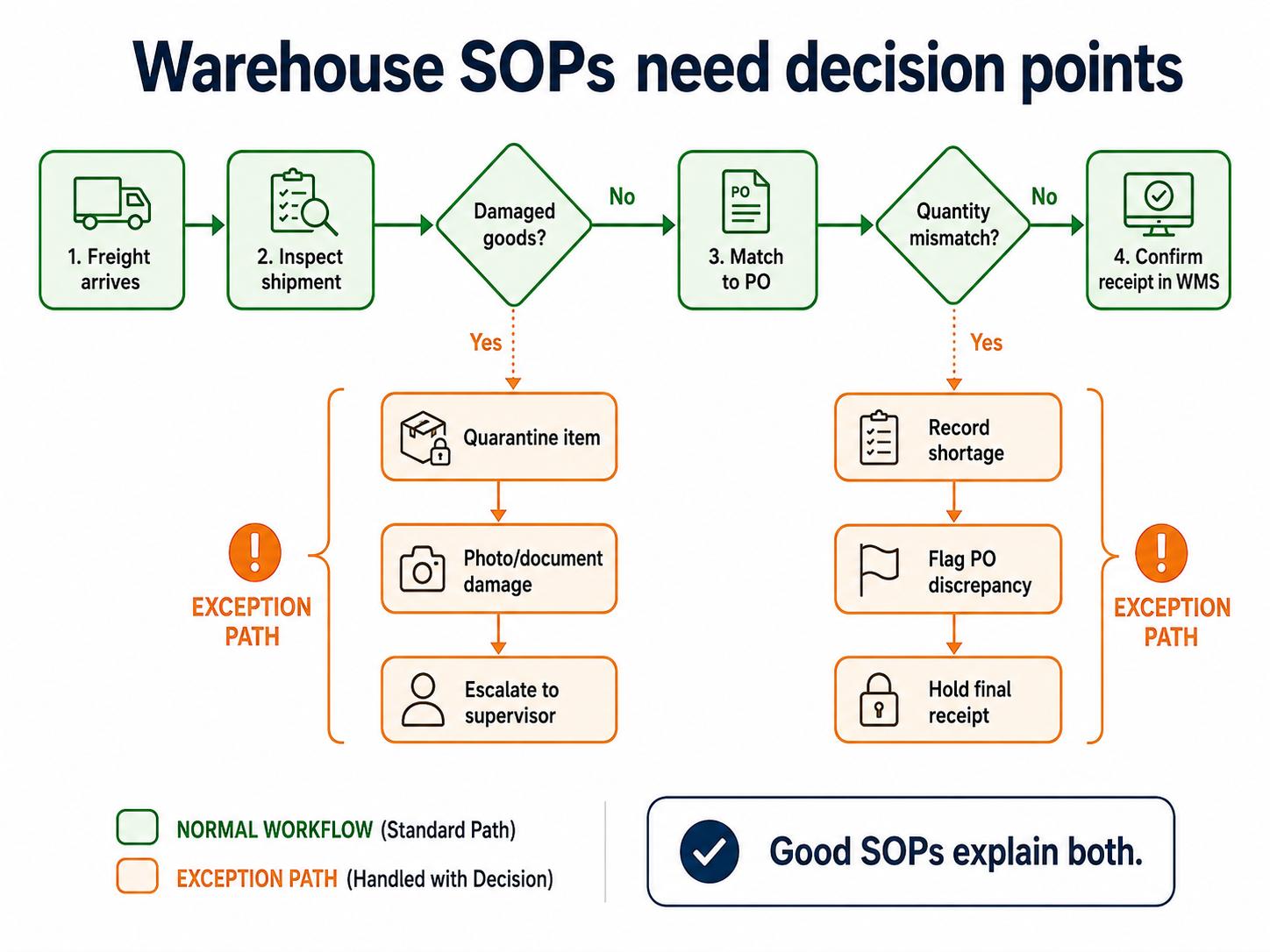
A warehouse SOP should be specific enough for someone to perform the task, but short enough to use during real work. For a receiving SOP, that might mean the arrival trigger, inspection steps, purchase-order check, damaged-goods handling, and final receipt confirmation in the warehouse management system.
- Purpose: why the procedure exists and what outcome it protects.
- Scope: which sites, teams, products, shifts, or order types it applies to.
- Owner: who maintains the SOP and who approves changes.
- Tools and systems: scanners, WMS screens, forms, labels, equipment, or checklists.
- Step-by-step procedure: the normal path through the work.
- Exceptions: damaged goods, missing inventory, wrong SKU, unsafe condition, system outage, or urgent order.
- Quality check: how the worker knows the task is complete and correct.
- Escalation path: when to pause and who to contact.
The exceptions section is where many warehouse SOPs either become useful or fall apart. Errors often happen at the edge of the process, not in the happy path. If the SOP ignores exceptions, employees are forced to improvise exactly when consistency matters most.2
Examples of warehouse SOPs
Some warehouse processes deserve especially clear SOPs because mistakes spread quickly into inventory records, customer orders, safety, or downstream work.3
| Warehouse process | What the SOP should clarify |
|---|---|
| Receiving inbound freight | Inspection steps, documentation, shortage handling, damaged goods, system receipt |
| Picking orders | Pick path, scanner use, substitution rules, short picks, tote or cart labeling |
| Packing shipments | Packaging standards, label placement, inserts, carrier-specific requirements |
| Cycle counting | Count schedule, recount threshold, variance approval, system updates |
| Returns processing | Inspection criteria, restock rules, quarantine steps, refund or replacement handoff |
| Replenishment | Reorder triggers, bin movement, priority rules, exception handling |
| Equipment checks | Pre-use inspection, defect reporting, escalation process |
A warehouse SOP does not need to explain every warehouse concept from scratch. It should focus on the decisions and actions required for that process. If a worker needs to leave the SOP to ask "What do I do next?" the document is probably missing a step, an exception, or a definition of done.
How to write a warehouse SOP
Start with the real workflow, not the conference-room version. Watch an experienced employee perform the task, capture the screens or forms they use, and ask where mistakes usually happen. Then write the SOP around the actual sequence of work.
- Name the process and define the outcome.
- Identify the trigger that starts the process.
- List each step in the order it happens.
- Add screenshots, photos, or short clips for steps that depend on visual judgment.
- Document common exceptions and escalation rules.
- Test the SOP with someone who does not normally do the task.
- Assign an owner and review trigger.
The test step is where weak SOPs reveal themselves. If a new or cross-trained employee cannot follow the document without extra coaching, the issue is usually not the employee. The SOP needs clearer steps, better visuals, or a sharper definition of done.
AI-ready warehouse SOP template
Use this prompt to turn a rough walkthrough into a first draft:
## Warehouse SOP Template

**Glossary term:** Warehouse SOP
**Source:** Trails Glossary — trails.so/glossary/warehouse-sop

---

### 01. Create a warehouse SOP draft

"Create a warehouse SOP for [process] used by [team/site].

Audience: [new hires, experienced associates, shift leads]
Trigger: [what starts the process]
Goal: [what a correct completed outcome looks like]
Systems/tools used: [WMS, scanner, labels, forms, equipment]
Known exceptions: [short pick, damaged item, missing label, unsafe condition]
Escalation owner: [role or team]

Write the SOP with these sections:
1. Purpose
2. Scope
3. Tools and materials
4. Step-by-step procedure
5. Exceptions and escalation
6. Quality check
7. Owner and review cadence

Use plain language, numbered steps, and call out any step where the worker should stop before continuing."
Treat the AI output as a draft, not the final operating standard. A supervisor or process owner should validate it against the real floor process before it becomes the source of truth.
Documentation takeaway
Warehouse SOPs work best when they are tied to the actual work surface: scanners, labels, locations, carts, forms, stations, and system screens. If the document only describes policy, people will still need informal coaching to do the job.
The most useful SOPs also link to visual work instructions where the task depends on what someone should see. A short written procedure plus a few clear visuals usually beats a long paragraph that tries to describe a physical or screen-based action from memory.
How Trails helps
Trails is useful when a warehouse process is easier to show than describe. A team member can capture the workflow as they perform it, then turn that capture into a polished step-by-step guide.
Trails can also create an AI-narrated video version for training or sharing, which helps when new hires need to see the process before doing it live. The written SOP gives the team a durable standard; the visual walkthrough makes the standard easier to learn.
FAQ
What is the difference between a warehouse SOP and a work instruction?
A warehouse SOP defines the standard process and expectations for a repeatable warehouse task. A work instruction is usually more detailed and task-level, often focused on exactly how to complete one step or activity.
How often should warehouse SOPs be reviewed?
Review them whenever the process, system, layout, equipment, product handling requirement, or exception path changes. For stable processes, assign a regular owner-led review so the SOP does not drift away from the floor.
Who should own warehouse SOPs?
The owner should be close enough to the work to keep the SOP accurate and senior enough to approve process changes. In many teams, that is a warehouse manager, operations lead, quality lead, or process owner.
- Logistics SOP
- Manufacturing SOP
- Safety SOP
- SOP software
- SOP meaning in business
- Work instruction
- Visual work instruction
- Purchasing SOP
Sources
- 1
Occupational Safety and Health Administration. Warehousing Overview. OSHA. www.osha.gov/warehousing. Accessed June 24, 2026.
- 2
Occupational Safety and Health Administration. 29 CFR 1910.176, Handling materials - general. OSHA. www.osha.gov/laws-regs/regulations/standardnumber/1910/1910.176. Accessed June 24, 2026.
- 3
GS1 US. RFID Use in Warehouse Management. GS1 US. www.supplychain.gs1us.org/rfid/warehouse-management. Accessed June 24, 2026.