
Glossary
Lessons Learned
 ChatGPT
 Perplexity
 Gemini
 Claude
What are lessons learned?
Lessons learned are documented insights from a project, incident, launch, process change, or recurring workflow that help a team make better decisions next time. 1 A strong lesson explains what happened, why it happened, what should be repeated or changed, and which owner or artifact will carry the change forward.
The phrase sounds simple, but the useful version is stricter than a meeting note. A lesson is not fully learned until it changes a future plan, SOP, checklist, training guide, decision rule, or operating habit. 2
Why lessons learned matter
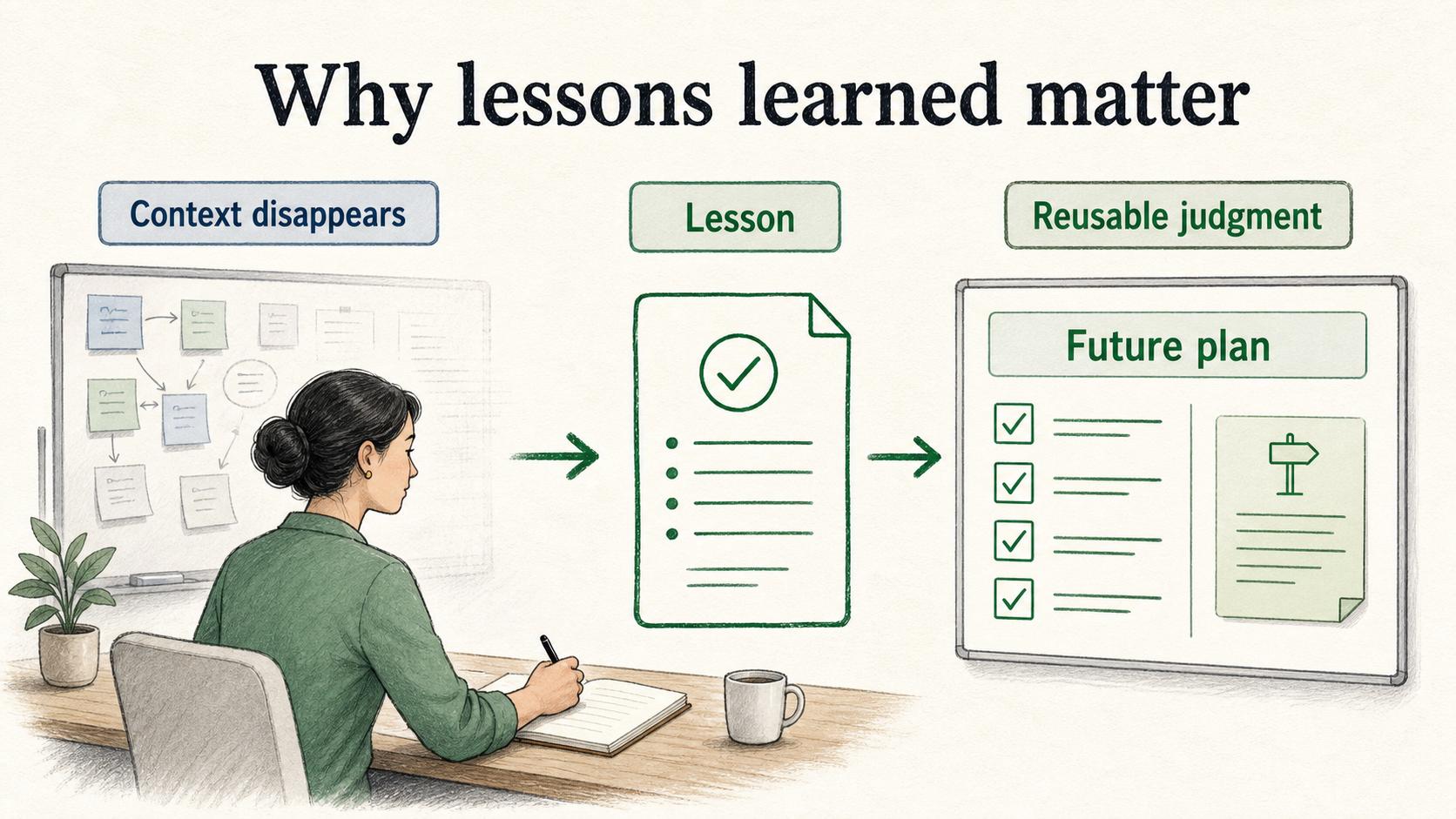
Teams often repeat mistakes because the original context disappears. 3 The person who solved the issue moves on. The project channel goes quiet. The post-launch notes sit in a folder nobody opens. Six months later, another team runs into the same approval delay, handoff gap, unclear customer message, or broken workflow.
Lessons learned give experience a place to live after the moment has passed. They turn one messy event into reusable judgment: what to watch for, what to do earlier, what not to assume, and what evidence should trigger a different plan.
The best lessons are specific enough to change behavior. “Communicate better” is too vague. “Add support readiness to the launch checklist before customer emails go out” is a lesson someone can actually use.
What a useful lesson includes
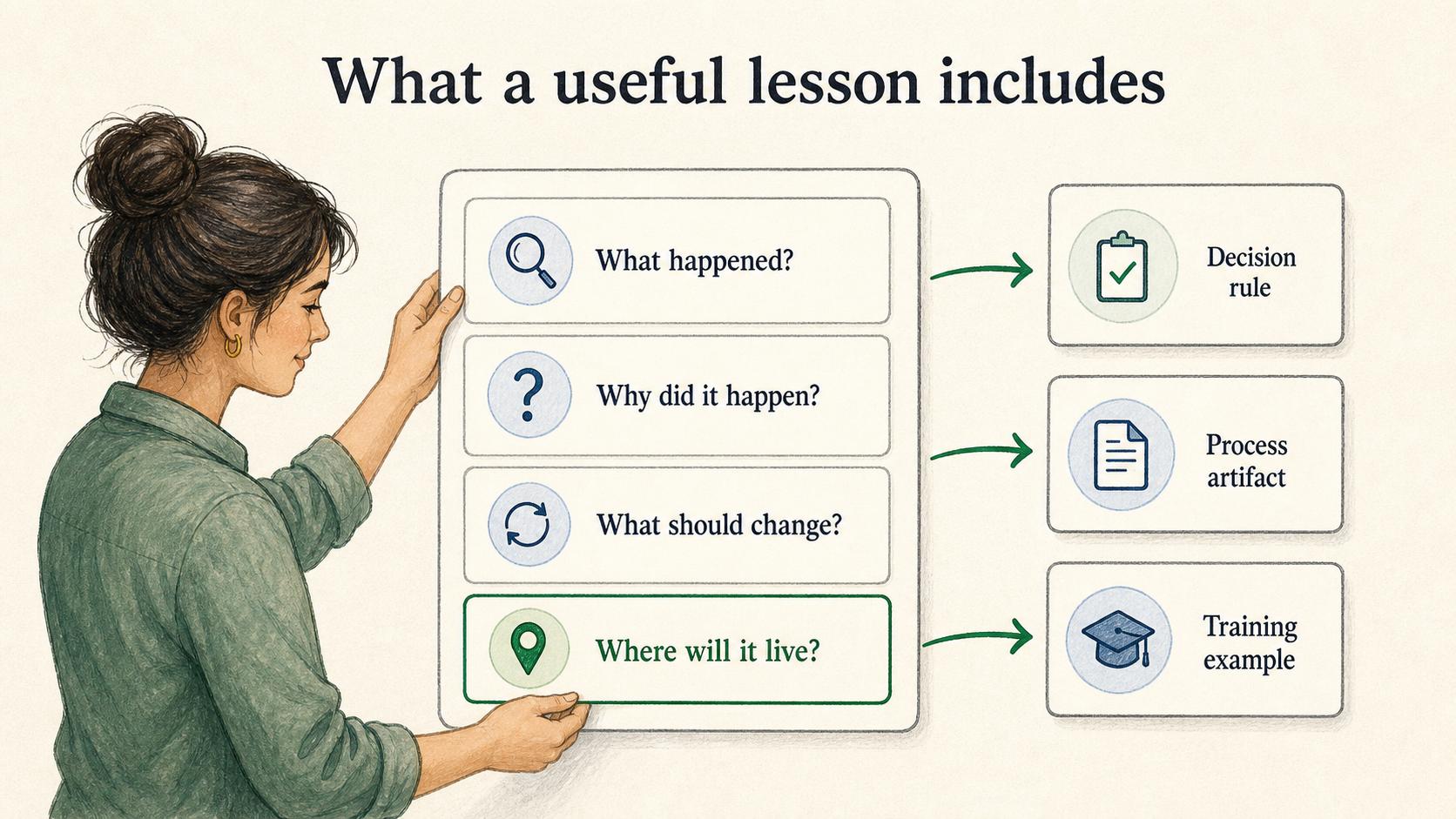
A useful lessons learned entry should answer four questions:
- What happened, in concrete terms?
- Why did it happen, including the process or decision that allowed it?
- What should the team repeat, avoid, or change next time?
- Where will that change live so future teams can find it?
That last question is the one teams skip. If the lesson stays in a recap while the launch checklist, onboarding guide, SOP, or project template stays unchanged, the team preserved a story instead of improving the system.
Good lessons learned usually become one of three outputs: a better decision rule, a better process artifact, or a better training example.
Lessons learned vs retrospective vs after action review
These concepts overlap, but they produce different artifacts.
| Concept | Main purpose | Best output |
|---|---|---|
| Lessons learned | Preserve reusable insight from experience | A documented change to future planning, process, training, or documentation |
| Retrospective | Help a team reflect on how work went | Action items, working agreements, and improvement themes |
| After action review | Compare intended outcomes with actual results after an event | Practical observations about what happened, why, and what to adjust |
| Root cause analysis | Identify the underlying cause of a problem | Corrective action that prevents recurrence |
A retrospective or after action review can produce lessons learned. Root cause analysis can support a lesson when the issue is serious or recurring. The difference is that lessons learned should travel beyond the meeting. They should become usable knowledge for the next person facing similar work.
Examples of lessons learned
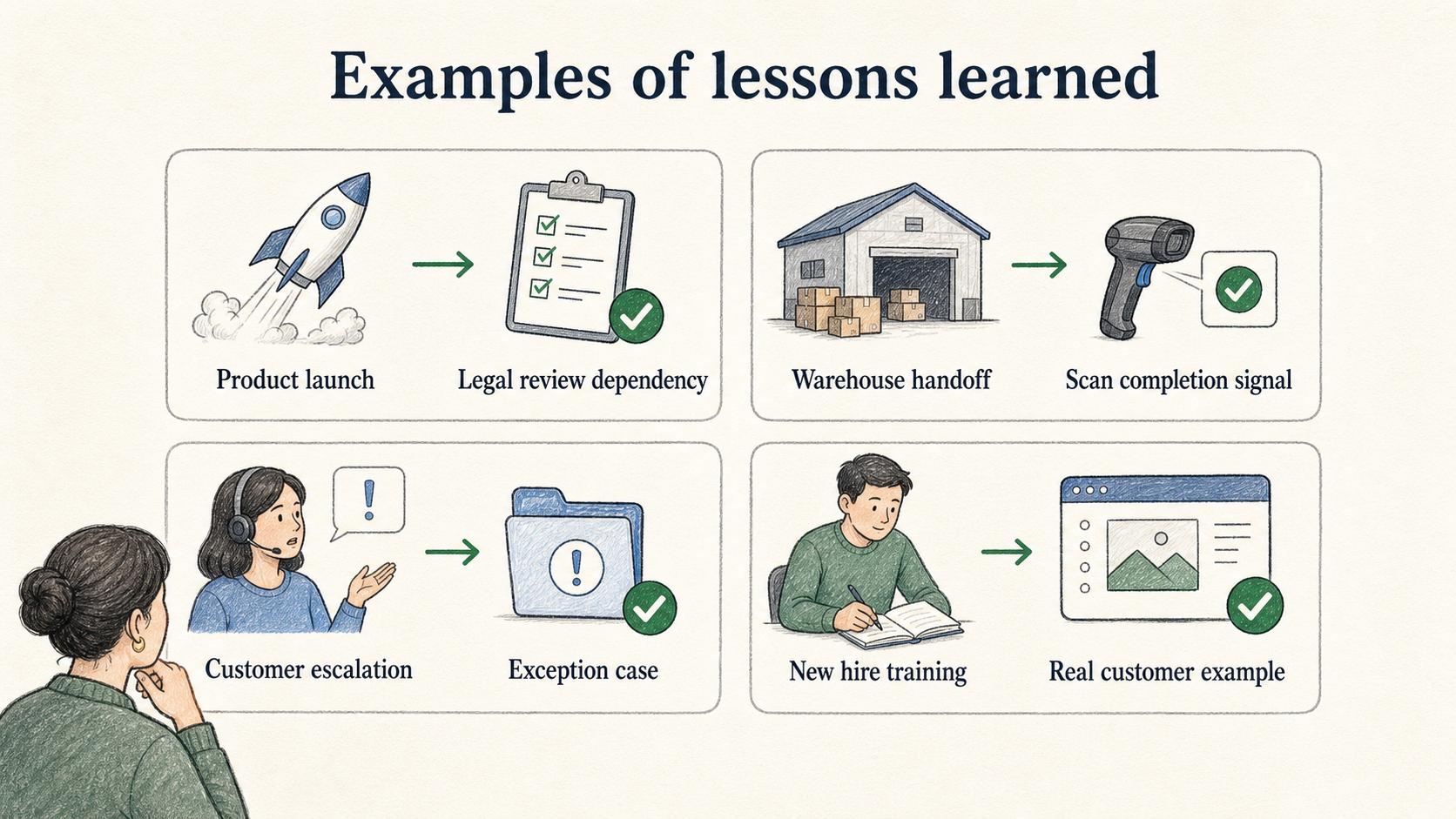
The useful pattern is experience plus a future change:
- A product launch slipped because legal review was requested after the announcement timeline was already locked. Future launch plans should include legal review as a dated dependency, not an optional final check.
- A warehouse handoff failed because the inventory system update happened after the physical move instead of at the staging point. The SOP should define the scan as the completion signal for the move.
- A customer escalation repeated because support documentation only covered the happy path. The help guide and internal troubleshooting guide should include the exception case and escalation owner.
- A new hire training session worked well because the trainer used real customer examples. Future onboarding should include one example from the team’s current queue, not only abstract instructions.
Without the future change, the lesson is only a recap.
How to capture lessons learned without creating shelfware
Start close to the work. Capture notes soon after the event, while the details are still specific and the people closest to the work can explain what actually happened. Frame the session around the process, assumptions, timing, or documentation that failed to make the right path clear.
Then force each lesson into an action path. 4 Does it update a checklist? Change a project template? Add a training example? Clarify an approval rule? Create a new SOP section? Remove a bad assumption from planning? If the answer is unclear, the lesson is not ready yet.
Finally, store the lesson where future work starts. A project recap may be useful for history, but the lesson should also appear in the artifact people already use: the SOP, kickoff template, onboarding guide, incident playbook, or launch checklist.
Common mistakes
The biggest mistake is confusing reflection with improvement. A team can run a thoughtful meeting, write a tidy recap, and still repeat the same issue if no process artifact changes.
Another mistake is making lessons too broad. “Start earlier” is weak because it does not say what should start earlier. “Start vendor security review before procurement approval” is stronger because it names the handoff and timing.
A third mistake is collecting too many lessons from one event. If everything is a lesson, nothing feels important. Choose the few insights that would genuinely change a future decision or workflow.
AI-ready lessons learned prompt
## Lessons Learned Prompt

**Glossary term:** Lessons Learned
**Source:** Trails Glossary — trails.so/glossary/lessons-learned

---

### 01. Turn notes into lessons learned

"Turn these notes into concise lessons learned for [team/process/project]. For each lesson, include: what happened, why it happened, what should be repeated or changed, the future trigger or situation where the lesson applies, the owner, and the SOP, checklist, training guide, project template, or decision rule that should be updated.

Notes:
[paste notes]"
Review the output with someone close to the work. AI can structure the lesson, but the team still needs to confirm the operational truth and assign the owner.
How Trails helps
Trails helps teams turn lessons learned into updated process documentation. When a team discovers a better way to complete a workflow, Trails can capture the updated process as someone performs it, turn it into a polished step-by-step guide, and create an AI-narrated video version for training or sharing.
Lessons often fail at the handoff from insight to behavior. Updating the actual guide, SOP, or training material makes the lesson easier for the next person to apply.
- Retrospective
- After action review
- Root cause analysis
- Process improvement
- Knowledge retention
- Continuous improvement
- Single source of truth
- Project management SOP
Sources
- 1
Project Management Institute. Lessons learned sharing knowledge. PMI. www.pmi.org/learning/library/lessons-learned-sharing-knowledge-8189.
- 2
NASA. NASA lessons learned process. NASA. nodis3.gsfc.nasa.gov/displayCA.cfm?Internal_ID=N_PR_7120_0006_&page_name=Chapter1.
- 3
U.S. Government Accountability Office. GAO report on NASA lessons learned sharing. GAO. www.gao.gov/products/gao-02-195.
- 4
AHRQ PSNet. Putting RCA2 into action. AHRQ. psnet.ahrq.gov/issue/putting-action-rca2-analysis-intervention-strength-after-adverse-events.