
Glossary
Project Management SOP
 ChatGPT
 Perplexity
 Gemini
 Claude
What is a project management SOP?
A project management SOP is a standard operating procedure that explains how an organization starts, plans, runs, changes, and closes projects. That lifecycle maps closely to PMI's traditional project process groups: initiating, planning, executing, monitoring and controlling, and closing. 1
It gives project managers, sponsors, contributors, and approvers a shared operating path so every project does not have to reinvent the process.
The useful version is the repeatable workflow for common project moments: intake, approval, kickoff, status reporting, risk escalation, change requests, handoffs, and closeout. It should define the decisions and records that keep project work from becoming dependent on one person's memory.
Why a project management SOP matters
Projects often break in ordinary places. A request arrives without a clear owner. A stakeholder gives feedback after the final review. A deadline changes, but nobody records who approved the tradeoff. A project manager leaves, and the team discovers that the real process lived in that person's head.
A project management SOP reduces that dependency on memory and personality. It defines how projects enter the system, how decisions are made, how progress is communicated, and how records are kept. GAO schedule guidance treats progress updates, documented schedule logic, and baseline maintenance as core controls for reliable project schedules. 2
The SOP also protects capacity. Without a standard intake and approval path, every request can look like a project and every project can look urgent. A good SOP separates real project work from tasks, ideas, favors, experiments, and emergencies that need different handling.
Project management SOP vs. project plan
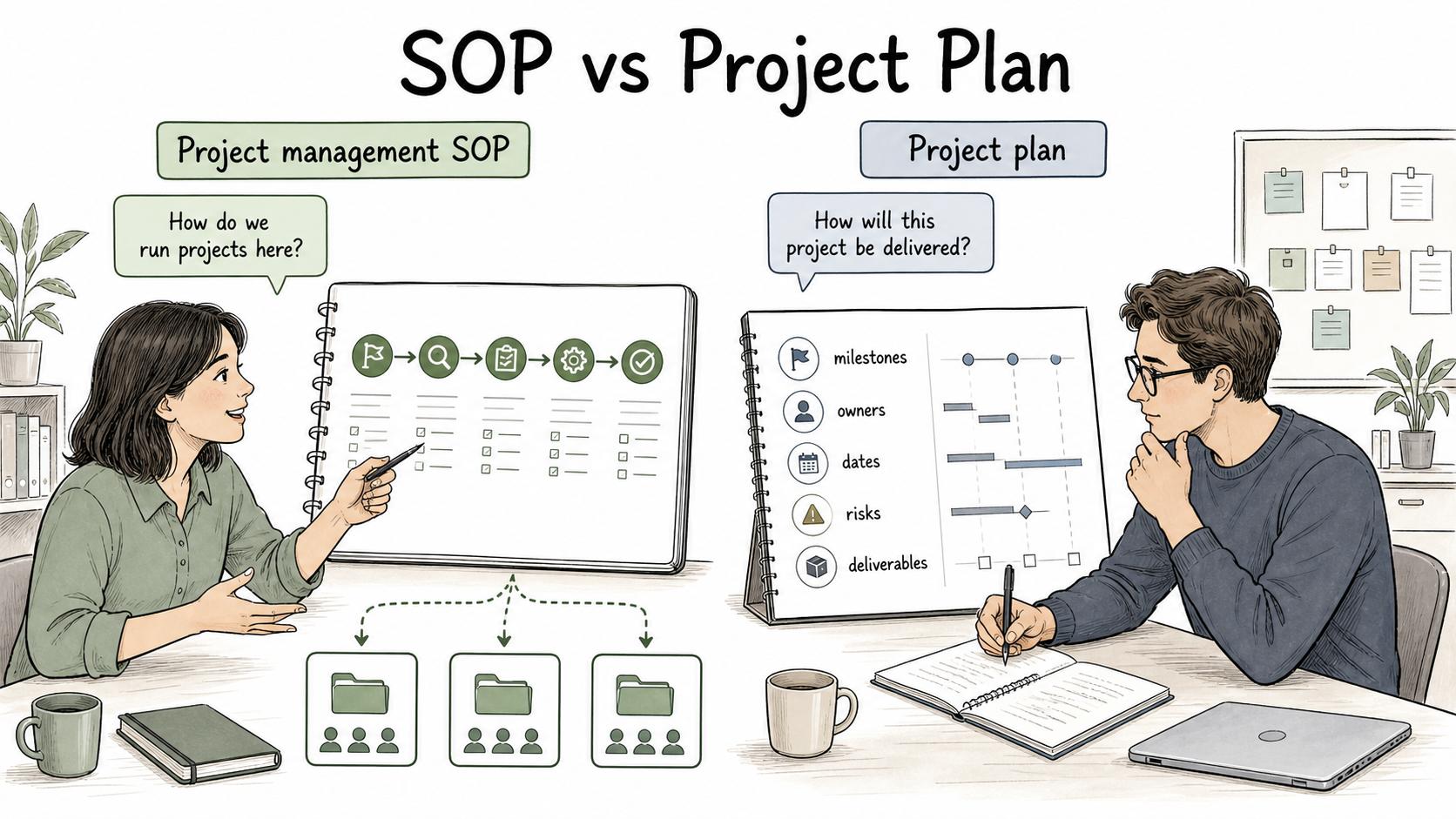
A project management SOP is the repeatable process. A project plan is the specific plan for one project.
| Document | What it answers | Example |
|---|---|---|
| Project management SOP | How do we run projects here? | Intake fields, kickoff rules, status cadence, change approval, closeout records |
| Project plan | How will this project be delivered? | Milestones, owners, dates, dependencies, risks, and deliverables for one launch |
| Status report | What is happening now? | Progress, blockers, decisions needed, next steps, and timeline changes |
The SOP should not replace the project plan. It should make project plans easier to create, compare, maintain, and hand off.
What to include in a project management SOP
The best SOPs define the lifecycle without drowning the team in ceremony. Start with these sections:
- Purpose and scope: which project types, sizes, teams, or risk levels the SOP covers.
- Roles: sponsor, project manager, project owner, contributors, reviewers, approvers, and ongoing owner.
- Intake: how requests are submitted and what information is required before review.
- Prioritization: how requests are evaluated against goals, capacity, timing, risk, and dependencies.
- Approval: who can approve scope, budget, timeline, resource commitments, and priority changes.
- Kickoff: what must be aligned before work begins, including success criteria and decision rules.
- Execution: how tasks, milestones, risks, dependencies, and decisions are tracked.
- Status reporting: format, cadence, audience, and owner.
- Change control: how scope, budget, deadline, or priority changes are requested and approved.
- Handoff and closeout: final acceptance, records, ownership transfer, retrospective, and lessons learned.
The tradeoff is depth. Too little detail leaves teams guessing. Too much detail makes the SOP slower than the work.
A practical SOP often uses tiers: lightweight steps for small internal projects and stronger controls for customer-facing, high-cost, or high-risk projects.
Example project management workflow
A simple project management SOP might define this lifecycle:
- Requester submits a project intake form with goal, business reason, deadline, owner, expected impact, and known constraints.
- Sponsor or intake owner reviews the request for fit, urgency, capacity, and dependencies.
- Project is approved, rejected, deferred, or returned for more information.
- Project manager creates a project plan with scope, milestones, owners, dates, risks, and communication cadence.
- Team runs kickoff and confirms responsibilities, decision rules, success criteria, and handoff expectations.
- Work is tracked in the approved system, with status updates on the defined cadence.
- Risks, blockers, and change requests are escalated through the documented path.
- Final deliverables are reviewed and accepted.
- Ownership transfers to the receiving team or ongoing owner.
- Records, decisions, lessons learned, and closeout notes are stored.
The SOP should name the moments where projects usually drift: intake, approval, change decisions, handoffs, and closeout. The exact steps can vary by team, but those control points need owners and records.
AI-ready project management SOP template
Use this prompt to draft or tighten a project management SOP:
## Project Management SOP

**Glossary term:** Project Management SOP
**Source:** Trails Glossary — trails.so/glossary/project-management-sop

---

### 01. Create a project management SOP

"Create a project management SOP for [team/company].

Context:
- Project types covered: [project types]
- Project types excluded: [small tasks, experiments, emergency work]
- Tools used: [project tool, docs, chat, intake form]
- Required roles: [sponsor, project manager, owner, contributors, approvers]
- Known failure modes: [unclear scope, late feedback, missed handoffs, deadline changes]

Return:
1. Purpose and scope
2. Roles and decision rights
3. Intake and approval workflow
4. Kickoff requirements
5. Execution, status, risk, and decision tracking rules
6. Change-control rules for scope, budget, timeline, and priority
7. Handoff and closeout checklist
8. Required records and where they live
9. Review cadence and SOP owner"
Common mistakes
One mistake is writing the SOP around a tool instead of the decisions. Tools change. The SOP should define who decides, what evidence is required, where work is tracked, and how handoffs happen even if the software changes later.
Another mistake is leaving change control vague. Projects rarely stay inside their original scope. For example, Georgia's project re-baselining guidance says scope, schedule, and budget baselines should change only through an integrated change-control process. 3 The SOP should explain when a change needs approval, who approves it, and where the decision is recorded.
A third mistake is treating closeout as optional. PMI notes that recording lessons learned helps organizations preserve and reuse project knowledge after closeout. 4 If the team skips final acceptance, ownership transfer, records, and lessons learned, the next project starts with the same avoidable confusion.
How Trails helps
Trails helps teams document recurring project workflows as they happen. A project manager can capture how to submit a request, update a project board, record a decision, run a handoff, or complete closeout steps, then turn that workflow into a polished step-by-step guide or AI-narrated training video.
That makes project management SOPs easier to train and maintain because the instructions come from the real process instead of being reconstructed after the work is already messy.
Sources
- 1
PMI. Process Groups: A Practice Guide. Project Management Institute. www.pmi.org/standards/process-groups.
- 2
U.S. Government Accountability Office. Schedule Assessment Guide. GAO. www.gao.gov/products/gao-16-89g.
- 3
Georgia Technology Authority. Project re-baselining guidelines. Georgia Technology Authority. gta-psg.georgia.gov/psg/project-re-baselining-guidelines-gm-22-001.
- 4
PMI. The importance of the project closing process group. Project Management Institute. www.pmi.org/learning/library/importance-of-closing-process-group-9949.