
Glossary
After Action Review
 ChatGPT
 Perplexity
 Gemini
 Claude
What an after action review is for
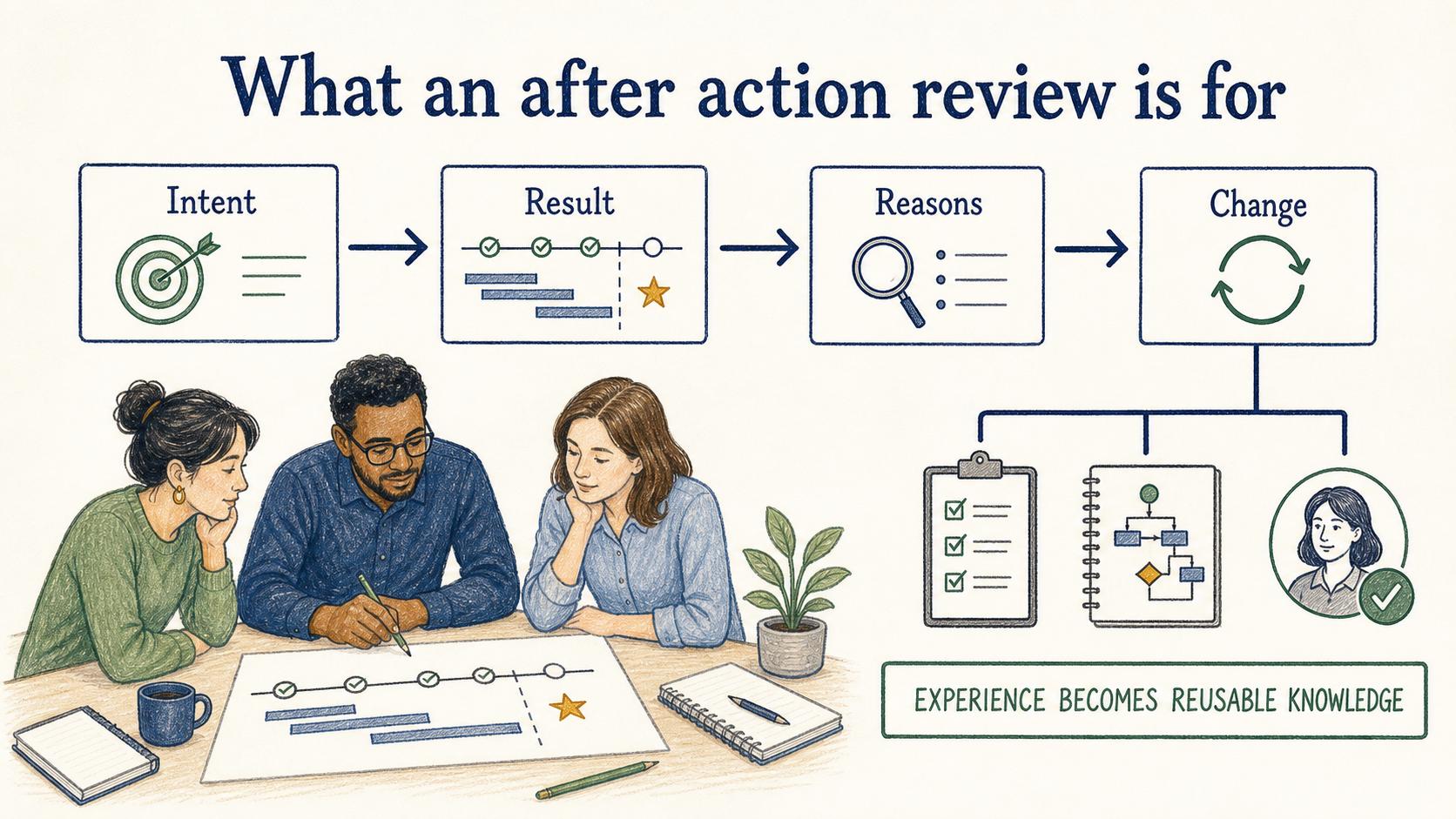
An after action review is a structured team discussion held after a project, incident, launch, training session, or workflow to understand what happened, why it happened, and what should change next time. It works because the details are still fresh. The team can turn real experience into decisions, follow-up actions, and documentation updates before the lesson gets flattened into a vague memory. 1
AARs are common in operations, project management, training, support, and process improvement because they capture the gap between the plan and reality. They are most useful when they are part of the operating rhythm, not a ceremony reserved for failures. Structured debriefs have evidence behind them: one meta-analysis found that debriefs improved team and individual effectiveness compared with control groups. 2
An after action review helps a team convert experience into reusable knowledge. Without one, people remember the loudest moment, the final outcome, or the person closest to the problem. That is rarely enough to improve the process.
A good AAR separates four things that teams often blur together:
- The intent: what the team expected to happen.
- The result: what happened in practice.
- The reasons: which conditions, decisions, assumptions, handoffs, or constraints shaped the result.
- The change: what the team will keep, stop, or do differently next time.
That last point is where many reviews fail. A conversation can feel useful in the room, but if no one turns the insight into a process change, training note, checklist, guide, or ownership decision, the same lesson has to be rediscovered later.
The core after action review questions
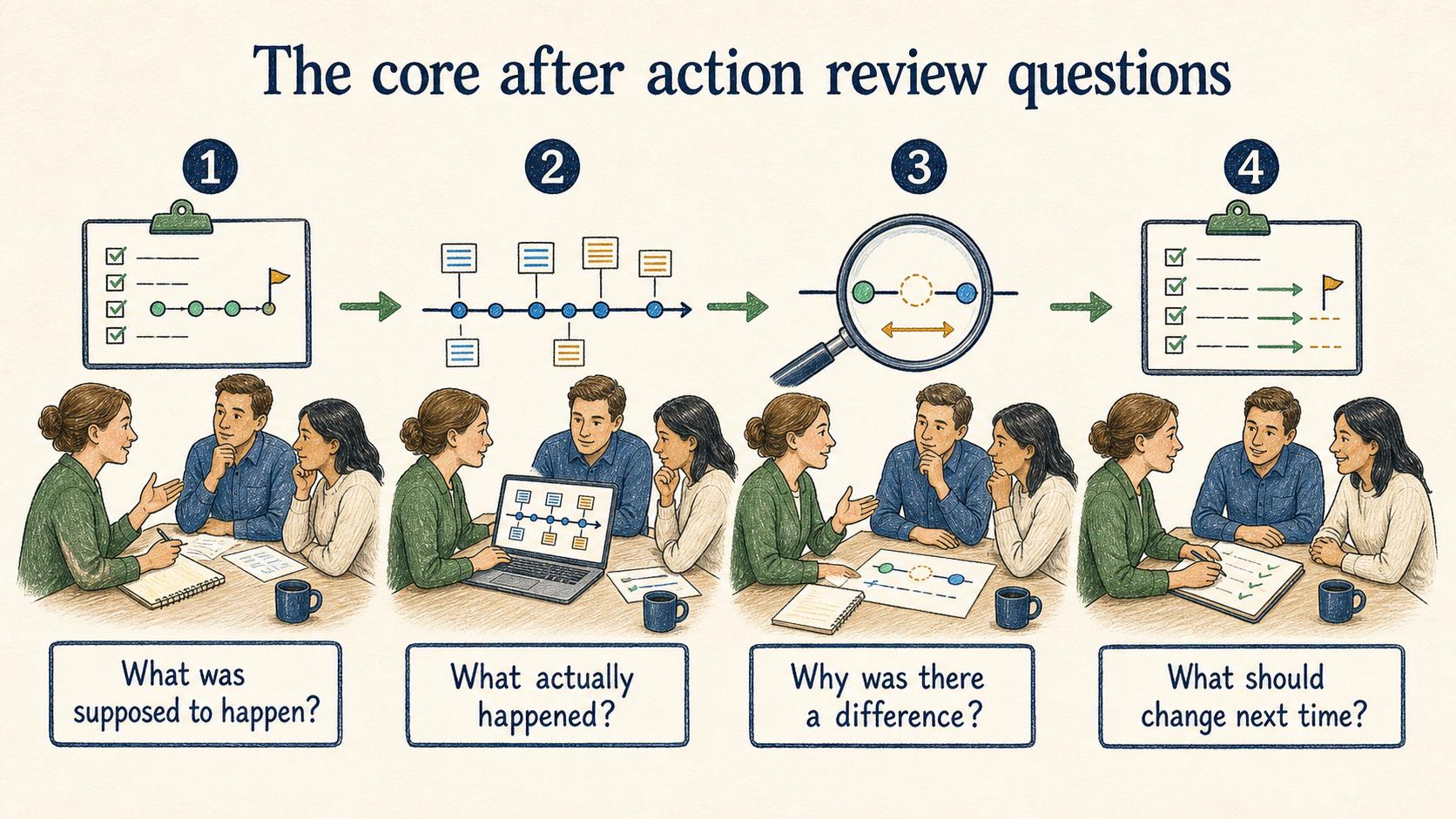
Most AARs are built around a small set of questions: 3
- What was supposed to happen?
- What actually happened?
- Why was there a difference?
- What should we keep, change, or stop doing next time?
The order matters. If the team jumps straight to improvements, people argue from memory and opinion. Starting with the intended outcome and actual result creates a shared record before the group starts interpreting causes.
For example, a customer onboarding team might review a new client launch. The plan was to complete setup in five business days. The actual launch took nine. The delay came from unclear data ownership between the customer success manager and implementation specialist. The useful fix is not "communicate better." It is a kickoff guide that names who collects each data field, where it is stored, and when escalation happens.
When to use an after action review
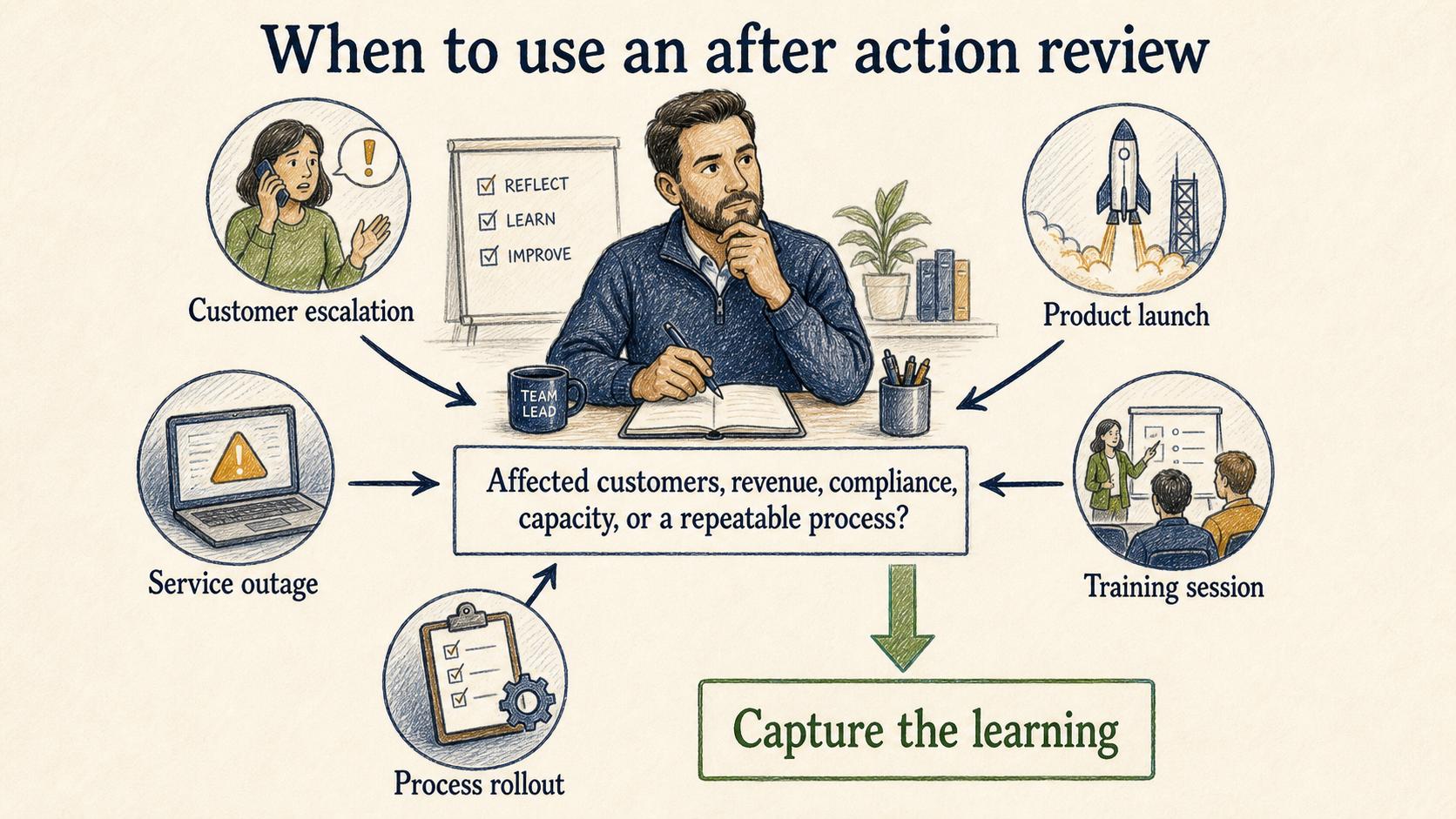
Use an AAR when the team has enough real experience to learn from and the details are still current. Good triggers include:
- A customer implementation, renewal, or escalation.
- A marketing campaign, webinar, or product launch.
- A support incident or service outage.
- A training session or onboarding cohort.
- A process rollout that exposed unclear ownership.
Not every task needs a formal review. Use the lightweight test: if the outcome affected customers, revenue, compliance, team capacity, or a repeatable process, the learning is worth capturing. For small events, a 15-minute review and a short written summary may be enough.
How to run an after action review without turning it into theater
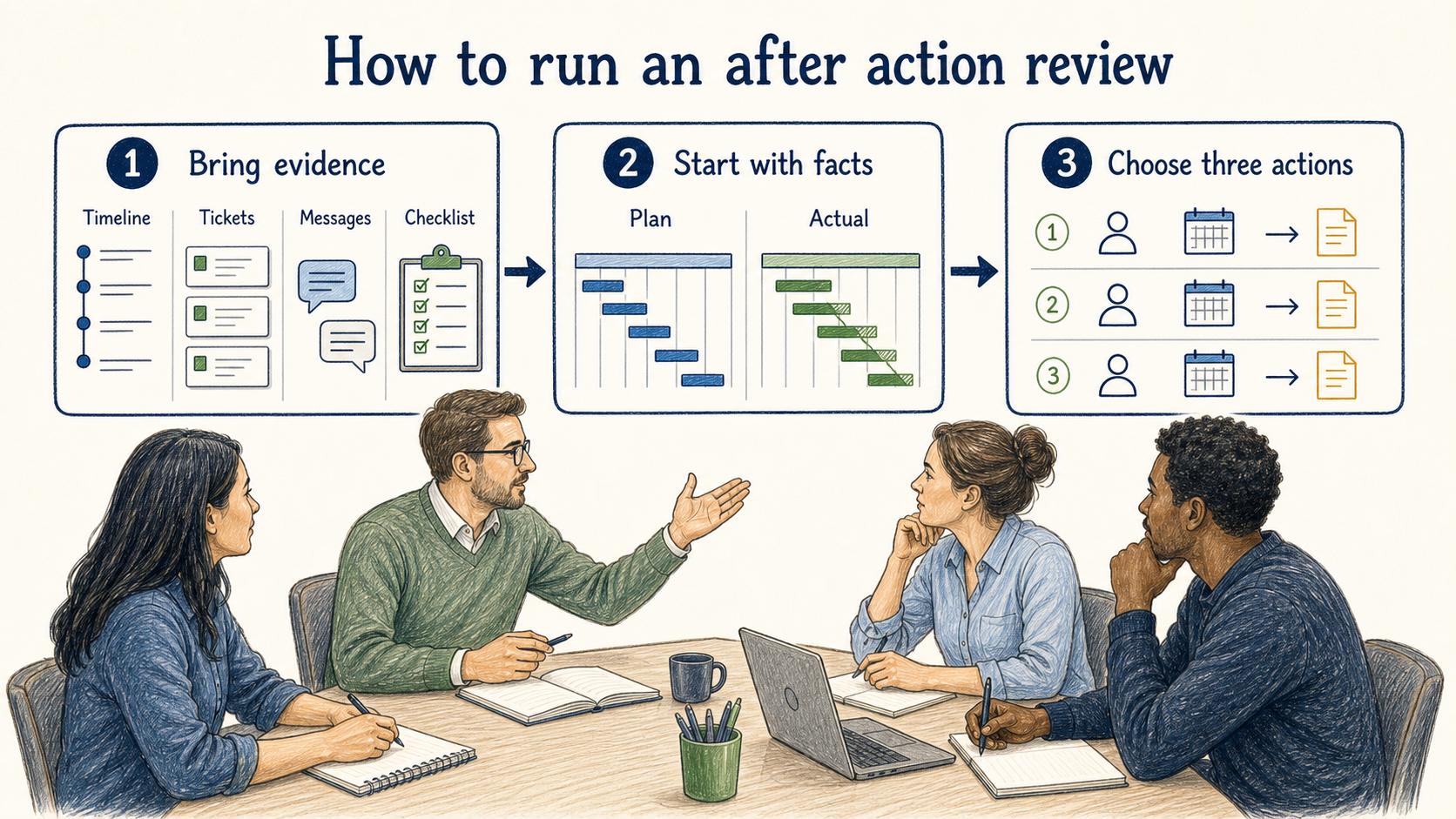
The facilitator's job is to keep the review close to evidence. AHRQ's TeamSTEPPS debrief guidance prompts teams to examine communication, roles, workload, errors, resources, and improvement opportunities. 4 Ask people to bring artifacts: timelines, messages, tickets, checklists, customer notes, recordings, or process docs. Otherwise the review becomes a memory contest.
Start with facts, then move into interpretation. When someone says, "The handoff was confusing," ask what made it confusing. Was there no owner? Did two teams use different systems? Was the SOP outdated? Did the customer receive conflicting instructions? The sharper the failure mode, the easier it is to fix.
Keep the output small. Three precise follow-up actions beat twelve vague improvements. Each action needs an owner, a due date, and a destination. A change that belongs in an SOP should not live only in meeting notes.
AI-ready after action review template
Use this prompt after the review conversation to turn notes into a cleaner summary:
## After Action Review Summary

**Glossary term:** After Action Review
**Source:** Trails Glossary — trails.so/glossary/after-action-review

---

### 01. Prompt

"Turn these after action review notes into a concise team learning summary.

Context: [project, event, incident, or workflow]
Intended outcome: [what was supposed to happen]
Actual outcome: [what happened]
Evidence: [timeline, customer notes, tickets, recordings, metrics, or artifacts]
What worked: [specific practices to repeat]
What broke or slowed us down: [specific failure modes]
Root causes or contributing conditions: [systems, ownership, assumptions, tools, timing]
Decisions made: [what the team agreed to change]
Follow-up actions: [owner, due date, destination document or workflow]

Write the summary in plain language. Separate facts from interpretation. Avoid blame. Convert each lesson into a specific process, training, or documentation update where possible."
Common mistakes
The most common mistake is producing lessons with no operating consequence. "Start earlier" or "improve communication" sounds reasonable, but it rarely changes behavior. A better lesson names the artifact or decision that would have prevented the problem: a readiness checklist, a revised handoff step, a new escalation threshold, or a clearer approval owner.
Another mistake is waiting too long. If the review happens weeks later, people reconstruct events through the final outcome instead of the actual sequence. That makes the conversation cleaner but less accurate.
A third mistake is treating the AAR as a performance review. When people feel judged, they protect themselves. The review should examine the work system: assumptions, handoffs, tools, documentation, timing, training, and decision rights.
How Trails helps
After action reviews often reveal that the real fix is better process documentation. Trails helps teams capture a workflow as someone performs it, turn that workflow into a polished step-by-step guide, and create an AI-narrated video version for training or sharing. That makes it easier to turn an AAR insight into documentation the next person can actually use.
FAQ
Is an after action review only for failures?
No. AARs are useful after successes too because they identify what should be repeated, standardized, or taught to other teams.
Who should attend an after action review?
Include the people who planned, performed, supported, or were affected by the work. Keep the group small enough that participants can discuss specific decisions and handoffs.
What should an after action review produce?
It should produce a short summary of what happened, why it happened, what should change, and where those changes will live. The strongest AARs end with updated process documentation, not just meeting notes.
- Lessons learned
- Retrospective
- Root cause analysis
- Continuous improvement
- Process improvement
- Knowledge management
- Knowledge retention
- Postmortem
Sources
- 1
First Army. FM 7-0 Appendix K: After Action Reviews. www.first.army.mil/Portals/102/FM%207-0%20Appendix%20K.pdf.
- 2
Tannenbaum and Cerasoli. Meta-analysis on debriefs. pubmed.ncbi.nlm.nih.gov/23516804/.
- 3
NWCG. After Action Reviews. www.nwcg.gov/wfldp/toolbox/aars.
- 4
AHRQ TeamSTEPPS. Reviewing the Team's Performance: Debrief. www.ahrq.gov/teamstepps-program/curriculum/team/tools/debrief.html.