
Glossary
Knowledge Retention
 ChatGPT
 Perplexity
 Gemini
 Claude
What is knowledge retention?
Knowledge retention is the practice of keeping important organizational knowledge available over time, even when people leave, roles change, systems evolve, or teams reorganize. It focuses on preserving the knowledge a business still needs to operate, make decisions, train employees, and avoid repeating mistakes.
The hard part is choosing what deserves maintenance. Teams do not need to save every preference, workaround, or old decision. They need to protect knowledge that would be expensive, risky, or slow to recreate.
Why knowledge retention matters
Organizations lose knowledge constantly. A senior employee leaves. A manager changes teams. A process changes but the reason behind the change is forgotten. A customer workaround lives in one person's head. A tool migration breaks an old workflow nobody documented. A systematic review of empirical research on turnover-related knowledge loss found a broad scope of effects at organizational and unit levels. \[1\]
Some loss is healthy. Teams should retire outdated practices and abandoned workarounds. Knowledge retention matters when the loss would slow down work, create risk, damage customer experience, extend onboarding, or force the organization to relearn something it already paid to learn.
That makes retention a judgment problem as much as a storage problem. The goal is to keep knowledge that still has operational value.
What types of knowledge should be retained?
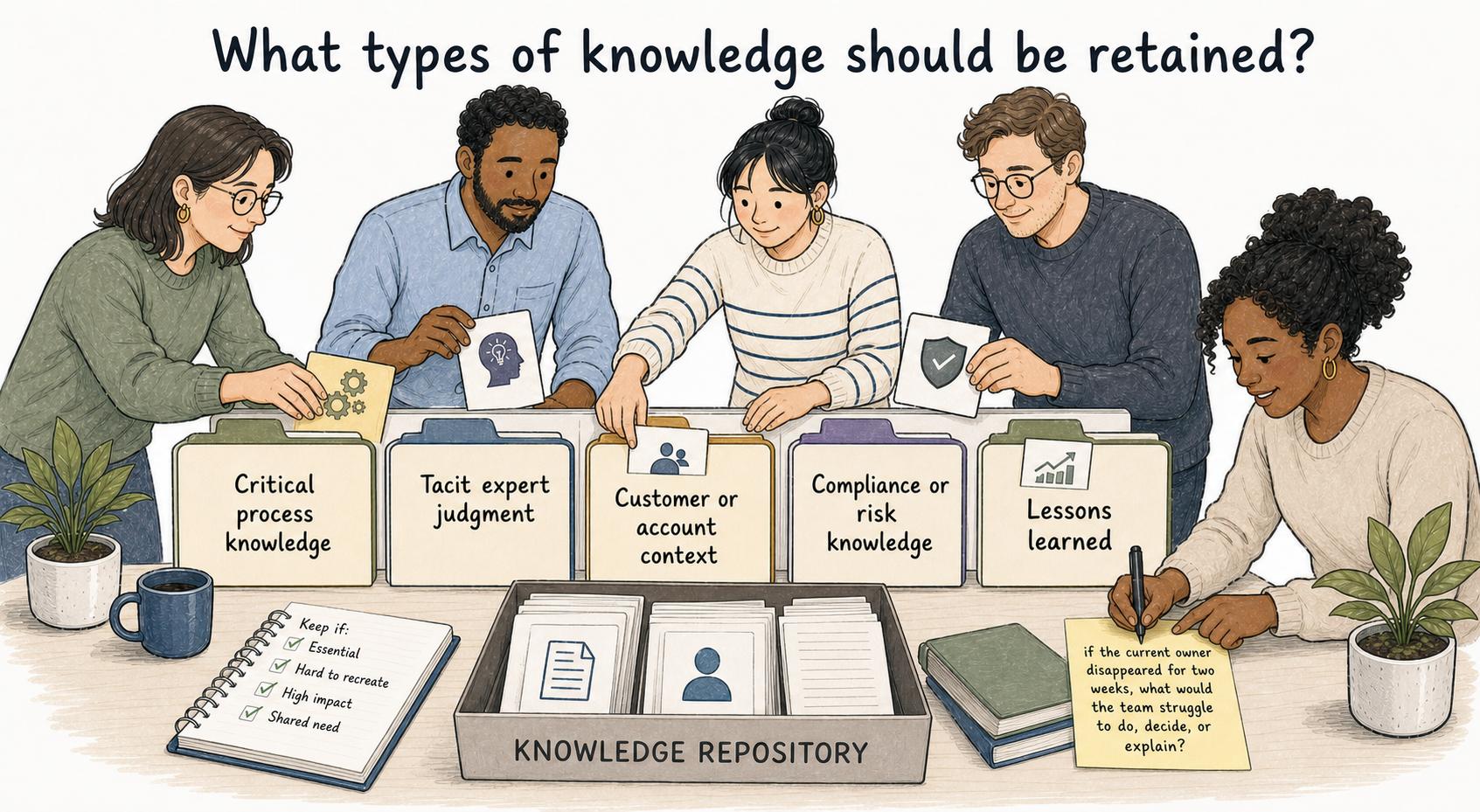
Knowledge retention usually focuses on know-how that is difficult to recreate quickly. Organizational knowledge is often embedded across members, tools, tasks, and the relationships among them, which is why retention has to cover more than files alone. \[2\]
| Knowledge type | Why it is worth retaining | Example artifact |
|---|---|---|
| Critical process knowledge | Work stops or quality drops if only one person knows the steps | SOP, workflow guide, runbook, checklist |
| Tacit expert judgment | The decision logic is not obvious from the formal process | Annotated examples, decision rules, escalation notes |
| Customer or account context | Losing history damages service or relationship continuity | Account brief, implementation notes, support history summary |
| Compliance or risk knowledge | Mistakes create legal, security, financial, or safety exposure | Approved procedure, audit trail, policy guide |
| Lessons learned | The team may repeat expensive mistakes without context | Retrospective summary, incident review, project postmortem |
</table>
A useful test is this: if the current owner disappeared for two weeks, what would the team struggle to do, decide, or explain? That is a retention candidate.
Knowledge retention vs knowledge transfer
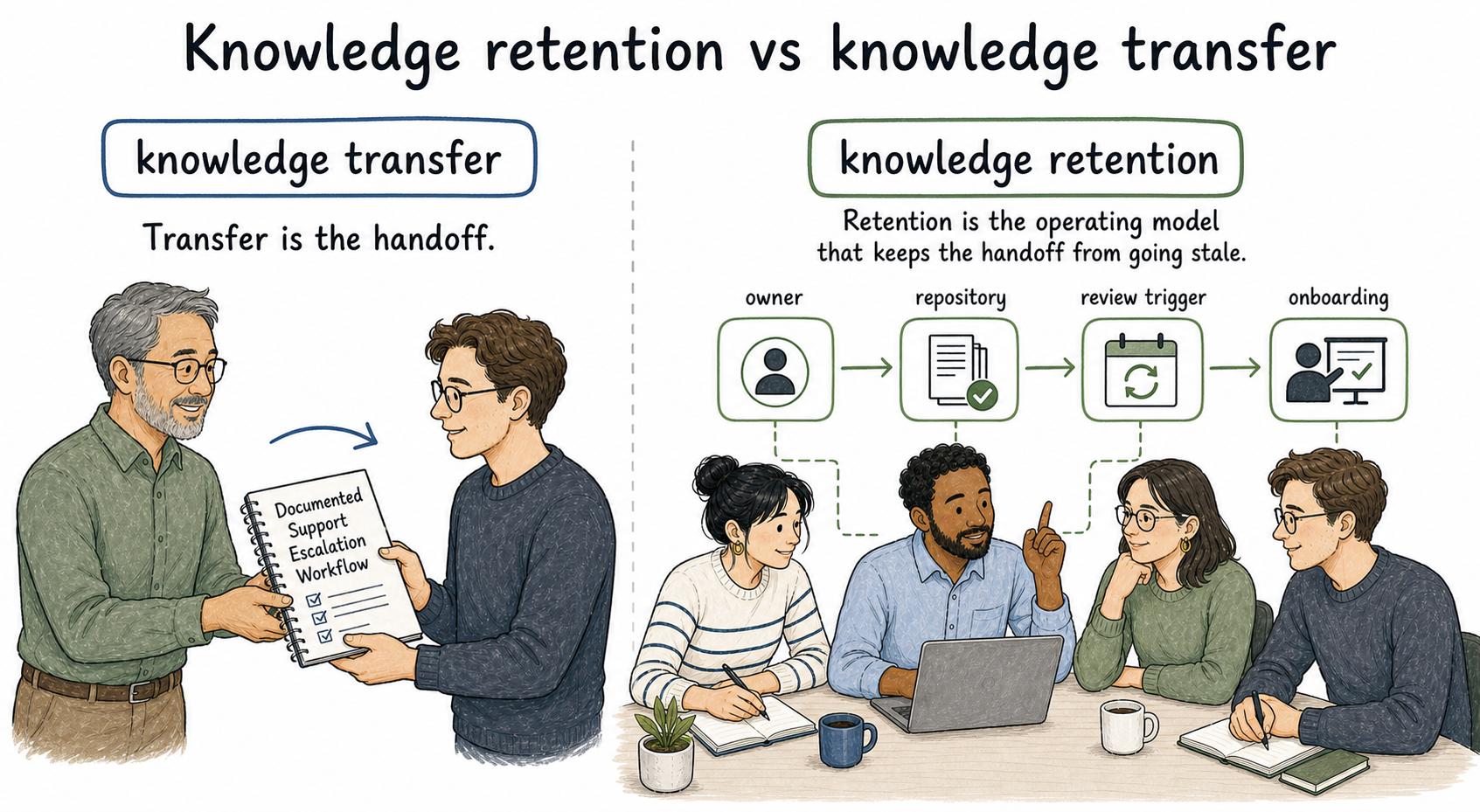
Knowledge transfer moves knowledge from one person or group to another. Knowledge retention makes sure that knowledge remains available after the transfer moment has passed.
For example, when a subject matter expert documents a support escalation workflow for a new team lead, that is knowledge transfer. When the team assigns an owner, stores the workflow in the right repository, reviews it after policy changes, and uses it in onboarding, that is knowledge retention.
Transfer is the handoff. Retention is the operating model that keeps the handoff from going stale.
Why knowledge retention fails
Knowledge retention often fails because teams capture content without capturing context. A step-by-step guide may explain what to click, but not why the sequence matters, which exceptions require escalation, or what has changed since the guide was written.
It also fails when ownership is unclear. If nobody owns a document, everyone quietly assumes someone else will fix it. Eventually employees stop trusting the resource and return to asking the most experienced person directly.
The third failure mode is false completeness. A company may have a knowledge base, shared drive, LMS, and wiki, but still lose critical know-how because important material is fragmented across all of them. Retention requires a findable source of truth, not a long list of places where information might exist.
A practical knowledge retention diagnostic
Use these questions to decide whether a piece of knowledge needs deliberate retention:
- Would losing this knowledge slow down onboarding, customer work, compliance, quality, or revenue-critical operations?
- Is the knowledge concentrated in one person, one team, or an informal group?
- Does the knowledge include judgment, exceptions, or history that a simple checklist would miss?
- Is the work repeated often enough that people need a reusable reference?
- Is there a clear owner, location, and review trigger for keeping the artifact current?
If the answer is yes to several of these, the knowledge probably needs more than a one-time note. ISO 30401 frames knowledge management as a system that should be established, implemented, maintained, reviewed, and improved. \[3\]
How to retain knowledge without hoarding everything
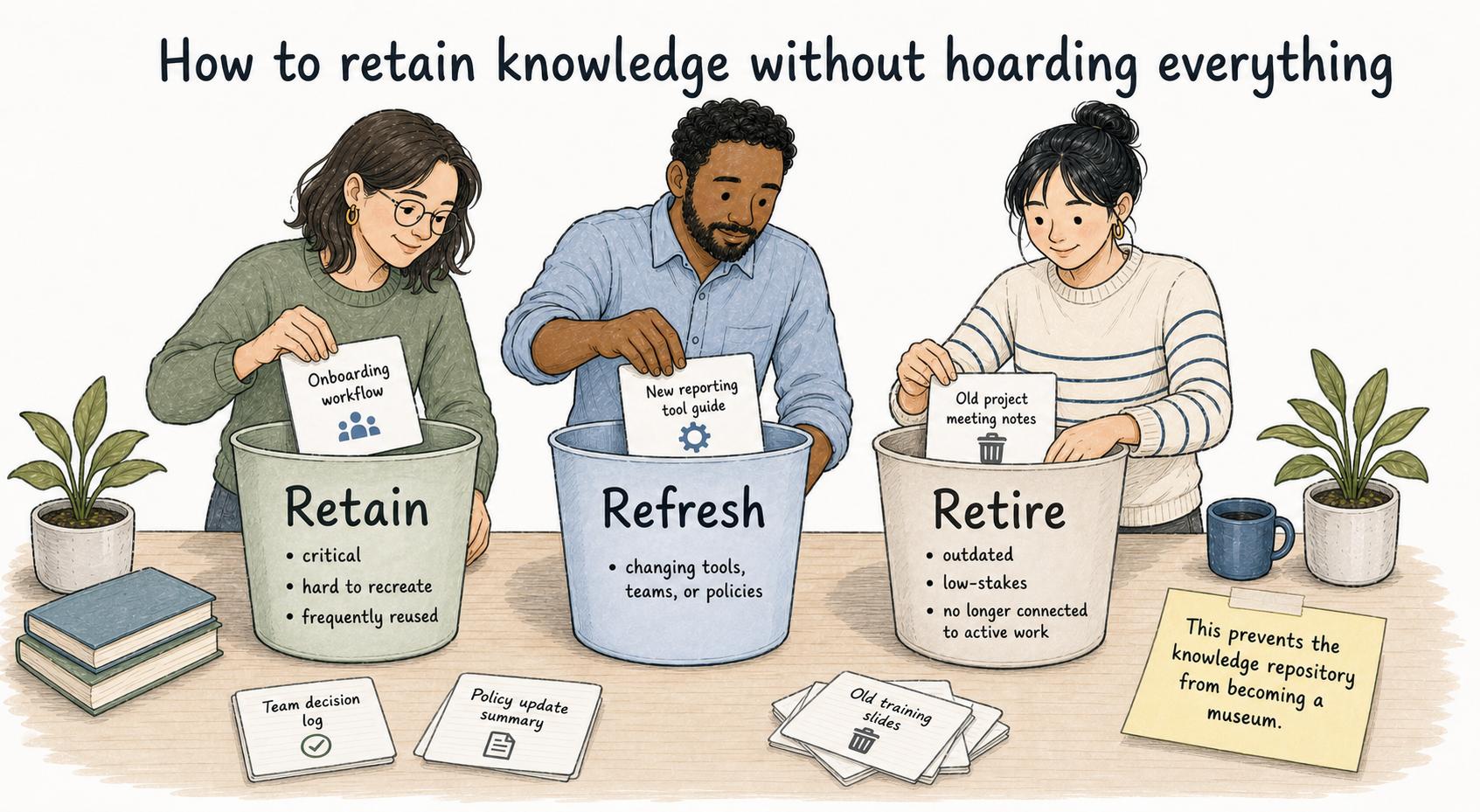
The best retention systems are selective. They preserve knowledge with real reuse value and retire knowledge that no longer reflects how work happens.
A practical approach is to sort knowledge into three buckets. Retain knowledge that is critical, hard to recreate, or frequently reused. Refresh knowledge that is still useful but tied to changing tools, teams, or policies. Retire knowledge that is outdated, low-stakes, or no longer connected to active work.
This prevents the knowledge repository from becoming a museum. A cluttered repository can be worse than no repository because it teaches employees that every answer might be stale.
Documentation takeaway
Knowledge retention depends on documentation, but documentation alone does not guarantee retention. The retained knowledge must be findable, trusted, current, and specific enough to help someone act.
The strongest artifacts capture both the workflow and the reasoning around it: what to do, what to watch for, when to escalate, and why the process exists. That is especially important for tacit knowledge, where the value lives in judgment rather than obvious steps.
How Trails helps
Trails helps teams capture repeatable workflows as people perform them, then turn those workflows into polished step-by-step guides. Teams can also create AI-narrated video versions for training or sharing.
That makes knowledge retention more practical when important know-how is embedded in day-to-day processes: onboarding tasks, customer support routines, operations work, tool walkthroughs, or expert procedures that should not depend on one person being available.
Sources
1. [Galan et al., Knowledge loss induced by organizational member turnover](https://www.researchgate.net/publication/368077389_Knowledge_loss_induced_by_organizational_member_turnover_a_review_of_empirical_literature_synthesis_and_future_research_directions_Part_I) - Supports the risk framing around turnover-related knowledge loss.
2. [Annual Review of Psychology on knowledge transfer within organizations](https://www.annualreviews.org/doi/pdf/10.1146/annurev-psych-022123-105424) - Supports the point that organizational knowledge is embedded in members, tools, tasks, and networks.
3. [ISO 30401:2018 knowledge management systems](https://www.iso.org/standard/68683.html) - Supports the need for an ongoing system to maintain, review, and improve knowledge management.
- Knowledge Transfer
- Knowledge Sharing
- Knowledge Management
- Knowledge Repository
- Tacit Knowledge
- Institutional Knowledge
- Tribal Knowledge
- Subject Matter Expert
Sources
- 1
Galan et al.. Knowledge loss induced by organizational member turnover. www.researchgate.net/publication/368077389_Knowledge_loss_induced_by_organizational_member_turnover_a_review_of_empirical_literature_synthesis_and_future_research_directions_Part_I.
- 2
Annual Review of Psychology on knowledge transfer within organizations. Annual Review of Psychology on knowledge transfer within organizations. www.annualreviews.org/doi/pdf/10.1146/annurev-psych-022123-105424.
- 3
ISO 30401:2018 knowledge management systems. ISO 30401:2018 knowledge management systems. www.iso.org/standard/68683.html.