
Glossary
Leader Standard Work
 ChatGPT
 Perplexity
 Gemini
 Claude
What is leader standard work?
Leader standard work is the recurring set of leadership routines that keeps operations visible, stable, and improving. It defines what leaders check, where they go to see the work, which conversations they lead, and how they follow up on problems.
The concept comes from lean management, where standard work is not only for frontline tasks. Lean Enterprise Institute frames leader standard work as "kaizen for management," with routines such as gemba walks, reflection, accountability, and mentoring.1 The point is simple: leaders need standard routines too, because their habits shape what teams notice, escalate, fix, and repeat.
Why leader standard work matters
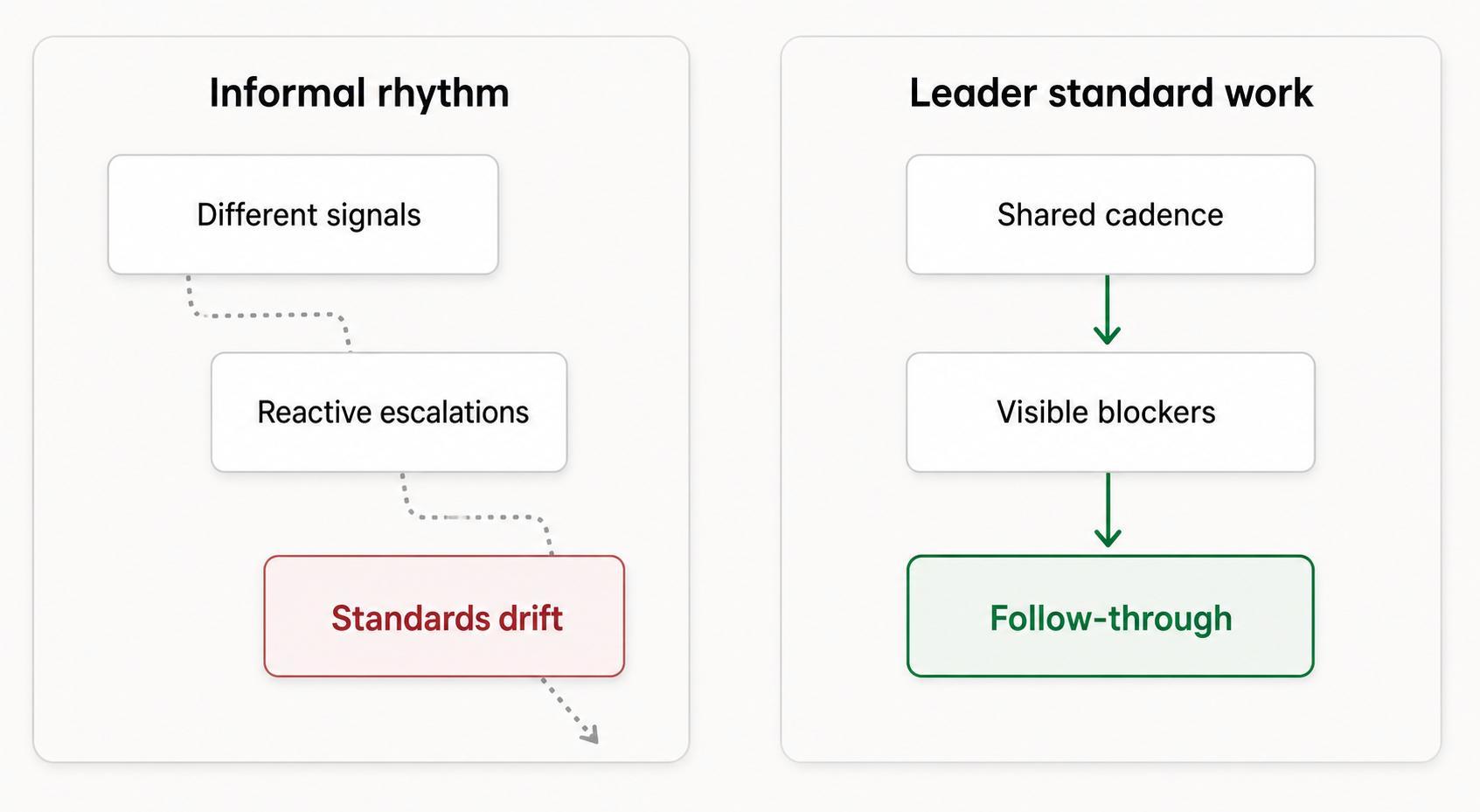
Teams rarely drift because nobody cares. They drift because the operating rhythm is informal. One manager checks the dashboard every morning, another waits for escalations, and another relies on whatever shows up in chat. Before long, the team's standards become whatever each leader happens to inspect.
Leader standard work makes those expectations visible. It answers practical questions:
- What should I check every day, week, or month?
- Where should I go to understand the work directly?
- Which signals deserve attention?
- How should I follow up on blockers or improvement ideas?
- How do I coach without taking over the work?
The goal is not to make leadership robotic. It is to make the behaviors that protect the operating system reliable.
What leader standard work includes
Leader standard work usually combines observation, communication, review, coaching, and follow-up. The exact routine depends on the role and environment, but lean management systems often pair leader standard work with visual management, daily accountability, huddles, KPI review, improvement opportunities, and leader coaching.2 Common elements include:
- Daily team check-ins or huddles
- Review of key performance, quality, safety, or customer signals
- Walkthroughs of the work area or workflow
- Confirmation that standard processes are being followed
- Coaching conversations with team members
- Escalation and blocker removal
- Follow-up on open improvement actions
- Reflection on whether the routine is still useful
A frontline supervisor might check shift readiness, handoffs, and quality issues each day. A department leader might review capacity, customer escalations, cross-functional blockers, and process improvement priorities each week.
Leader standard work vs standard work
Leader standard work is related to standard work, but the subject is different.
| Concept | Focus | Example |
|---|---|---|
| Standard work | The best-known current way to perform a task or process | Steps for processing a refund request |
| Leader standard work | The recurring leadership routines that sustain and improve the system | Daily review of refund backlog, blockers, and coaching needs |
| Work instruction | Detailed task-level guidance | How to issue the refund in the billing system |
The mistake is treating leader standard work as a manager's to-do list. A to-do list captures tasks. Leader standard work captures the behaviors that keep the operating system visible and improving.
Example leader standard work checklist
A useful checklist is short enough to survive a normal day and specific enough to change behavior. Healthcare authors describing leader standard work emphasize manageable, leader-owned routines that can be implemented quickly, which is a useful guardrail for keeping the checklist practical.3 For a customer support manager, it might look like this:
- Review queue volume, aging tickets, and urgent escalations before the daily huddle.
- Join the huddle and ask what is blocked, not just what is busy.
- Compare one documented support workflow with how the work is actually being done.
- Follow up on yesterday's unresolved escalation or improvement action.
- Coach one team member on a recurring issue, handoff, or customer pattern.
- Record process gaps that need documentation, training, or tooling changes.
That list is not meant to fill the manager's day. It creates a repeatable spine so the important work does not depend on memory, mood, or whichever problem is loudest.
Common mistakes
The biggest risk with leader standard work is compliance theater. If leaders complete the checklist without learning anything, the routine has missed the point. Follow-through matters: AHRQ summarizes a BMJ Quality & Safety study finding that work settings receiving feedback from Leadership WalkRounds had higher safety culture and employee engagement scores.4
Common mistakes include:
- Measuring checklist completion instead of visibility and follow-through
- Writing routines that are too long to survive a normal day
- Inspecting people instead of inspecting the process
- Using the routine to catch mistakes rather than remove blockers
- Leaving the routine untouched as the team changes
A useful test is simple: does the routine help leaders see reality sooner and respond better? If not, simplify it.
Documentation takeaway
Leader standard work should be documented, but lightly. The routine needs enough structure to be repeatable, visible, and teachable. It should not become a dense manual nobody opens.
Document the cadence, trigger, expected action, source of truth, and follow-up path. For example: "Every Monday before 10 a.m., review onboarding completion, identify stalled hires, and assign follow-up owners in the team tracker." That is more useful than "Monitor onboarding."
How Trails helps
Trails fits the documentation side of leader standard work. When a leader or team member performs a repeatable process, Trails captures the workflow as it happens, turns it into a polished step-by-step guide, and can create an AI-narrated video version for training or sharing.
That gives leaders a clearer reference point. They are not just asking whether a process was followed; they can point to a maintained guide for what the process actually is.
FAQ
Is leader standard work only for manufacturing?
No. It is common in lean manufacturing, but the idea applies anywhere leaders need consistent routines to support quality, flow, coaching, and improvement.
How detailed should leader standard work be?
It should be detailed enough that another leader can understand the routine, but not so detailed that it becomes brittle. Cadence, purpose, source of truth, and follow-up expectations matter most.
Who owns leader standard work?
The leader owns their routine, but the organization should align on expectations. If every leader invents a separate operating rhythm, the system becomes harder to coach, compare, and improve.
- Standard work
- Work instruction software
- Digital work instruction
- SOP software
- Process documentation software
- Daily management system
- Gemba walk
Sources
- 1
Lean Enterprise Institute. Leader Standard Work. Lean Enterprise Institute. www.lean.org/lexicon-terms/leader-standard-work/. Accessed June 15, 2026.
- 2
Winner et al.. Lean Management Systems in Health Care: A Review of the Literature. PubMed, 2022. pubmed.ncbi.nlm.nih.gov/35180733/. Accessed June 15, 2026.
- 3
Kupec et al.. Leader Standard Work: A Model for Improving Efficiencies in Leadership and Healthcare. PubMed, 2022. pubmed.ncbi.nlm.nih.gov/35608975/. Accessed June 15, 2026.
- 4
Agency for Healthcare Research and Quality. AHRQ PSNet summary of Sexton et al. on Leadership WalkRounds feedback. AHRQ PSNet. psnet.ahrq.gov/issue/providing-feedback-following-leadership-walkrounds-associated-better-patient-safety-culture. Accessed June 15, 2026.