
Glossary
Gemba Walk
 ChatGPT
 Perplexity
 Gemini
 Claude
What is a gemba walk?
A gemba walk is a Lean management practice where leaders or process owners go to the place where work actually happens, observe the process directly, and ask questions to understand how value is created. Lean Enterprise Institute defines gemba as the actual place where value-creating work occurs. 1
It is not a surprise inspection. It is a structured way to see the real workflow, learn from the people doing the work, and spot friction that reports and dashboards often hide. Toyota's related genchi genbutsu practice emphasizes going to see the actual place or process before solving the problem. 2
Why gemba walks matter
Processes usually look cleaner in documentation than they do in real life. The SOP may say one thing, the software may require another, the handoff may depend on a workaround, and the metric may only show the final delay.
A focused observation can reveal waiting, rework, duplicate entry, unclear ownership, missing materials, unnecessary motion, and quiet escalation paths. The observer's job is to understand the system before judging the person; if employees experience the walk as performance policing, they will hide workarounds instead of explaining them.
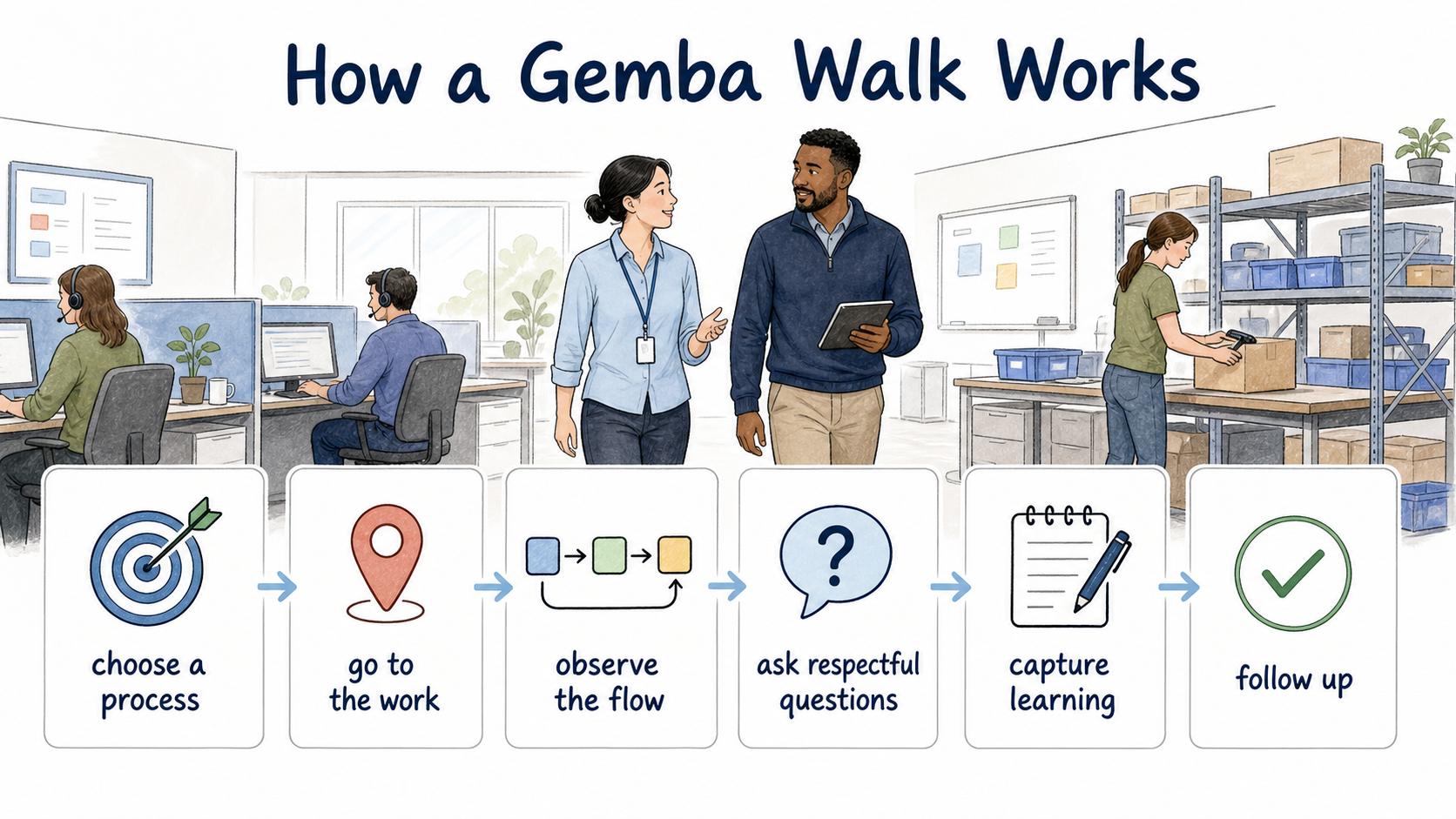
How a gemba walk works
Choose a narrow process, go to where the work happens, observe the actual flow, ask respectful questions, capture what you learn, and follow up on improvement opportunities. A focused question—such as why invoice approvals take too long—is more useful than a broad walk through an entire department.
Ask open questions: What triggers this step? What information do you need? What slows you down? What do you do when the normal path fails? Which part is hardest to explain to a new person? Then assign ownership and tell the team what happened as a result.
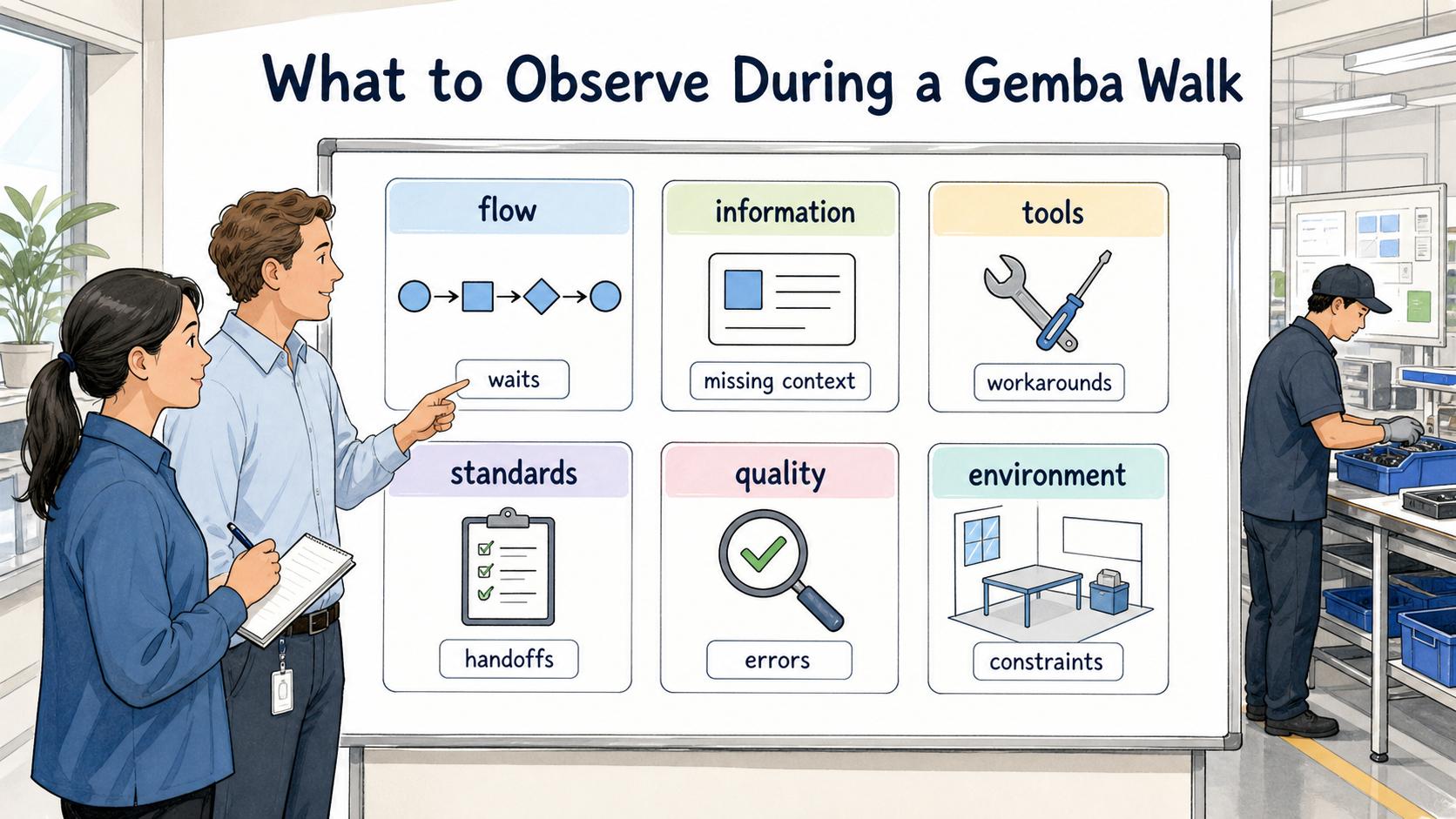
What to observe during a gemba walk
| Observation area | What to look for | What it may reveal |
|---|---|---|
| Flow | Where work waits, loops back, or changes hands | Bottlenecks, unclear ownership, or overcomplicated approvals |
| Information | What people need before they can act | Missing context, duplicate entry, or unreliable source systems |
| Tools | Systems, files, forms, or devices used | Shadow processes, manual workarounds, or software friction |
| Standards | Whether documented steps match reality | Outdated SOPs, undocumented exceptions, or training gaps |
| Quality | Where errors, rework, or checks happen | Root causes that appear earlier than the final defect |
| Environment | Layout, access, interruptions, and constraints | Practical barriers that metrics do not show |
The real place may be a physical floor, shared inbox, ticket queue, CRM, or video call. AHRQ's workflow-assessment toolkit similarly treats understanding current clinical and administrative workflows as a prerequisite for redesigning them well. 3
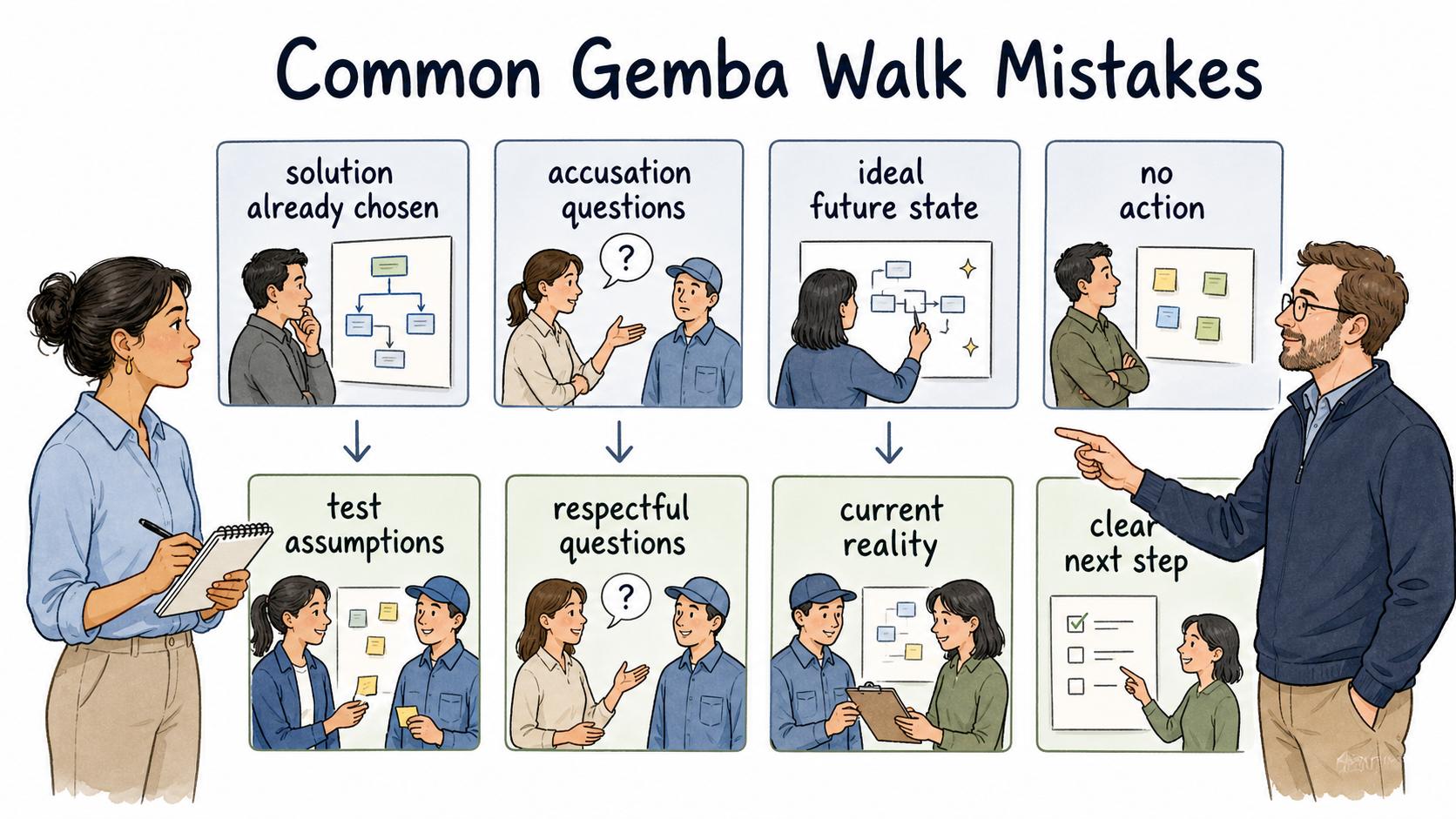
Common mistakes
- Arriving with a solution already chosen instead of testing assumptions.
- Asking questions that sound accusatory rather than curious.
- Documenting only the ideal future state instead of the current workaround, delay, duplicate spreadsheet, or confusing handoff.
- Failing to connect observations to action, ownership, and feedback to the team.
Gemba walk template
## Gemba walk template

**Glossary term:** Gemba Walk
**Source:** Trails Glossary — trails.so/glossary/gemba-walk

---

### 01. Plan a gemba walk

"Plan a gemba walk for [process] performed by [team].

Focus question: [what we are trying to understand]
Place where work happens: [floor, system, queue, meeting, workspace, or handoff]
People involved: [roles to observe or speak with]

Capture:
- Trigger: what starts the work
- Flow: main steps and handoffs as they happen in practice
- Friction: waiting, rework, missing information, duplicate entry, unclear ownership
- Workarounds: what people do when the standard process does not fit reality
- Questions asked: open questions and answers from the team
- Documentation gap: where the SOP, guide, checklist, or training differs from reality
- Follow-up: action, owner, deadline, and how the team will hear back"
Documentation takeaway
A gemba walk keeps process documentation honest. Watching the work happen surfaces the handoffs, checks, and exceptions that static templates miss, so teams can update SOPs and training guides from evidence rather than memory.
How Trails helps
When a workflow happens in a browser or software tool, Trails can capture it as someone performs it and turn that capture into a polished step-by-step guide or AI-narrated video. That gives teams a practical way to share the observed workflow with people who were not present during the walk.
FAQ
Is a gemba walk only for manufacturing?
No. It comes from Lean manufacturing, but applies anywhere work has a real flow: a ticket queue, CRM, shared inbox, onboarding workflow, or internal system.
Who should do a gemba walk?
Managers, process owners, team leads, operations leaders, quality teams, and documentation owners can all use them. Curiosity and follow-through matter more than rank.
What should happen after a gemba walk?
Summarize and validate the observations with people doing the work, choose the next action, and communicate what will change. Update the relevant SOP, guide, checklist, or training material when there is a documentation gap.
Sources
- 1
Lean Enterprise Institute. Gemba. www.lean.org/lexicon-terms/gemba/.
- 2
Toyota UK. Genchi Genbutsu. mag.toyota.co.uk/genchi-genbutsu/.
- 3
AHRQ. Workflow Assessment for Health IT Toolkit. digital.ahrq.gov/health-it-tools-and-resources/evaluation-resources/workflow-assessment-health-it-toolkit.