
Glossary
Operational Excellence
 ChatGPT
 Perplexity
 Gemini
 Claude
What is operational excellence?
Operational excellence is the discipline of making work reliable, visible, and continuously better. It means a team can define how important work should run, see when performance drifts, improve the system, and turn better methods into the new standard. ISO 9001 frames quality management around consistent products and services, efficiency, and customer expectations, which fits the practical definition of operational excellence. 1
Useful operational excellence is practical. It shows up when people, processes, tools, standards, and learning loops are connected well enough that good execution does not depend on heroics.
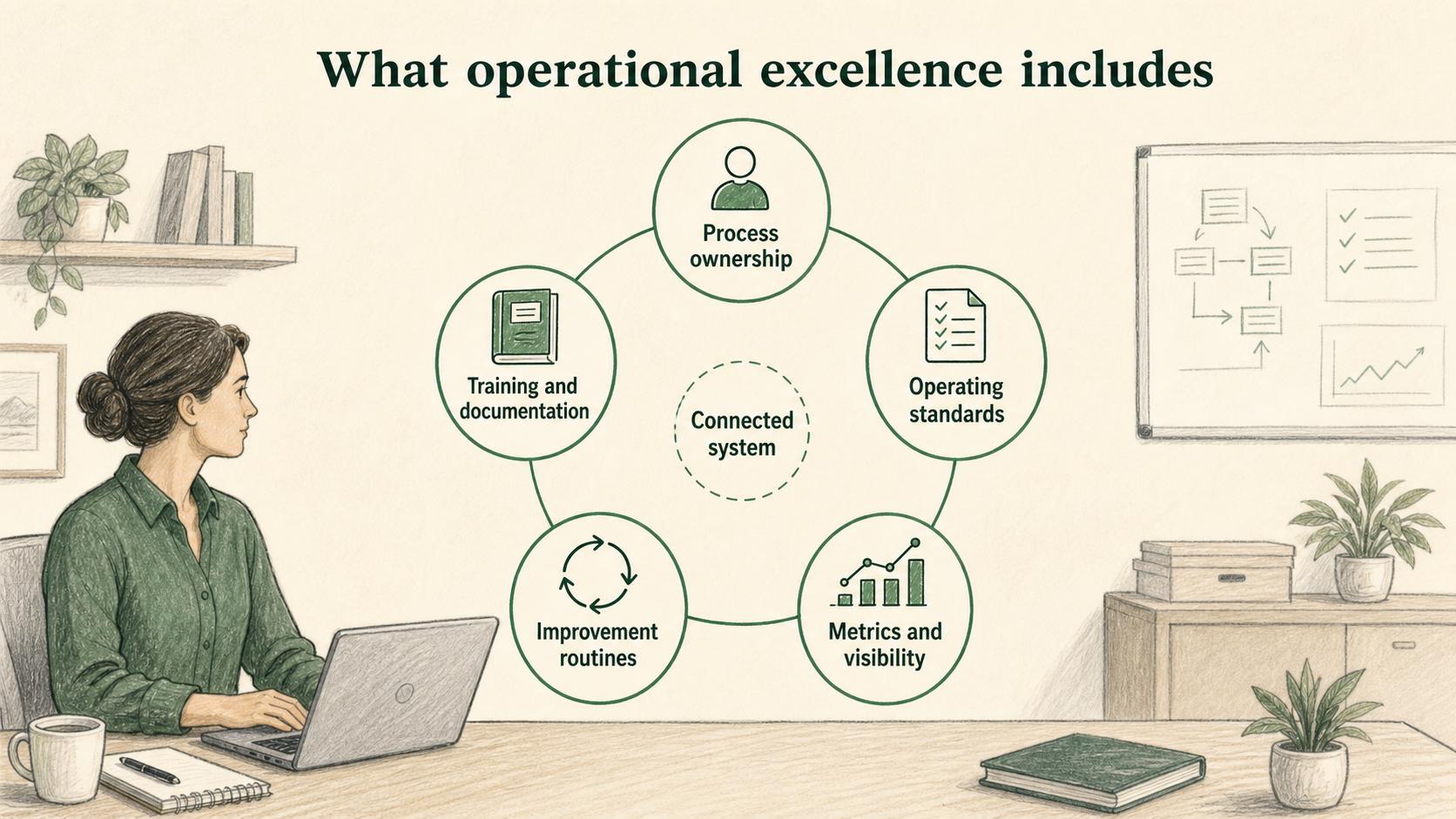
What operational excellence includes
Operational excellence usually shows up through a few connected habits. Each one is useful, but the system only works when they reinforce each other.
| Element | What it does | What goes wrong without it |
|---|---|---|
| Process ownership | Makes someone accountable for how work performs | Problems bounce between teams |
| Operating standards | Defines the current best way to do repeatable work | People rely on memory or personal style |
| Metrics and visibility | Shows whether work is healthy or drifting | Issues stay hidden until they become urgent |
| Improvement routines | Creates a way to learn and adjust | Problems get fixed once and then return |
| Training and documentation | Helps the standard spread and stay current | Improvements disappear when people change |
The connective tissue is the important part. SOPs do not create operational excellence if people do not use them. Metrics do not help if nobody acts on the signals. Improvement projects do not last if the better way never becomes standard work. NIST guidance on security-focused configuration management treats documented policy, procedures, and plans as part of implementation, which is a useful model for turning standards into operating practice. 2
Operational excellence vs process improvement
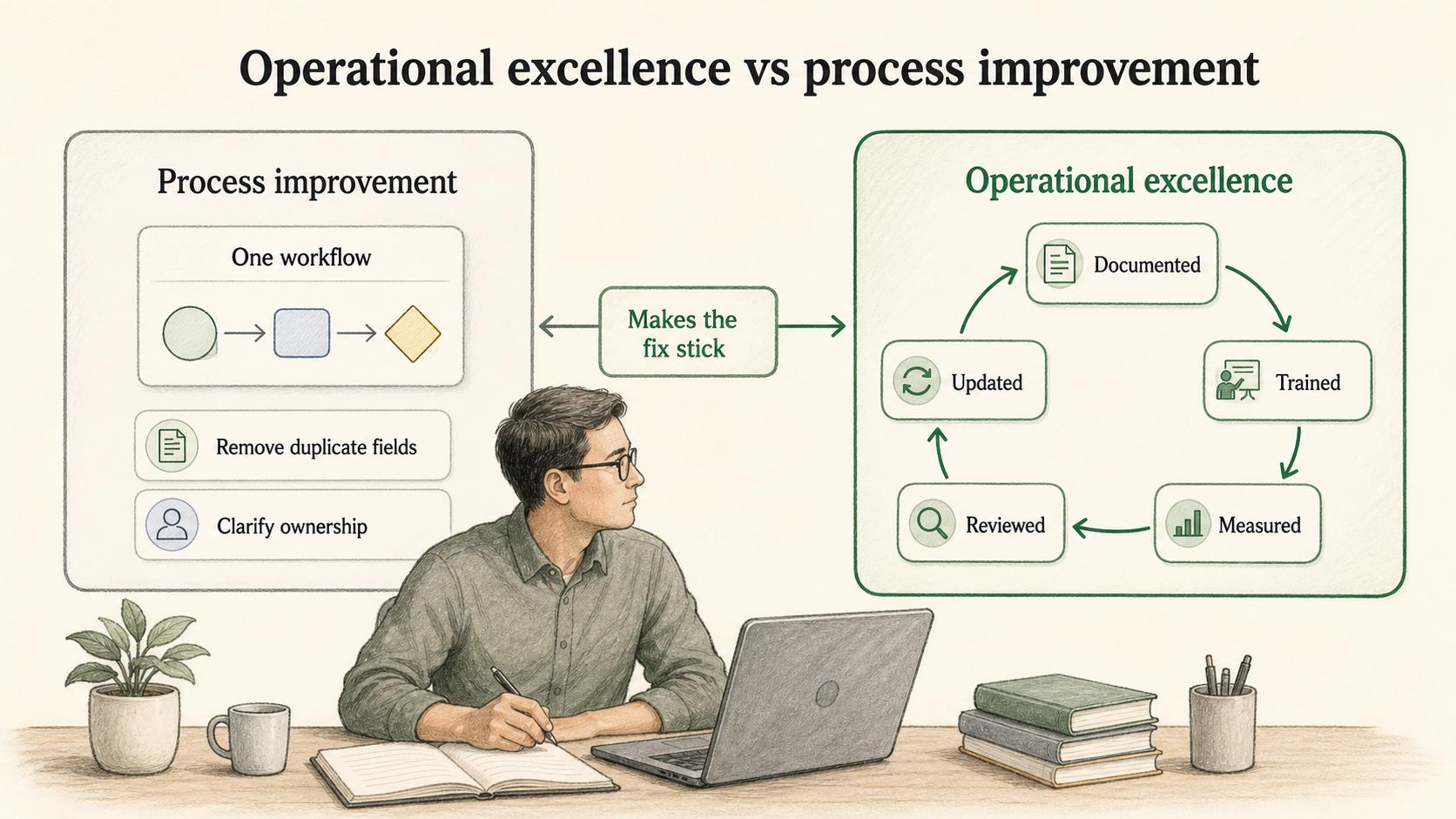
Process improvement usually focuses on making a specific workflow better. Operational excellence is the management system that makes improvement repeatable across many workflows.
For example, a team might improve its customer onboarding handoff by removing duplicate fields and clarifying ownership. Operational excellence makes that improvement stick: the new handoff is documented, trained, measured, reviewed, and updated when the business changes.
This distinction matters because teams often celebrate the fix and neglect the operating system. The work improves for a few weeks, then slips back because the SOP is old, the metric is not reviewed, or new employees learn the previous method from a teammate.
What operational excellence looks like in practice
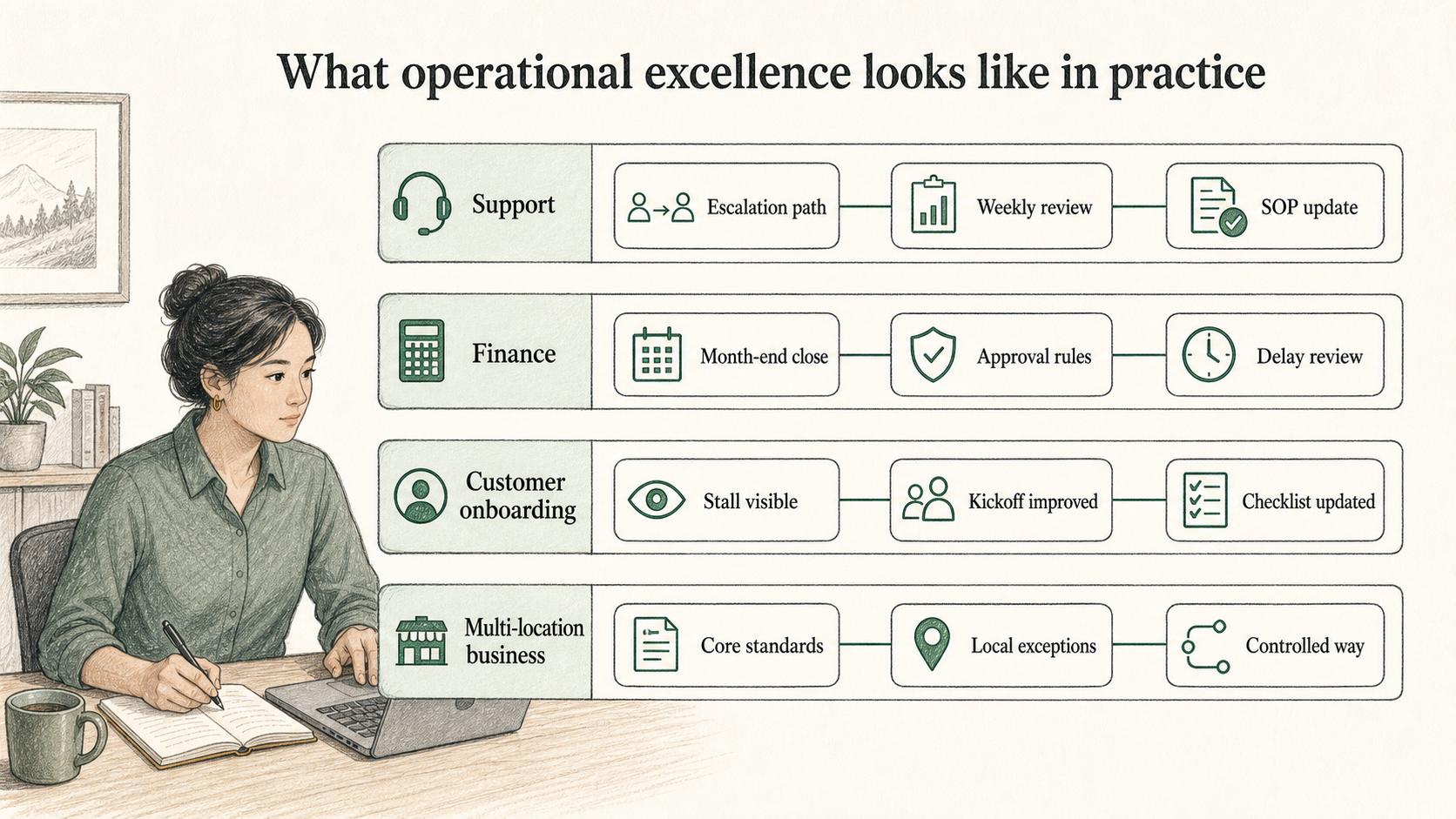
Operational excellence is easiest to see in ordinary work:
- A support team has a clear escalation path, reviews incomplete tickets each week, updates the bug-reporting SOP when patterns appear, and trains agents on the change.
- A finance team has a documented month-end close process, owners for each step, clear approval rules, and a review routine for delays or rework.
- A customer onboarding team can see where accounts stall, improve the kickoff workflow, update the checklist, and make the new method part of training.
- A multi-location business keeps core standards consistent while still letting each location handle local exceptions in a controlled way.
The pattern is the same: the team knows the current standard, can see when reality differs from the standard, and has a practical way to improve the standard.
Common operating gaps
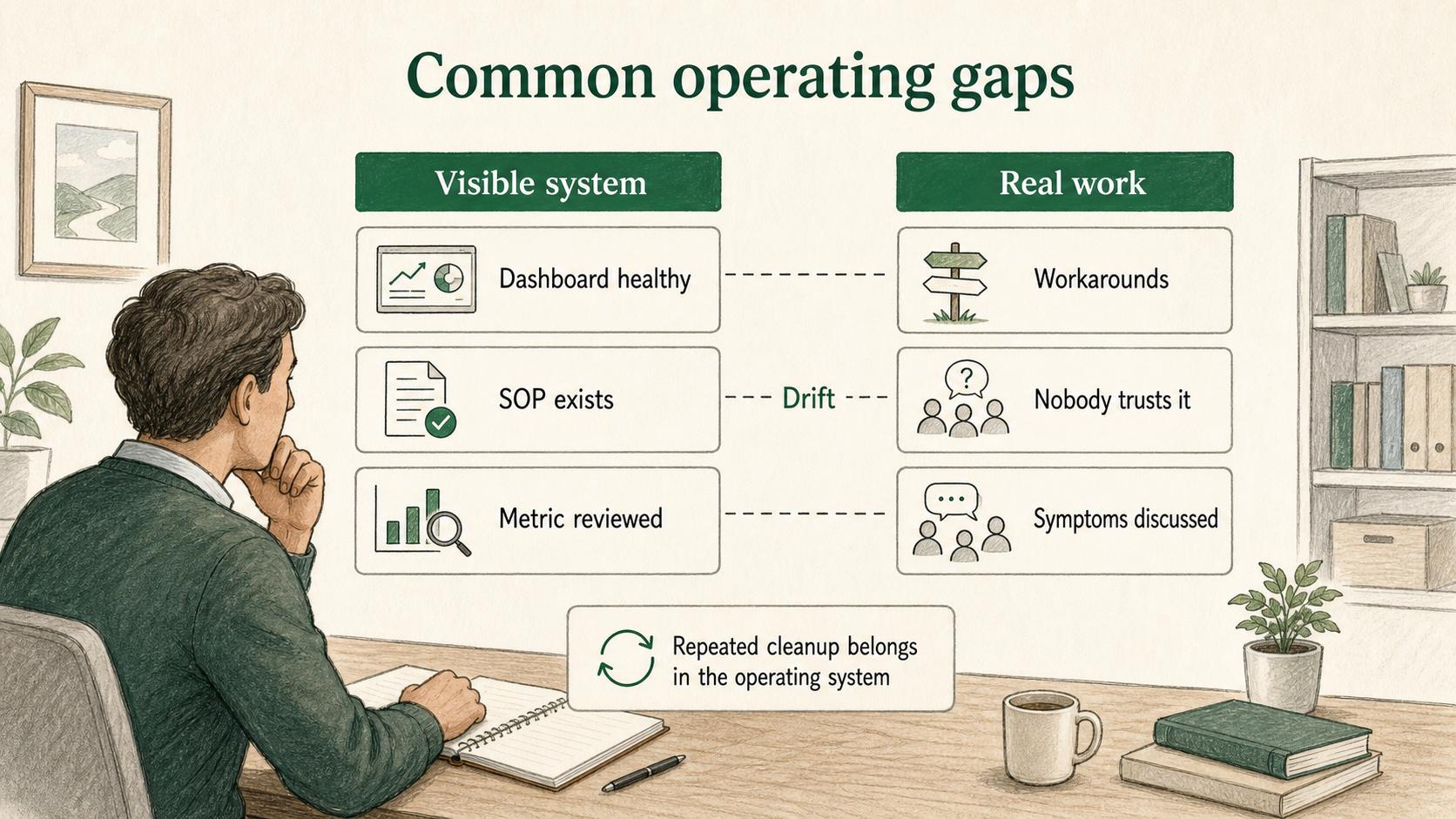
Operational excellence breaks down when the visible system and the real work drift apart. The dashboard says the process is healthy, but employees are using workarounds. The SOP exists, but nobody trusts it. The metric is reviewed, but the team only discusses symptoms. A manager solves the same exception every week, but no one changes the process that creates the exception.
These gaps are rarely solved by telling people to care more. They need better operating design: clearer ownership, a more realistic standard, a tighter feedback loop, or documentation that is easier to update when work changes.
One useful rule: if the same issue requires repeated explanation, repeated escalation, or repeated cleanup, it probably belongs in the operating system rather than a manager's memory.
How to build operational excellence
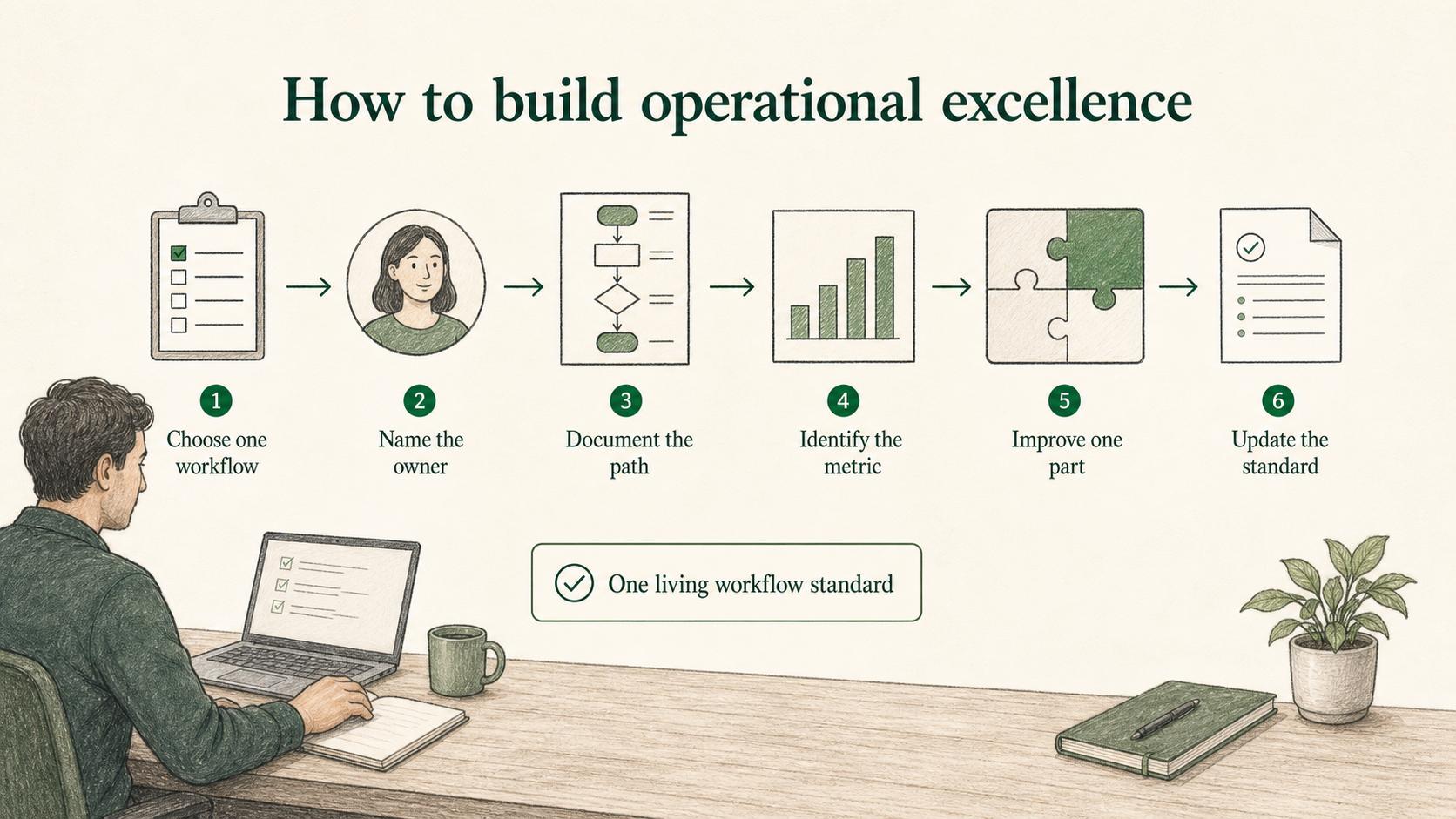
Start with one important workflow. Trying to improve every process at once usually creates more noise than discipline.
Choose a workflow that is frequent, visible, and painful when it breaks. Name the owner. Document the current path. Identify the metric that best shows whether the workflow is healthy. Watch where handoffs, exceptions, delays, or rework appear. Improve one part of the system, then update the standard so the improvement can survive the next busy week.
The first loop matters more than the first library. A team with one living workflow standard, one review cadence, and one habit of updating documentation after improvement is closer to operational excellence than a team with hundreds of stale pages. Microsoft research found that 62% of surveyed workers struggle with too much time spent searching for information, so a smaller set of current standards can be more useful than a large library people cannot navigate. 3
Operational excellence assessment prompt
Use this prompt to assess a workflow:
## Operational excellence assessment prompt

**Glossary term:** Operational Excellence
**Source:** Trails Glossary — trails.so/glossary/operational-excellence

---

### 01. Assess a workflow

"Assess operational excellence for [workflow]. Identify the process owner, current standard, core metric, common exceptions, handoff risks, training gaps, documentation gaps, and the review cadence. Recommend one improvement to test, how to measure it, and what SOP, checklist, guide, or operations manual section should change if the test works."
This prompt keeps the assessment practical. It connects improvement to measurement and documentation instead of producing a vague maturity score.
Documentation takeaway
Operational excellence needs standards that people can actually use. Process maps, SOPs, checklists, work instructions, operations manuals, and training guides give improvement somewhere to land.
Documentation makes the system visible. When it is current and connected to real workflows, teams can train faster, reduce avoidable variation, and make improvements stick.
How Trails helps
Trails helps teams document real workflows and turn them into polished step-by-step guides. That gives operational excellence work a practical way to capture the current standard, share process changes, create AI-narrated training videos, and keep repeatable work easier to maintain.
Sources
- 1
ISO. ISO 9001 explained. www.iso.org/home/insights-news/resources/iso-9001-explained.html.
- 2
National Institute of Standards and Technology. NIST SP 800-128. NIST. nvlpubs.nist.gov/nistpubs/SpecialPublications/NIST.SP.800-128.pdf.
- 3
Microsoft. 2023 Work Trend Index. assets.ctfassets.net/y8fb0rhks3b3/5eyZc6gDu1bzftdY6w3ZVV/beeb0f2e437044fc99a0408867a263d8/WTI_Annual_2023_Will_AI_Fix_Work_.pdf.