
Glossary
Tribal Knowledge
 ChatGPT
 Perplexity
 Gemini
 Claude
What is tribal knowledge?
Tribal knowledge is informal, undocumented know-how that lives in people's heads instead of in shared systems, guides, or processes. It often includes shortcuts, context, exceptions, tool quirks, customer history, and judgment calls that experienced employees use every day.1
Experience is valuable. Operational risk starts when the organization depends on knowledge only a few people can access.
Why tribal knowledge matters
Tribal knowledge usually becomes visible when dependency shows up. A senior employee goes on vacation and nobody knows how to run a monthly report. A support lead leaves and the team loses the unwritten rule for handling a tricky customer segment. A new hire follows the documented steps and still fails because the real process has three exceptions nobody wrote down.
The risk goes beyond inconvenience. Tribal knowledge can slow onboarding, create inconsistent customer experiences, hide compliance gaps, and make teams overly dependent on a few experienced people.2
Some judgment will always live in people. The useful work is capturing the repeatable, teachable parts so expertise can scale instead of becoming a bottleneck.
Examples of tribal knowledge
Tribal knowledge often hides around handoffs, exceptions, and tools.
- The finance manager who knows which vendor invoices always need extra review.
- The support agent who knows the unofficial workaround for a product bug.
- The operations lead who remembers why a step exists even though the policy does not explain it.
- The implementation specialist who knows which customer kickoff order prevents rework.
- The warehouse supervisor who knows the safe but undocumented way to handle an unusual return.
If the answer to "How do we do this?" is "Ask Maya," the team has tribal knowledge. Maya may be excellent. The system is still fragile.
Tribal knowledge vs tacit knowledge
Tribal knowledge overlaps with tacit knowledge, but the terms are not identical.
Tacit knowledge is knowledge that is hard to fully explain in words, such as judgment, pattern recognition, timing, or skill gained through experience. Tribal knowledge is informal knowledge held by a group or a few experienced people, whether it is hard to explain or simply never got documented.3
That distinction matters because knowledge needs different capture methods. A password reset workflow can become a step-by-step guide. A senior manager's judgment about an escalated customer may need examples, principles, and coaching instead of a rigid script.
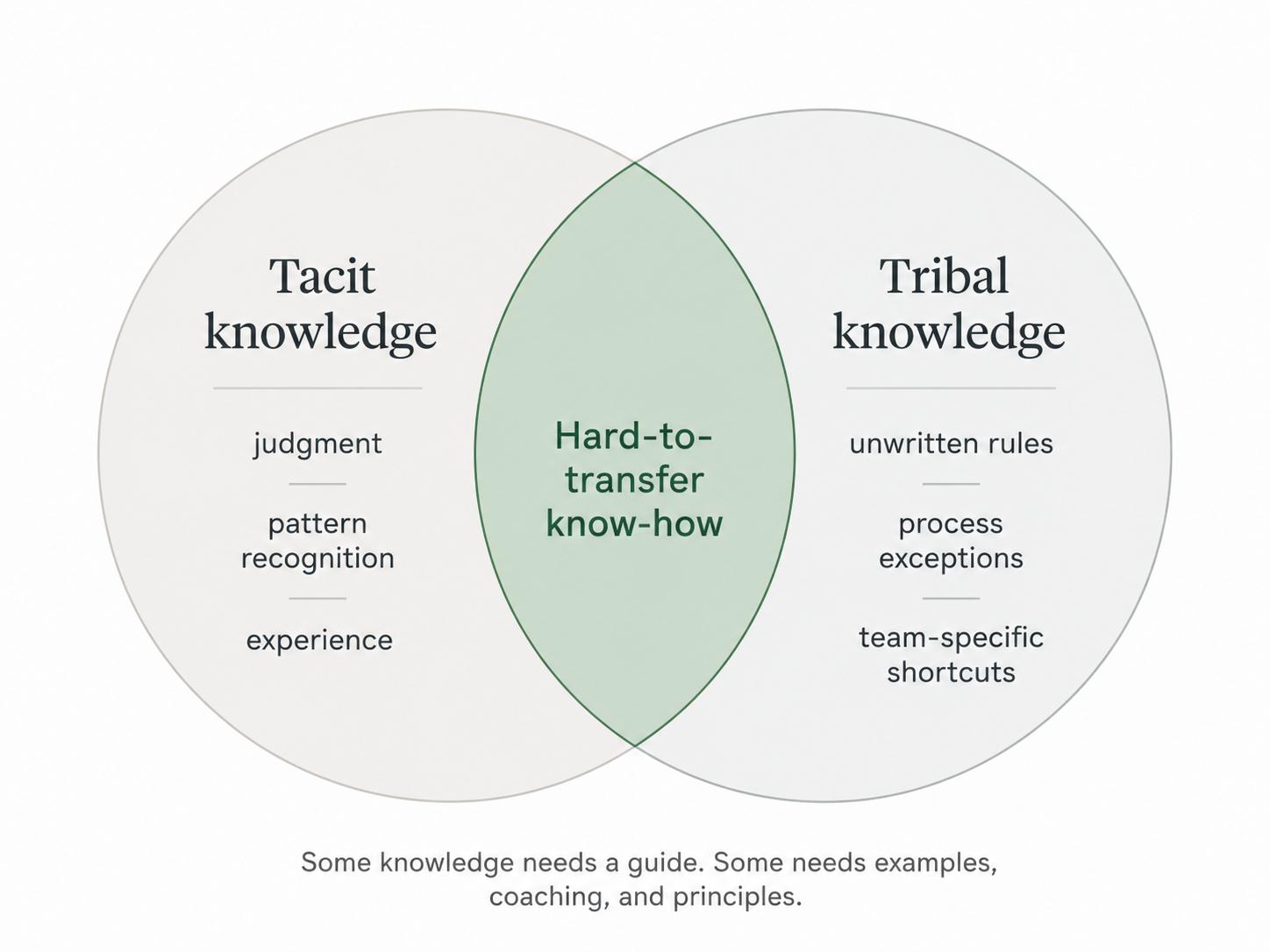
A good knowledge-management system identifies which knowledge must be shared for the team to operate reliably.
How to identify tribal knowledge
Start where undocumented know-how already creates risk or delay. Skip the vague "document everything" campaign and pick the places where knowledge gaps hurt the team.
Look for:
- Tasks only one or two people can do.
- Processes that stall when a specific person is unavailable.
- Repeated questions in Slack, email, or meetings.
- Training that depends on shadowing but has no reference material.
- Exceptions that experienced employees handle differently.
- Customer or compliance issues caused by inconsistent execution.
- Workarounds that everyone uses but nobody owns.
The best signals are repeated dependency and repeated interruption. If the same person keeps getting pulled into the same question, the knowledge probably needs a durable home.
How to capture tribal knowledge
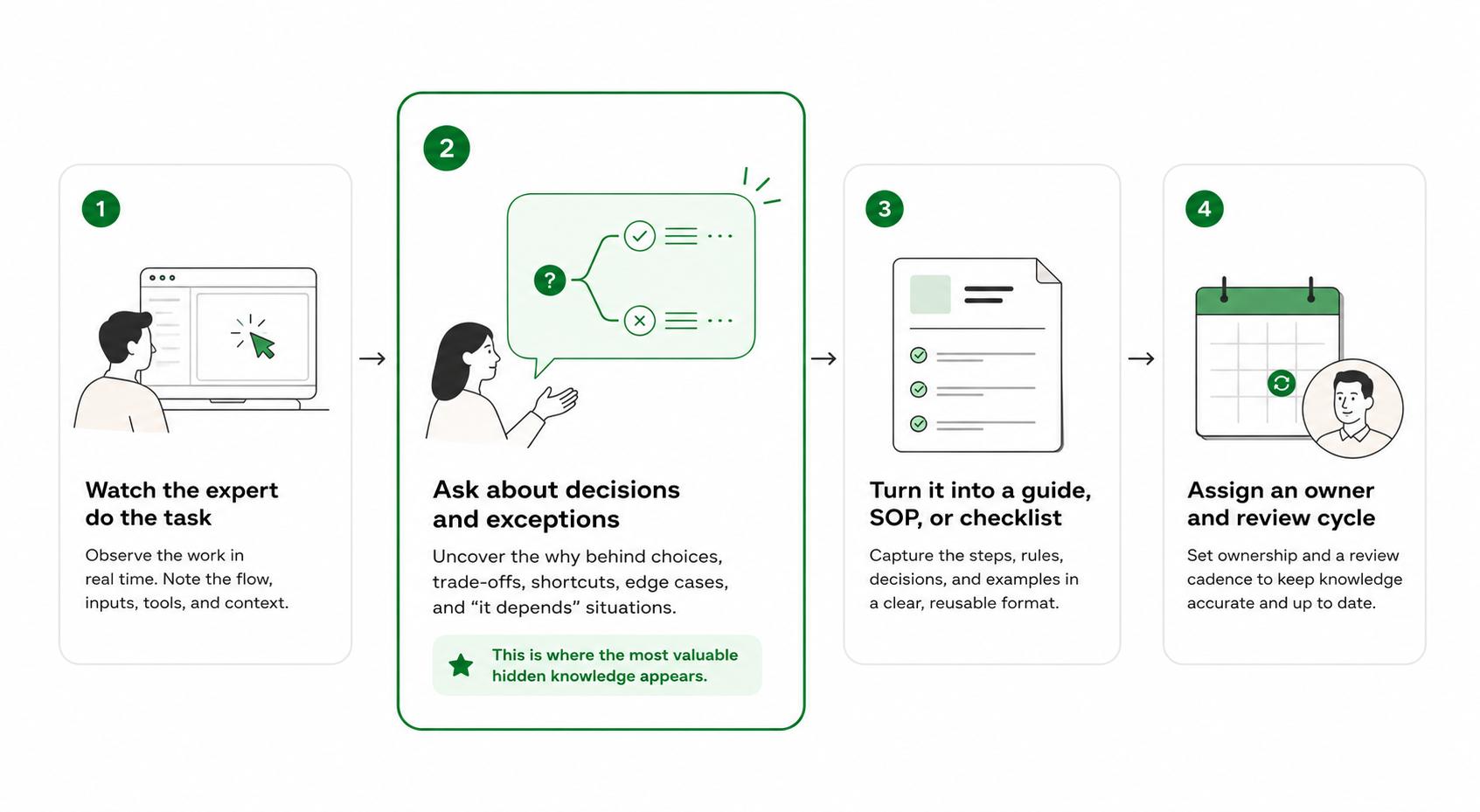
Capture the knowledge close to the work. Watch the expert perform the task, ask what decisions they are making, and document the trigger, steps, exceptions, and signs of success.
## Tribal Knowledge Capture Prompt

**Glossary term:** Tribal Knowledge
**Source:** Trails Glossary — trails.so/glossary/tribal-knowledge

---

### 01. Capture undocumented know-how

"Task or decision: [what needs to be captured]
Expert owner: [who knows it today]
When this comes up: [trigger or scenario]
Normal steps: [repeatable sequence]
Exceptions: [when the normal path changes]
Decision rules: [how the expert chooses]
Common mistakes: [what newer employees miss]
Good example: [what success looks like]
Where this should live: [SOP, guide, checklist, knowledge base]
Review owner: [who keeps it current]"
The strongest documentation includes examples. Tribal knowledge often hides in "it depends," so show what it depends on. A good example can teach judgment better than another abstract rule.
Common mistakes
One mistake is confusing capture with usable documentation. Dumping notes into a shared folder does not make the knowledge useful. The captured knowledge needs a clear owner, a clear audience, and a place people already look when doing the work.4
Another mistake is waiting until an expert is leaving. Exit interviews can help, but the best time to capture tribal knowledge is while the work is still happening and the expert can test whether the documentation reflects reality.
A third mistake is over-standardizing judgment. Some expertise should become principles, examples, and escalation rules rather than rigid steps. If the work genuinely depends on context, the documentation should teach the context.
How Trails helps
Trails helps teams capture tribal knowledge while the work is happening. A knowledgeable teammate can perform a workflow, and Trails turns that workflow into a polished step-by-step guide. Trails can also create an AI-narrated video version for training or sharing.
That matters because experts often skip details when explaining from memory. Capturing the workflow as it happens preserves the small decisions, system steps, and context that would otherwise be missed.
FAQ
Is tribal knowledge always bad?
No. Experienced employees naturally build valuable knowledge. It becomes a problem when the team depends on that knowledge but cannot access, teach, or maintain it.
What is the best way to capture tribal knowledge?
Capture it during real work. Record the task, ask the expert about decisions and exceptions, then turn the result into a guide, SOP, checklist, or knowledge base article.
Should all tribal knowledge become documentation?
No. Focus on knowledge that affects execution, customer experience, quality, compliance, onboarding, or continuity. Some judgment is better supported with examples and coaching.
- Tacit knowledge
- Institutional knowledge
- Knowledge management
- Knowledge management software
- Knowledge base
- Knowledge curation
- Single source of truth
- Process documentation software
Sources
- 1
APQC. Knowledge Management. APQC. www.apqc.org/expertise/knowledge-management. Accessed June 25, 2026.
- 2
APQC. Understanding Knowledge Loss. APQC. www.apqc.org/resource-library/resource/understanding-knowledge-loss-0. Accessed June 25, 2026.
- 3
Ikujiro Nonaka. The Knowledge-Creating Company. Oxford University Press. www.uky.edu/~gmswan3/575/nonaka.pdf. Accessed June 25, 2026.
- 4
International Organization for Standardization. Guidance on Documented Information. ISO. www.iso.org/iso/documented_information.pdf. Accessed June 25, 2026.