
Glossary
Subject Matter Expert
 ChatGPT
 Perplexity
 Gemini
 Claude
What is a subject matter expert?
A subject matter expert, often shortened to SME, is a person with deep knowledge of a specific topic, process, product, tool, customer segment, or operating domain. In documentation, training, support, and operations work, the SME is the person who can tell whether the instructions are accurate and whether they match how the work actually happens.1
The important word is subject. A subject matter expert is not an expert in everything. Their value comes from specific, practical knowledge that keeps vague, outdated, or incorrect guidance from becoming official.
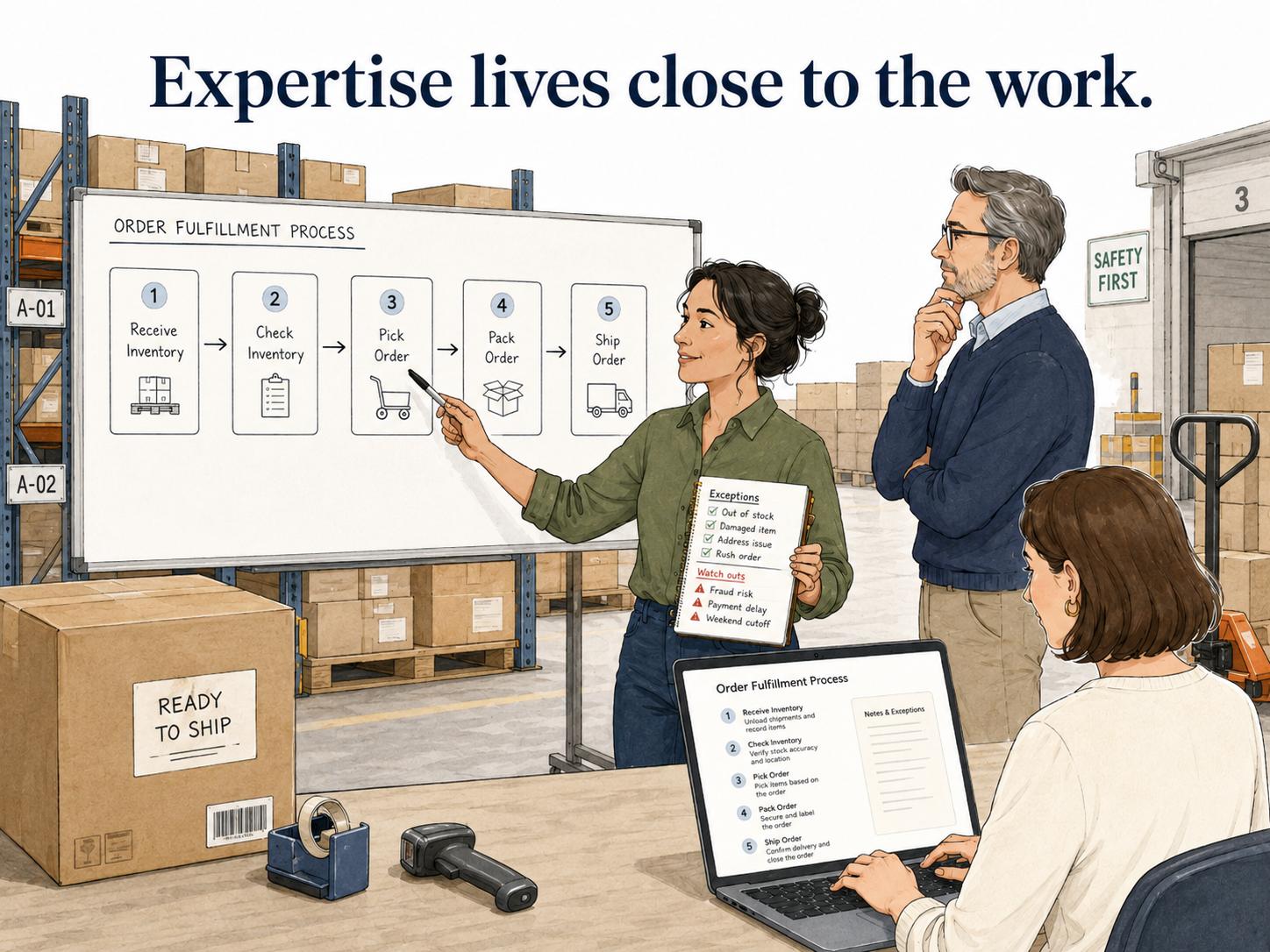
What a subject matter expert does
A subject matter expert helps teams make better decisions, create accurate documentation, train employees, troubleshoot edge cases, and validate process changes before those changes affect customers or employees.
In practice, an SME explains how work happens today, identifies exceptions that outsiders miss, reviews guides for accuracy, clarifies why a decision is made, helps turn tacit knowledge into reusable guidance, and spots risks before a workflow is rolled out.
For example, a billing operations SME may know when a support agent can issue a credit, when Finance needs to approve it, which account history details matter, and which refund wording causes confusion. That knowledge is too important to leave only in one person's memory.
SME vs. technical writer vs. manager
SMEs often contribute to documentation, but they do not play the same role as writers, trainers, or managers.
The SME supplies accuracy, context, exceptions, and judgment. The technical writer shapes that knowledge into clear, usable material. The training owner decides how people will learn and reinforce the process. The manager or process owner makes sure the documented process is adopted and maintained.2
When those roles blur, documentation gets weaker. Asking an SME to write the full guide can produce a dense expert explanation that a new hire cannot follow. Asking a writer to document a complex process without SME access can produce clean prose with fragile assumptions. The best documentation usually comes from a deliberate handoff: source knowledge from the SME, structure from the writer, ownership from the team that runs the process.
When to involve an SME
Involve a subject matter expert when the topic has consequences, hidden complexity, or practical judgment that cannot be guessed from the outside. SME review matters most when a wrong answer could create customer confusion, compliance risk, operational rework, security exposure, or inconsistent training.
Good moments to involve an SME include new SOPs, support macros, escalation guidance, training materials, product documentation, workflow changes, system migrations, and customer-facing help content that must be precise.
You do not need an SME to approve every sentence. Use their time where accuracy, exceptions, and judgment matter. A useful review request is "Please validate the decision rule and edge cases," not "Can you read this whole document and tell me what you think?"
How to work with an SME without creating a bottleneck
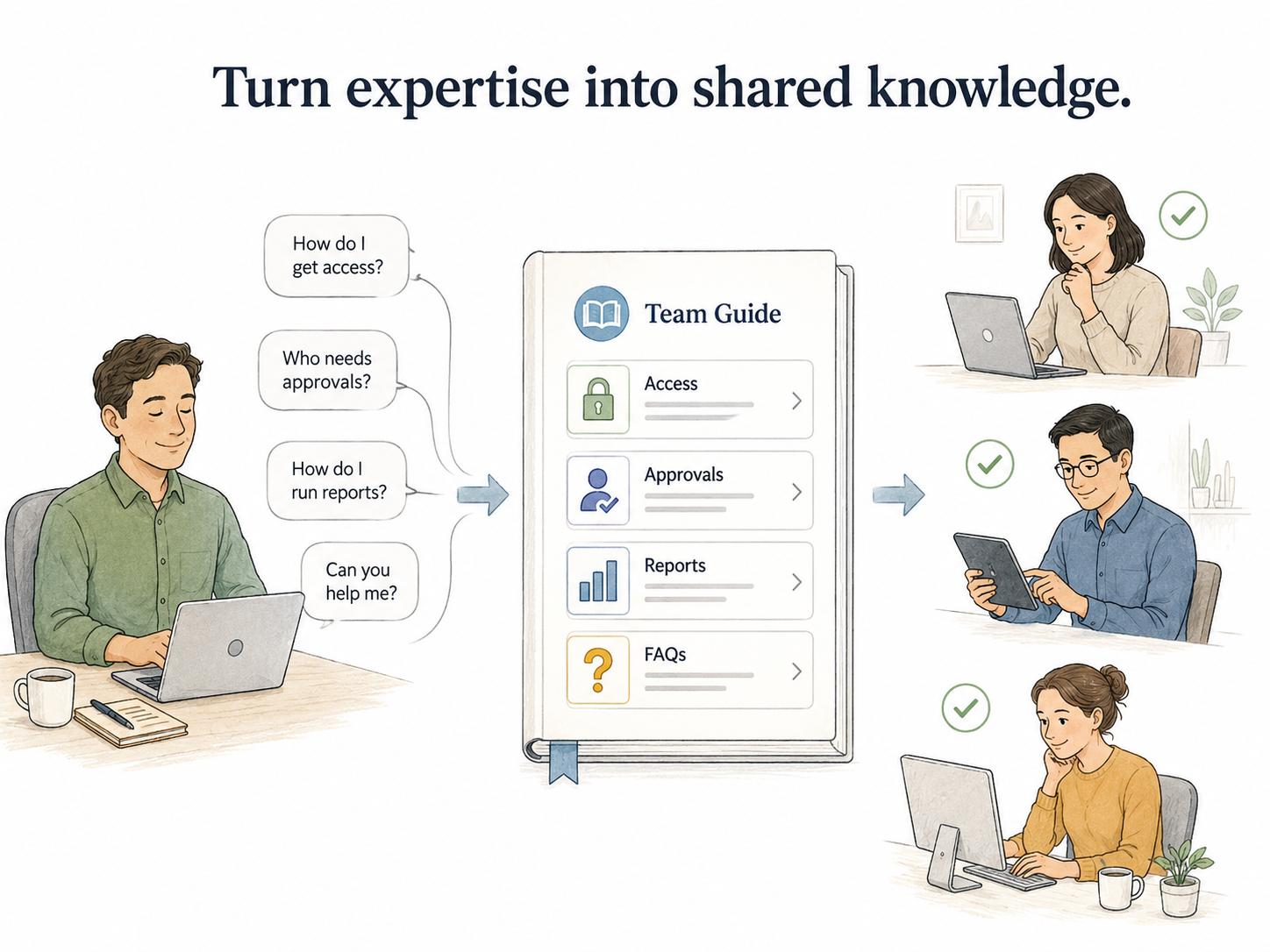
The biggest mistake is making the SME the permanent answer desk. That may feel efficient at first, but it creates a fragile system. Every repeated question goes back to the same person, and the organization never converts expertise into shared knowledge.
Use the SME for source knowledge and targeted validation. Capture the workflow, ask focused questions, draft from the answers, and bring the SME back to review the parts where accuracy matters.
Good SME interview questions include:
- What triggers this process?
- Who performs each step?
- Which tools or systems are used?
- What decisions change the path?
- What mistakes do beginners make?
- What exceptions require escalation?
- What does a correct outcome look like?
- What would make this documentation wrong or outdated?
Those questions turn expertise into usable source material and reduce review cycles because the draft is built around details the SME already confirmed.3
AI-ready prompt for SME knowledge capture
## SME Knowledge Capture Prompt

**Glossary term:** Subject Matter Expert
**Source:** Trails Glossary — trails.so/glossary/subject-matter-expert

---

### 01. Turn an SME interview into documentation

"Turn this SME interview into practical documentation for [process/topic].
Audience: [new hire, support agent, operations teammate, customer]
SME notes: [paste notes]

Create:
- A plain-English summary of the process or concept
- The normal workflow
- Key decisions and why they matter
- Common mistakes beginners make
- Exceptions and escalation rules
- Terms or context the reader must understand
- Questions to ask the SME before publishing

Do not invent missing details. Flag unclear ownership, risky assumptions, and places where SME review is required."
Common mistakes
One mistake is assuming the most senior person is automatically the right SME. For operational documentation, the best SME is often the person who performs, reviews, or fixes the work regularly.
Another mistake is using SME review too late. If the draft is already polished before the expert sees it, people may hesitate to challenge weak assumptions. Bring the SME in early for source knowledge, then again for targeted validation.
A third mistake is documenting only what the SME says happens normally. Expert value often sits in exceptions: the edge case, warning sign, escalation threshold, or practical shortcut that keeps work from breaking.
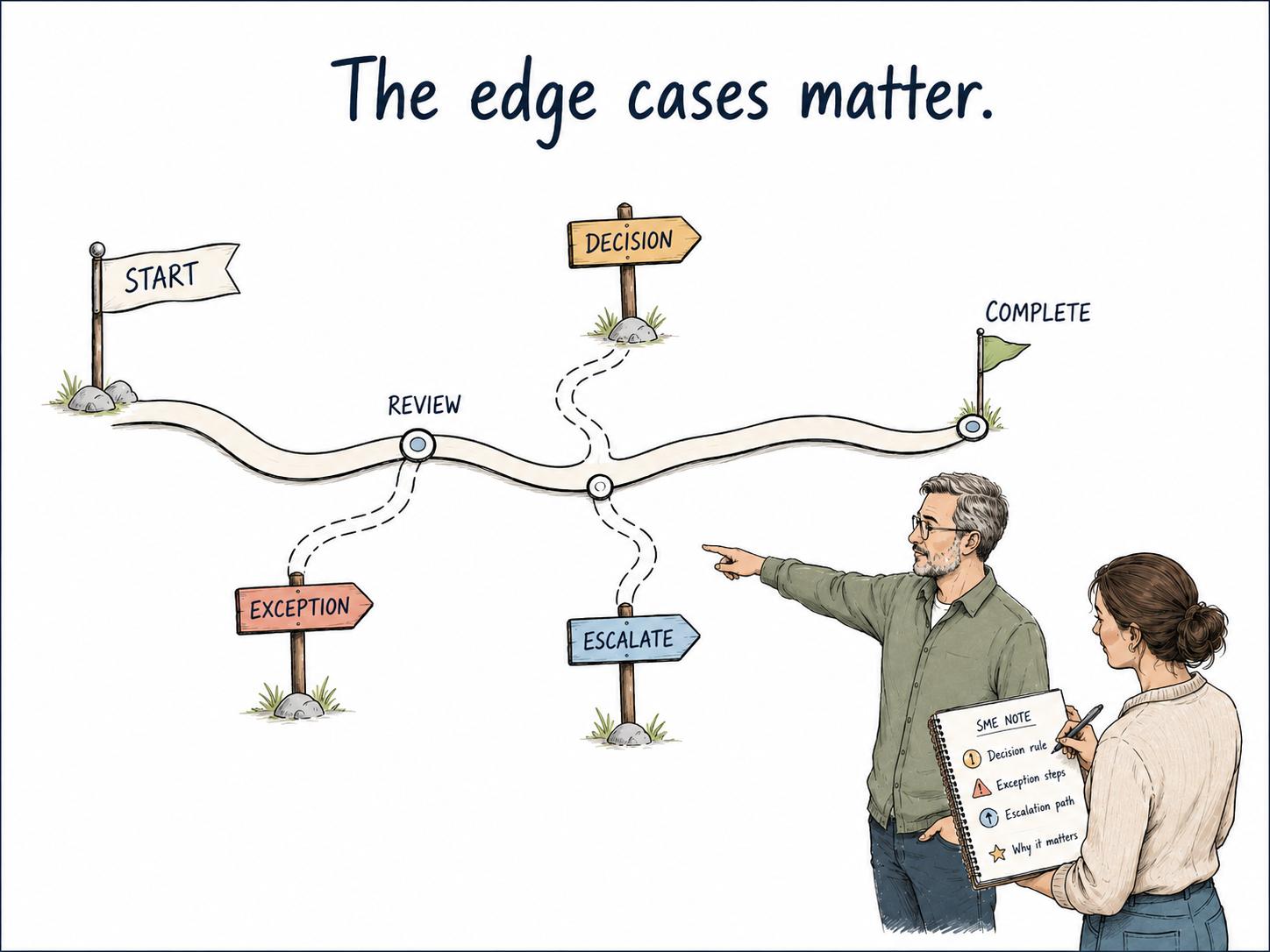
Documentation takeaway
SMEs are most valuable when their knowledge becomes shared knowledge. Good documentation captures the SME's judgment, examples, exceptions, and standards in a format other people can use.
That gives new employees a better starting point, gives support and operations teams a shared reference, and gives the SME more time for problems that truly require expertise.
How Trails helps
Trails helps teams capture a workflow as an SME performs it, then turn that workflow into a polished step-by-step guide. That makes it easier to document expert knowledge while it is happening instead of relying only on long follow-up interviews.
Trails can also create an AI-narrated video version, which is useful when the SME's process needs to become training material for a wider team.
- Tacit knowledge
- Tribal knowledge
- Technical writer
- Train the trainer
- Support documentation
- Process owner
- Knowledge owner
Sources
- 1
Association for Talent Development. Successful Subject Matter Expert Projects. ATD. www.td.org/education-courses/l/micro-course/successful-subject-matter-expert-sme-projects. Accessed July 2, 2026.
- 2
Association for Talent Development. Subject Matter Experts vs. Instructional Designers. ATD. www.td.org/content/atd-blog/subject-matter-experts-vs-instructional-designers-which-is-better. Accessed July 2, 2026.
- 3
Centers for Disease Control and Prevention. Cognitive Task Analysis with Subject Matter Experts. CDC Stacks. stacks.cdc.gov/view/cdc/76288/cdc_76288_DS1.pdf. Accessed July 2, 2026.