
Glossary
Institutional Knowledge
 ChatGPT
 Perplexity
 Gemini
 Claude
What is institutional knowledge?
Institutional knowledge is the accumulated know-how, context, decisions, habits, and lessons that help an organization keep operating. It includes documented facts, but the most valuable parts are often experiential: why a process works this way, who needs to be involved, what exceptions matter, and what has failed before. Knowledge-management research describes this as the interplay between explicit knowledge and tacit knowledge built through experience. 1
It becomes a risk when it only lives in conversations, inboxes, spreadsheets, or long-tenured employees' heads; APQC frames knowledge loss as a core reason organizations build knowledge management programs. 2
What counts as institutional knowledge
Institutional knowledge is broader than a file library. Useful context includes edge cases that need approval, vendor preferences, seasonal patterns, recurring bottlenecks, account history, implementation traps, and the reason a process was designed a certain way.
The practical test is whether the knowledge changes what someone would do. If it explains why a documented process looks the way it does, what to watch for, or when judgment is needed, it is institutional knowledge.
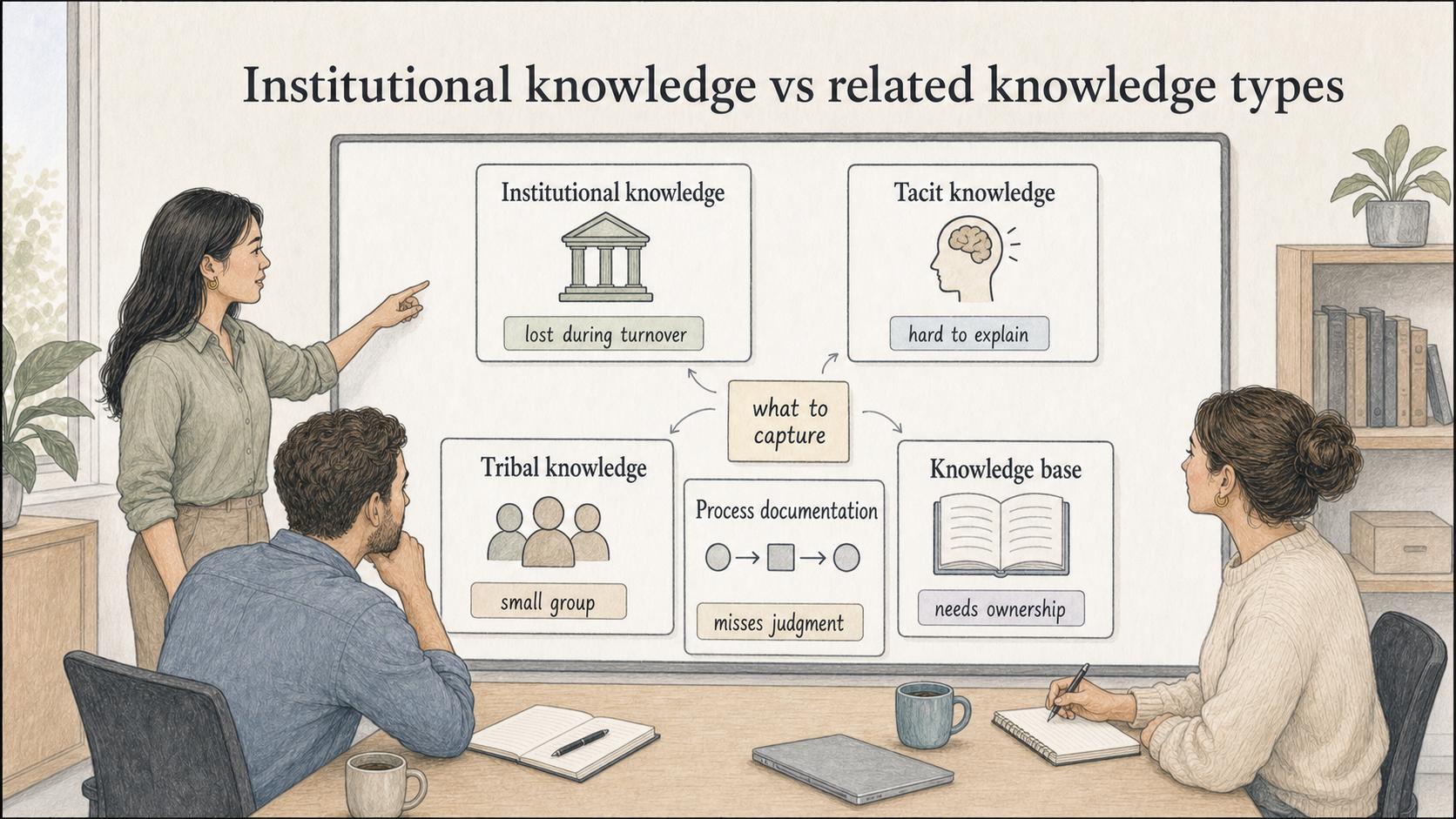
Institutional knowledge vs related knowledge types
| Term | What it means | Common risk |
|---|---|---|
| Institutional knowledge | Organization-specific context built over time | It disappears during turnover or reorgs |
| Tacit knowledge | Know-how built through experience | Experts underestimate what beginners need |
| Tribal knowledge | Informal knowledge shared inside a small group | Other teams cannot access or verify it |
| Process documentation | Written instructions for how work gets done | It can miss judgment behind exceptions |
| Knowledge base | Organized reference content | It becomes a dumping ground without ownership |
Capture knowledge that affects quality, speed, risk, or customer experience. APQC's knowledge-loss risk matrix focuses teams on knowledge that is both critical and at high risk of being lost. 3
How to capture the knowledge that matters
- Start with work that breaks when one person is unavailable.
- Capture decisions, not just steps.
- Use recent exceptions to reveal operating judgment.
- Attach ownership after capture.
- Keep the system small enough to trust.
Capture institutional knowledge closest to the moment it is used: during retrospectives, handoffs, walkthroughs, escalations, and onboarding shadow sessions. NASA's lifecycle follows the same pattern: collect, record, disseminate, and apply lessons. 4
## Institutional knowledge capture prompt

**Glossary term:** Institutional Knowledge
**Source:** Trails Glossary — trails.so/glossary/institutional-knowledge

---

### 01. Capture operating knowledge

"For [process or responsibility], identify the knowledge a capable replacement would need in their first 30 days. Include the normal workflow, common exceptions, decision rules, key people or systems, known failure modes, and links to any existing documentation. Separate facts from judgment, and flag anything that is outdated or disputed."
How Trails helps
Trails helps teams capture institutional knowledge that lives inside repeatable workflows by turning the work into a polished step-by-step guide and AI-narrated video for onboarding, cross-training, and handoffs.
Sources
- 1
ASCN Higher Education. SECI Model of Knowledge Creation. ascnhighered.org/ASCN/change_theories/collection/seci.html.
- 2
APQC. Understanding knowledge loss. www.apqc.org/resource-library/resource/understanding-knowledge-loss-0.
- 3
APQC. Knowledge Loss Risk Matrix. www.apqc.org/resource-library/resource-listing/apqcs-knowledge-loss-risk-matrix.
- 4
NASA. Lessons learned lifecycle. www.nasa.gov/learning-resources/for-professionals/appel-lessons-learned/.