
Glossary
Tacit Knowledge
 ChatGPT
 Perplexity
 Gemini
 Claude
What is tacit knowledge?
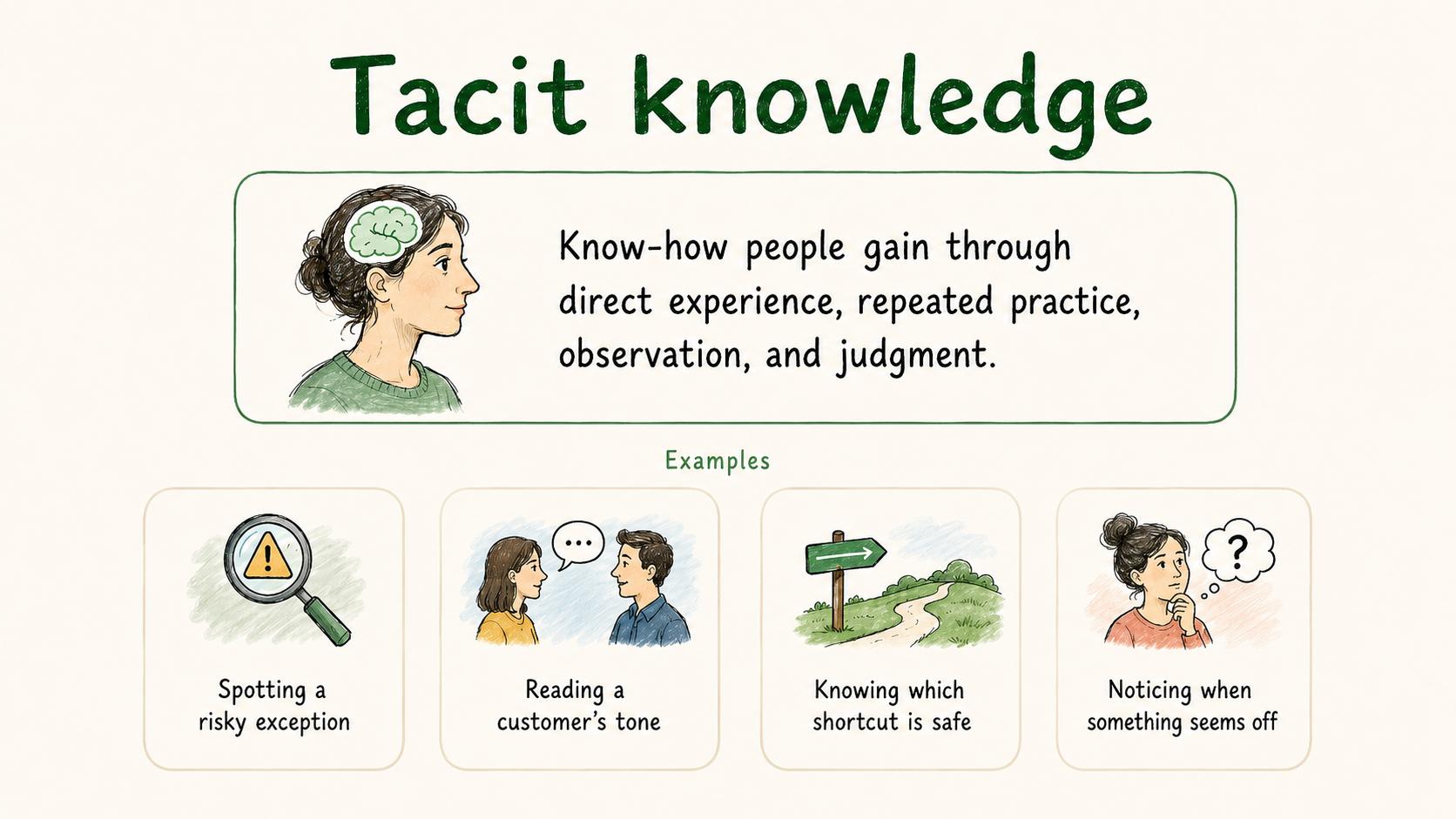
Tacit knowledge is know-how people gain through direct experience, repeated practice, observation, and judgment. It is the part of work someone can often do well before they can fully explain it: spotting a risky exception, reading a customer's tone, or knowing which shortcut is safe and which one will cause trouble later.1
For teams, tacit knowledge is valuable because it reflects real operating experience. It is also risky because it often lives in one person's head, habits, or private notes. When that person is out, promoted, or overloaded, the process can look documented while the judgment behind it remains unavailable.
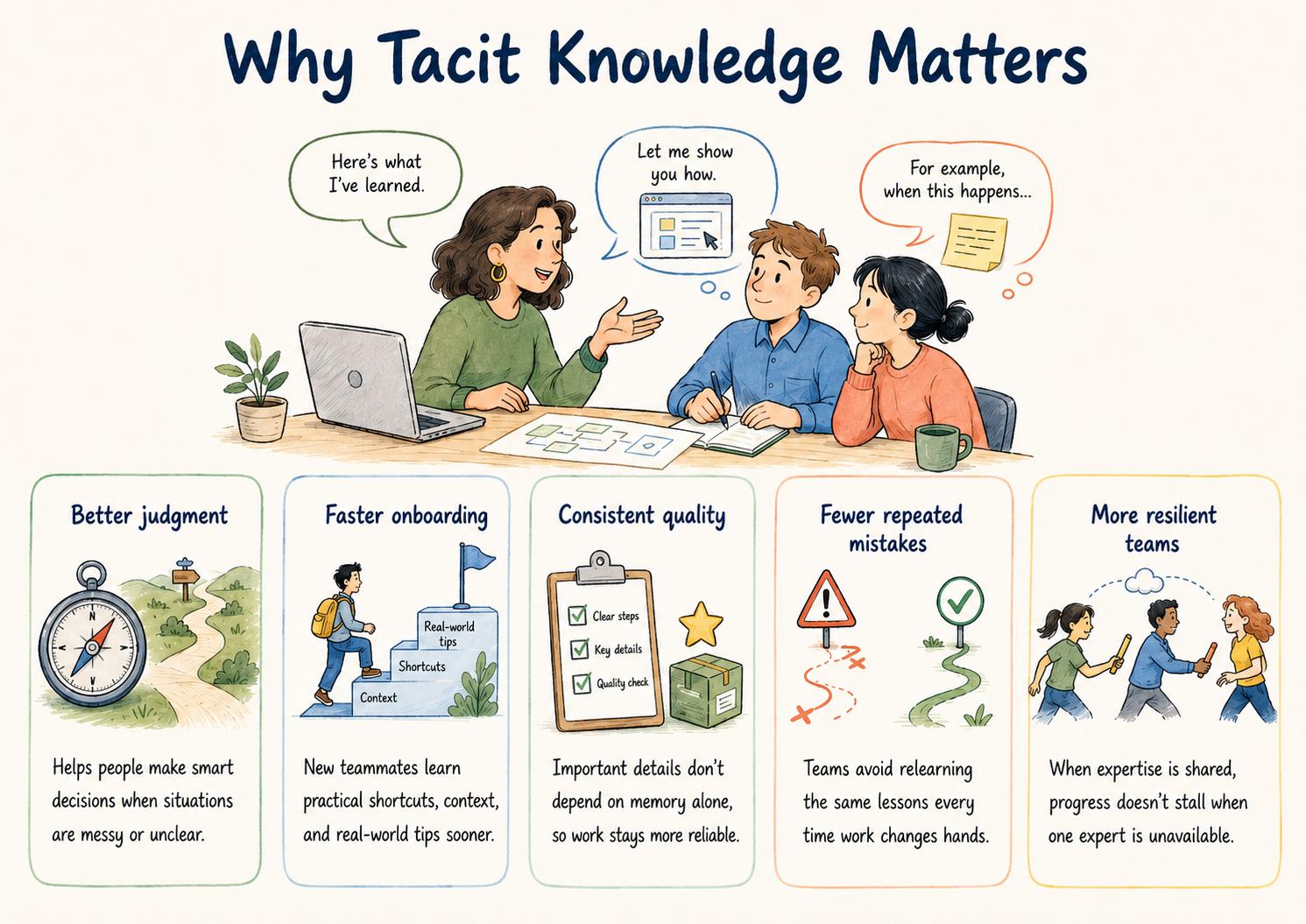
Why tacit knowledge matters
Most teams discover tacit knowledge when a routine process suddenly becomes difficult. A support queue runs smoothly until the senior rep is out. A customer onboarding checklist exists, but only one coordinator knows which setup step always needs extra context. A back-office SOP exists, yet new employees still ask the same expert what to do when the inputs are messy.
That gap matters because documentation that captures only the visible steps can create false confidence. The reader knows what to click, submit, or send, but not what to watch for. The useful knowledge is often hiding in judgment calls: when to pause, when to escalate, what a normal exception looks like, and which detail changes the next step.
The practical job is to find the repeatable moments where hidden judgment causes delays, rework, or avoidable questions, then make those moments easier for others to learn.
Tacit knowledge vs explicit knowledge
Explicit knowledge is knowledge that has been written, recorded, structured, or otherwise made easy to share. A checklist, refund policy, SOP, troubleshooting article, or training video is explicit knowledge.
Tacit knowledge is harder to package. It may show up as pattern recognition, a sense of timing, a practical workaround, or a feel for what matters in a specific situation. A customer success manager may know that a calm customer email is actually a churn warning because they have seen the pattern before. A warehouse lead may know that a small inventory mismatch is harmless in one location but serious in another.
The mistake is treating tacit and explicit knowledge as separate worlds. Strong documentation often combines them. The explicit part gives people the standard path. The tacit part adds examples, warning signs, thresholds, and decision rules that help someone handle the real-world version of the process.2
Examples of tacit knowledge at work
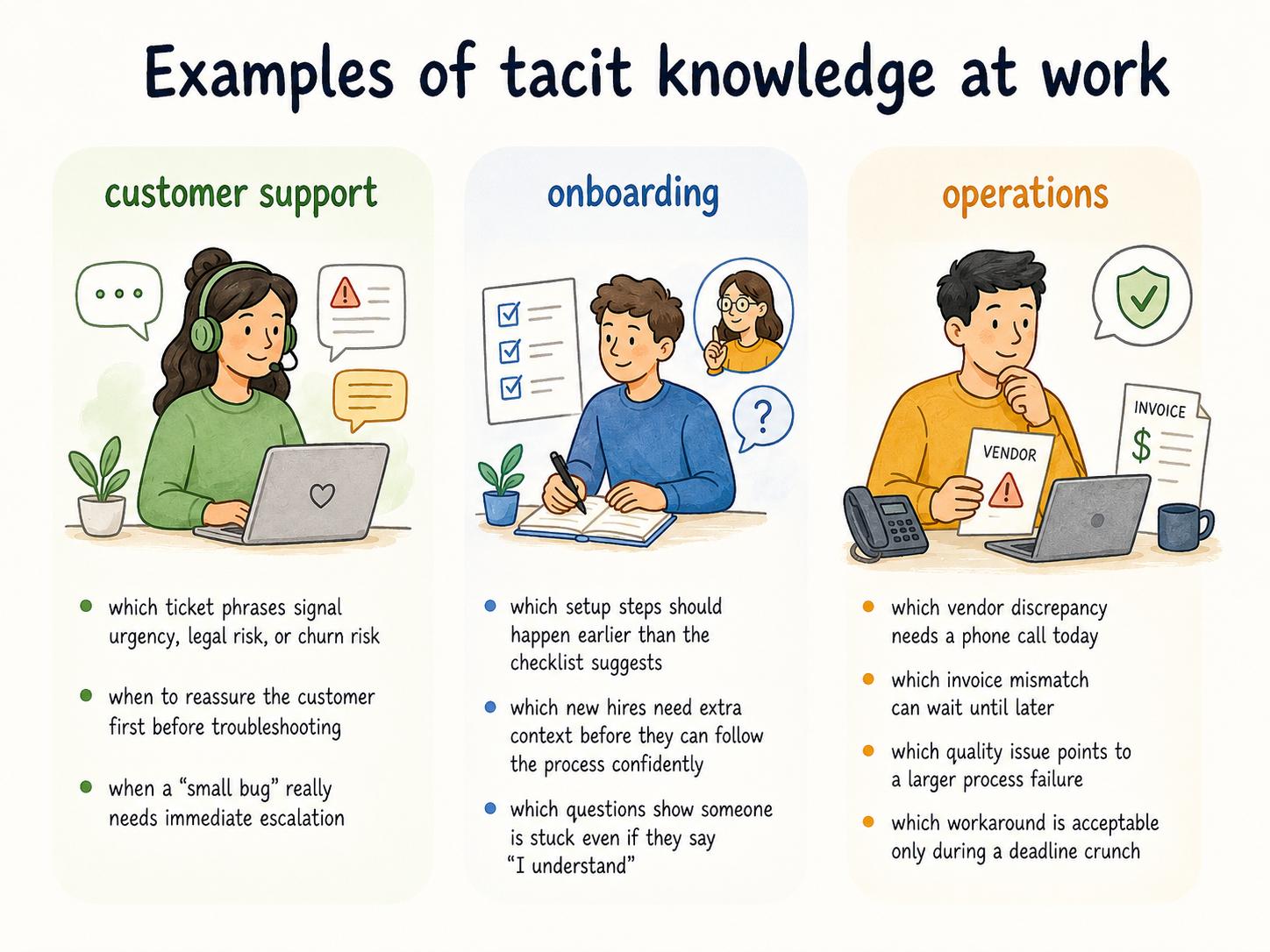
In customer support, tacit knowledge might be knowing which ticket phrases signal confusion, legal risk, or a product issue that should skip the normal queue. The written process says to categorize the ticket. The experienced rep knows which words make the category insufficient.
In onboarding, tacit knowledge may be knowing which employee setup steps should happen earlier than the checklist implies because a downstream team has a long turnaround time.
In operations, it often appears around exceptions: which vendor discrepancy needs a phone call, which invoice mismatch can wait, which quality issue suggests a larger process failure, and which workaround is acceptable only during a deadline.
A useful test is simple: if a strong performer can explain what they noticed, what they ignored, and what would have made them choose a different action, there is probably tacit knowledge worth capturing.
How to capture tacit knowledge without flattening it
Do not ask an expert to "write down everything you know." That prompt usually produces either vague advice or a long document nobody uses. Start with one repeated moment of judgment.
Choose a task where new teammates hesitate, make preventable mistakes, or depend on one person for confirmation. Watch the experienced person do the task, or have them narrate a recent example. Then ask concrete questions: What made this case normal? What would have made it risky? What did you check first? What would a beginner miss? What would trigger escalation?3
The output should be small enough to use. A decision rule, annotated example, escalation threshold, or "watch for" note can be more useful than another page of procedure text. Tacit knowledge becomes usable when it is tied to the moment where it changes behavior.
AI-ready prompt for capturing tacit knowledge
## Tacit Knowledge Capture Prompt

**Glossary term:** Tacit Knowledge
**Source:** Trails Glossary — trails.so/glossary/tacit-knowledge

---

### 01. Turn interview notes into a tacit knowledge guide

"Turn these interview notes into a practical tacit knowledge guide for [team/process].
Audience: [new hire, support rep, operations coordinator, manager]
Situation: [recurring task, exception, or decision]

Create:
- A short explanation of the normal path
- The cues an experienced person watches for
- The decision rule or escalation threshold
- One normal example and one edge-case example
- The mistakes a beginner is likely to make
- The parts that should become a checklist, SOP, training note, or example library

Keep the guide focused on judgment and real signals, not generic process advice."
Documentation takeaway
Good tacit-knowledge documentation gives people better first instincts. Add the details that change a decision: warning signs, examples, screenshots, customer language, timing constraints, exception thresholds, and escalation criteria.
If a document only says what to do when everything goes right, it probably has not captured the most useful tacit knowledge yet.
How Trails helps
Trails captures a workflow as someone performs it, then turns that workflow into a polished step-by-step guide. That makes it easier to document the real path people use, not just the version they remember after the fact.
Teams can add expert notes, decision cues, and examples to the guide, then share it as written documentation or an AI-narrated video for training.
- Tribal knowledge
- Knowledge management software
- Subject matter expert
- Support documentation
- Self service knowledge
- Explicit knowledge
Sources
- 1
Ikujiro Nonaka. A Dynamic Theory of Organizational Knowledge Creation. Organization Science, 1994. josephmahoney.web.illinois.edu/BA504_Fall%202008/Uploaded%20in%20Nov%202007/Nonaka%20%281994%29.pdf. Accessed July 2, 2026.
- 2
University of Kentucky. The Role of Tacit and Explicit Knowledge in the Workplace. University of Kentucky. www.uky.edu/~gmswan3/575/KM_roles.pdf. Accessed July 2, 2026.
- 3
Carnegie Mellon University. Knowledge Transfer in Organizations. Carnegie Mellon University. www.cmu.edu/tepper-news/news/stories/2023/november/knowledge-transfer-organizations.html. Accessed July 2, 2026.