
Glossary
Knowledge Sharing
 ChatGPT
 Perplexity
 Gemini
 Claude
What is knowledge sharing?
Knowledge sharing is the practice of making useful knowledge available to other people so they can learn, decide, or act more effectively. Research on individual-level knowledge sharing treats it as a core part of knowledge management and examines the organizational, team, cultural, individual, and motivational factors that shape it. \[1\]
Knowledge sharing can happen through conversations, documentation, training, demos, retrospectives, communities of practice, knowledge bases, process guides, or everyday team rituals. The useful version does not ask everyone to publish everything they know. It moves the right context to the right people in a form they can understand and reuse.
Why knowledge sharing matters
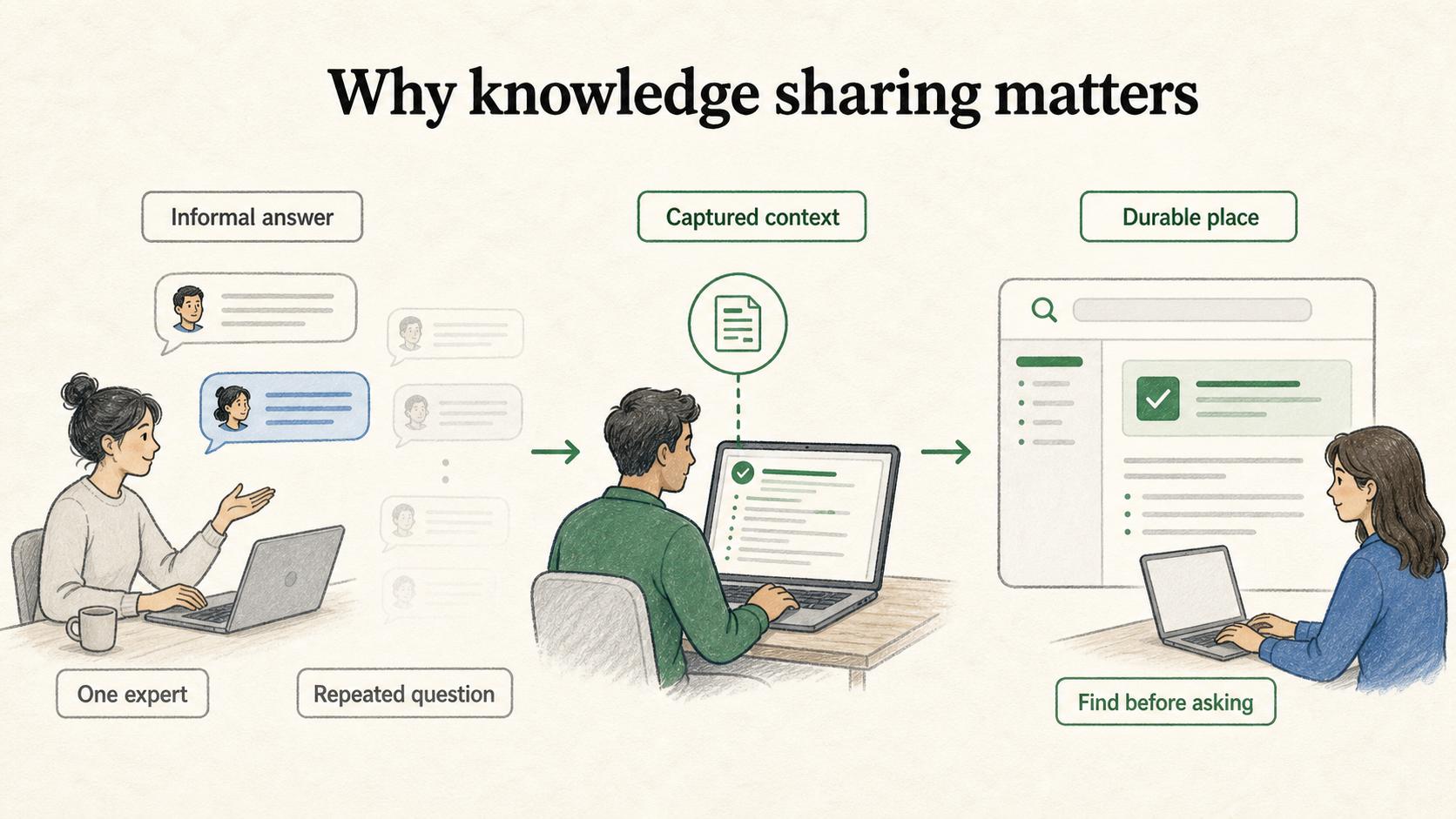
Most teams already share knowledge informally. A teammate explains a workaround in Slack, a manager answers the same onboarding question again, or a senior employee gives a quick walkthrough on a call. Those moments are useful, but they disappear quickly when they are not captured or routed to a durable place.
Weak knowledge sharing creates avoidable dependence. People wait for the one expert, repeat solved mistakes, miss context from other teams, or make decisions from partial information. Strong knowledge sharing reduces that friction by making useful know-how easier to discover before someone has to ask.
The trap is volume. A team can create a lot of documents and still share knowledge poorly if nobody knows what is current, who owns it, or which artifact answers which question.
Knowledge sharing vs knowledge transfer
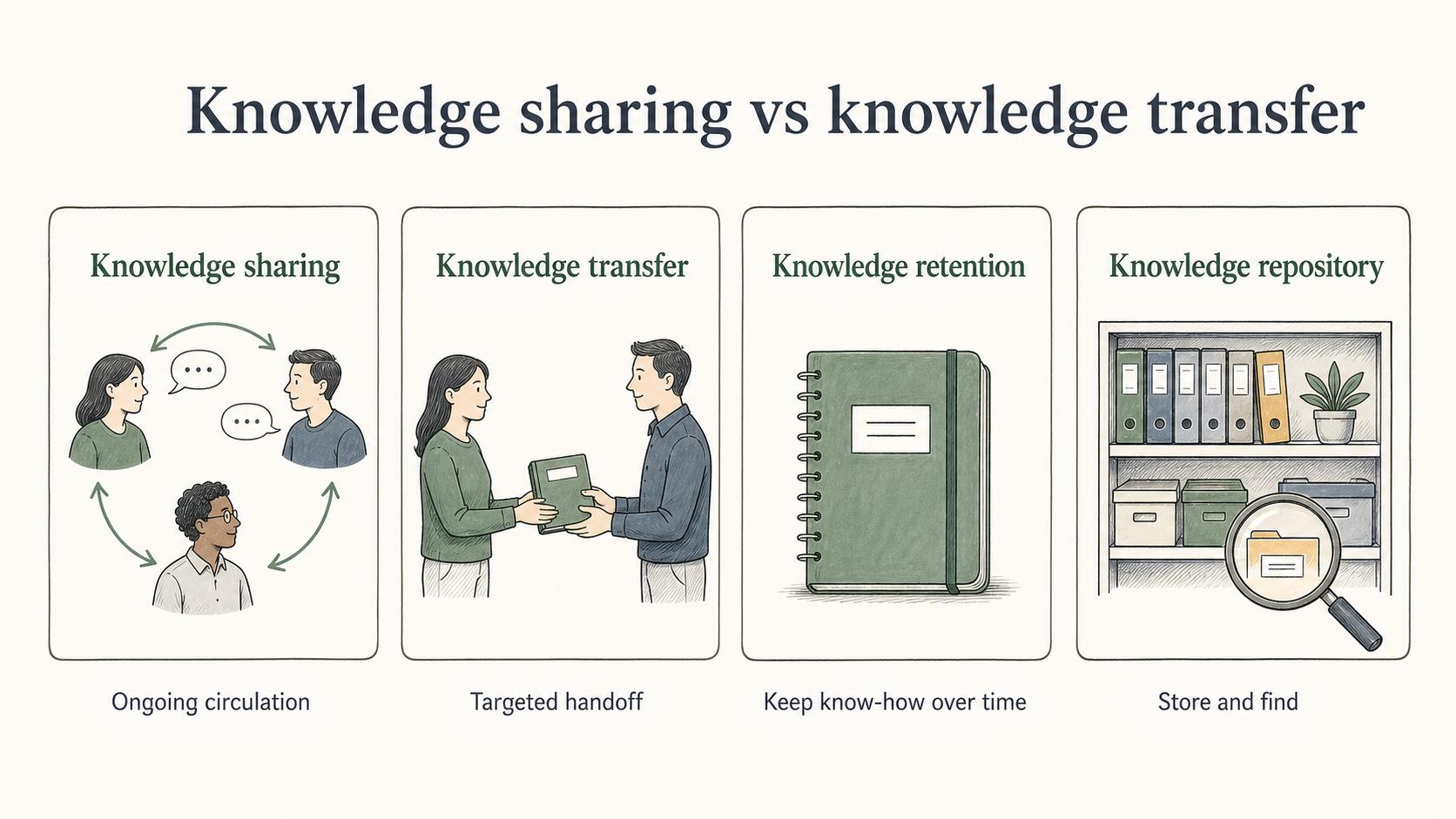
Knowledge sharing is broad and ongoing. Knowledge transfer is usually more targeted.
| Term | When it is used | Example |
|---|---|---|
| Knowledge sharing | A team wants useful context to circulate continuously | A support team posts lessons from recurring customer issues and turns the best ones into help articles |
| Knowledge transfer | A person or group needs to take over specific knowledge | A departing operations lead documents a vendor renewal process for the new owner |
| Knowledge retention | The organization needs to keep important know-how available over time | A company captures expert workflows before a reorg or role change |
| Knowledge repository | A structured place where knowledge can be stored and found | A searchable internal hub for SOPs, training guides, decisions, and FAQs |
</table>
The difference matters because each problem needs a different fix. If people are not discovering existing answers, the issue may be repository design. If one expert is about to leave, it is a transfer problem. If useful lessons never leave private conversations, it is a sharing problem.
What effective knowledge sharing looks like
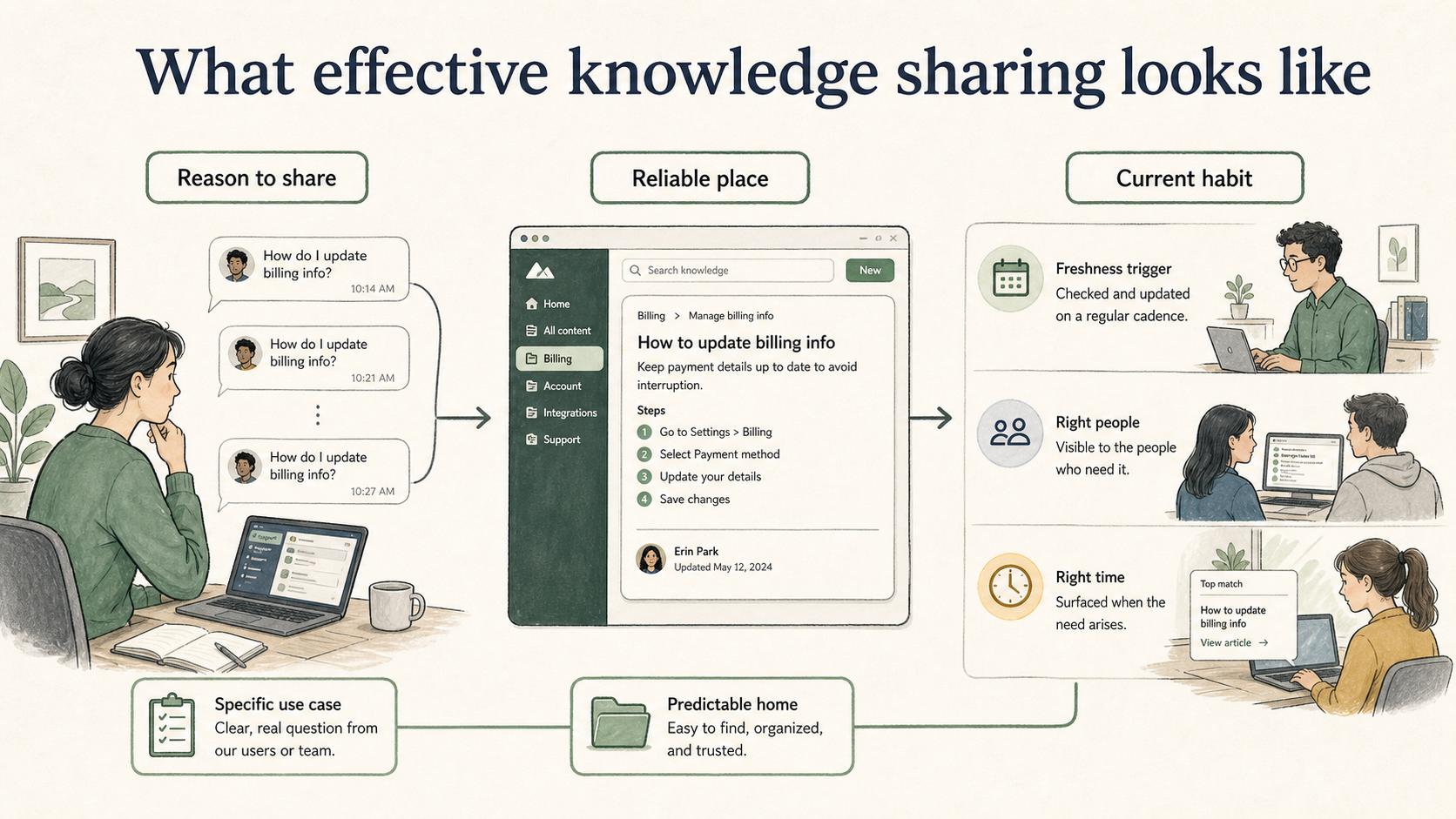
Effective knowledge sharing needs a reason to share, a reliable place for the knowledge to land, and a habit that keeps it current. APQC defines knowledge management as systematic approaches that help knowledge flow to and between the right people at the right time. \[2\]
The reason should be tied to work. "Share more" is too vague. A better reason is "reduce duplicate support escalations," "help new hires complete their first customer setup," or "make release decisions visible to downstream teams." Specific use cases make it easier to choose what should be captured.
The place matters because knowledge that lives everywhere effectively lives nowhere. Teams need predictable homes for different kinds of knowledge: process guides, customer learnings, decision records, training materials, or FAQs. The goal is predictable retrieval, not one perfect tool.
The habit matters because knowledge sharing decays without a trigger. Useful triggers include end-of-project reviews, incident reviews, onboarding questions, process changes, customer escalations, and repeated Slack answers. When the same answer is typed twice, that is usually a signal to document it once.
Common knowledge sharing mistakes
The first mistake is rewarding performance instead of reuse. People may give polished presentations, but if the useful part is not captured in a searchable format, the knowledge still disappears.
The second mistake is ignoring context. A short answer may be correct but unusable if it does not explain when to apply it, what assumptions it depends on, or what exceptions change the decision.
The third mistake is treating every shared note as permanent truth. Knowledge sharing needs ownership and freshness signals. APQC's content governance guidance calls out owners, approvals, review triggers, and monitoring as core practices for keeping knowledge reliable. \[3\] Without them, people stop trusting the repository and go back to asking the expert directly.
A practical prompt for turning shared context into documentation
Use this after a meeting, incident, customer issue, workflow change, or repeated team question:
## A practical prompt for turning shared context into documentation

**Glossary term:** knowledge sharing
**Source:** Trails Glossary — trails.so/glossary/knowledge-sharing

---

### 01. A practical prompt for turning shared context into documentation

"Turn the following notes into a reusable knowledge-sharing artifact for [audience].
Context: [what happened or what was discussed]
Audience needs: [what the audience will need to do or decide]
Important decisions: [decisions made and why]
Steps or guidance: [actions, process, or recommendations]
Edge cases: [exceptions, risks, or things people often misunderstand]
Owner: [person/team responsible for keeping this current]
Destination: [where this should live]

Create a concise draft that explains the practical takeaway, when to use it, and what someone should do next. Flag any missing context that would make the artifact unreliable."
This prompt works because it asks for the decision and the use case, not only a summary. A summary is useful for memory. A knowledge artifact is useful for action.
How to encourage knowledge sharing without creating noise
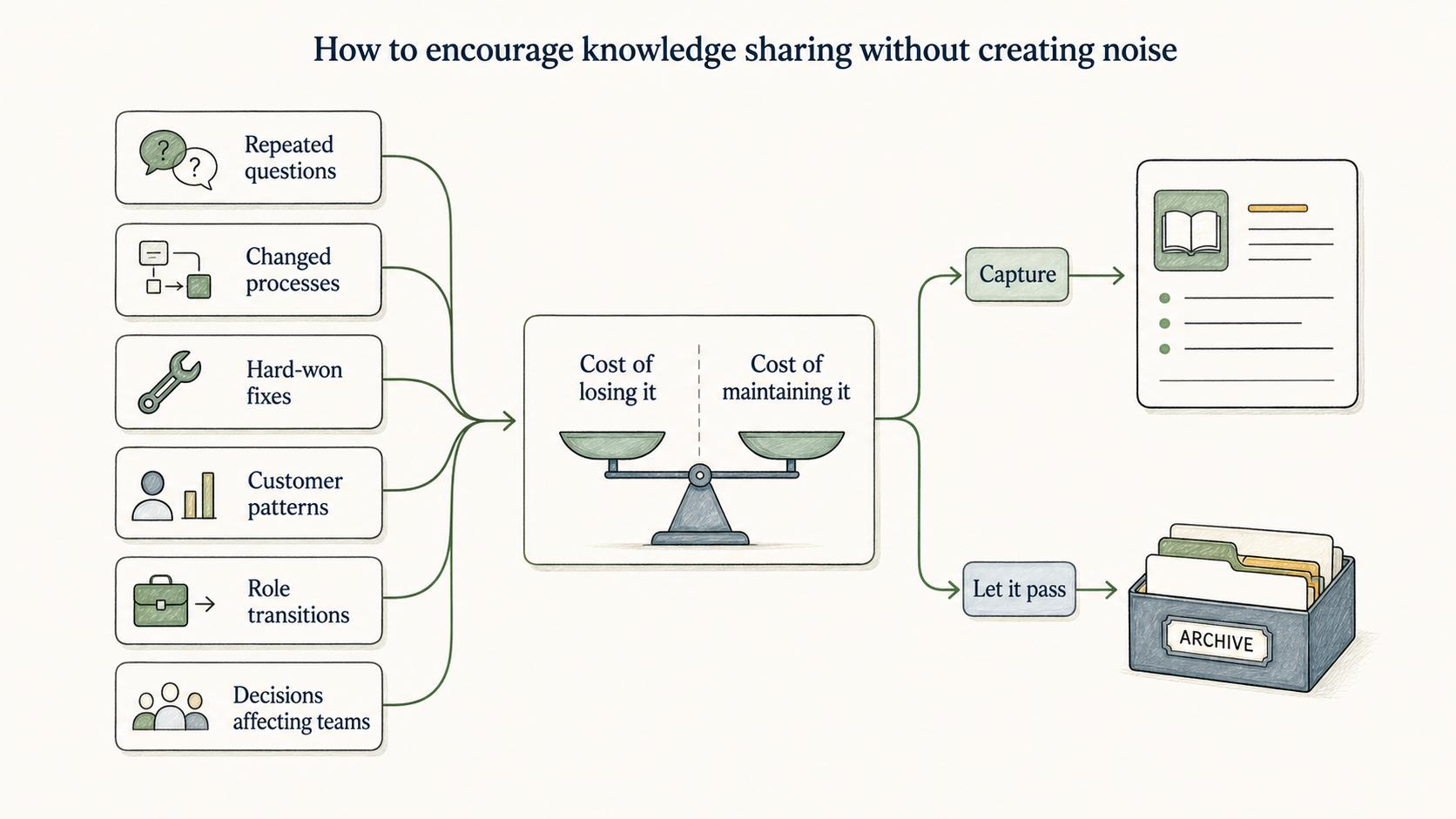
The healthiest knowledge sharing systems are selective. They focus on moments where reuse is likely: repeated questions, changed processes, hard-won fixes, customer patterns, role transitions, and decisions that affect other teams.
A good rule is to capture knowledge when the cost of losing it is higher than the cost of maintaining it. That rule keeps teams from creating low-value note piles while still preserving context that would otherwise disappear.
Managers also need to model the behavior. If leaders praise quick answers but never ask where the answer should live, the team learns that documentation is optional cleanup. If leaders ask, "Where should this go so the next person can find it?" knowledge sharing becomes part of the work.
Documentation takeaway
Knowledge sharing becomes durable when conversation turns into accessible documentation. The best artifacts are specific, owned, searchable, and connected to real workflows.
Documentation should not replace conversation. It should prevent the same conversation from being required every time someone needs the answer.
How Trails helps
Trails helps teams turn repeatable know-how into step-by-step documentation. A teammate can capture a workflow as they perform it, convert it into a polished guide, and create an AI-narrated video version for training or sharing.
That makes knowledge sharing more practical when the useful knowledge is embedded in how work gets done: support workflows, onboarding tasks, operational routines, tool walkthroughs, or process changes that need to reach more than one person.
Sources
1. [Wang and Noe, Knowledge Sharing: A Review and Directions for Future Research](https://www.researchgate.net/profile/Witold_Orlik/post/can_any_one_provide_me_with_articles_that_have_knowledge_sharing_as_moderate_variable/attachment/59d62bdf79197b807798a434/AS%3A344962022559745%401459256763404/download/02e7e534beee992841000000.pdf) - Supports the definition and factors behind workplace knowledge sharing.
2. [APQC knowledge management overview](https://www.apqc.org/expertise/knowledge-management) - Supports the point that useful knowledge sharing is about knowledge flowing to the right people at the right time.
3. [APQC on content governance for trustworthy knowledge](https://www.apqc.org/resources/blog/what-big-data-and-knowledge-management) - Supports the need for ownership, review triggers, and quality standards.
- Knowledge Transfer
- Knowledge Retention
- Knowledge Management
- Knowledge Base
- Knowledge Repository
- Tacit Knowledge
- Explicit Knowledge
- Process Documentation
Sources
- 1
Wang and Noe. Knowledge Sharing: A Review and Directions for Future Research. www.researchgate.net/profile/Witold_Orlik/post/can_any_one_provide_me_with_articles_that_have_knowledge_sharing_as_moderate_variable/attachment/59d62bdf79197b807798a434/AS%3A344962022559745%401459256763404/download/02e7e534beee992841000000.pdf.
- 2
APQC knowledge management overview. APQC knowledge management overview. www.apqc.org/expertise/knowledge-management.
- 3
APQC on content governance for trustworthy knowledge. APQC on content governance for trustworthy knowledge. www.apqc.org/resources/blog/what-big-data-and-knowledge-management.