
Glossary
Explicit Knowledge
 ChatGPT
 Perplexity
 Gemini
 Claude
What is explicit knowledge?
Explicit knowledge is information a team has made clear enough to write down, store, search, teach, and reuse. Knowledge-management research distinguishes codified explicit knowledge from tacit knowledge that is harder to formalize. 1 In day-to-day operations, it shows up as SOPs, checklists, manuals, policies, templates, diagrams, FAQs, and process guides.
A document only counts if it is usable. A team does not have explicit knowledge just because something sits in a folder. The knowledge has to be findable and specific enough that someone else can act on it without chasing the original expert.
Why explicit knowledge matters
Explicit knowledge gives a team memory outside individual people. When a support lead documents how to handle refund exceptions, or an operations manager writes the steps for closing the month, the team is less dependent on one person being online, available, or still employed. APQC frames knowledge transfer as turning what is in people’s heads into content, learning materials, tools, and processes others can use. 2
The strongest explicit knowledge usually sits at points of repeated risk: a decision made inconsistently, a process that causes rework, a customer issue that keeps resurfacing, or a task new hires struggle to learn. A worked example, exception rule, or screenshot of the real system can carry more operational value than a tidy definition.
Explicit knowledge vs tacit knowledge
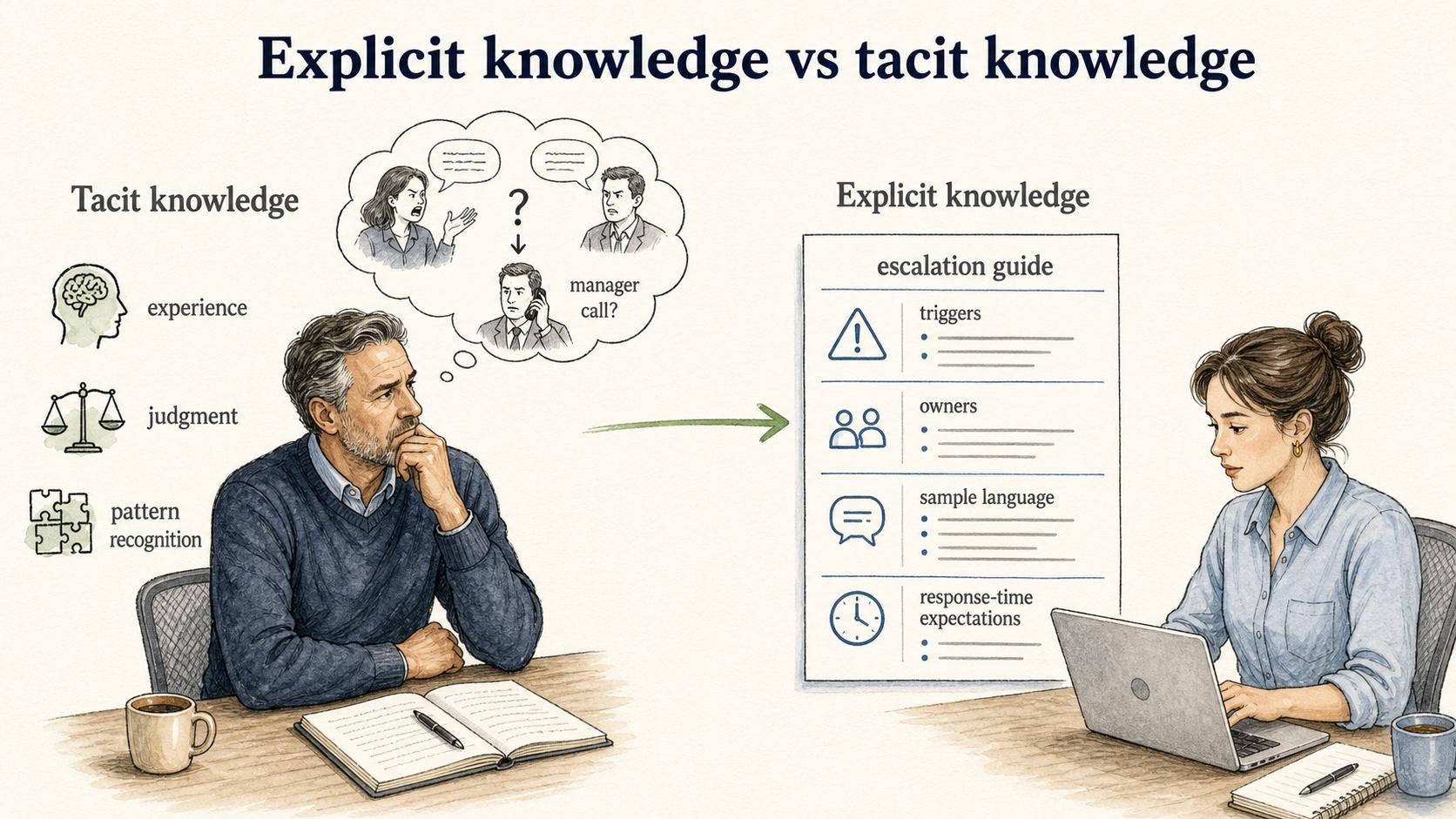
Tacit knowledge is know-how that lives in someone’s experience, judgment, pattern recognition, or muscle memory. Explicit knowledge is what the team has successfully made visible and reusable.
A veteran customer success manager may know when an angry account needs a manager call instead of another email. That judgment is tacit knowledge. A documented escalation guide that names triggers, owners, sample language, and response-time expectations is explicit knowledge. Nonaka’s SECI model describes knowledge creation as movement between tacit and explicit knowledge. 3
Examples of explicit knowledge
Useful explicit knowledge gives someone a decision, sequence, standard, or reusable artifact. Common examples include:
- SOPs and checklists for repeatable work, onboarding, QA, compliance, or handoffs.
- Troubleshooting guides and support macros that turn recurring customer issues into reusable responses.
- Training manuals and job aids that help someone perform a task while learning it.
- Decision rules for approvals, exceptions, escalations, and manager review.
- Templates for recurring work, such as project briefs, customer updates, or status reports.
The best examples explain when the process applies, what inputs are needed, what output proves the work is complete, who owns exceptions, and where the reader should go when something does not match the normal path.
How to turn know-how into explicit knowledge
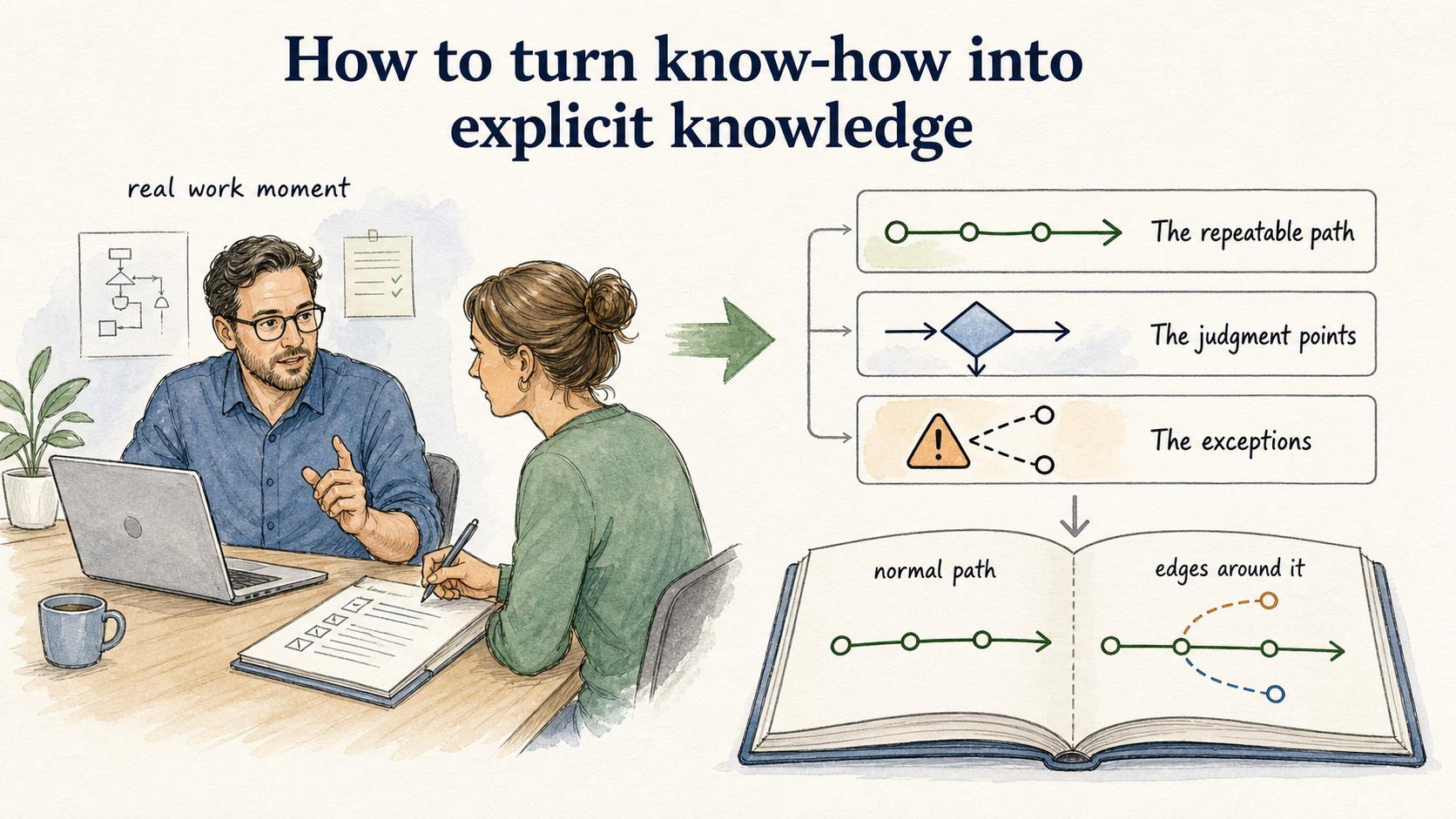
Start with a real work moment, not a blank documentation request. Ask the person who knows the process to perform it, narrate their decisions, or walk through a recent example. Capture where they pause, what they check, and what would make them change course.
- The repeatable path: the normal sequence someone can follow most of the time.
- The judgment points: the places where experience changes the answer.
- The exceptions: cases that should trigger escalation, a different workflow, or a manager decision.
Useful explicit knowledge shows the normal path and the edges around it. It avoids a shallow document that says only ‘handle the request’ and a brittle one that pretends every request follows the same path.
AI-ready capture prompt
Use this prompt when converting an expert walkthrough, recorded process, or rough notes into a first draft:
## Explicit knowledge capture prompt

**Glossary term:** explicit knowledge
**Source:** Trails Glossary — trails.so/glossary/explicit-knowledge

---

### 01. Turn an expert walkthrough into explicit knowledge

"Turn the following expert walkthrough into explicit knowledge for [team].

Audience: [new hire, support rep, operations manager, etc.]
Process or decision: [process name]
Source notes: [paste transcript, notes, screenshots, or rough steps]

Create:
1. A plain-English summary of what this knowledge helps someone do.
2. The normal step-by-step path.
3. The decision points where judgment matters.
4. Common mistakes or exceptions.
5. The owner or escalation path when the normal process does not apply.
6. A short checklist someone can use while doing the work.

Keep the output practical. Do not invent policy. Flag missing information as questions."
AI can help shape explicit knowledge, but it should not silently fill operational gaps. APQC notes that elicitation is difficult because knowledgeable people can struggle to explain complex knowledge without support. 4 Missing ownership, unclear exceptions, and outdated screenshots are issues the drafting process should surface.
How Trails helps
Trails helps teams turn process know-how into explicit knowledge by capturing a workflow as someone performs it. It turns that workflow into a polished step-by-step guide and can create an AI-narrated video version for training or sharing. Instead of asking an expert to remember every step afterward, teams can document the work while it is happening and refine it into a reusable artifact.
Sources
- 1
Nonaka. A Dynamic Theory of Organizational Knowledge Creation. josephmahoney.web.illinois.edu/BA504_Fall%202008/Uploaded%20in%20Nov%202007/Nonaka%20%281994%29.pdf.
- 2
APQC. What is Knowledge Transfer?. www.apqc.org/blog/what-knowledge-transfer.
- 3
ASCN. SECI Model of Knowledge Creation. ascnhighered.org/ASCN/change_theories/collection/seci.html.
- 4
APQC. How to Transfer Knowledge Through Structured Elicitation. www.apqc.org/resource-library/resource-listing/how-transfer-knowledge-through-structured-elicitation.