
Glossary
Knowledge Repository
 ChatGPT
 Perplexity
 Gemini
 Claude
What is a knowledge repository?
A knowledge repository is a centralized place where an organization stores, organizes, and maintains important knowledge so people can find and reuse it. Knowledge management systems research describes storage, retrieval, transfer, and application as core knowledge processes that information systems can support. 1 A repository may include process documentation, SOPs, training guides, FAQs, decision records, troubleshooting notes, templates, policies, customer context, and other internal resources.
The value of a knowledge repository is not volume. It is whether people can find trustworthy knowledge at the moment they need it.
What belongs in a knowledge repository?
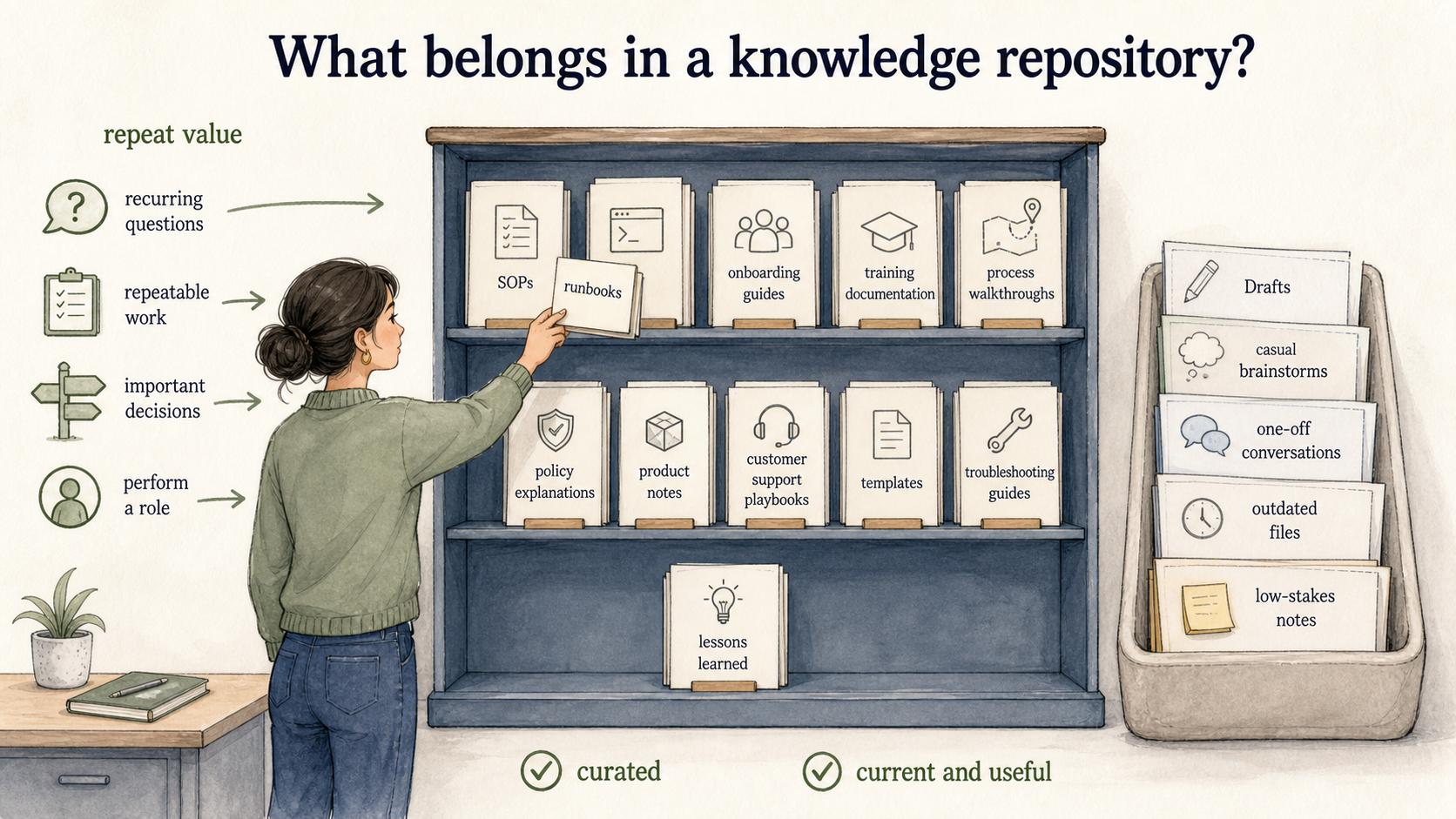
A useful repository stores knowledge with repeat value. That usually means information that answers recurring questions, supports repeatable work, preserves important decisions, or helps someone perform a role without depending on a specific person.
Common repository content includes SOPs, runbooks, onboarding guides, training documentation, process walkthroughs, policy explanations, product notes, customer support playbooks, templates, troubleshooting guides, and lessons learned from projects or incidents.
Not everything belongs there. Drafts, casual brainstorms, one-off conversations, outdated files, and low-stakes notes can make a repository harder to trust. The best repositories are curated enough that employees believe the material is current and useful.
Knowledge repository vs knowledge base vs wiki
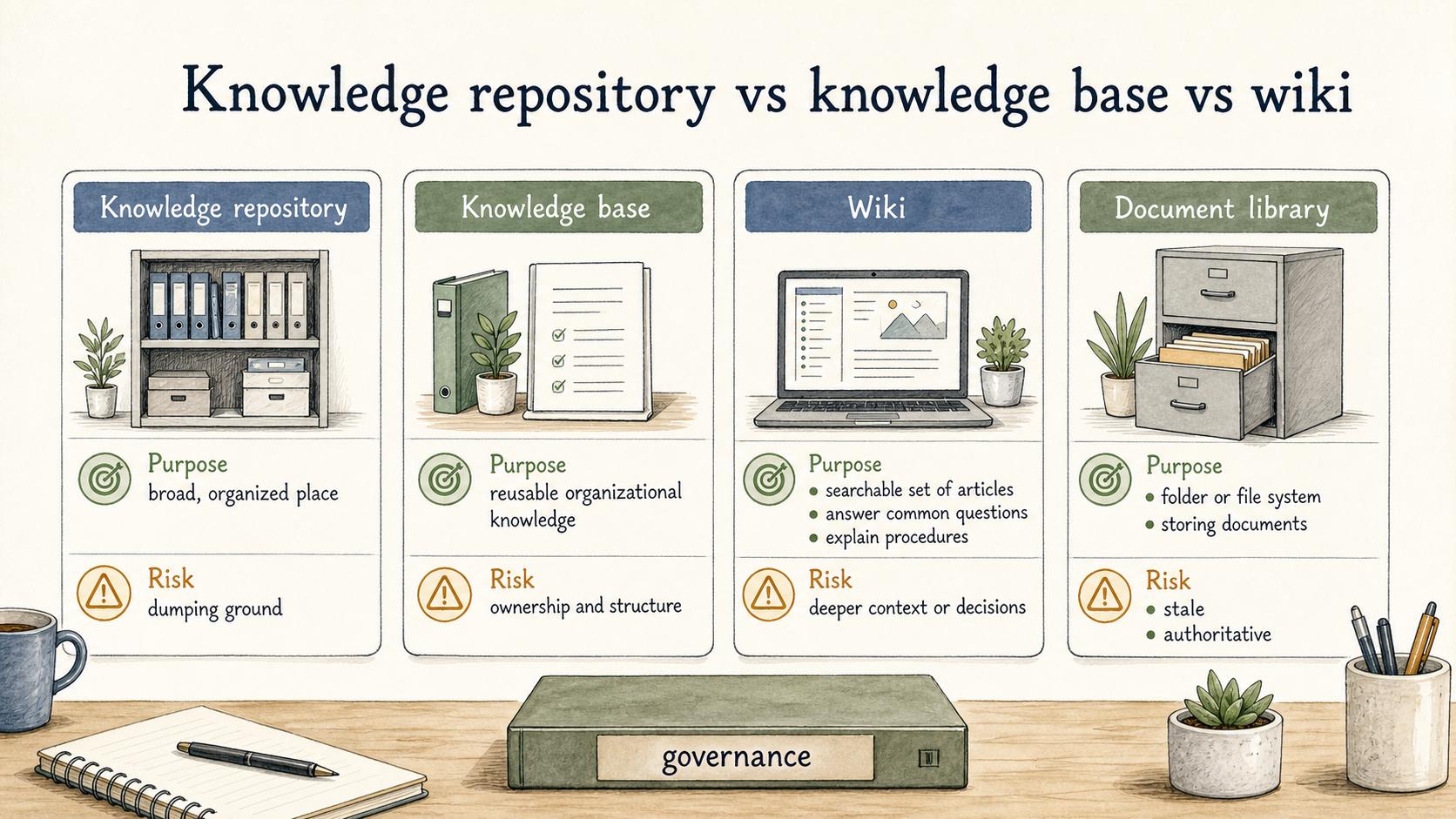
These terms are often used loosely, but the distinctions are helpful when designing a system.
| Term | Typical purpose | Common risk |
|---|---|---|
| Knowledge repository | A broad, organized place for reusable organizational knowledge | Becomes a dumping ground without ownership and structure |
| Knowledge base | A searchable set of articles that answer common questions or explain procedures | Optimized for answers, but may not capture deeper context or decisions |
| Wiki | A collaborative space where teams can create and update pages | Easy to grow, but easy to let pages become stale |
| Document library | A folder or file system for storing documents | Stores files, but may not help people understand which one is authoritative |
A repository can include a knowledge base, wiki pages, and document libraries. The important part is governance: where knowledge should live, who owns it, how it is organized, and how people know whether it is still valid. ISO 30401 frames knowledge management as an ongoing system that should be maintained, reviewed, and improved. 2
What makes a knowledge repository trustworthy?
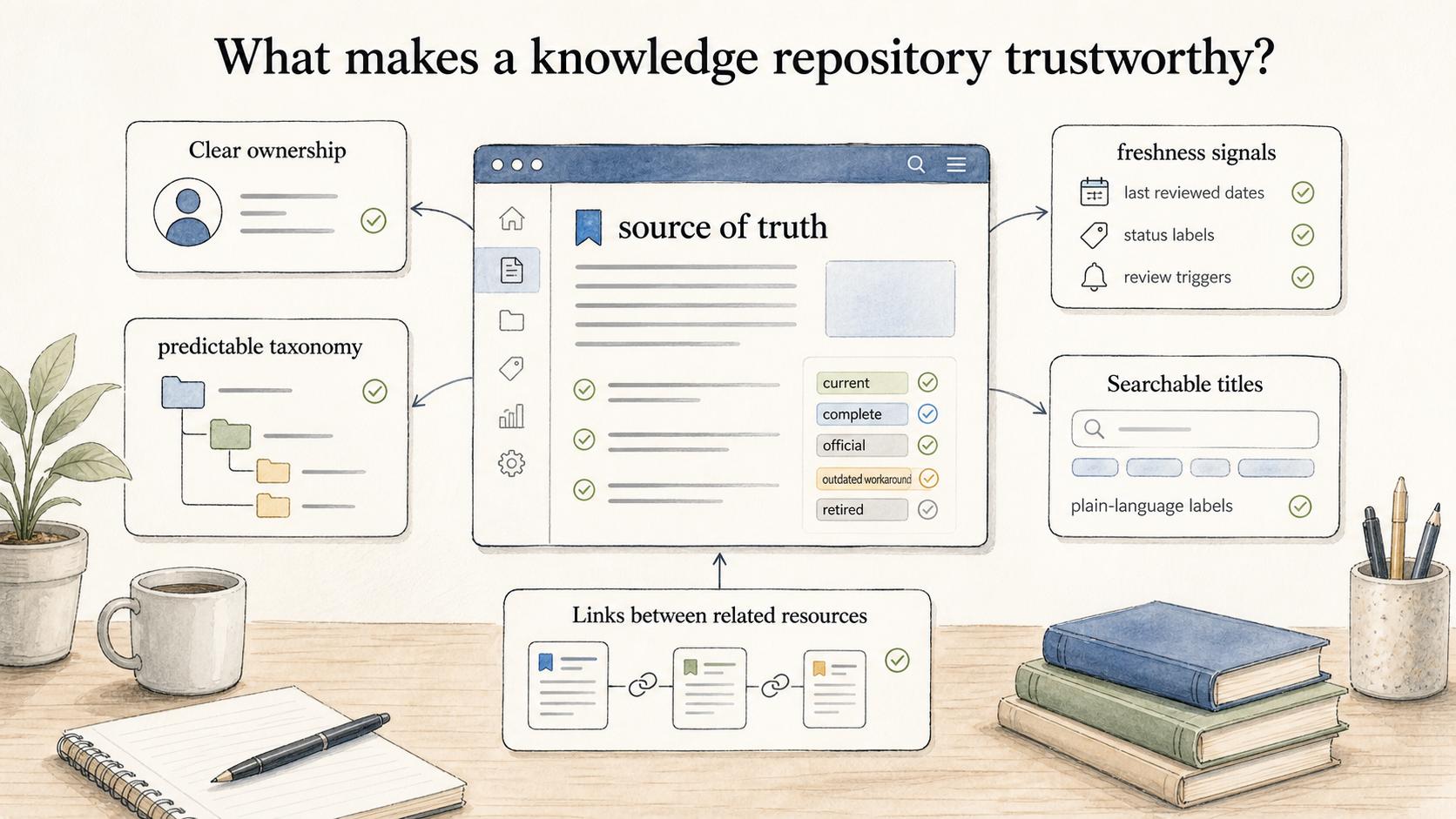
Trust is the central design problem. Employees stop using a repository when they cannot tell whether the answer is current, complete, or official.
A trustworthy repository usually has five traits. APQC's content governance guidance highlights clear owners, approval processes, review triggers, and monitoring as practices that keep knowledge reliable. 3
- Clear ownership for important pages or collections
- A predictable taxonomy, not a maze of personal folder names
- Freshness signals such as last reviewed dates, status labels, or review triggers
- Searchable titles and plain-language labels that match how employees ask questions
- Links between related resources so people can move from an answer to the broader process
Repository quality is mostly operational. A tool can provide search and folders, but it cannot decide which page is the source of truth or whether an outdated workaround should be retired.
How to structure a knowledge repository
Start with how people look for information. A repository organized entirely around departments may make sense to leaders but fail for employees who search by task: refund process, new hire setup, sales handoff, or how to escalate a billing issue.
A practical structure often combines a few entry points: team or function, process or workflow, audience or role, and content type. Avoid overbuilding the taxonomy too early. The repository should be structured enough to guide discovery, but not so complex that people need training just to file a page correctly.
A practical knowledge repository audit prompt
Use this to evaluate an existing repository or plan a cleanup:
## Knowledge repository audit prompt

**Glossary term:** Knowledge Repository
**Source:** Trails Glossary — trails.so/glossary/knowledge-repository

---

### 01. Audit a knowledge repository

"Audit this knowledge repository for [team/company].
Audience: [who uses it]
Core use cases: [onboarding, support, operations, compliance, customer work]
Current structure: [main sections or folders]
Known problems: [stale docs, duplicate pages, poor search, unclear ownership]
High-value content types: [SOPs, guides, templates, FAQs, policies]

Identify the pages or sections that should be retained, refreshed, merged, archived, or moved. Recommend a simpler structure, ownership model, and freshness signals. Prioritize changes that would make the repository easier to trust and use within the next 30 days."
A good audit finds stale pages and the decision rules that prevent them from returning. If nobody knows whether a page should be updated, merged, or archived, the repository will drift again after cleanup.
Common knowledge repository mistakes
The first mistake is confusing centralization with usefulness. Putting everything in one place does not help if the place is noisy, poorly labeled, or full of stale material.
The second mistake is relying on search alone. Search works best when titles, headings, and page structure reflect the language employees actually use.
The third mistake is failing to close the loop after process changes. When a tool, policy, workflow, or owner changes, related documentation should be reviewed as part of the change.
Documentation takeaway
A knowledge repository is only as useful as its maintenance model. Teams need clear owners, practical organization, freshness signals, and a habit of turning repeated questions or process changes into updated documentation.
A strong repository earns trust by staying specific, current, and easy to use before someone has to ask an expert.
How Trails helps
Trails helps teams create the kinds of process documentation that belong in a knowledge repository. A team can capture a workflow as someone performs it, turn it into a polished step-by-step guide, and create an AI-narrated video version for training or sharing.
- Knowledge base
- Knowledge management
- Knowledge sharing
- Knowledge retention
- Knowledge transfer
- Process documentation
- Standard operating procedure
- Runbook
Sources
- 1
Alavi and Leidner. Knowledge Management and Knowledge Management Systems. home.business.utah.edu/actme/7410/Alavi%20and%20Leidner.pdf.
- 2
ISO. ISO 30401:2018 knowledge management systems. www.iso.org/standard/68683.html.
- 3
APQC. Content governance for trustworthy knowledge. www.apqc.org/resources/blog/what-big-data-and-knowledge-management.