
Glossary
Knowledge Management
 ChatGPT
 Perplexity
 Gemini
 Claude
What is knowledge management?
Knowledge management is the discipline of capturing, organizing, maintaining, and sharing the knowledge people need to do their work well. It covers documents and software, but it also includes the owners, habits, and workflows that keep knowledge accurate and useful. 1
The practical test is simple: can people find a trusted answer, use it in real work, and improve it when reality changes?
Why knowledge management matters
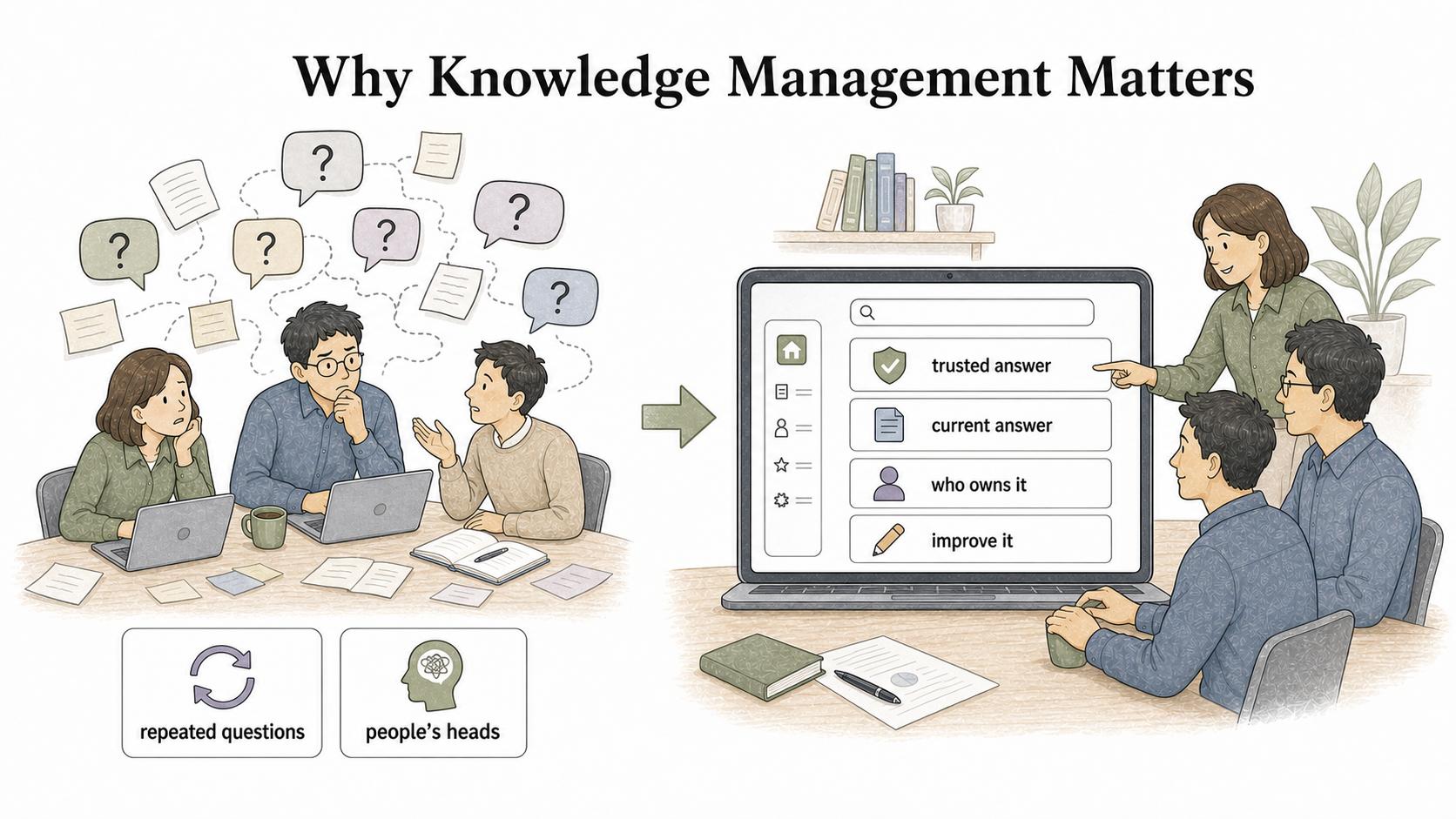
When knowledge is unmanaged, the cost shows up as slow onboarding, inconsistent customer answers, duplicated work, avoidable mistakes, and dependency on a few experienced people. 2
Good knowledge management creates a practical promise: people should know where to find the current answer, who owns it, and how to improve it when reality changes.
How knowledge management works
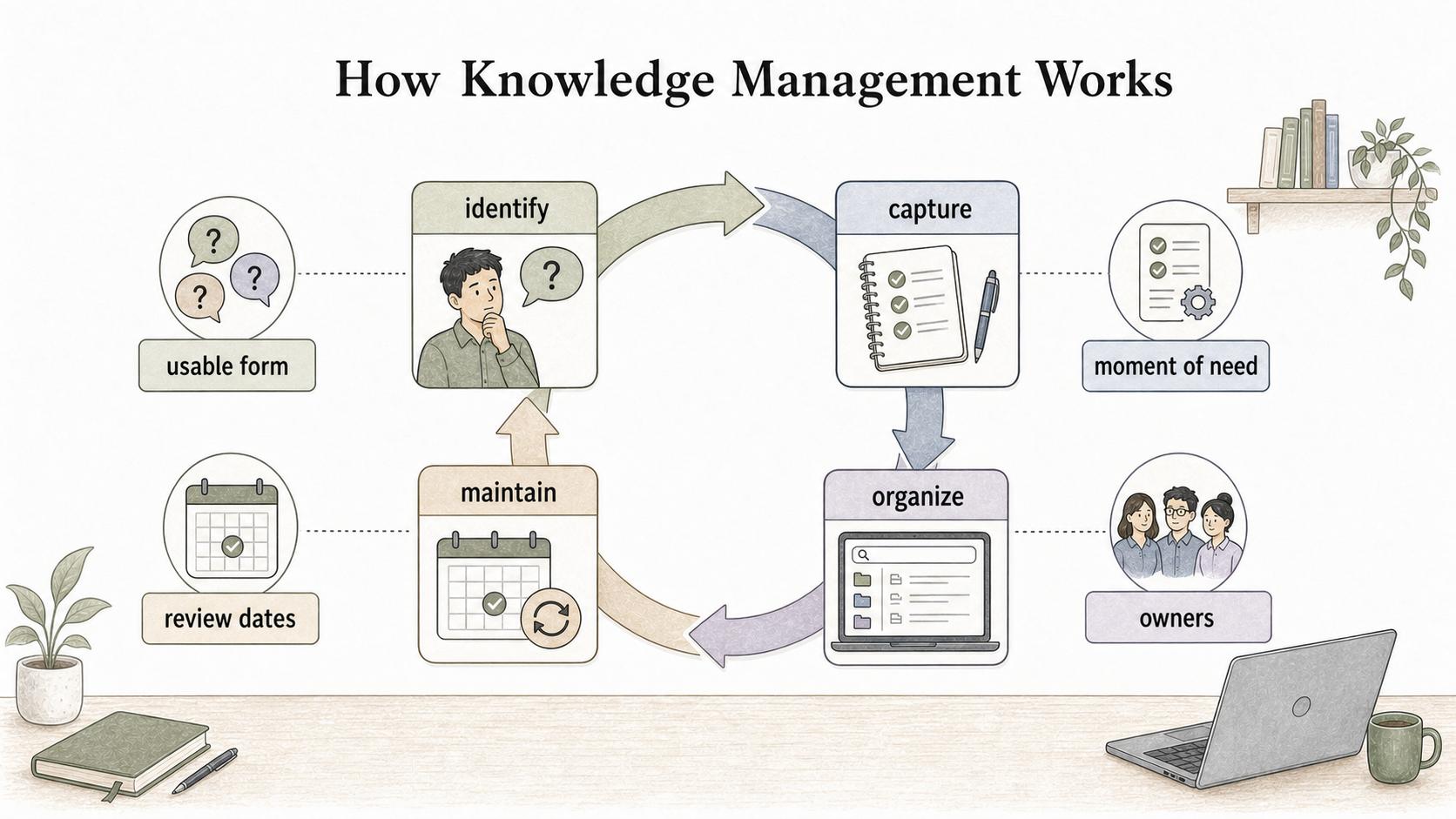
Knowledge management works as a loop. 3
- Identify important knowledge from repeated questions, high-risk processes, customer issues, training needs, or workflows only one person can explain.
- Capture it in a usable form such as a guide, checklist, SOP, playbook, FAQ, decision record, video walkthrough, or template.
- Organize it through clear titles, ownership, categories, and links between related topics.
- Maintain it with owners, review dates, and update habits so documentation stays trustworthy.
Types of knowledge teams manage
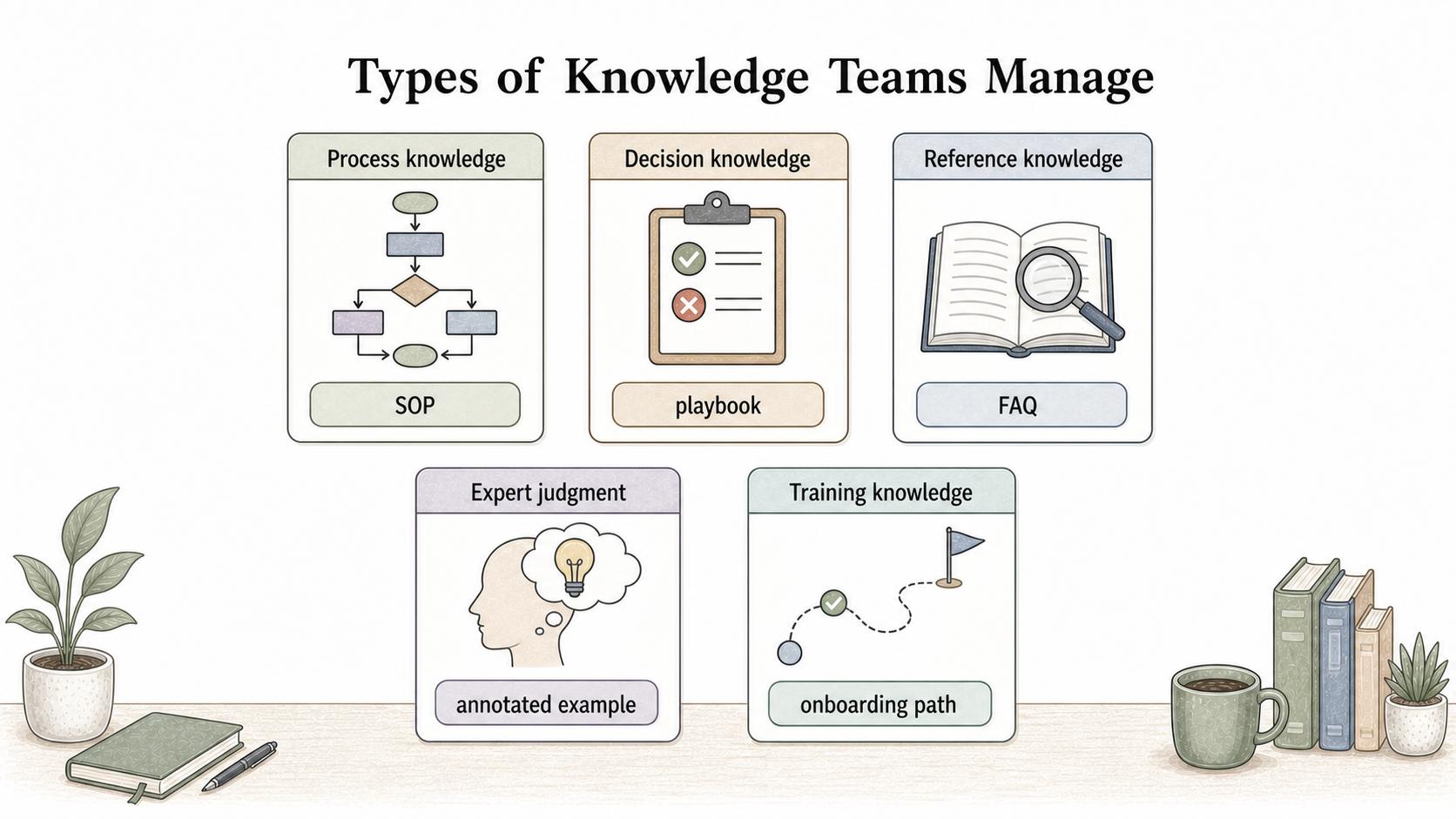
| Knowledge type | Example | Best capture format |
|---|---|---|
| Process knowledge | How to approve a refund or onboard a customer | Step-by-step guide or SOP |
| Decision knowledge | When to escalate an account or make an exception | Decision rule or playbook |
| Reference knowledge | Product limits, policy details, system fields | Knowledge base article or FAQ |
| Expert judgment | Why an experienced teammate chooses one path | Annotated example or interview-based guide |
| Training knowledge | What a new hire needs to practice | Onboarding path, checklist, or video guide |
A long article is wrong for a quick reference answer, and a checklist is too thin for judgment-heavy work.
Knowledge management vs documentation
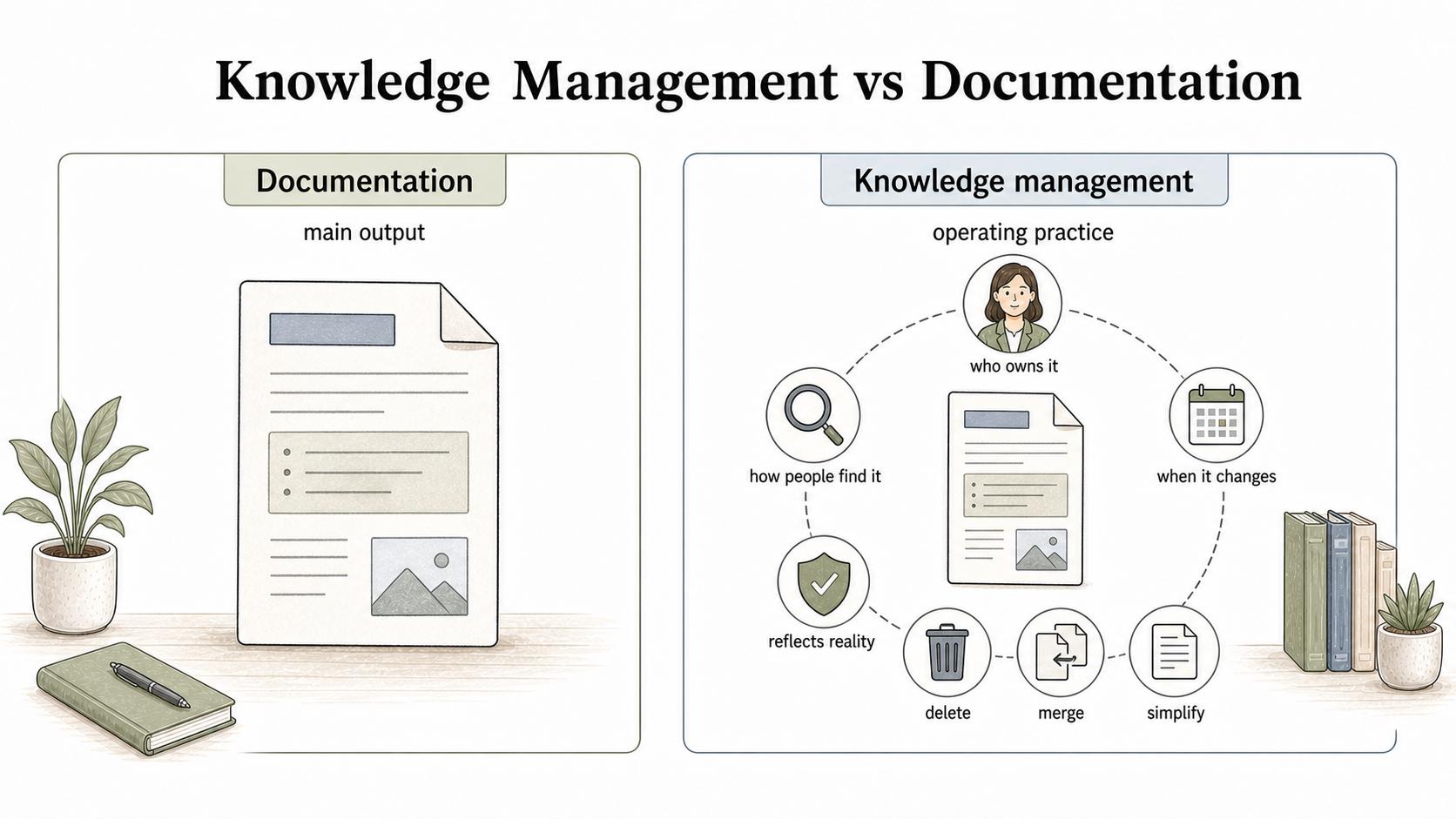
Documentation is one main output of knowledge management. Knowledge management is the operating practice around the artifact: deciding what should exist, who owns it, how people find it, when it changes, and whether it still reflects reality.
Sometimes the best knowledge work is removing five stale pages so one current answer becomes obvious.
Common knowledge management mistakes
The common mistakes are treating knowledge management as a storage problem, capturing expert knowledge too late, and documenting only the official process while omitting exceptions, judgment calls, shortcuts, and handoffs.
How Trails helps
Trails helps with the procedural side of knowledge management by turning a performed workflow into a polished step-by-step guide or AI-narrated video for onboarding, support operations, admin workflows, and repeatable internal processes.
FAQ
What is the goal of knowledge management?
To make important knowledge easier to find, trust, reuse, and improve, supporting faster onboarding, fewer repeated questions, and more consistent decisions.
What is the first step in knowledge management?
Start with a painful knowledge problem, such as repeated questions, slow onboarding, or an expert bottleneck, rather than a complete taxonomy.
- Knowledge management system
- Knowledge manager
- Knowledge mapping
- Knowledge gap
- Knowledge base
- Knowledge transfer
- Organizational knowledge
Sources
- 1
APQC. What is Knowledge Management?. www.apqc.org/What-is-Knowledge-Management.
- 2
APQC. What is a Knowledge Manager?. www.apqc.org/resources/blog/what-knowledge-manager.
- 3
APQC. Managing Knowledge Starts with Knowledge Flow. www.apqc.org/blog/managing-knowledge-starts-knowledge-flow.
- 4
APQC. What is Big Data and Knowledge Management?. www.apqc.org/resources/blog/what-big-data-and-knowledge-management.