
Glossary
Runbook
 ChatGPT
 Perplexity
 Gemini
 Claude
What is a runbook?
A runbook is a step-by-step operational guide for handling a recurring task, alert, incident, or maintenance procedure. AWS describes runbooks as documented processes made of steps someone follows to achieve a specific outcome.1 It tells a responder what to check, what action to take, how to verify the result, and when to stop or escalate.
Runbooks are common in IT, DevOps, security, support, and operations teams, but they are not only technical documents. Any team that repeats urgent or failure-prone work can use a runbook to keep the response from depending on memory.
What is a runbook used for?
A runbook is useful when improvising has a real cost. The work may be a production alert, a maintenance task, a monthly reporting handoff, or a customer support escalation. The common thread is that the team needs a reliable path before pressure rises.
Common runbook examples include:
- Responding to a production alert
- Restarting a failed service
- Rolling back a release
- Checking system health after an outage
- Rotating a certificate or API key
- Escalating a support incident
- Recovering from a backup
- Running scheduled maintenance
- Handling a security notification
The best runbooks make the first few minutes calmer. Google SRE's incident management guidance makes the same point from the opposite direction: if teams have not planned likely incident responses in advance, principled response can break down during real incidents.2 A good runbook does not ask the reader to remember which dashboard matters, which command is safe, or who needs the next update. For security work, NIST's incident response guidance emphasizes systematic response and recovery through analysis and action, which is where security runbooks help responders stay consistent.3
What should a runbook include?
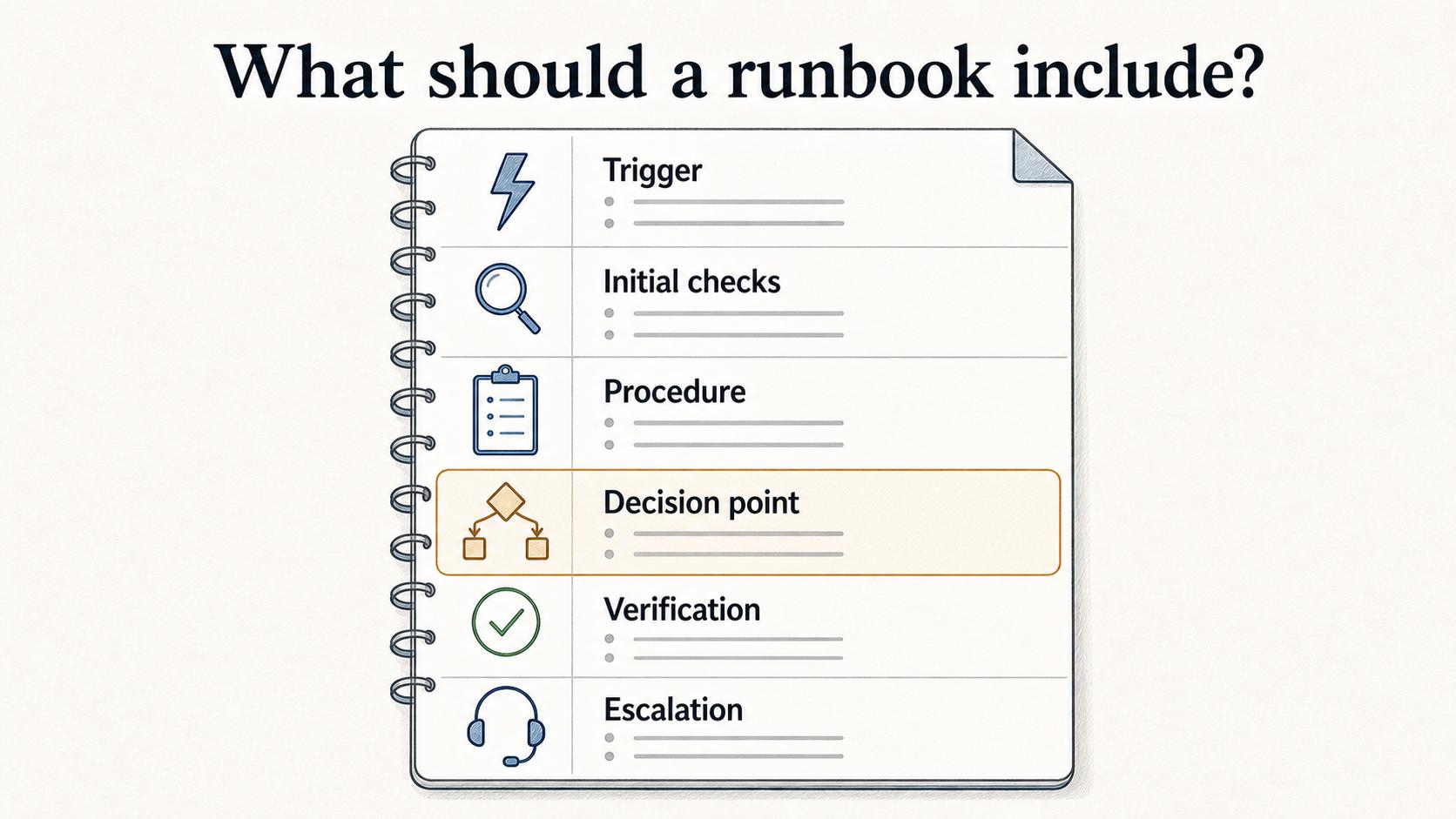
A runbook should include enough context to prevent bad action, but not so much that the reader has to study the system before acting. That balance is the hard part.
Most runbooks need:
- Purpose, scope, and trigger
- Systems, customers, or workflows affected
- Required access, tools, dashboards, and permissions
- Initial checks before taking action
- Step-by-step procedure with expected results
- Decision points and branching paths
- Rollback, recovery, or safe-stop guidance
- Escalation owner and communication path
- Evidence to capture, such as logs, tickets, screenshots, or timestamps
- Follow-up actions after the task is complete
The most important section is often not the procedure itself. It is the boundary condition: when should the reader stop following the runbook and escalate? A runbook that makes unsafe confidence easy is worse than no runbook.
Runbook vs. SOP vs. playbook
These terms overlap, but they serve different jobs.
| Document | Best use | Example |
|---|---|---|
| Runbook | Executing or responding to a specific operational scenario | What to do when a database alert fires |
| SOP | Standardizing a recurring process | How to approve a customer refund |
| Playbook | Coordinating a broader response strategy | How the company handles a major outage |
| Checklist | Confirming a known sequence was completed | Pre-release deployment checklist |
A runbook is usually more tactical than a playbook. It should help someone do the work, not merely understand the strategy.
How to write a useful runbook
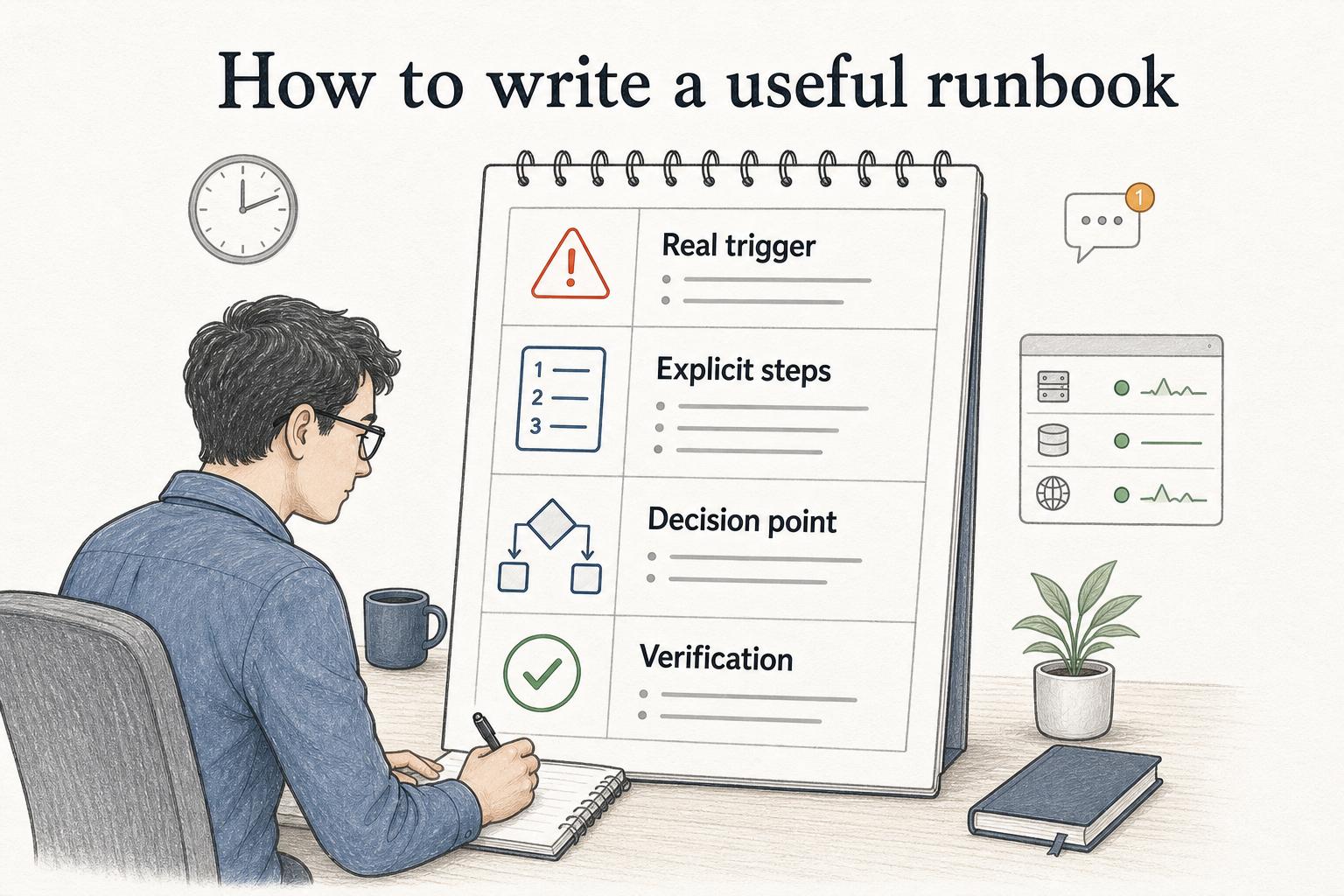
Start with a real trigger. If the runbook is for an alert, name the alert and explain what it usually means. If it is for a maintenance process, state when to run it and what must be true before starting.
Then write for the worst realistic moment: the reader may be new, tired, distracted, or responding while other people are asking for updates. Use short sections, explicit commands, visible decision points, and verification steps that tell the reader what healthy looks like.
## Runbook Template

**Glossary term:** Runbook
**Source:** Trails Glossary — trails.so/glossary/runbook

---

### 01. Document an operational runbook

"Runbook: [task, alert, or scenario]
Purpose: [why this runbook exists]
Use when: [trigger or condition]
Do not use when: [boundary or escalation condition]
Owner: [team or role]
Required access: [systems, tools, permissions]
Initial checks: [facts to confirm before acting]
Procedure:
1. [action]
   Expected result: [healthy signal]
2. [action]
   Expected result: [healthy signal]
Decision point: If [condition], then [next step]
Rollback or recovery: [safe reversal or stabilizing action]
Escalation: [who to contact and when]
Evidence to capture: [logs, timestamps, screenshots, ticket links]
After-action: [cleanup, follow-up, review]"
Do not hide judgment in vague language. "Investigate logs" is not a step. "Open the payment service logs, filter by request ID, and check for timeout errors in the last 15 minutes" is a step. Google SRE's toil guidance is also a useful check: repetitive, manual, tactical operational work is a candidate for automation or clearer procedure.4
Common mistakes
Writing the runbook like an architecture overview. Background context matters, but it should support action. If a responder has to read five paragraphs before finding the first check, the runbook is too slow.
Skipping verification. Every major action should explain how to tell whether it worked. Without verification, people keep doing steps after the problem has changed.
Leaving runbooks ownerless. Alerts change, dashboards move, permissions expire, and recovery commands become stale. A runbook needs an owner and review trigger, especially after incidents, tooling changes, or repeated escalations.
Documentation takeaway
A runbook is practical operating documentation. It converts a known trigger into a clear path: check, act, verify, communicate, escalate, and follow up.
The strongest runbooks are specific enough to use under pressure and honest enough to say when the written procedure is no longer safe to follow.
How Trails helps
Trails helps teams capture repeatable workflows as they happen and turn them into polished step-by-step guides. For runbooks, that can help teams document checks, screens, commands, handoffs, and recovery steps while the process is still fresh.
For the human steps in operational runbooks, explore IT documentation with Trails, including repeatable fixes, system rollouts, and tool walkthroughs.
Sources
- 1
Amazon Web Services. Use runbooks to perform procedures. AWS Well-Architected Framework. docs.aws.amazon.com/wellarchitected/latest/framework/ops_ready_to_support_use_runbooks.html. Accessed July 9, 2026.
- 2
Google SRE. Managing Incidents. Google. sre.google/sre-book/managing-incidents/. Accessed July 9, 2026.
- 3
National Institute of Standards and Technology. Incident Response Recommendations and Considerations. NIST, 2025. nvlpubs.nist.gov/nistpubs/specialpublications/nist.sp.800-61r3.pdf. Accessed July 9, 2026.
- 4
Google SRE. Eliminating Toil. Google. sre.google/sre-book/eliminating-toil/. Accessed July 9, 2026.