
Glossary
Just in Time Training
 ChatGPT
 Perplexity
 Gemini
 Claude
What is just in time training?
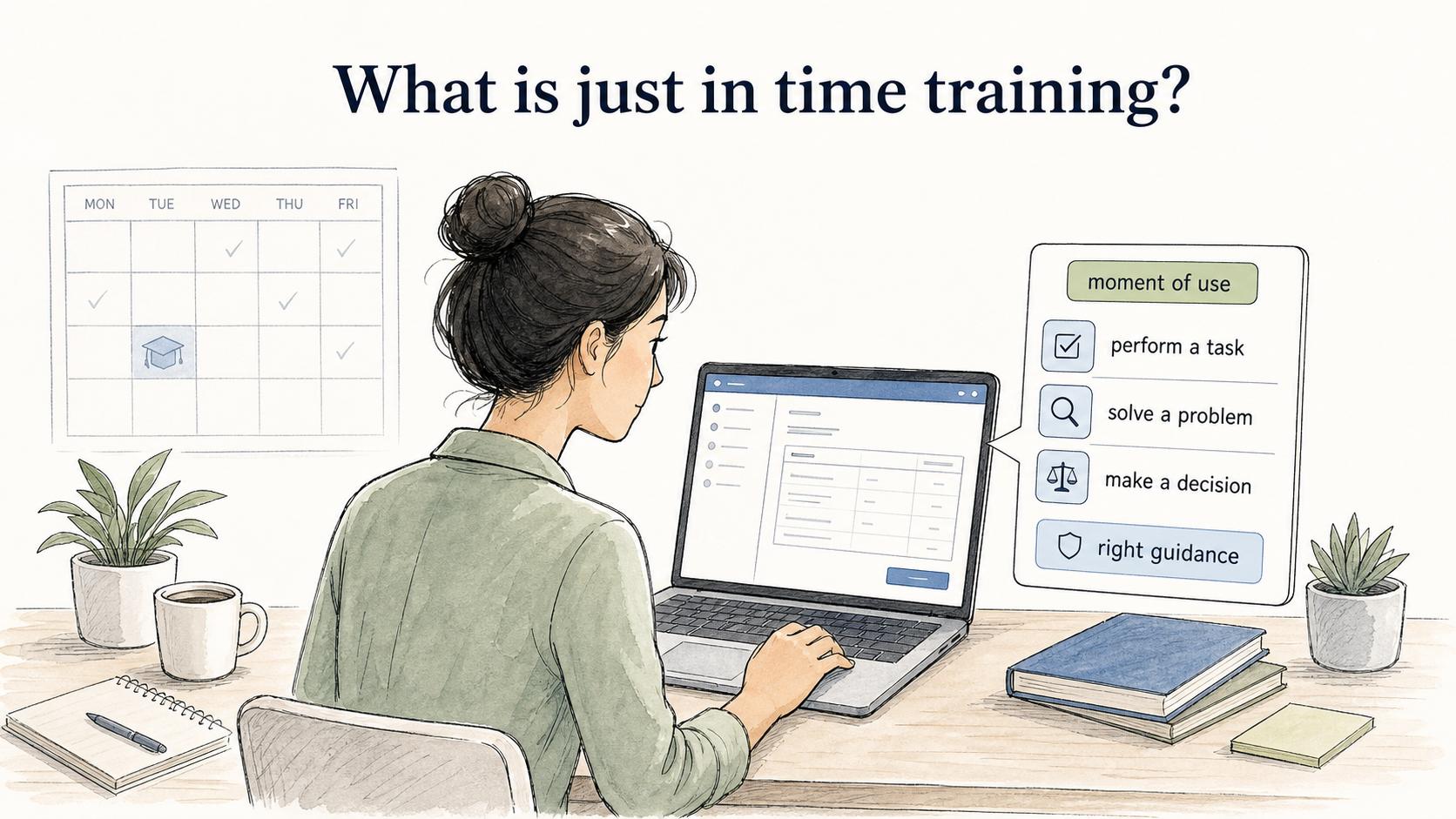
Just in time training is training delivered at the moment someone needs to perform a task, solve a problem, or make a decision. Instead of teaching everything upfront, it gives people the right guidance close to the moment of use. 1
A new hire might not need a full system walkthrough on day one, but they do need a short guide when they are about to process their first refund. A manager might not remember a policy from annual training, but they do need a clear decision rule when an edge case appears. Just in time training works because it connects learning to real work.
How just in time training works
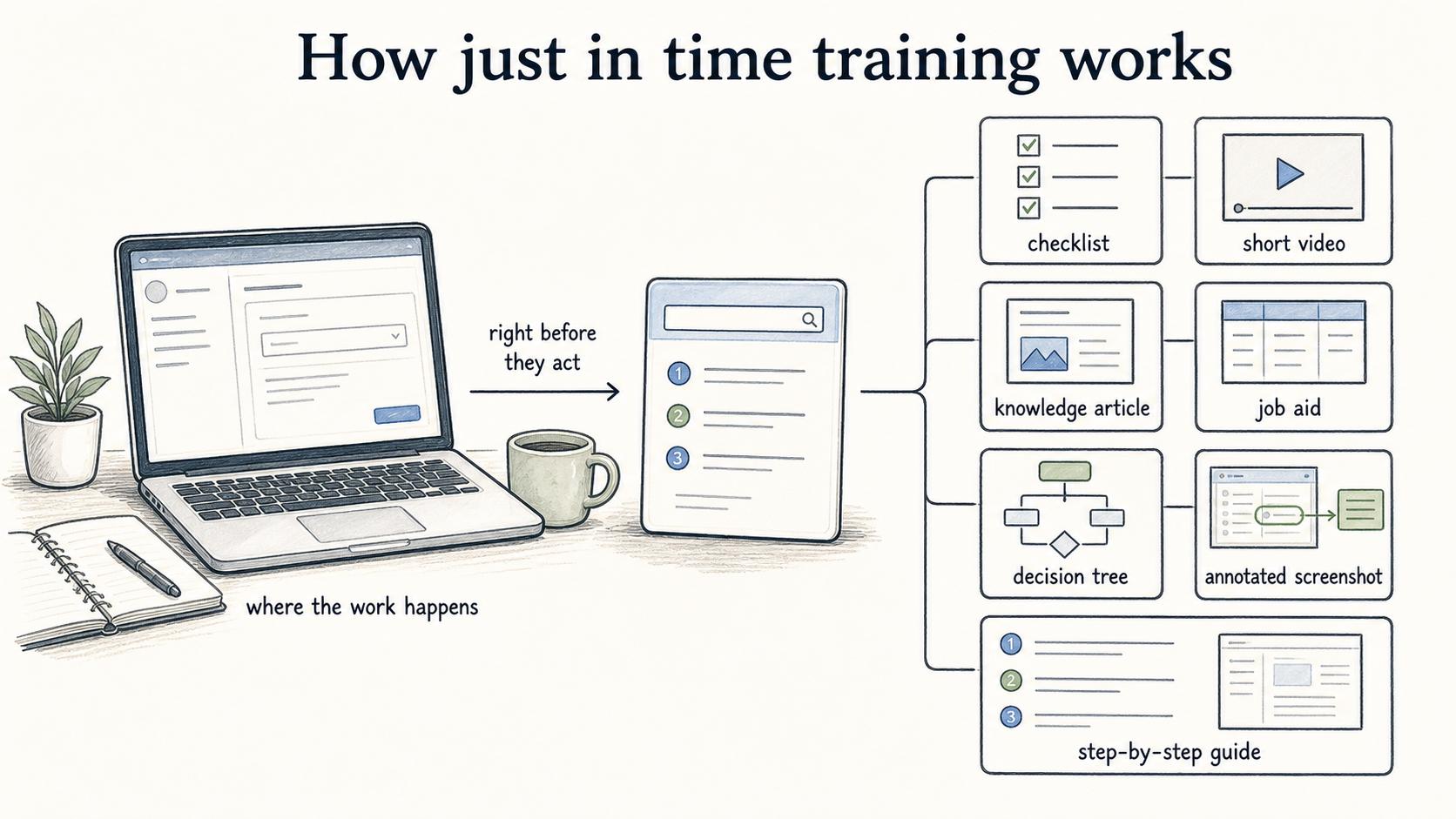
Just in time training starts with a practical question: what does someone need to know right before they act? The answer is usually narrower than a full course. It might be a checklist, short video, knowledge article, job aid, decision tree, annotated screenshot, or step-by-step guide. 2
The timing matters as much as the content. Training that arrives too early is easy to forget. Training that arrives too late becomes cleanup. Put the guidance where the work happens: inside a help center, next to a tool, linked from a task, embedded in an onboarding path, or shared at the point of handoff. 3
The strongest versions are designed for use, not completion. The learner may not sit down to take training. They may scan a guide, confirm the next step, and get back to work.
Just in time training vs traditional training
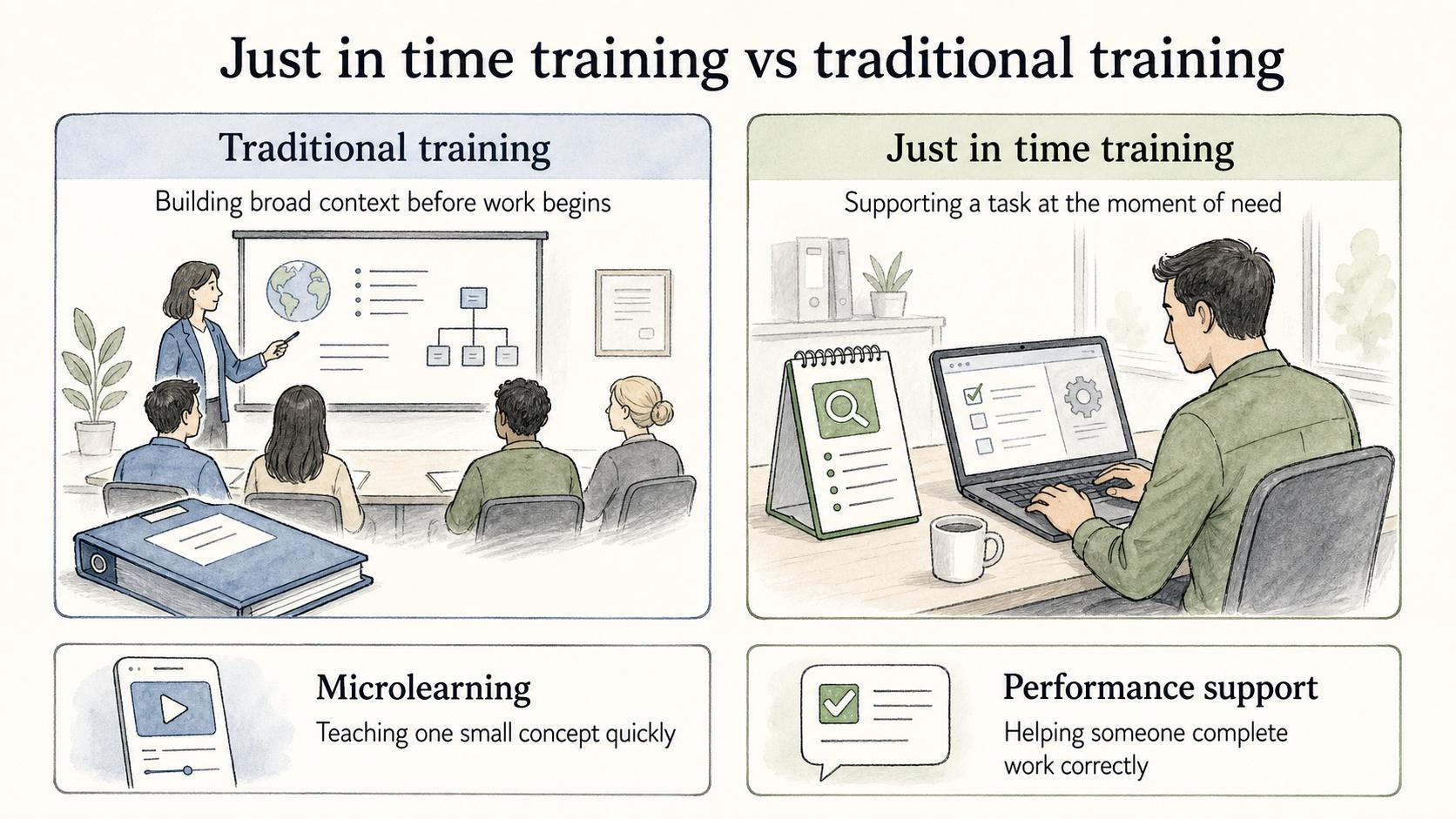
Traditional training and just in time training solve different problems. A formal onboarding program helps people understand the role, the team, and the larger system. Just in time training helps them perform a specific task when the need becomes real.
| Training type | Best for | Example | Watch out for |
|---|---|---|---|
| Traditional training | Building broad context before work begins | New hire orientation | People may forget details before using them |
| Just in time training | Supporting a task at the moment of need | Refund processing guide linked from the support queue | Guidance can become fragmented if no one owns it |
| Microlearning | Teaching one small concept quickly | Three-minute lesson on a policy change | Small lessons can lack operational context |
| Performance support | Helping someone complete work correctly | Checklist, job aid, or decision rule | Tools can go stale if workflows change |
The best training systems use both. Teach the stable foundations early, then support real tasks with just in time guidance.
When should you use just in time training?
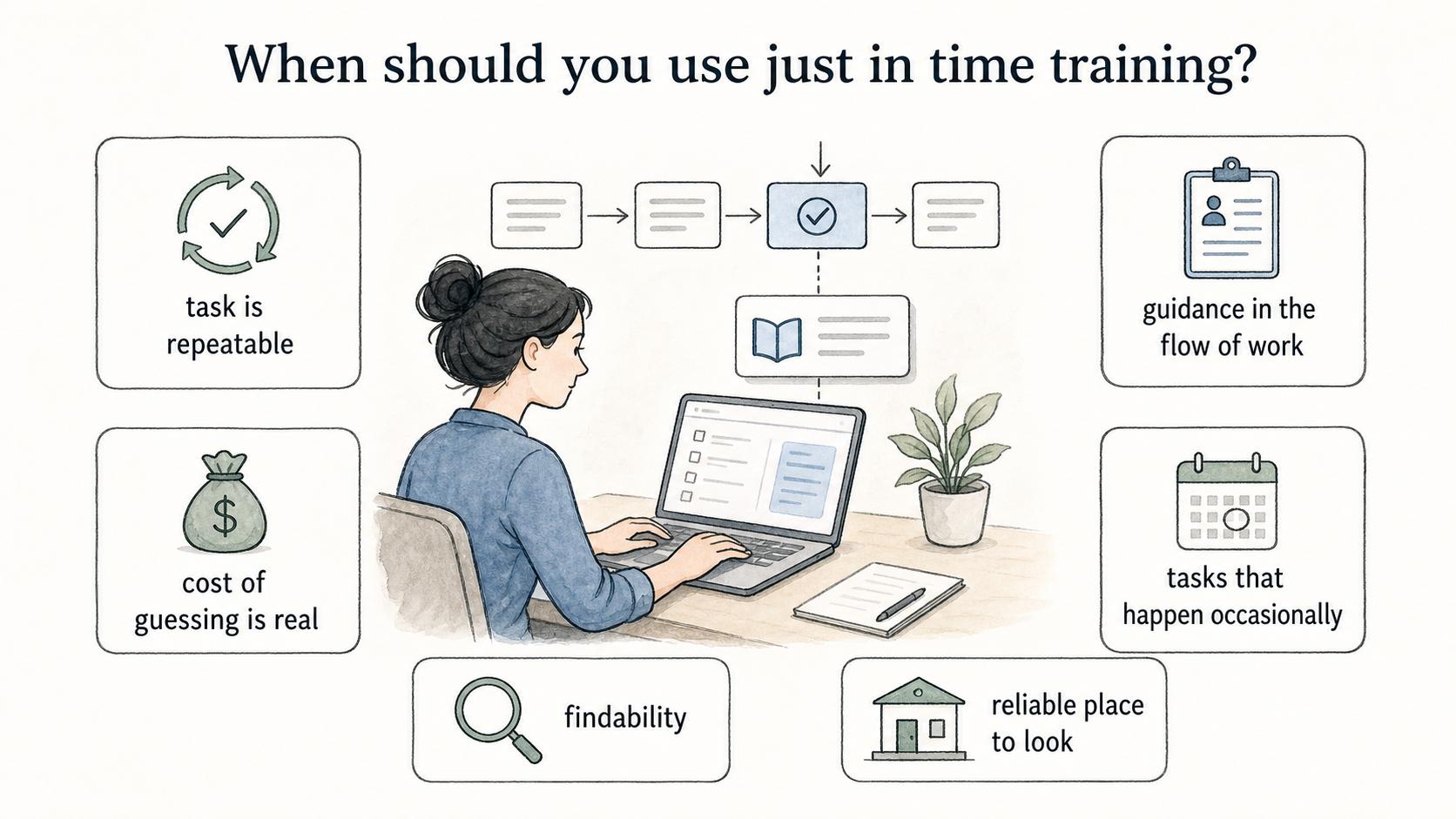
Use just in time training when the task is repeatable, the cost of guessing is real, and the learner can benefit from guidance in the flow of work. 4
It is especially useful for tasks that happen occasionally. People do not need to memorize every rare exception. They need a reliable place to look when the exception appears. It also works well when a process changes: update the workflow guide and place it where people already go to do the task.
The constraint is findability. If someone has to search through a course library, old chat threads, and a wiki folder, the training has missed its moment.
Examples of just in time training
- A support team links a short escalation guide inside its ticketing workflow so a rep can classify an issue, collect the right information, and know when to escalate.
- A customer success team uses a brief account-review checklist and example questions before a renewal call.
- An operations team uses a step-by-step guide for a monthly finance task that happens too infrequently to rely on memory.
- An onboarding team combines formal training with task-specific guides as new hires begin doing real work.
Common mistakes
- Confusing just in time training with dumping links into a knowledge base. The guidance must appear in the context where the task happens.
- Making the content too broad when someone needs one decision rule, step sequence, example, or warning.
- Leaving old guidance in circulation. Assign ownership and review triggers when the workflow changes.
Just in time training design prompt
Use this prompt to turn a workflow or recurring question into just in time training:
## Just in time training design prompt

**Glossary term:** Just in Time Training
**Source:** Trails Glossary — trails.so/glossary/just-in-time-training

---

### 01. Create just in time training

"Create just in time training for [role/audience] performing [specific task].

Context:
- Moment of need: [where/when the learner needs help]
- Current risk: [mistake, delay, inconsistency, escalation, or confusion]
- Required outcome: [what successful completion looks like]
- Existing source material: [notes, SOP, policy, transcript, or screenshots]

Return:
- The best format: checklist, short guide, job aid, decision tree, or video script.
- The minimum context the learner needs.
- Step-by-step guidance or decision rules.
- Warnings or escalation points.
- Where this training should be placed so it appears at the right moment."
How Trails helps
Trails fits just in time training when the training needs to show a real workflow. A team member can perform the task once, capture it in Trails, and turn it into a polished step-by-step guide or an AI-narrated video. That is useful for infrequent tasks, changing workflows, and handoffs where a short guide is more helpful than a full course.
FAQ
Is just in time training the same as microlearning?
Not exactly. Microlearning describes a short learning format. Just in time training describes when and why the guidance is delivered. A micro lesson can be used for just in time training, but not all just in time training is microlearning.
Can just in time training replace onboarding?
No. It supports onboarding rather than replacing it. New hires still need context, expectations, relationships, and role understanding.
- Microlearning
- Performance support
- Training documentation
- Work instruction
- Standard operating procedure
- Knowledge article
- Knowledge base
- Job aid
Sources
- 1
Cambridge Core. Learning in the flow of work: Designing person-centric learning experiences with just-in-time microlearning. www.cambridge.org/core/journals/industrial-and-organizational-psychology/article/learning-in-the-flow-of-work-designing-personcentric-learning-experiences-with-justintime-microlearning/5DF634858CC6A503EE311A428B6965DC.
- 2
BCIT. Strategies to enhance transfer of learning. www.bcit.ca/files/ltc/pdf/transfer.pdf.
- 3
NIH/PLOS. Replication of Ebbinghaus' forgetting curve. pmc.ncbi.nlm.nih.gov/articles/PMC4492928/.
- 4
BCL Training. The Five Moments of Need. bcltraining.com/learning-library/the-five-moments-of-need/.