
Glossary
Knowledge Article
 ChatGPT
 Perplexity
 Gemini
 Claude
What is a knowledge article?
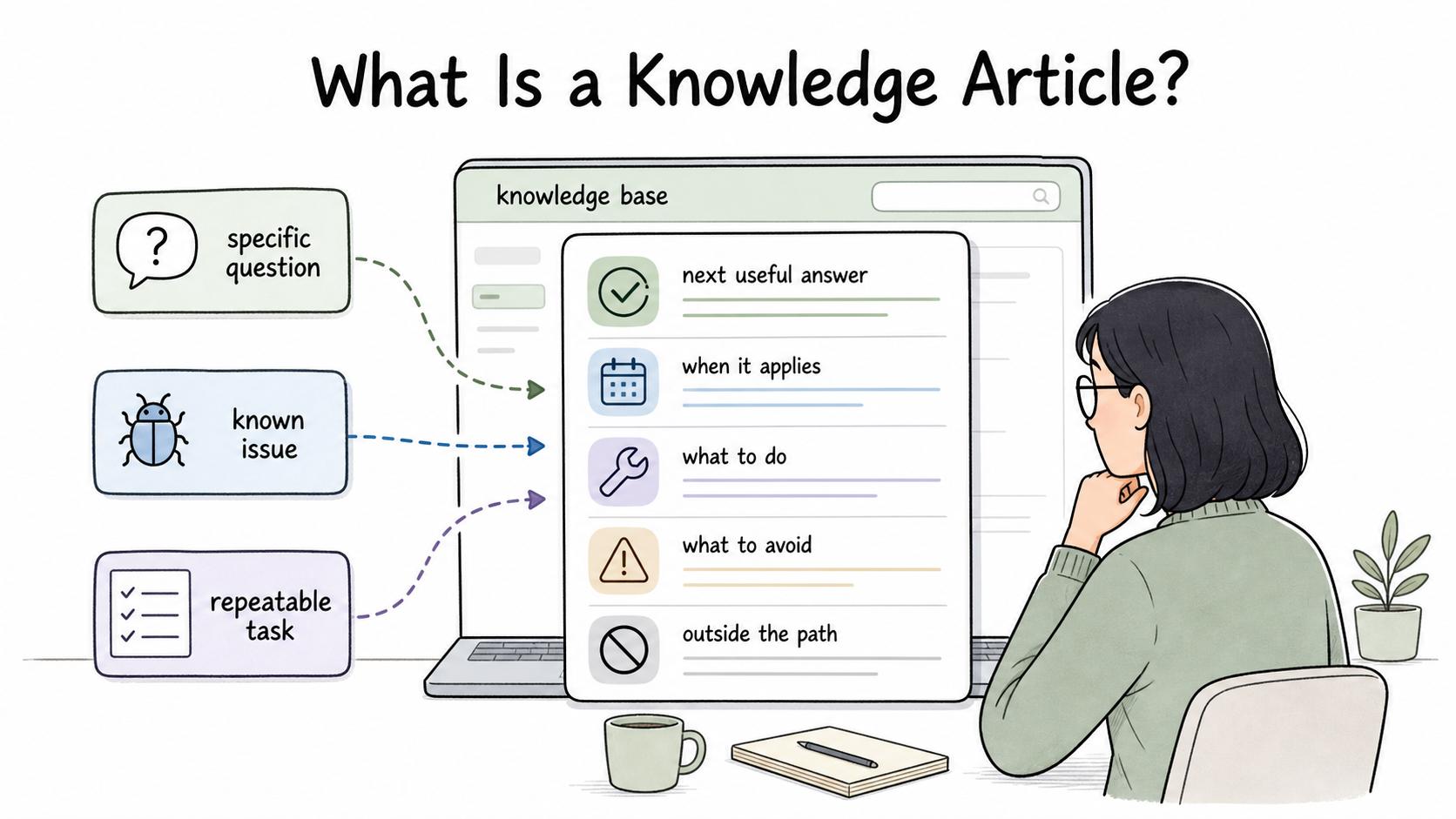
A knowledge article is a structured piece of documentation that answers a specific question, explains a known issue, or helps someone complete a repeatable task. It usually lives in a knowledge base, help center, internal wiki, or support documentation system. 1
A strong knowledge article is narrow on purpose. It gives the reader the next useful answer: when the article applies, what to do, what to avoid, and where to go if the situation falls outside the documented path.
What makes a knowledge article different from general documentation?
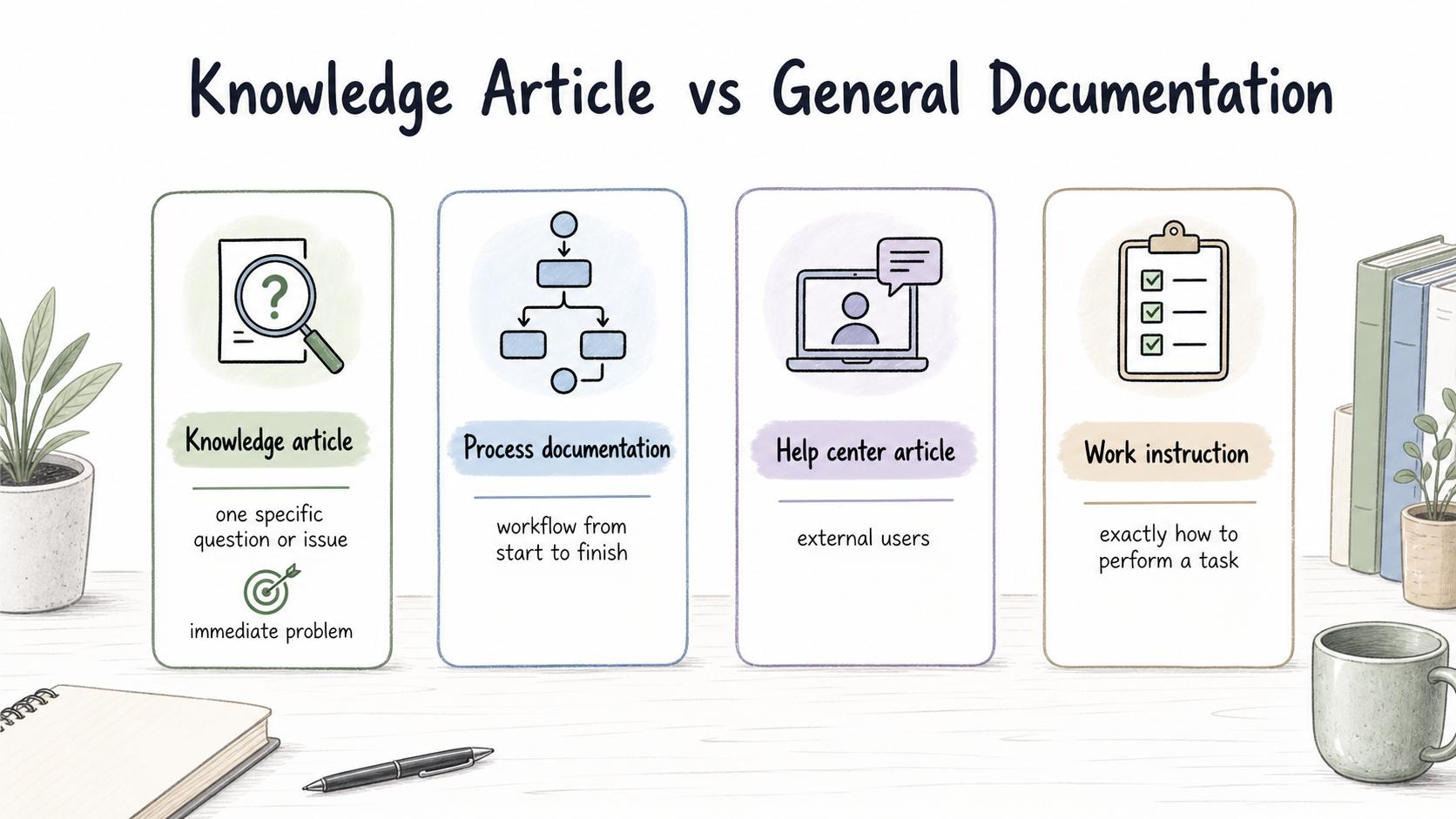
A knowledge article is more targeted than a broad guide. It is usually built around one user need, support question, troubleshooting path, or operational decision.
| Content type | Best for | Watch out for |
|---|---|---|
| Knowledge article | One specific question or issue | Becoming too broad |
| Process documentation | A workflow from start to finish | Hiding small answers in a long guide |
| Help center article | External product tasks | Assuming internal context |
| Work instruction | Exactly how to perform a task | Leaving out why it matters |
When should you create a knowledge article?
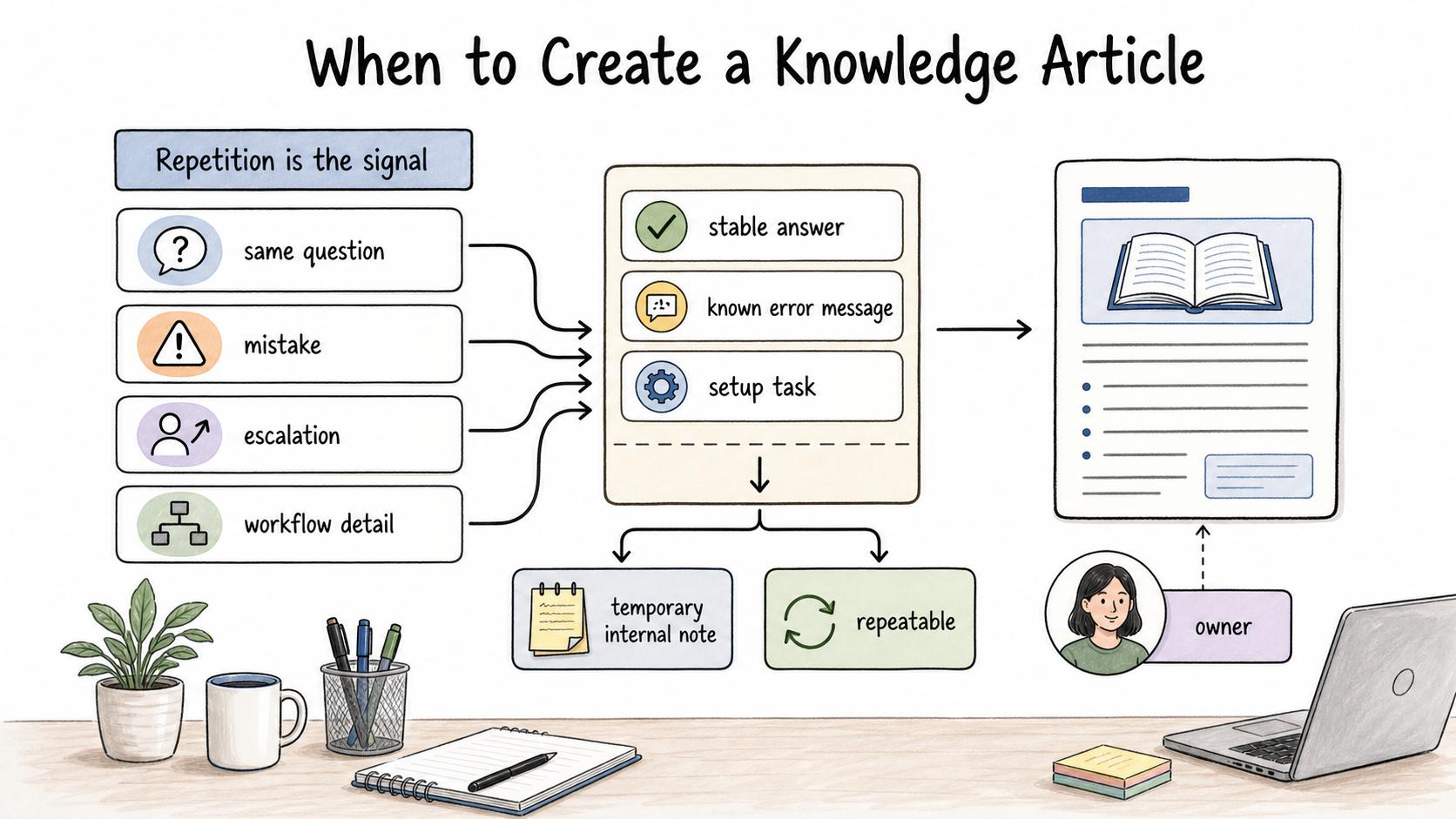
Create one when the same question, mistake, escalation, or workflow detail appears more than once. Repetition is the signal: repeated information-seeking creates a hidden productivity cost. 2
- A customer question with a stable answer.
- A known error message with a clear fix.
- A policy or product behavior people often misinterpret.
- A setup task that is too small for a full SOP but too important to leave in chat.
If the answer changes daily, write a temporary internal note. If it is repeatable, turn it into a knowledge article and give it an owner.
What should a good knowledge article include?
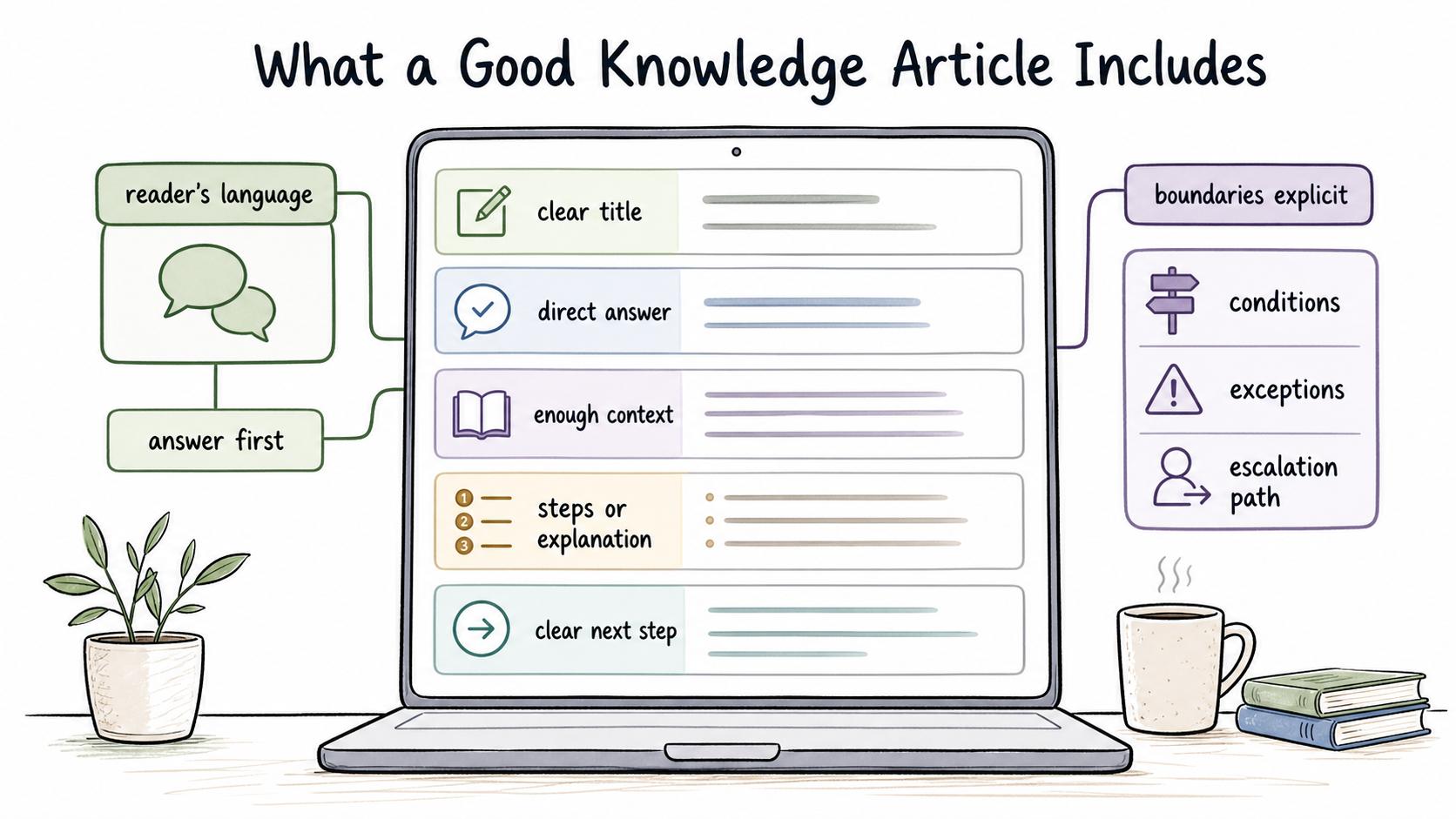
A useful article needs five jobs covered: a clear title, a direct answer, enough context to know whether the answer applies, the steps or explanation the reader needs, and a clear next step.
Use the reader's language, not internal shorthand. The opening should answer the question quickly, and the body should make boundaries explicit: if the answer depends on a plan, team, product version, or exception path, say so near the top. 3
Common mistakes with knowledge articles
Do not write only for the person who already knows the answer. Include the error text, screen name, visible symptom, or phrase a customer actually used. Do not let one article become a junk drawer; split it when its scope keeps growing.
Do not publish without ownership. A knowledge article with no owner quietly expires. KCS guidance supports keeping articles simple, findable, readable, and structured. 4
AI-ready knowledge article template
Use this prompt when turning a support answer, Slack thread, or rough note into a draft knowledge article:
## Knowledge article template

**Glossary term:** Knowledge Article
**Source:** Trails Glossary — trails.so/glossary/knowledge-article

---

### 01. Create a knowledge article

"Create a knowledge article for [audience] about [specific question, issue, or task].

Use this source material:
[Paste notes, transcript, support answer, or workflow details]

Draft the article with:
- A plain-language title that matches how the reader would search.
- A 2–3 sentence direct answer at the top.
- A short 'When this applies' section.
- Clear steps or explanation.
- Warnings, limits, or escalation paths.
- Related article suggestions.

Keep the article narrow. Do not turn it into a full process guide unless the source material clearly requires that."
How Trails helps
Trails is useful when a knowledge article needs to explain a real workflow, not just a policy or concept. A team member can perform the workflow once, capture it in Trails, and turn it into a polished step-by-step guide or an AI-narrated video version.
Sources
- 1
Nielsen Norman Group. Help and Documentation. www.nngroup.com/articles/help-and-documentation/.
- 2
McKinsey Global Institute. The social economy. www.mckinsey.com/industries/technology-media-and-telecommunications/our-insights/the-social-economy.
- 3
Digital.gov. Plain language guide. digital.gov/guides/plain-language.
- 4
Consortium for Service Innovation. KCS article structure. library.serviceinnovation.org/KCS/KCS_v6/KCS_v6_Practices_Guide/030/040/010/020.