
Glossary
Internal Process
 ChatGPT
 Perplexity
 Gemini
 Claude
What is an internal process?
An internal process is a repeatable way work gets done inside an organization. It describes how employees coordinate actions, decisions, handoffs, tools, and approvals to complete work that customers usually never see.
Common internal processes include expense approvals, employee onboarding, support escalations, vendor reviews, help article publishing, and software access requests. Once a process affects quality, speed, risk, or consistency, it needs to be understood and documented. 1
Why internal processes matter
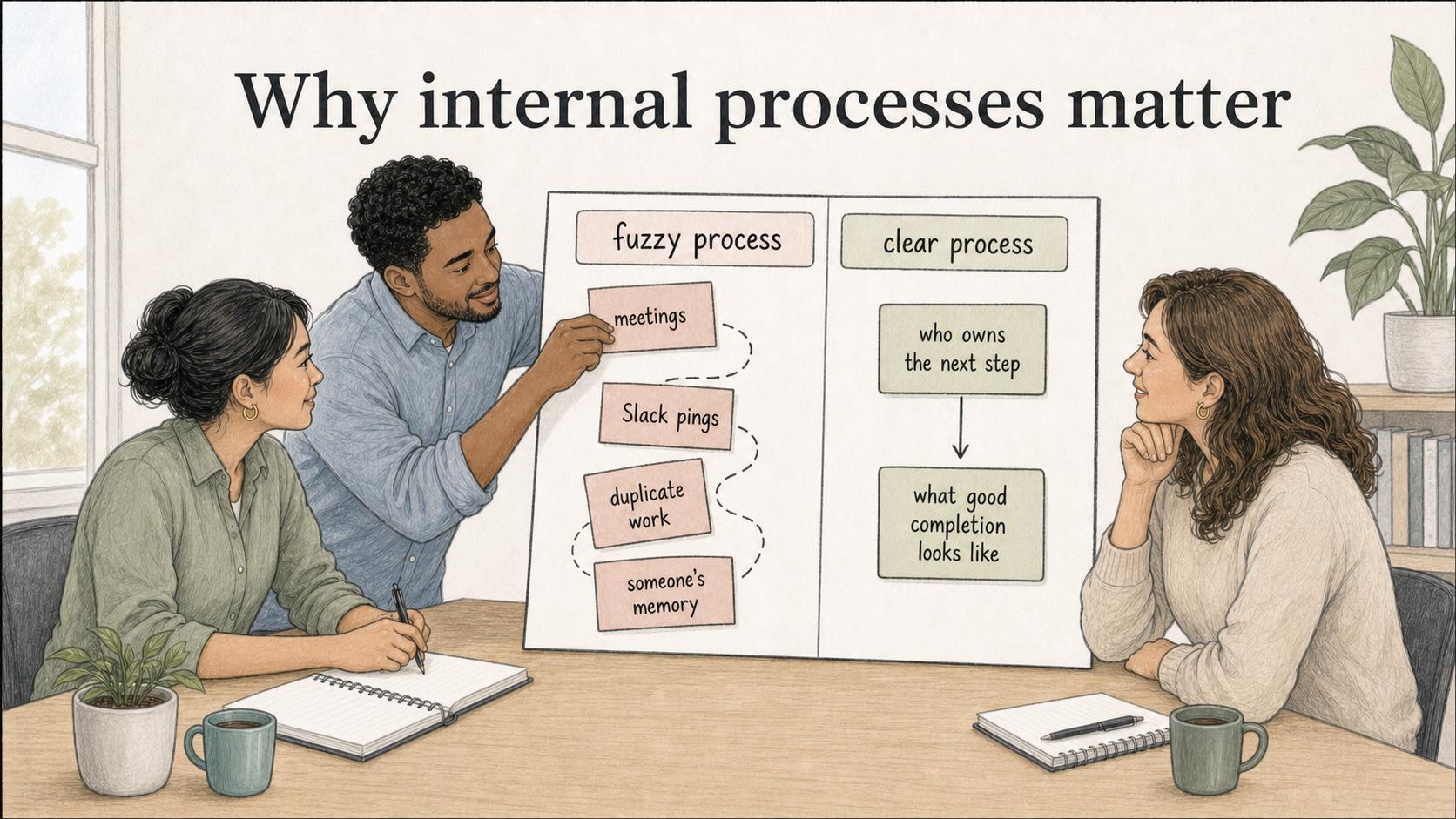
Internal processes decide how work actually moves. A clear process tells people what to do, who owns the next step, and what good completion looks like. 2 A fuzzy process gets patched with meetings, Slack pings, duplicate work, and someone’s memory.
Document the process when confusion repeats, work crosses teams, errors carry risk, or the work must survive onboarding, role changes, or audits. 3
Internal process vs SOP vs workflow
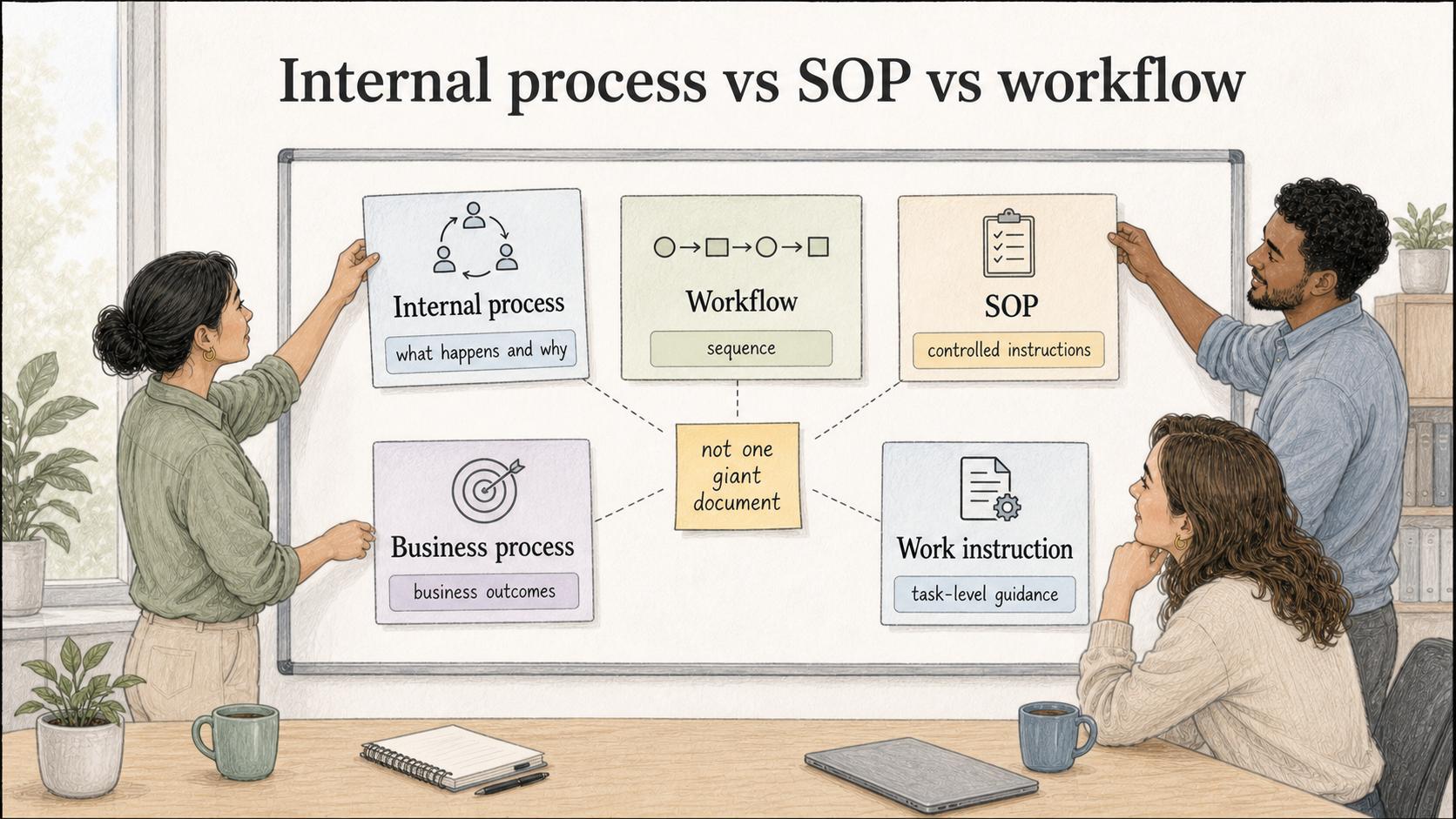
| Term | What it describes | Best use |
|---|---|---|
| Internal process | How work happens inside the company | Ownership, decisions, handoffs, outcomes |
| Workflow | The sequence of steps | Showing how work moves |
| SOP | Controlled instructions for repeatable work | Consistency or compliance |
| Business process | A broader process supporting outcomes | Cross-functional operations |
| Work instruction | Detailed task-level guidance | Specific actions |
The internal process explains what happens and why. The workflow shows the sequence. The SOP or work instruction gives exact operating instructions when precision matters.
Examples of internal processes
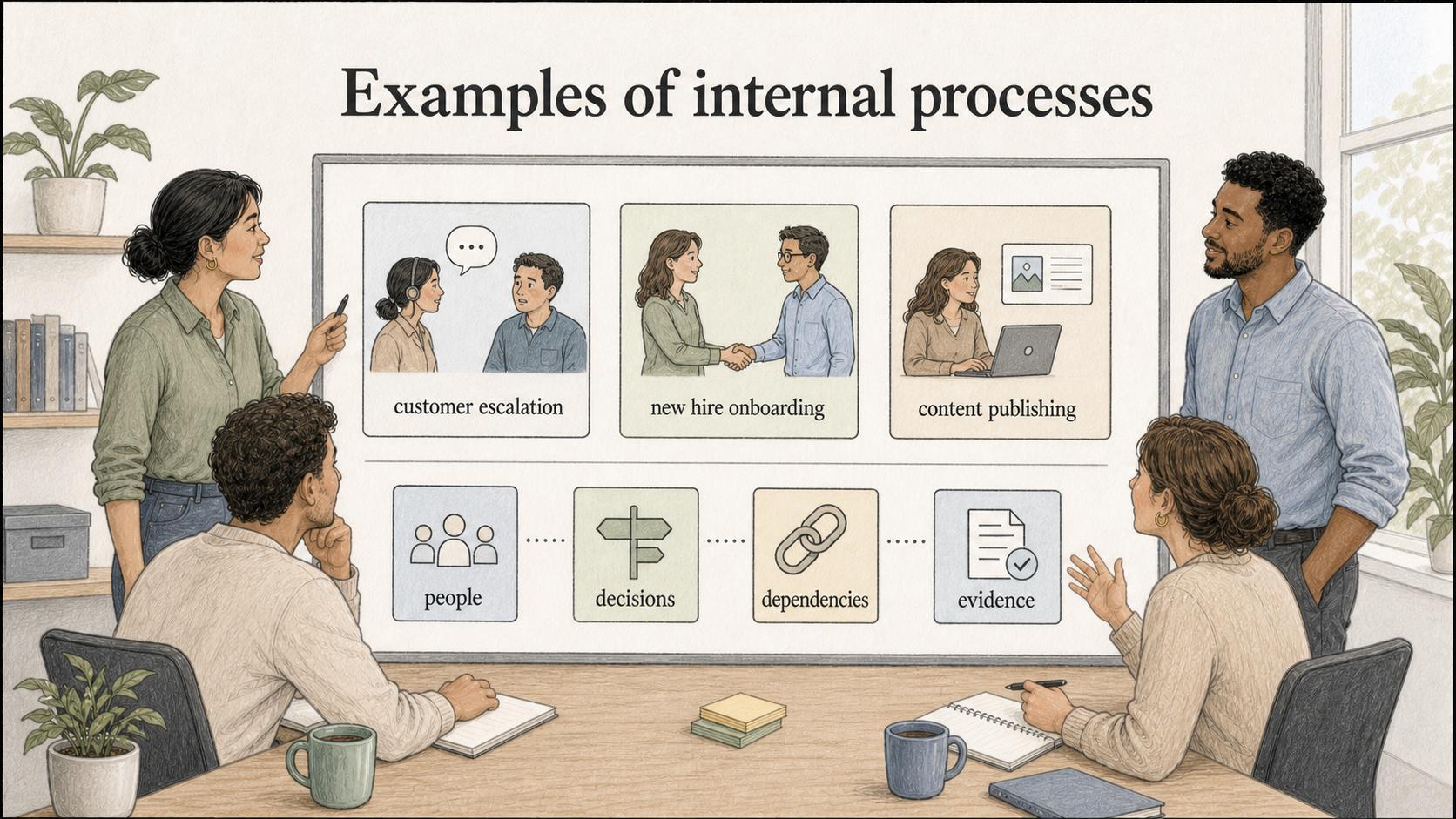
A customer escalation can define what information must be included, which team reviews it, how status is communicated, and when the case returns to the frontline owner. Onboarding can define paperwork, equipment, provisioning, training, and check-ins. A publishing process can define drafting, review, approval, release, and updates. 4
Where internal processes fail
Internal processes fail when they are designed as if the normal path is the only path. Real work has exceptions: an approver is out, a customer is urgent, a tool changed, a request is incomplete, or teams disagree about ownership.
A useful process names those pressure points and says when to continue, stop, escalate, or pause. Capture the real process first, then improve it.
How to document an internal process
- Start with the trigger and finish line: define what starts the process, what counts as done, and the output or evidence that should exist.
- Name owners by role, not person.
- Capture handoffs with context: what moves, where it moves, who receives it, and what happens if it is incomplete.
- Write the exception path early so workarounds can be approved, improved, or removed.
AI-ready internal process prompt
## Internal Process Prompt

**Glossary term:** Internal Process
**Source:** Trails Glossary — trails.so/glossary/internal-process

---

### 01. Turn a description into a process

"Turn this description into an internal process document for [team]:

[Paste notes, transcript, or rough steps]

Create a summary, trigger, outcome and completion evidence, roles, normal steps, decision points and exception paths, tools/records, and open questions. Do not invent missing details; mark them [needs confirmation]."
Internal process examples
How Trails helps
Trails helps teams capture internal processes while the work is being done, then turn that workflow into a polished step-by-step guide and AI-narrated video.
Sources
- 1
ISO. Guidance on the process approach in ISO 9001:2015. ISO. www.iso.org/iso/iso9001_2015_process_approach.pdf.
- 2
APQC. Process standardization. APQC. www.apqc.org/blog/what-process-standardization.
- 3
APQC. Process frameworks. APQC. www.apqc.org/process-frameworks.
- 4
McKinsey. Operational excellence. McKinsey. www.mckinsey.com/capabilities/operations/our-insights/operational-excellence-how-purpose-and-technology-can-power-performance.