
Glossary
Internal Wiki
 ChatGPT
 Perplexity
 Gemini
 Claude
What is an internal wiki?
An internal wiki is a private, shared knowledge hub where a company stores information employees need to understand how the organization works. It usually includes policies, process notes, team documentation, onboarding material, FAQs, decisions, and links to deeper resources.
A useful internal wiki acts as a map for company knowledge. Employees should be able to find the right answer, understand the context behind it, and know when to move into a more detailed guide, SOP, or system of record. 1
Why an internal wiki matters
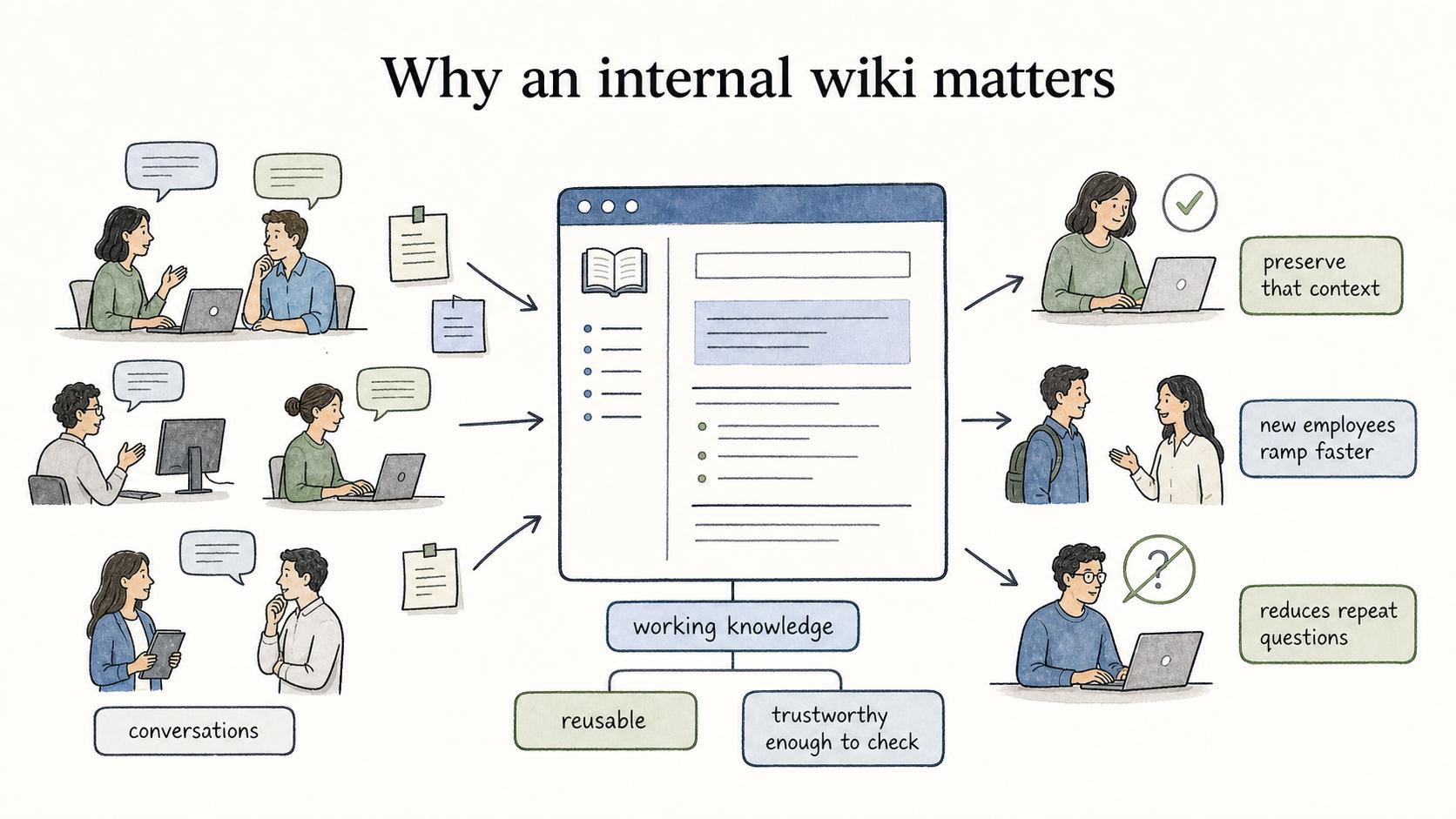
Internal knowledge usually starts in conversations. That works when the team is small. It breaks when people join quickly, change roles, work remotely, or forget why a decision was made. 2
An internal wiki gives the organization a place to preserve that context. It helps new employees ramp faster, reduces repeat questions, and gives experienced employees a way to turn working knowledge into something reusable. 34
What belongs in an internal wiki
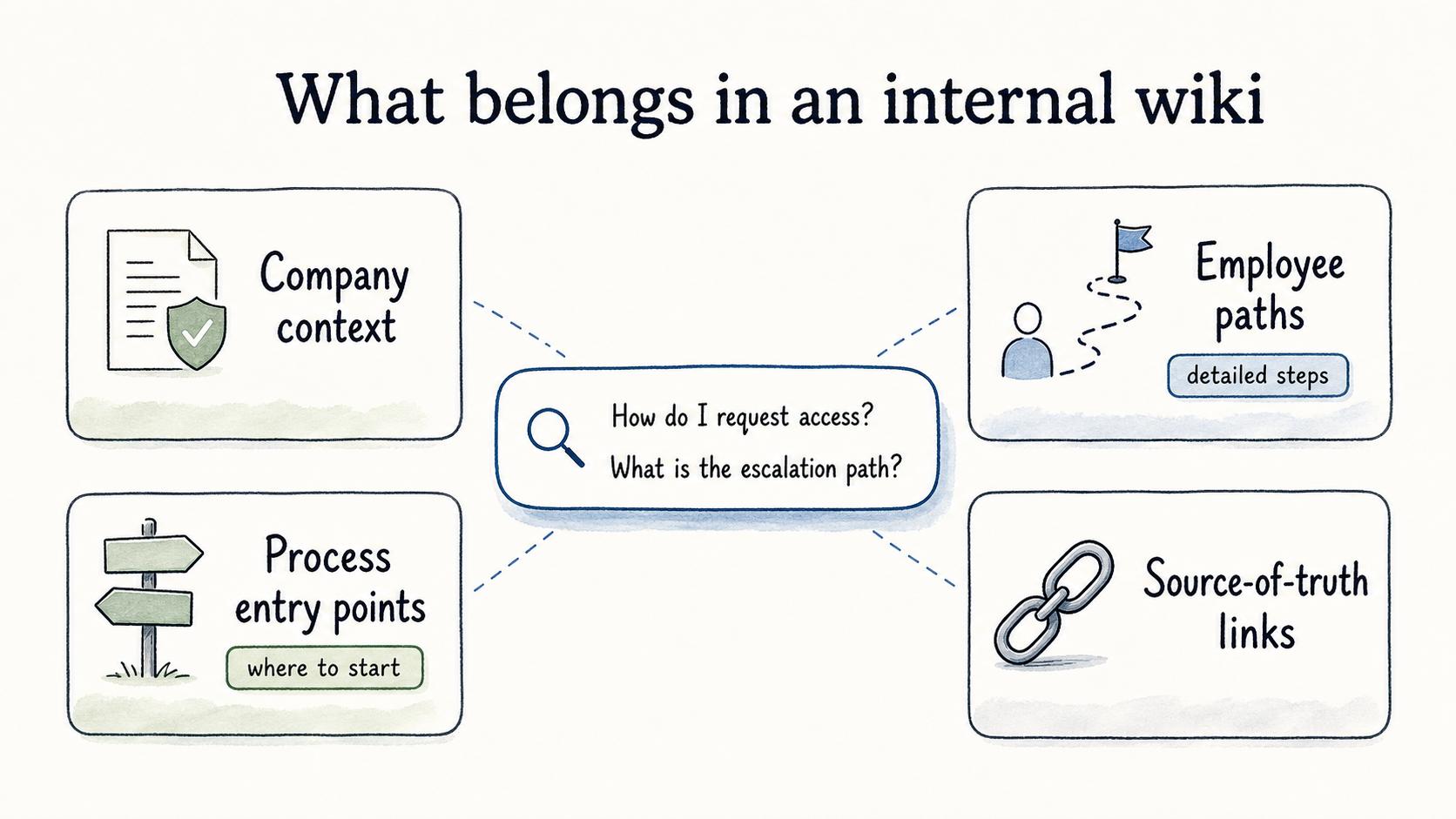
A good internal wiki organizes information by how employees look for it, not by how teams happen to store files. It should answer practical questions such as ‘How do I request access?’ or ‘What is the escalation path for this customer issue?’
- Company context: policies, norms, team charters, ownership notes, and decision records.
- Employee paths: onboarding pages, tool setup guidance, access instructions, and FAQs.
- Process entry points: overviews that explain where a process starts, who owns it, and which SOP or guide has detailed steps.
- Source-of-truth links: pointers to HR, finance, CRM, support, security, or operations systems where the official record lives.
A wiki page can explain that a process exists, who owns it, and where to start. The detailed workflow may belong in a dedicated guide or SOP. Mixing every detail into the wiki makes it harder to scan and maintain.
Internal wiki vs internal knowledge base
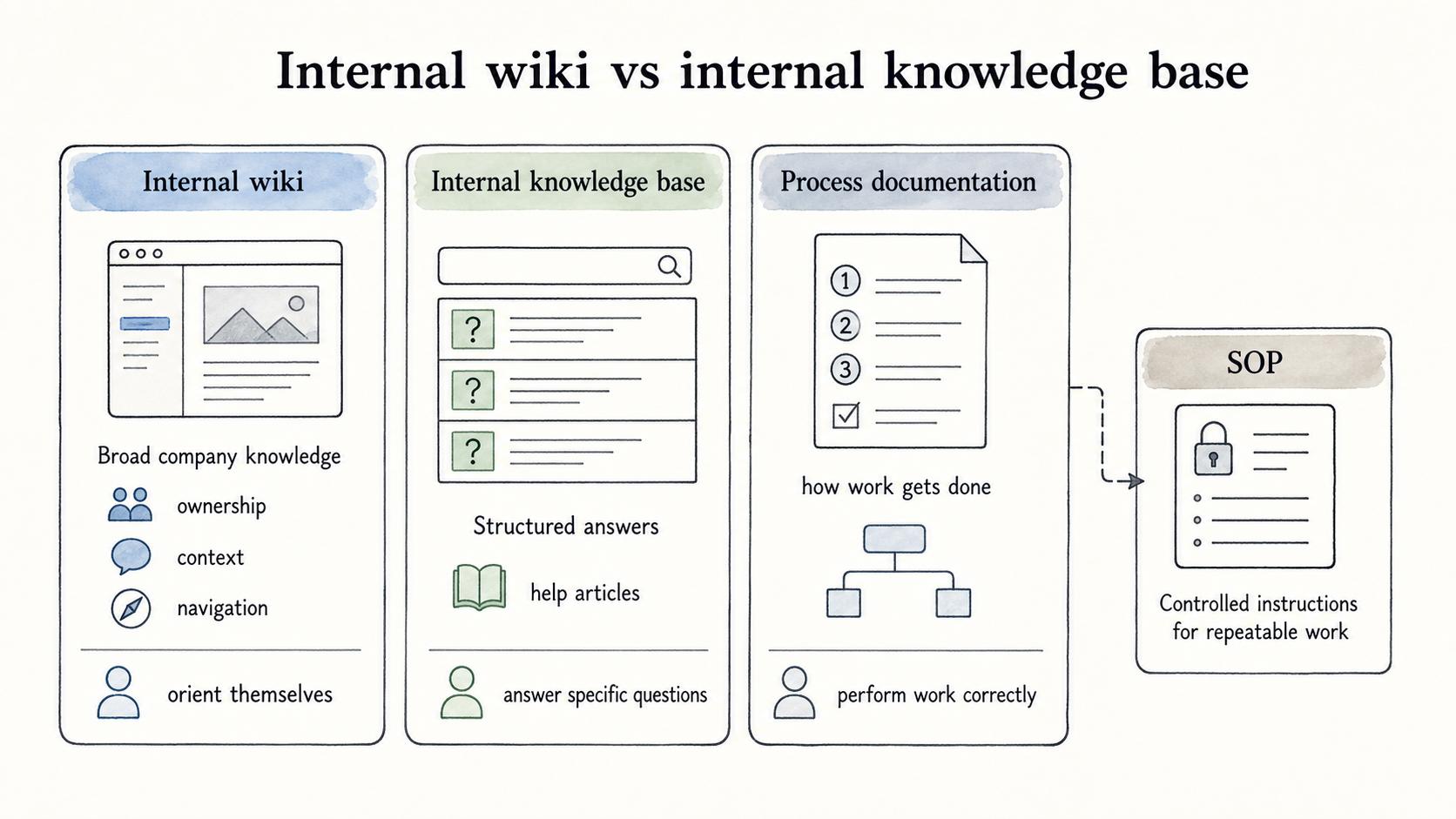
| Term | Best use | Typical failure mode |
|---|---|---|
| Internal wiki | Broad company knowledge, ownership, context, and navigation | Becomes a messy archive with no clear source of truth |
| Internal knowledge base | Structured answers, help articles, and reusable internal support content | Becomes too support-like and loses strategic context |
| Process documentation | Detailed explanation of how work gets done | Gets buried where employees can't find it |
| SOP | Controlled instructions for repeatable work | Gets copied into the wiki and then drifts out of sync |
A wiki helps employees orient themselves; a knowledge base helps them answer specific questions; process documentation helps them perform work correctly.
Where internal wikis fail
Internal wikis usually fail for one of three reasons: they are too empty, too full, or too stale.
An empty wiki never builds the habit because employees can't find enough useful answers. A bloated wiki makes search return outdated fragments, duplicate pages, and half-finished notes. A stale wiki teaches people that the answer might be wrong, so they ask a teammate instead.
Every important page needs an owner, a review trigger, and a clear link to the system or process it summarizes.
How to build a useful internal wiki
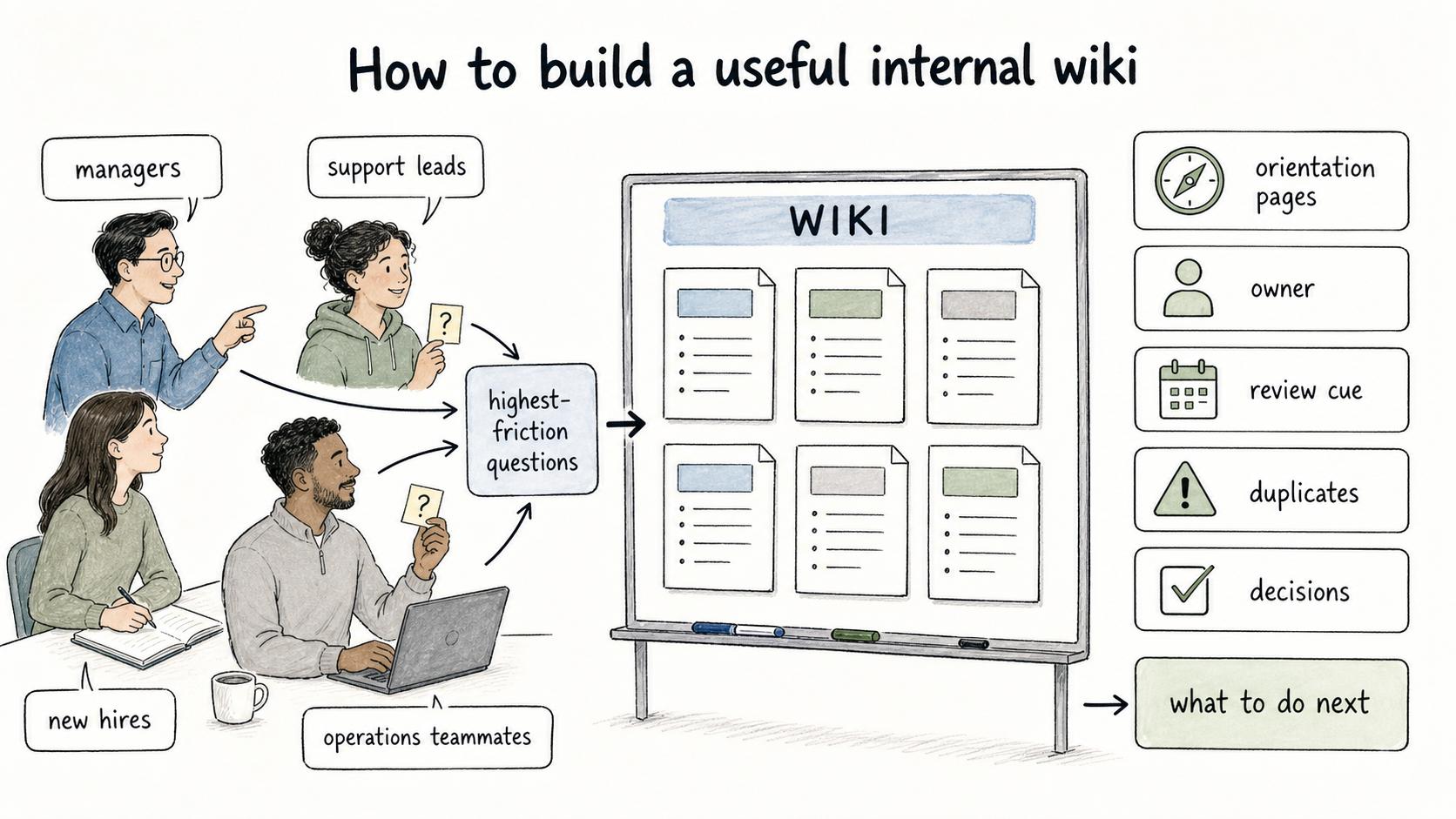
Start with the highest-friction questions instead of a perfect information architecture. Ask managers, new hires, support leads, and operations teammates what they explain repeatedly.
- Write orientation pages before exhaustive pages.
- Make freshness visible with an owner and review cue.
- Use duplicates as a warning sign of an ownership gap.
- Preserve decisions alongside instructions so future teammates understand why the company works a certain way.
Internal wiki starter template
## Internal wiki starter template

**Glossary term:** internal wiki
**Source:** Trails Glossary — trails.so/glossary/internal-wiki

---

### 01. Prompt

"Create an internal wiki page for [topic] for [team or audience].\n\nInclude:\n- A 2-3 sentence overview of what this topic is and why it matters.\n- The owner and the teams involved.\n- What employees should do first.\n- Links or placeholders for the source of truth, SOPs, policies, or systems.\n- Common mistakes or edge cases employees should know.\n- A review trigger that tells the owner when the page should be updated.\n\nKeep it concise enough for a new employee to scan in under three minutes."
How Trails helps
Trails helps teams create the step-by-step documentation that an internal wiki should point to. A teammate can capture a workflow while performing it, turn it into a polished guide, and create an AI-narrated video version for training or sharing.
The wiki can explain what the process is, who owns it, and when to use it, while Trails holds the practical workflow guide employees need to follow.
- Internal knowledge base
- Knowledge base
- Knowledge management
- Single source of truth
- Documentation software
- Process documentation
- Company wiki
Sources
- 1
APQC. What is Knowledge Management?. www.apqc.org/What-is-Knowledge-Management.
- 2
Gallup. Hybrid Work Indicator. www.gallup.com/401384/indicator-hybrid-work.aspx.
- 3
Microsoft. 2023 Work Trend Index. www.microsoft.com/en-us/worklab/work-trend-index/will-ai-fix-work.
- 4
APQC. What is knowledge transfer?. www.apqc.org/blog/what-knowledge-transfer.