
Glossary
Internal Knowledge Base
 ChatGPT
 Perplexity
 Gemini
 Claude
What is an internal knowledge base?
An internal knowledge base is a private, employee-facing library that helps people answer work questions without asking another teammate every time. It contains reusable articles, process guidance, troubleshooting steps, tool instructions, policies, and links to source systems. 1
Use it for repeat questions that interrupt managers, support leads, operations teams, HR, IT, or subject-matter experts. Its job is to make common answers easier to find, trust, and apply. 2
Why an internal knowledge base matters
Employees regularly ask how to request access, submit expenses, escalate a customer issue, find the latest template, or respond when a tool breaks. If answers live only in chat threads and individual memory, the same questions keep returning.
A knowledge base gives employees a first place to look and lets experts send people to a maintained answer instead of rewriting it. It turns scattered answers into managed knowledge. 3
Trust matters more than page count. Old screenshots, vague instructions, and conflicting pages send employees back to asking someone directly.
What belongs in an internal knowledge base
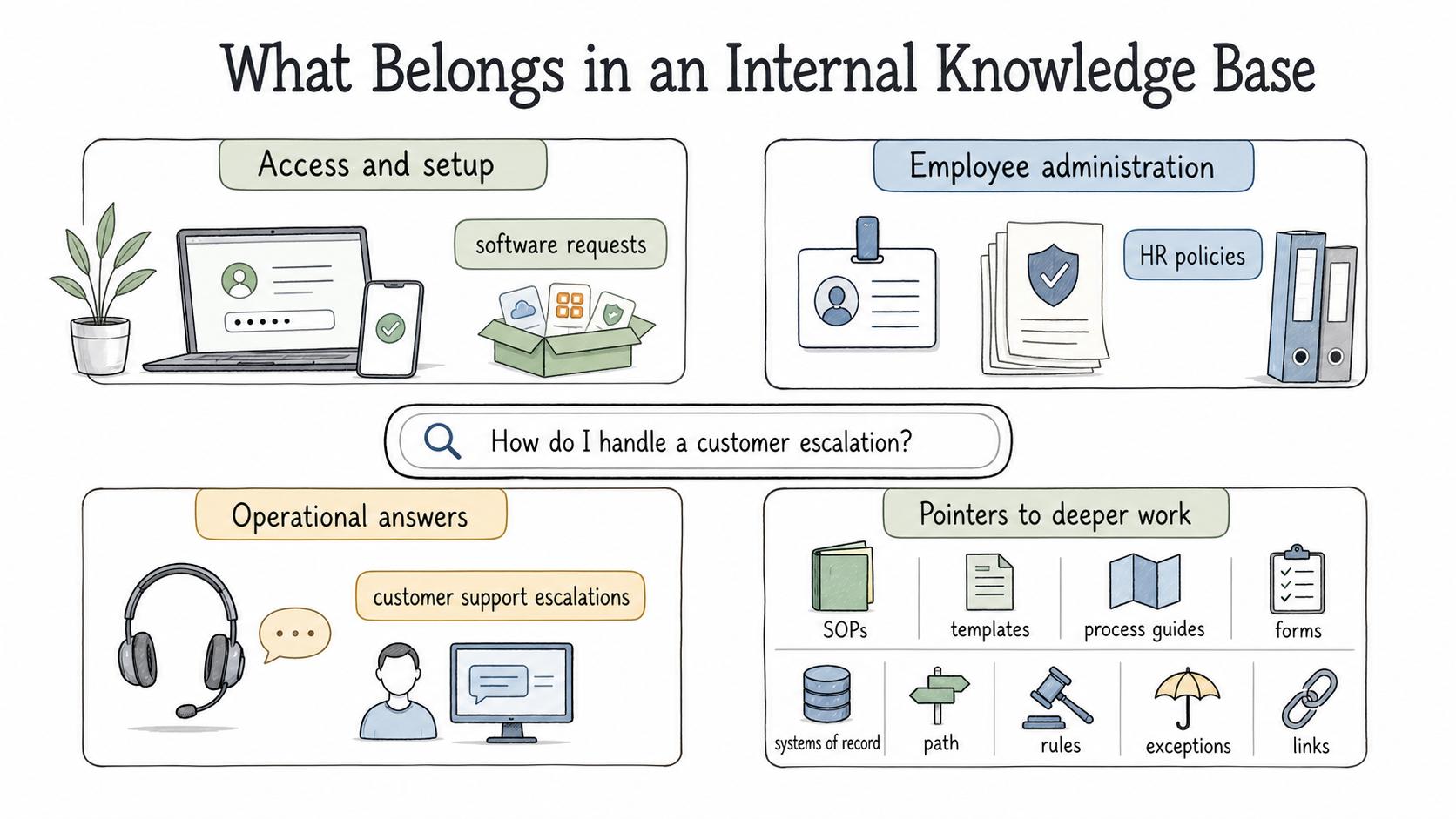
- Access and setup: software requests, account setup, device guidance, permissions, and tool troubleshooting.
- Employee administration: HR policies, benefits, expense instructions, finance rules, and recurring forms.
- Operational answers: support escalations, playbooks, internal FAQs, and handoff rules.
- Pointers to deeper work: links to SOPs, templates, process guides, forms, and systems of record.
The best articles solve a specific question without becoming process manuals. Point to detailed process documentation or an SOP when a deeper workflow is needed.
Internal knowledge base vs wiki vs help center
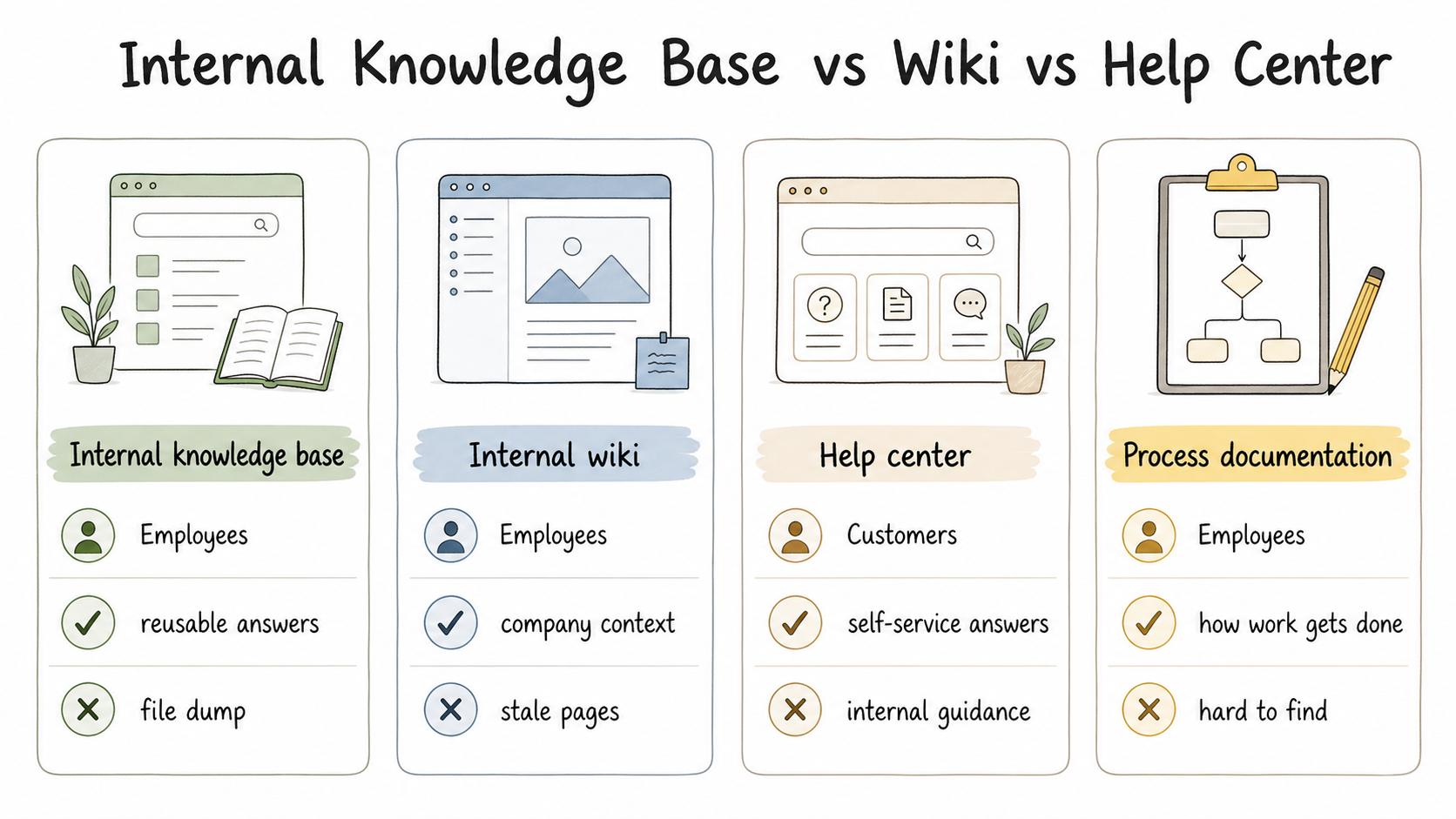
| Term | Audience | Best use | Common mistake |
|---|---|---|---|
| Internal knowledge base | Employees | Reusable internal answers | Treating it like a file dump |
| Internal wiki | Employees | Company context and decisions | Stale broad pages |
| Help center | Customers | External self-service | Mixing external and internal guidance |
| Process documentation | Operators | Detailed workflows | Hiding it |
The internal knowledge base is closest to internal self-service support. A wiki can hold broader context and process documentation can carry detailed workflows; the knowledge base often points to both.
Where internal knowledge bases fail
Article sprawl happens when teams create answers but do not group duplicates, remove outdated content, or notice that multiple articles explain the same policy differently. 4
Other failures are missing ownership and skipping the hard judgment: what counts as urgent, which exception needs approval, when to involve a manager, or what evidence to attach.
How to build an internal knowledge base that employees trust
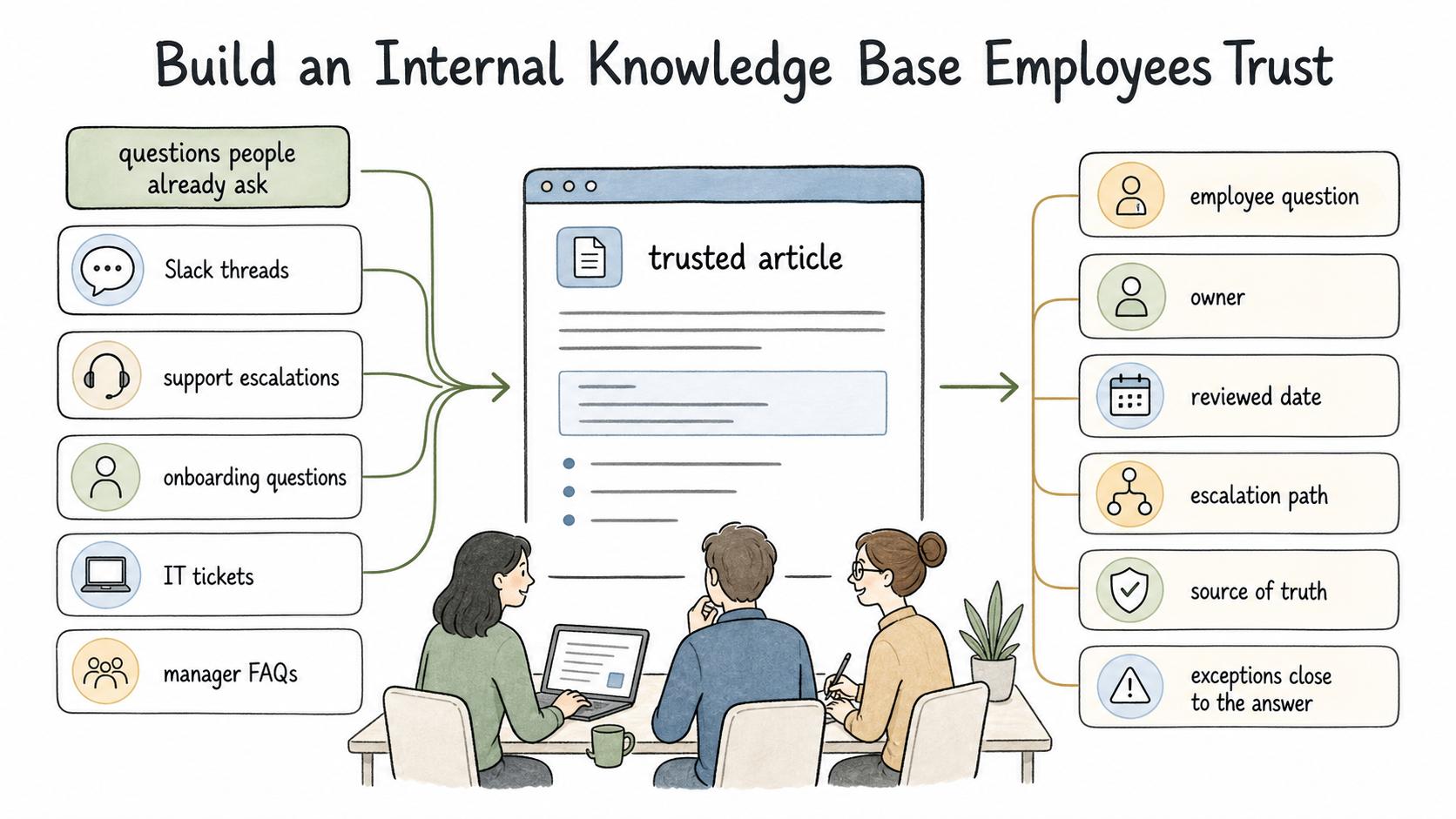
- Start with real questions from Slack, support escalations, onboarding, IT tickets, manager FAQs, and repeated explanations.
- Design articles around the employee’s question using titles that sound like what someone would search.
- Make ownership impossible to miss with an owner, review date, and escalation path.
- Link to the source of truth for policies, forms, workflows, and SOPs.
- Keep exceptions close to the answer.
Internal knowledge base article template
## Internal Knowledge Base Article Prompt

**Glossary term:** Internal Knowledge Base
**Source:** Trails Glossary — trails.so/glossary/internal-knowledge-base

---

### 01. Draft an employee-facing article

"Create an internal knowledge base article answering this employee question:

[Question]

Audience: [role/team]
Owner: [team or role]
Source of truth: [system, policy, SOP, or document]

Include a direct answer, applicability, steps if needed, exceptions, links/placeholders, escalation, and a review trigger. Mark unknown details as [needs confirmation]."
Trails helps teams create the workflow documentation that knowledge-base articles often need to reference, keeping articles focused on the answer while linking to accurate steps.
Internal knowledge base examples
Sources
- 1
APQC. What is knowledge management?. APQC. www.apqc.org/expertise/whatisknowledgemanagement.
- 2
Microsoft. 2023 Work Trend Index. Microsoft. www.microsoft.com/en-us/worklab/work-trend-index/will-ai-fix-work.
- 3
APQC. Managing knowledge starts with knowledge flow. APQC. www.apqc.org/blog/managing-knowledge-starts-knowledge-flow.
- 4
HDI. Knowledge-Centered Service principles. HDI. www.thinkhdi.com/education/courses/kcs-principles.