
Glossary
HR Standard Operating Procedures
 ChatGPT
 Perplexity
 Gemini
 Claude
What are HR standard operating procedures?
HR standard operating procedures are written instructions for repeatable human resources processes, such as hiring, onboarding, employee changes, performance reviews, policy updates, training coordination, and offboarding. They define who does what, in what order, with which approvals, records, tools, and handoffs.
Good HR SOPs make sensitive, recurring work consistent without turning every people decision into bureaucracy. Employees, managers, and the business should not have to rely on memory or improvisation for routine HR processes.
Why HR SOPs matter
HR work touches pay, access, legal risk, employee trust, manager expectations, and confidential information. That combination makes informal processes risky. 1
HR SOPs give the team a shared operating path before a situation becomes urgent, especially when HR coordinates with managers, IT, finance, legal, payroll, or department leaders. 2
Examples of HR standard operating procedures
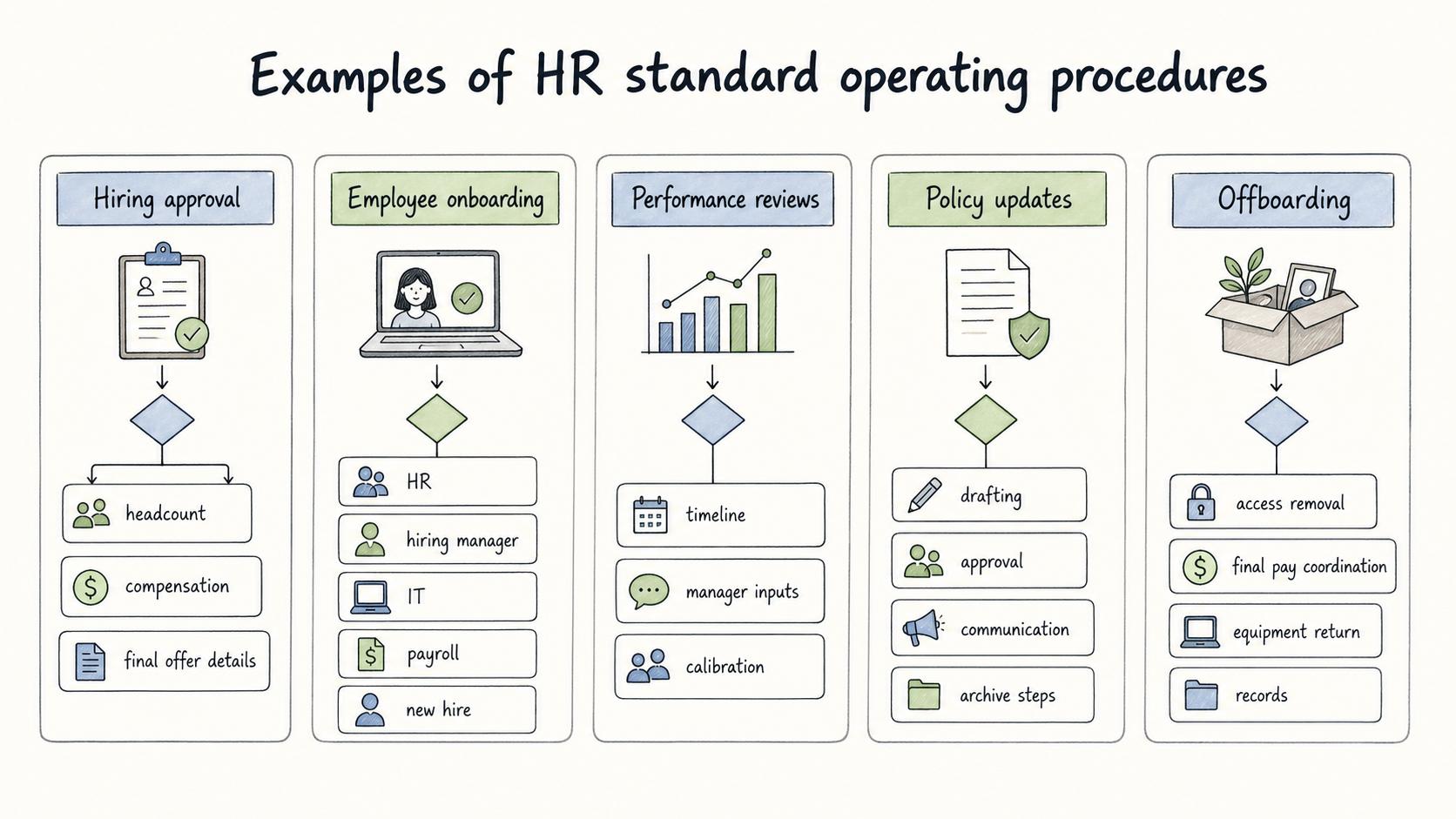
| HR process | SOP should clarify | Common failure mode |
|---|---|---|
| Hiring approval | Who approves headcount, compensation, and final offer details | Offers move faster than approvals |
| Employee onboarding | Handoffs between HR, hiring manager, IT, payroll, and the new hire | Everyone owns a piece, but nobody owns the sequence |
| Performance reviews | Timeline, manager inputs, calibration, employee communication | Reviews become inconsistent writing exercises |
| Policy updates | Drafting, approval, communication, and archive steps | Employees find stale policy versions |
| Offboarding | Access removal, final pay coordination, equipment return, records | Sensitive steps happen late or informally |
What belongs in an HR SOP
- Purpose and trigger
- Owner and participants
- Tools and systems
- Critical procedure steps and approvals
- Required records
- Common exceptions and escalation paths
- Review owner and review cadence
HR processes often break at the exception: a delayed start date, manager absence, compensation change, remote hire, sensitive employee-relations issue, or a recently changed policy. Good SOPs make the normal path clear and show where judgment begins. 3
HR SOPs vs HR policies
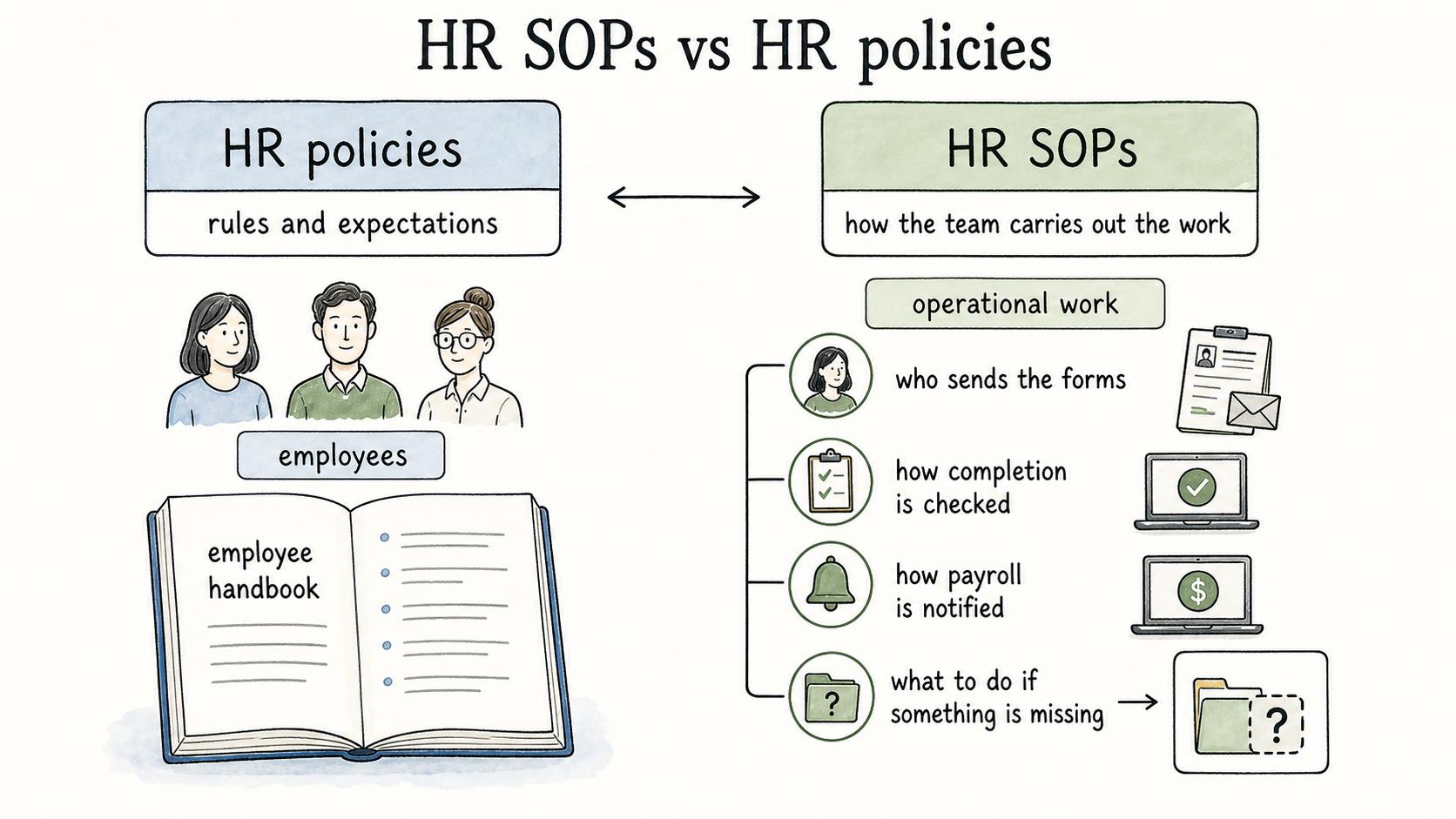
HR policies explain rules and expectations. HR SOPs explain how the team carries out the work. A handbook might require new-hire paperwork; an onboarding SOP explains who sends forms, checks completion, sends reminders, notifies payroll, and handles missing information.
How to create HR SOPs without over-documenting
Start with workflows that create repeated confusion, missed handoffs, or uneven manager behavior. Capture the real tools and approvals, then tighten weak spots. Assign ownership: HR SOPs go stale when systems, vendors, laws, benefits, or responsibilities change. 4
AI-ready HR SOP template
## HR Standard Operating Procedure Template

**Glossary term:** HR Standard Operating Procedures
**Source:** Trails Glossary — trails.so/glossary/hr-standard-operating-procedures

---

### 01. Create an HR SOP

"Create an HR standard operating procedure for [process].
Audience: [HR role, manager, or cross-functional team]
Company context: [team size, locations, tools, and constraints]
Trigger: [event that starts the process]
Primary owner: [role]
Teams involved: [HR, manager, IT, payroll, finance, legal, etc.]
Known exceptions: [edge cases]
Required records: [documents, approvals, forms, notes]

Write the SOP with: purpose, scope, roles and responsibilities, step-by-step procedure, approval points, systems and templates, exception handling, records to save, and review cadence. Flag any step where legal, payroll, or policy review may be needed."
How Trails helps
Many HR SOPs are easiest to document by watching the work happen. Trails captures a workflow as someone performs it, turns it into a polished step-by-step guide, and can create an AI-narrated video version for training or manager enablement.
FAQ
Which HR processes need SOPs first?
Start with frequent, sensitive, cross-functional, or easy-to-mishandle processes: hiring approvals, onboarding, performance reviews, policy updates, employee changes, leave coordination, and offboarding.
Are HR SOPs the same as an employee handbook?
No. A handbook explains employee policies and expectations; HR SOPs explain the operational work behind those policies.
- Onboarding SOP
- Hiring SOP
- Recruitment SOP
- Performance review SOP
- Employee handbook
- HR manager
- SOP training
Sources
- 1
U.S. Department of Labor. FLSA recordkeeping fact sheet. www.dol.gov/agencies/whd/fact-sheets/21-flsa-recordkeeping.
- 2
EEOC. Summary of selected recordkeeping obligations. www.eeoc.gov/employers/summary-selected-recordkeeping-obligations-29-cfr-part-1602.
- 3
ISO. Guidance on documented information for ISO 9001:2015. www.iso.org/iso/documented_information.pdf.
- 4
OSHA. Recommended practices for safety and health programs. www.osha.gov/sites/default/files/publications/OSHA3885.pdf.