
Glossary
Hiring SOP
 ChatGPT
 Perplexity
 Gemini
 Claude
What is a hiring SOP?
A hiring SOP is a standard operating procedure that documents how a team opens, runs, evaluates, and closes a hiring process. It turns recruiting expectations into repeatable steps so hiring managers, recruiters, interviewers, and operations teams know who owns each stage, when decisions happen, and what evidence has to be captured.
A strong hiring SOP keeps the process consistent without pretending hiring is mechanical. Candidates get a fairer experience, managers do not reinvent the workflow for every role, and the company can explain why decisions were made. 1
Why a hiring SOP matters
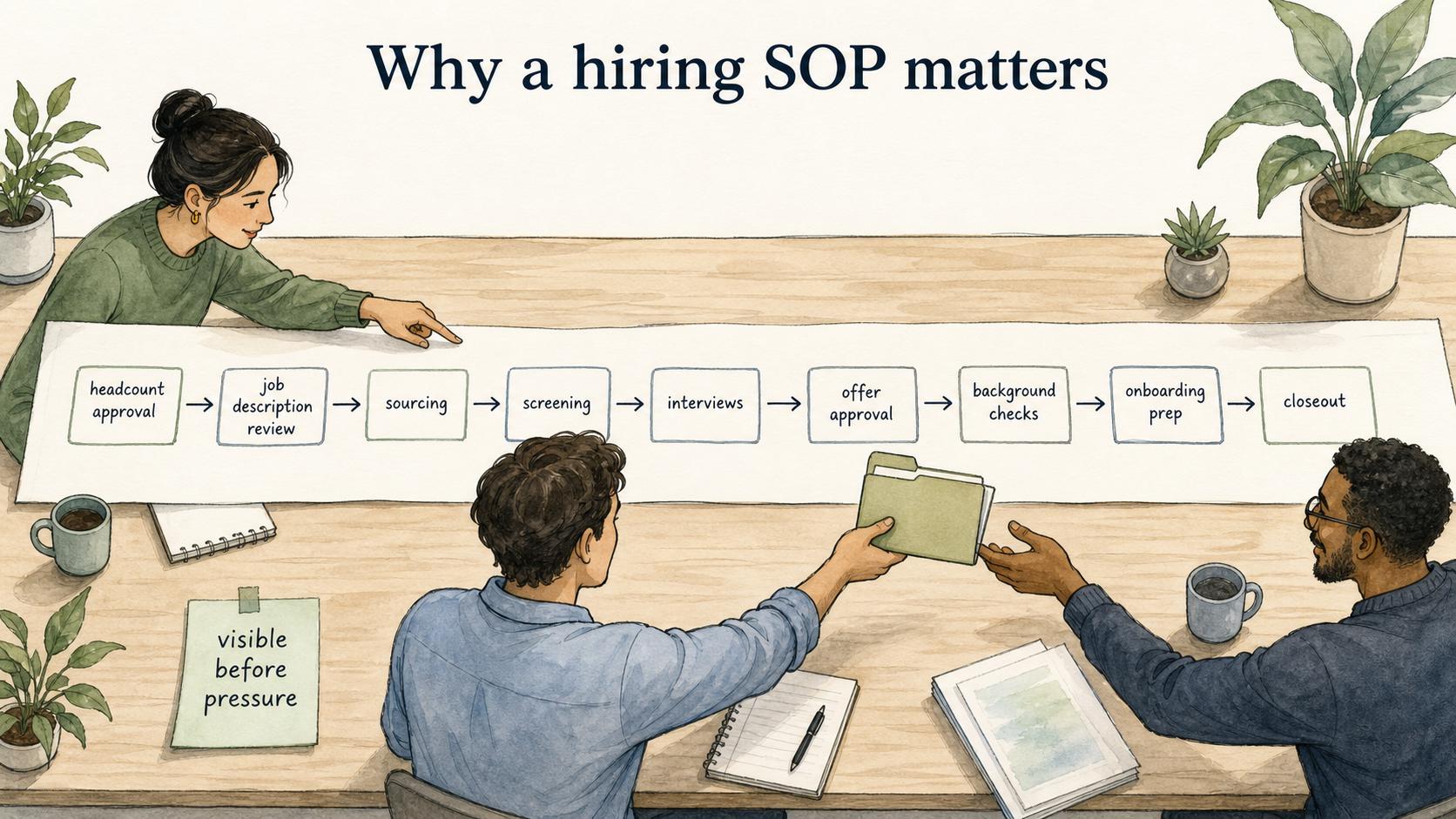
Hiring moves through headcount approval, role review, sourcing, screening, interviews, offer approval, background checks, onboarding preparation, and closeout. Without an SOP, urgency becomes the process: scorecards are skipped, stages are added ad hoc, and candidate experience changes by role.
A good hiring SOP makes the work and its record visible before the team is under pressure to fill the seat. Hiring mistakes carry real cost in time, morale, and trust. 2
What a hiring SOP should include
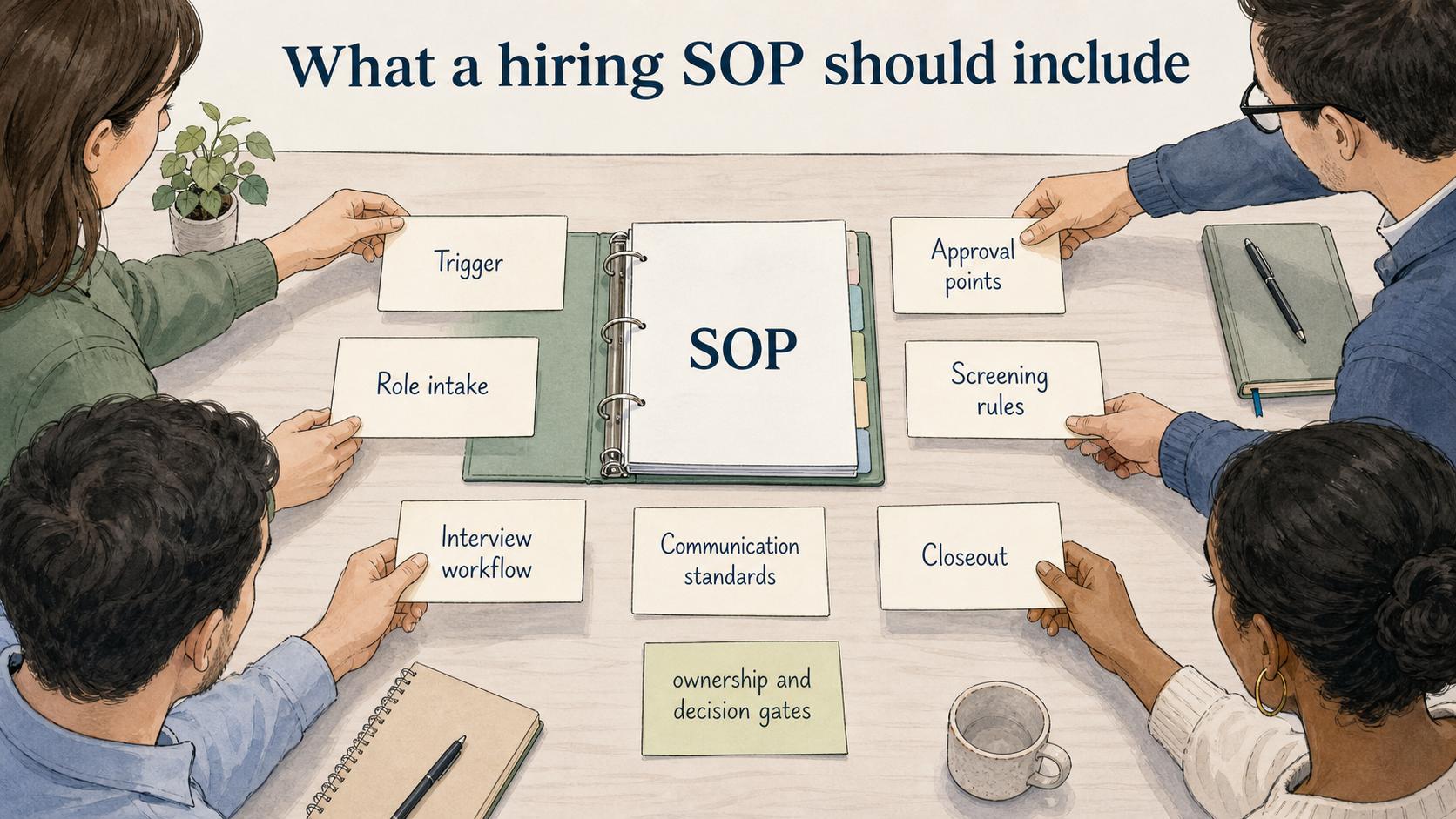
- Trigger and role intake: approved headcount or another role request, plus scope, range, criteria, interview plan, and target date.
- Approval points: role opening, job description, compensation, offer, and exceptions.
- Screening and interview rules: the criteria, assigned evaluators, feedback process, and debrief timing.
- Communication and closeout: who updates candidates, records the decision, archives materials, and starts onboarding preparation.
Hiring is a chain of decisions, not just a task list. If the SOP does not name the evidence required at each gate, people fill the gap with preference, habit, or urgency.
Example: structured interview workflow
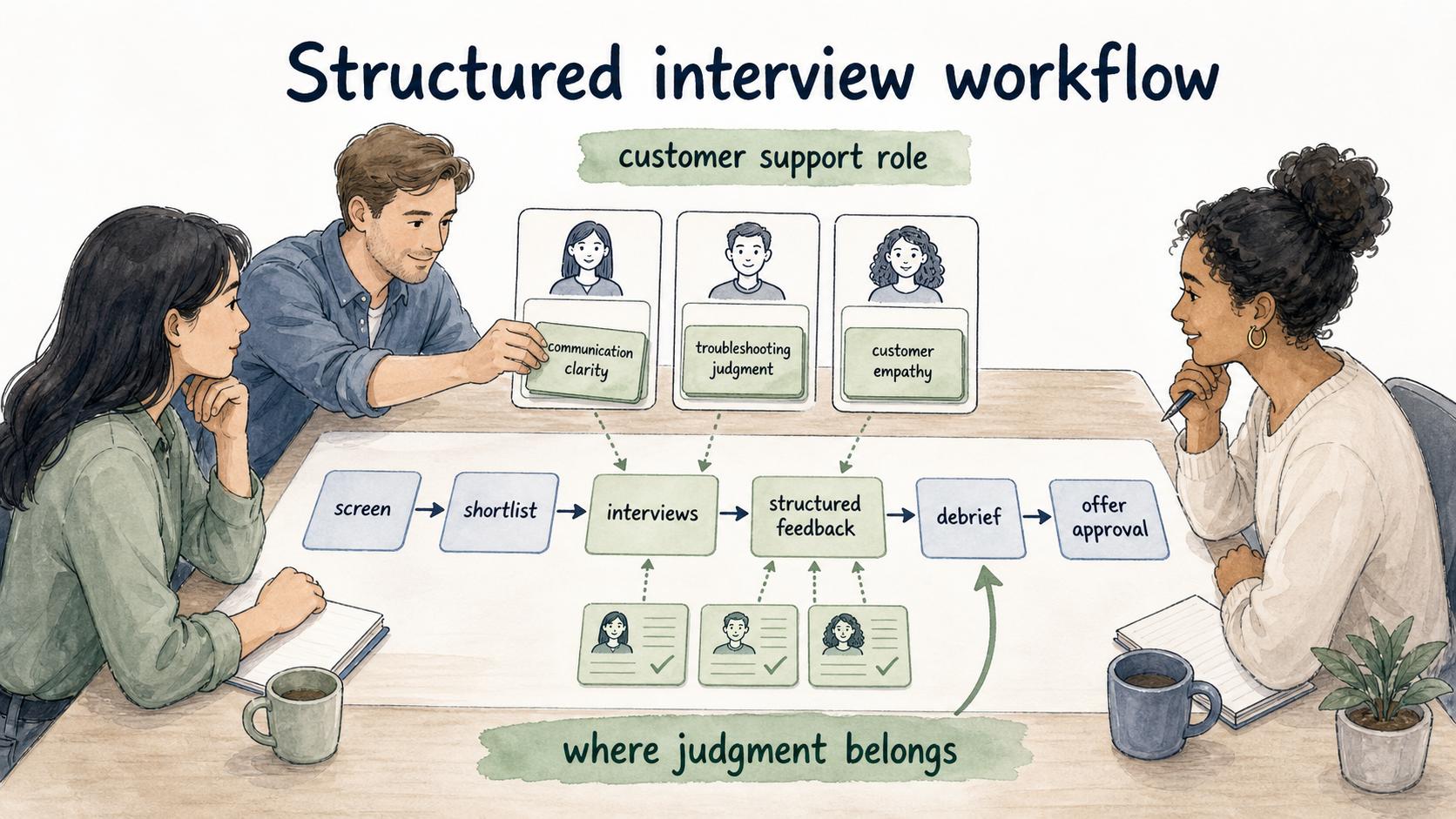
A customer-support hiring workflow might assign role intake to the manager, screening to recruiting, and structured feedback to interviewers. Before interviews, the team agrees on evaluation areas such as communication clarity, troubleshooting judgment, and customer empathy. 3
- Recruiting screens for basic qualifications and availability.
- The hiring manager reviews the shortlist against agreed criteria.
- Interviewers own assigned competencies and submit feedback before the debrief.
- The offer waits until compensation and required approvals are complete.
Common mistakes
Do not document only the happy path. Include exception rules for delayed feedback, compensation changes, candidate withdrawals, referral conflicts, urgent backfills, and changing roles. Also separate coordination ownership from decision ownership and make candidate communication specific; candidate experience breaks in the gaps between stages. 4
AI-ready hiring SOP template
## Hiring SOP Template

**Glossary term:** Hiring SOP
**Source:** Trails Glossary — trails.so/glossary/hiring-sop

---

### 01. Create a hiring SOP

"Create a hiring SOP for [role type or department].

Context:
- Company size: [size]
- Hiring tools: [ATS, HRIS, calendar, assessment tools]
- Process owners: [recruiter, hiring manager, HR, finance, department head]
- Required approvals: [headcount, compensation, offer, background check, legal review]
- Candidate stages: [intake, sourcing, screen, interviews, offer, closeout]

Include purpose and scope, intake requirements, responsibilities, stage-by-stage workflow, decision criteria and evidence, communication standards, exception handling, and the closeout/onboarding handoff."
How Trails helps
Trails helps HR and recruiting teams capture repeatable steps across tools, approvals, and handoffs, then turn them into polished guides or AI-narrated videos without rebuilding the process documentation from scratch.
- Hospitality SOP
- Employee onboarding
- Employee handbook
- Approval workflow
- Checklist
Sources
- 1
EEOC. Employment Tests and Selection Procedures. www.eeoc.gov/laws/guidance/employment-tests-and-selection-procedures.
- 2
SHRM. 2025 Benchmarking Reports. www.shrm.org/about/press-room/shrm-releases-2025-benchmarking-reports--how-does-your-organizat.
- 3
Schmidt, Oh, and Shaffer. Selection-Method Validity Update. home.ubalt.edu/NTYGMITC/645/session%204/Schmidt%20%26%20Oh%20validity%20and%20util%20100%20yrs%20of%20research%20Wk%20PPR%202016.pdf.
- 4
SHRM. Talent Board Candidate-Experience Research. www.shrm.org/topics-tools/news/talent-acquisition/candidate-experience-talent-board-research-candes.