
Glossary
Recruitment SOP
 ChatGPT
 Perplexity
 Gemini
 Claude
What is a recruitment SOP?
A recruitment SOP is a standard operating procedure that defines how an organization runs its hiring process. It explains the repeatable steps for opening a role, sourcing candidates, screening, interviewing, making decisions, extending offers, and handing a new hire into onboarding.
A good recruitment SOP does not remove judgment from hiring. It makes the judgment visible: what criteria matter, who decides, which approvals are required, and what records need to be captured.
Why a recruitment SOP matters
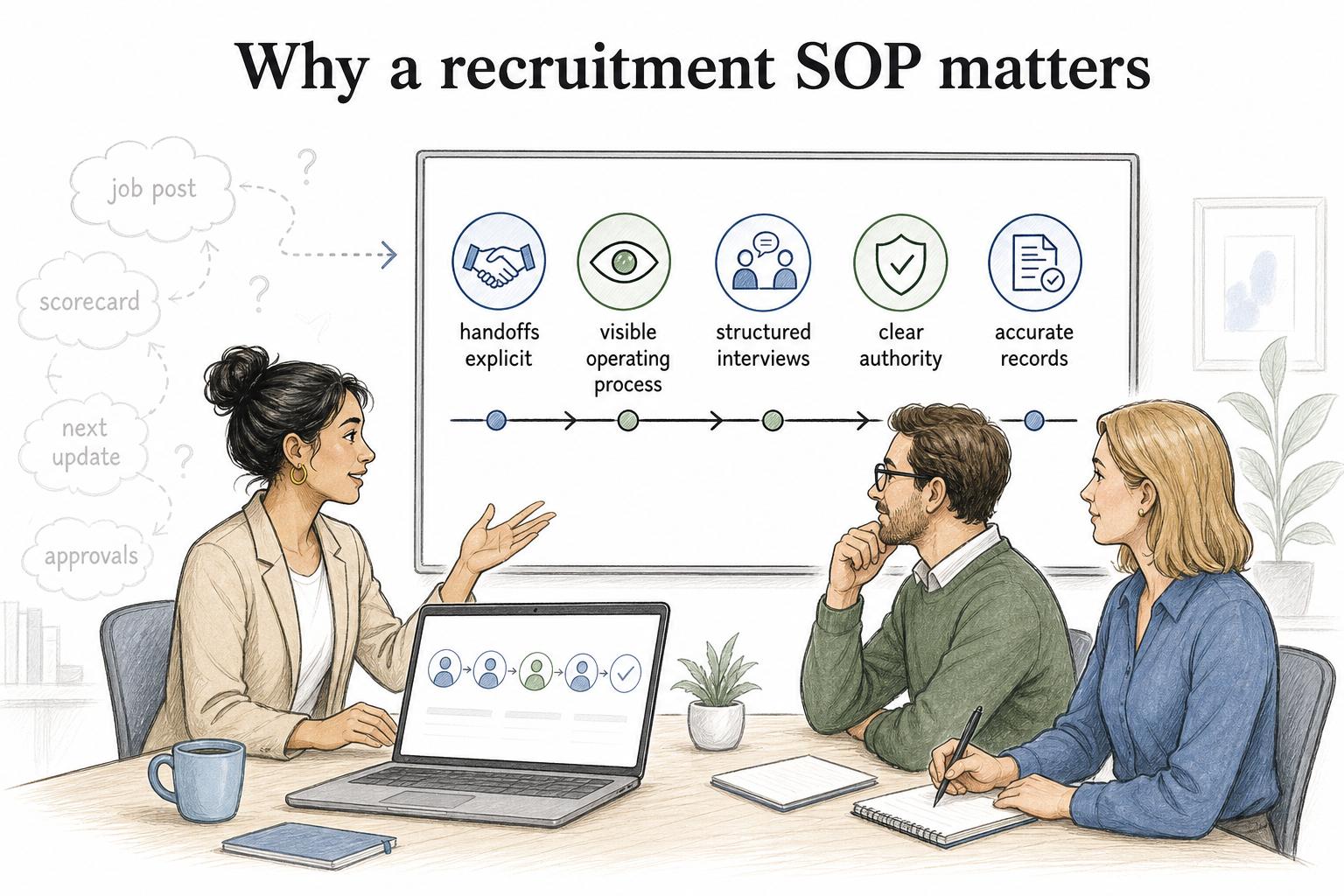
Hiring often breaks in the spaces between people. A hiring manager assumes the recruiter will write the job post. The recruiter assumes the manager owns the scorecard. Interviewers use different criteria. Finance is pulled in after the offer is already drafted. Candidates wait because nobody owns the next update.
A recruitment SOP makes those handoffs explicit. It turns hiring from a series of informal requests into a visible operating process.
That matters even for small teams. Without a documented process, every role becomes a one-off project. The EEOC's private-sector best practices emphasize consistent application procedures, structured interviews, clear authority, and accurate records around selection decisions.1 A team may still hire good people without an SOP, but the process becomes harder to scale, audit, and improve because no one can see where delays or inconsistent decisions are coming from.
What a recruitment SOP should include
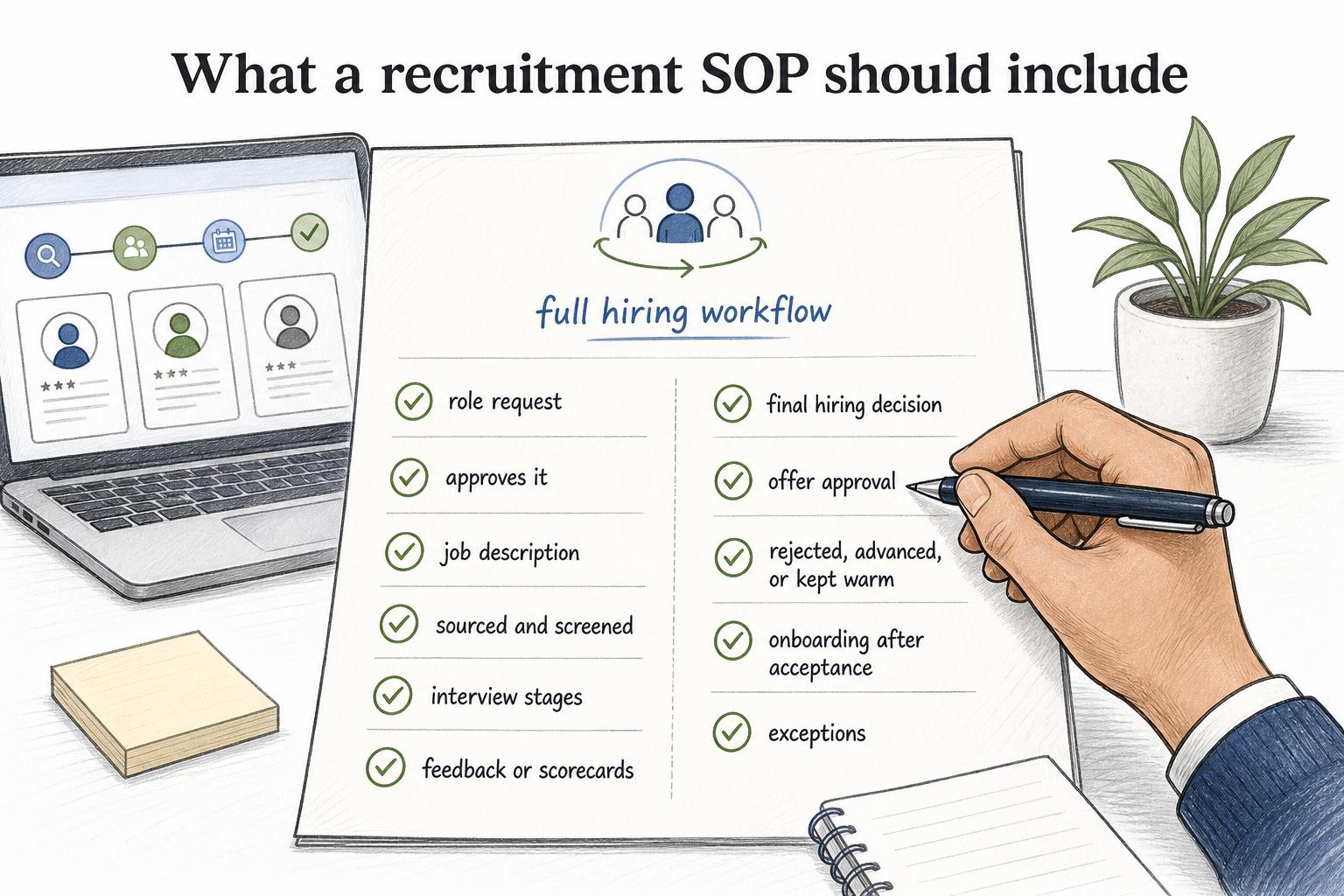
A useful recruitment SOP covers the full hiring workflow, including more than interview scheduling. The exact sections depend on the organization, but most recruitment SOPs need to define:
- How a role request starts and who approves it.
- What information is required before a role opens.
- Who writes, reviews, and posts the job description.
- How candidates are sourced and screened.
- Which interview stages happen, in what order, and who owns each one.
- How interview feedback or scorecards are captured.
- Who makes the final hiring decision and offer approval.
- How candidates are rejected, advanced, or kept warm.
- What gets handed off to onboarding after acceptance.
The SOP should also name exceptions. Internal candidates, urgent hires, referrals, contractors, location-specific roles, and executive searches often need variations. If exceptions are not documented, they become side doors that quietly replace the process.
Example recruitment SOP workflow
A simple recruitment SOP might follow this flow:
- Hiring manager submits a role request with business need, budget, level, location, and target start date.
- Approver confirms headcount, compensation range, and priority.
- Recruiter and hiring manager run intake to define must-have criteria, interview plan, and candidate profile.
- Recruiter drafts or updates the job description.
- Hiring manager reviews the posting before launch.
- Recruiter sources candidates and screens against agreed criteria.
- Interviewers use assigned focus areas and submit feedback in the same format.
- Recruiter gathers feedback and flags decision gaps.
- Hiring manager makes the hiring decision with required approvals.
- Recruiter manages offer communication and records the outcome.
- Accepted candidate details move to onboarding.
The exact number of steps matters less than the operating pattern. Each step should have an owner, input, output, and decision rule.
Recruitment SOP vs hiring policy
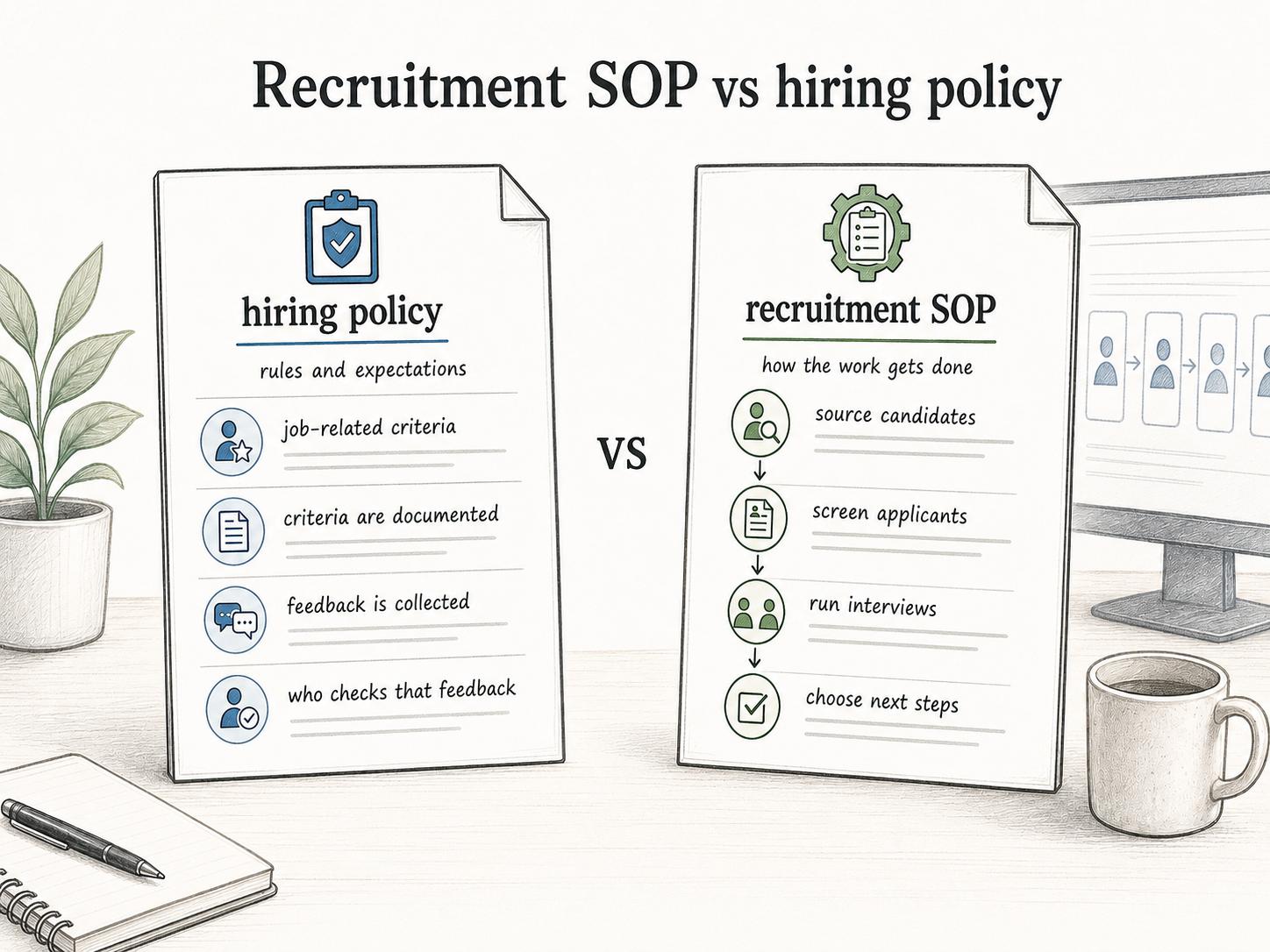
A hiring policy defines rules and expectations. A recruitment SOP explains how the work gets done.
For example, a hiring policy might say that all candidates must be evaluated using job-related criteria. The Uniform Guidelines on Employee Selection Procedures apply to tests and selection procedures used for employment decisions, including hiring.2 The recruitment SOP would explain where the criteria are documented, when interviewers receive them, how feedback is collected, and who checks that feedback before a decision is made.
That distinction matters because policies are often too broad to guide daily work. The SOP converts policy intent into repeatable behavior without trying to restate every rule.
How to write a recruitment SOP
Start by mapping the current process with the people who actually run it. Do not begin with an idealized hiring workflow. Begin with what happens today, then decide what should become standard.
Use this prompt as a working template:
## Recruitment SOP Template

**Glossary term:** Recruitment SOP
**Source:** Trails Glossary — trails.so/glossary/recruitment-sop

---

### 01. Create a recruitment SOP

"Create a recruitment SOP for [team, department, location, or role type].

Purpose: [why this hiring process needs to be standardized]
Scope: [roles, employment types, locations, or departments covered]
Roles: [recruiter, hiring manager, interviewers, approvers, HR, finance]
Trigger: [what starts the process]
Required inputs: [role details, budget, criteria, timeline]
Procedure: [step-by-step hiring workflow]
Decision points: [approval, screening, interview, offer]
Artifacts: [intake form, job description, scorecard, offer request, candidate emails]
Records: [where notes, feedback, approvals, and outcomes are stored]
Exceptions: [urgent hires, internal moves, referrals, contractors]
Handoff: [what onboarding receives after acceptance]
Owner and review cadence: [who maintains the SOP]

Write the SOP so a new recruiter or hiring manager can follow the workflow without asking where the next handoff happens."
After drafting, pressure-test the SOP against a real recent hire. If the SOP cannot explain where that hire stalled, who made key decisions, or what artifacts were produced, it is not operational enough yet.
Common mistakes
One mistake is documenting only the recruiter's work. Recruitment is cross-functional. A good SOP also covers hiring manager input, interviewer responsibilities, approval timing, communication expectations, and onboarding handoff.
Another mistake is burying decision criteria in conversation. Criteria should be agreed before screening starts, not reconstructed after interviews when people already have preferences. OPM guidance says structured interviews use rules for eliciting, observing, and evaluating responses, increasing interviewer agreement by limiting discretion.3
A third mistake is treating the SOP as legal coverage. A recruitment SOP can improve consistency, but it should still be reviewed against company policy and applicable HR, privacy, and employment requirements by the right internal owners. EEOC guidance notes that tests and selection procedures can raise issues under federal anti-discrimination laws if used in discriminatory ways or if they disproportionately exclude protected groups without legal justification.4
How Trails helps
Trails helps teams document the actual hiring workflow as it is performed, then turn it into a polished step-by-step guide. For recruitment SOPs, that can capture intake forms, approval paths, applicant tracking steps, interview handoffs, candidate communication tasks, and onboarding transitions. Teams can also create an AI-narrated video version for hiring managers or interviewers who need a quick walkthrough.
See how teams use Trails for HR process documentation to turn recruiting and onboarding system steps into references for hiring managers.
Sources
- 1
EEOC. Best Practices of Private Sector Employers. U.S. Equal Employment Opportunity Commission. www.eeoc.gov/best-practices-private-sector-employers. Accessed July 13, 2026.
- 2
U.S. Department of Labor. Uniform Guidelines on Employee Selection Procedures. eCFR. www.ecfr.gov/current/title-41/subtitle-B/chapter-60/part-60-3. Accessed July 13, 2026.
- 3
U.S. Office of Personnel Management. Structured Interviews. OPM. www.opm.gov/policy-data-oversight/assessment-and-selection/other-assessment-methods/structured-interviews/. Accessed July 13, 2026.
- 4
EEOC. Employment Tests and Selection Procedures. U.S. Equal Employment Opportunity Commission. www.eeoc.gov/laws/guidance/employment-tests-and-selection-procedures. Accessed July 13, 2026.