
Glossary
Performance Review SOP
 ChatGPT
 Perplexity
 Gemini
 Claude
What is a performance review SOP?
A performance review SOP is a standard operating procedure for running employee performance reviews. It documents the review timeline, roles, manager steps, employee steps, forms, calibration points, recordkeeping expectations, and follow-up actions.
The SOP does not judge employee performance. It defines how the review process runs, so HR, managers, and employees are not rebuilding the workflow every cycle. Performance reviews require judgment; the operating process around them should not feel improvised.
Why a performance review SOP matters
Performance reviews sit between people management, documentation, compensation, development, and manager communication. When the process is vague, the problems usually show up as late manager submissions, mismatched employee instructions, rushed calibration, unclear follow-up, or HR answering the same procedural questions one manager at a time.
A good SOP gives the cycle an operating rhythm. It tells HR when to open the cycle, tells managers what to prepare, tells employees what to expect, and tells leadership where calibration or approval fits. Structured reviews still matter when they support regular conversations, clear measures, and useful feedback.1 A consistent workflow gives managers more room to handle the human conversation thoughtfully.
What the SOP should cover
A performance review SOP should cover the full cycle, not just the review meeting. The meeting is the visible moment, but many failures happen before or after it.
Useful sections include scope, eligibility, timeline, roles, required tools, communication plan, manager preparation, employee self-review, calibration, review meeting expectations, documentation requirements, follow-up actions, exception handling, and process ownership.
The section teams most often underwrite is exceptions. New hires, employees on leave, recent manager changes, role transfers, missed deadlines, and unusual performance situations all create ambiguity. If HR does not document those cases, the SOP can look complete while still forcing one-off decisions during the busiest part of the cycle.
A practical review-cycle workflow
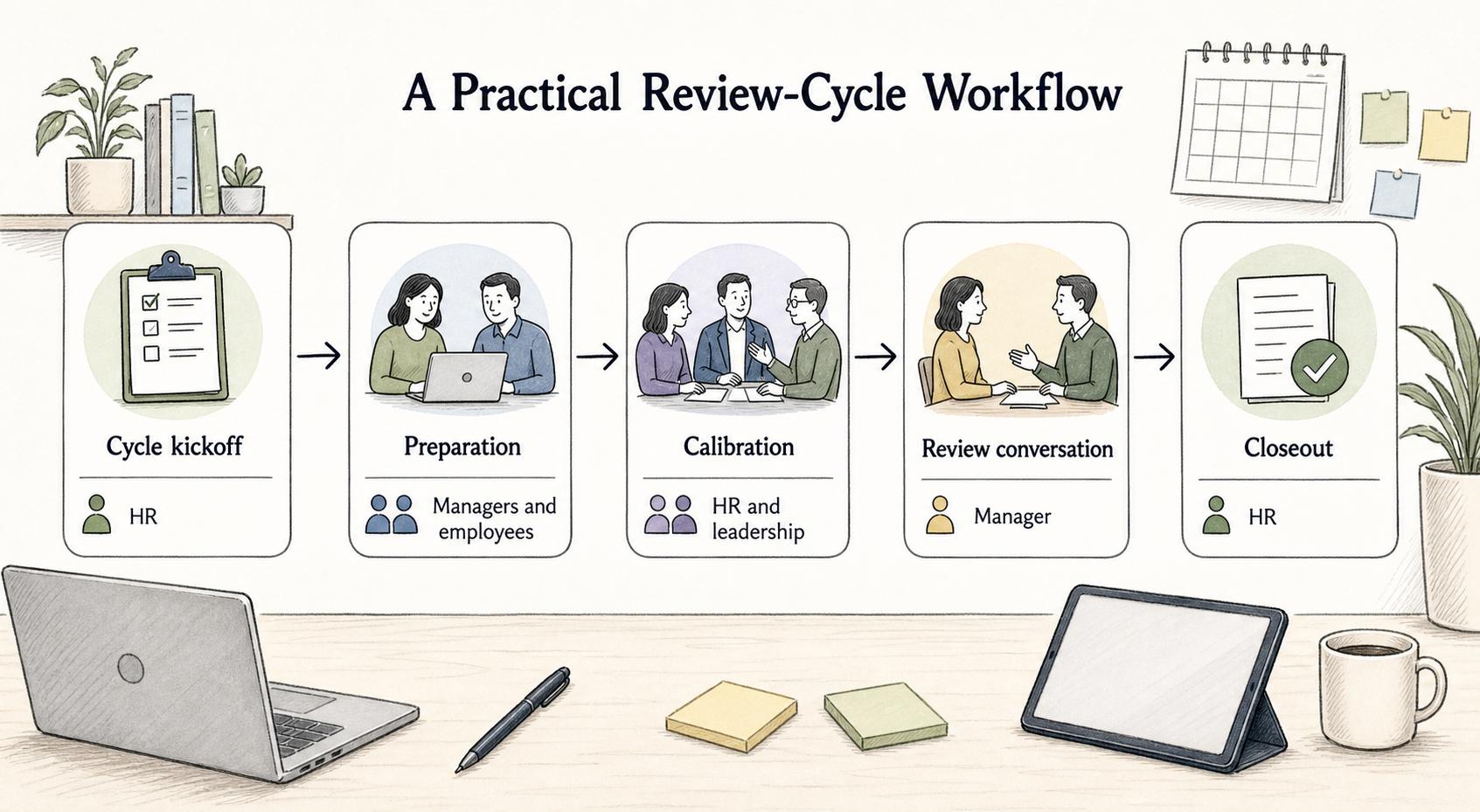
A clear SOP turns the review cycle into owned handoffs. A simple version might look like this:
| Stage | Owner | What must be clear |
|---|---|---|
| Cycle kickoff | HR | Eligibility, timeline, tools, manager instructions, employee instructions |
| Preparation | Managers and employees | Self-review prompts, evidence to gather, draft deadline, support resources |
| Calibration | HR and leadership | Rating guidance, consistency checks, approval path, exception handling |
| Review conversation | Manager | Discussion agenda, documentation expectations, follow-up commitments |
| Closeout | HR | Completion tracking, saved records, goals or action items, process retrospective |
This table is the spine, not the whole SOP. The SOP should add enough detail that each owner knows what to do, where to do it, and what evidence shows the step is complete.
Performance review SOP vs. performance review policy
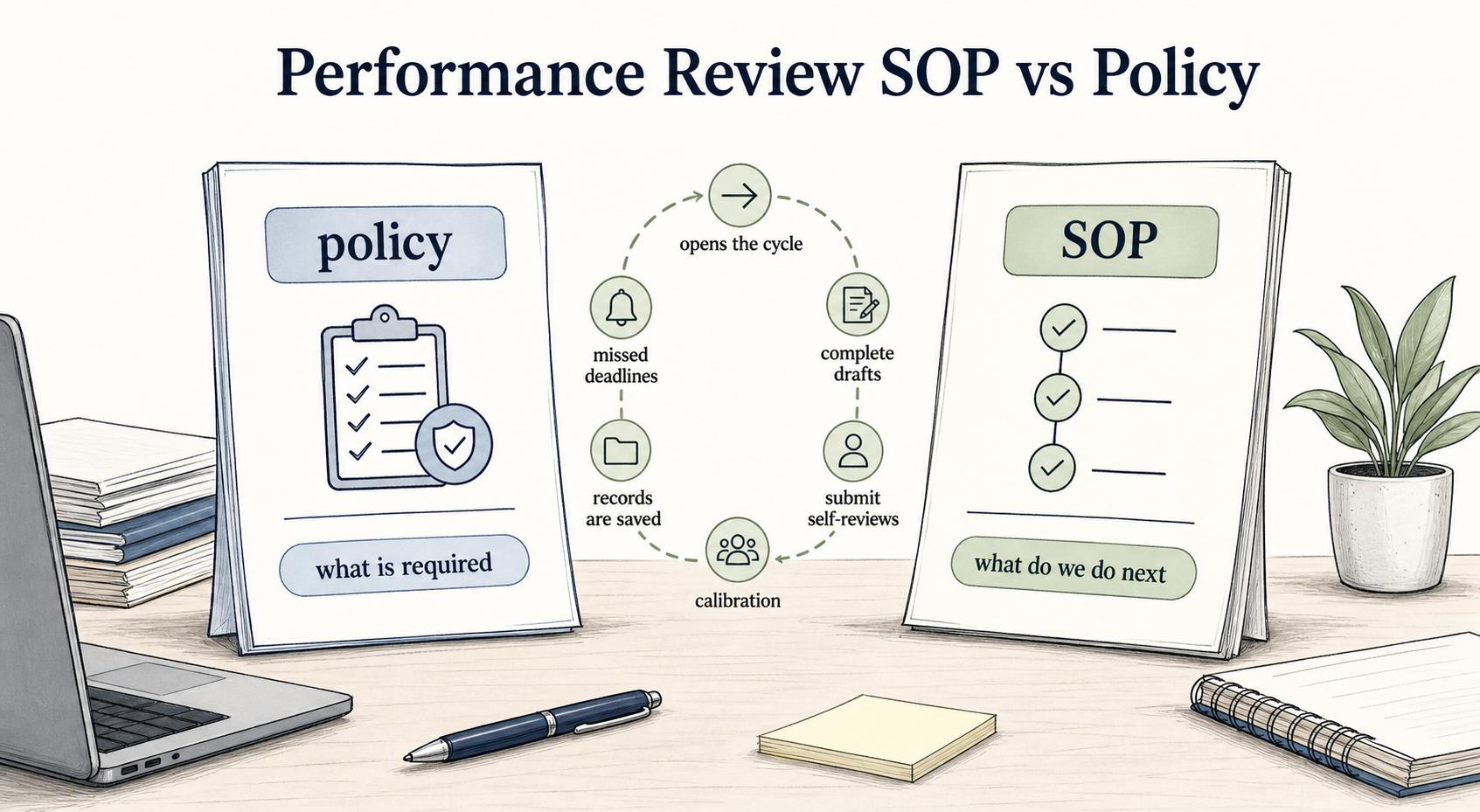
A policy states the rule or expectation. An SOP explains how the team carries it out.
A performance review policy might say eligible employees receive a formal review twice a year, managers are responsible for conducting reviews, and review records must be retained in the approved HR system. The SOP explains how HR opens the cycle, how managers complete drafts, how employees submit self-reviews, when calibration happens, where records are saved, and how missed deadlines are handled.
If the document answers "what is required," it is probably policy. If it answers "what do we do next," it is probably procedure.
Performance review SOP template
Use this as a starting point for a team-specific SOP. Adapt it to your HR system, review philosophy, manager training model, and local policy requirements.
## Performance Review SOP Template

**Glossary term:** Performance Review SOP
**Source:** Trails Glossary — trails.so/glossary/performance-review-sop

---

### 01. Create a performance review SOP

"SOP title: [Company/team] performance review process
Owner: [HR owner]
Audience: HR, managers, employees, leadership
Purpose: Run a consistent performance review cycle that supports feedback, documentation, and follow-up.
Scope: [eligible employees, review types, exclusions]
Review cycle: [annual, semiannual, quarterly, probationary, project-based]
Systems and records: [HRIS, forms, folders, templates]

Roles:
- HR: [opens cycle, sends instructions, tracks completion, supports managers]
- Manager: [prepares review, gathers examples, holds conversation, records outcomes]
- Employee: [completes self-review, prepares discussion points, agrees on next steps]
- Leadership: [calibration, approvals, exception review]

Procedure:
1. Confirm eligible employees and review timeline.
2. Send instructions, templates, and deadlines.
3. Employees complete self-reviews.
4. Managers draft reviews using required examples and criteria.
5. HR checks completion and flags missing or inconsistent submissions.
6. Leadership or HR runs calibration if required.
7. Managers hold review conversations.
8. Managers document outcomes, goals, and follow-up actions.
9. HR closes the cycle and records process improvements.

Exceptions:
- New hires: [rule]
- Employees on leave: [rule]
- Manager changes: [rule]
- Missed deadlines: [rule]
- Escalations: [rule]"
The template becomes valuable when the placeholders become real system names, dates, forms, owner names, and escalation thresholds. Generic SOPs are easy to approve and hard to use.
Common mistakes
One mistake is treating the SOP as a compliance document only. It should also enable managers. They need to know what evidence to gather, how to prepare, what the conversation should cover, and what to do after the meeting. SHRM frames strong reviews around both accurate evaluation and employee development, which is why the procedure around the meeting matters.2
Another mistake is documenting the happy path while leaving edge cases to Slack or memory. That creates inconsistent treatment across teams and puts unnecessary pressure on HR during the review window. Fairness research also ties employees' perceptions of appraisal fairness to whether the process feels trustworthy and consistently applied.3
A third mistake is failing to connect reviews to follow-up. If goals, development plans, compensation notes, or action items are part of the process, the SOP should say where they go and who owns them after the meeting.
Documentation takeaway
A performance review SOP gives structure to a sensitive people process. The strongest version is specific enough to run the cycle without pretending every employee situation is the same. It reduces procedural confusion so managers and employees can spend more attention on the quality of feedback.
How Trails helps
Trails helps HR and people-ops teams document repeatable review workflows for managers and employees. Teams can capture the steps in the review cycle, turn them into clear guides, and create AI-narrated video walkthroughs for training managers before each cycle starts.
Sources
- 1
CIPD. CIPD performance reviews factsheet. www.cipd.org/en/knowledge/factsheets/appraisals-factsheet/.
- 2
SHRM. SHRM guidance on conducting performance reviews. www.shrm.org/topics-tools/news/employee-relations/how-to-conduct-great-performance-review.
- 3
Sage. Sage research on perceived fairness in performance appraisal. journals.sagepub.com/doi/abs/10.1177/0091026014564071.