
Glossary
Guidelines
 ChatGPT
 Perplexity
 Gemini
 Claude
What are guidelines?
Guidelines are recommended principles, standards, or decision rules that help people choose the right action without prescribing every step. Formal guideline-development bodies treat guidelines as recommendations produced through a defined method, not casual advice. 1
The practical value is consistency in situations that still require judgment. A useful guideline tells the reader what tradeoff matters, what the default should be, and when context should change the decision.
Why guidelines matter
Most teams have work that cannot be reduced to a perfect script. A support rep may decide when to bend a refund rule; a customer success manager may choose the right tone for a renewal email; a manager may decide when an exception should become a process change.
Guidelines are useful in those gray areas. They do not replace ownership or training, but they give people enough structure to act consistently without escalating every decision. A line like “use good judgment” is only a wish; a better guideline names the default, the tradeoff behind it, and the signals that justify a different call.
Guidelines vs policies, procedures, and work instructions
These document types answer different reader needs.
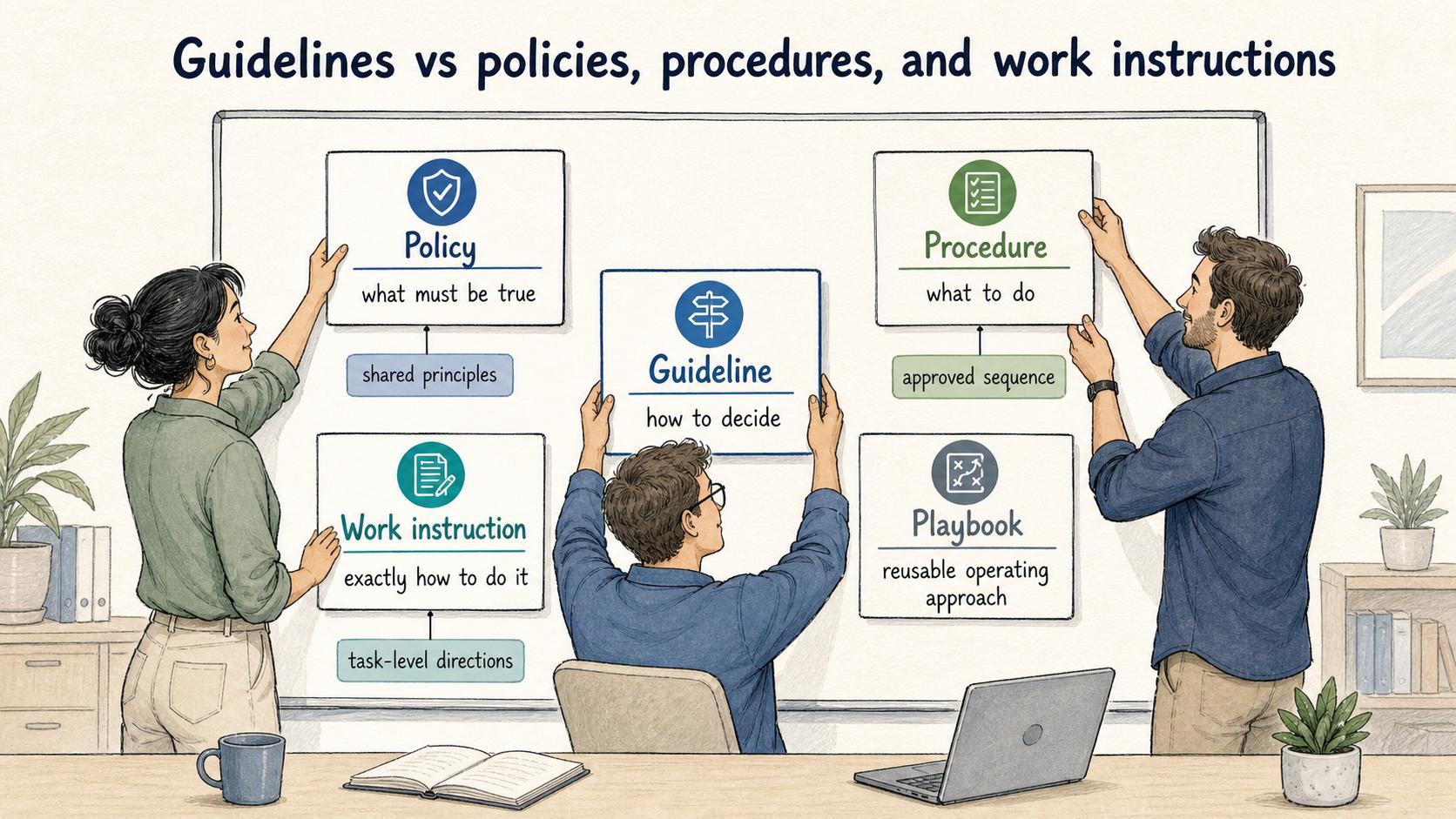
| Document type | What it does | Best used when |
|---|---|---|
| Policy | Sets a required rule, standard, or position | The organization needs clear boundaries or compliance control |
| Guideline | Helps people make consistent judgment calls | Work varies, but decisions should follow shared principles |
| Procedure | Explains the approved sequence for completing a process | The workflow should happen the same way most of the time |
| Work instruction | Gives task-level directions for a specific action | Someone needs exact steps, screenshots, settings, or measurements |
| Playbook | Combines guidance, examples, workflows, and tactics | A team needs a reusable operating approach for a recurring situation |
Policies say what must be true, procedures say what to do, work instructions say exactly how to do it, and guidelines say how to decide when the answer depends on context.
What good guidelines include
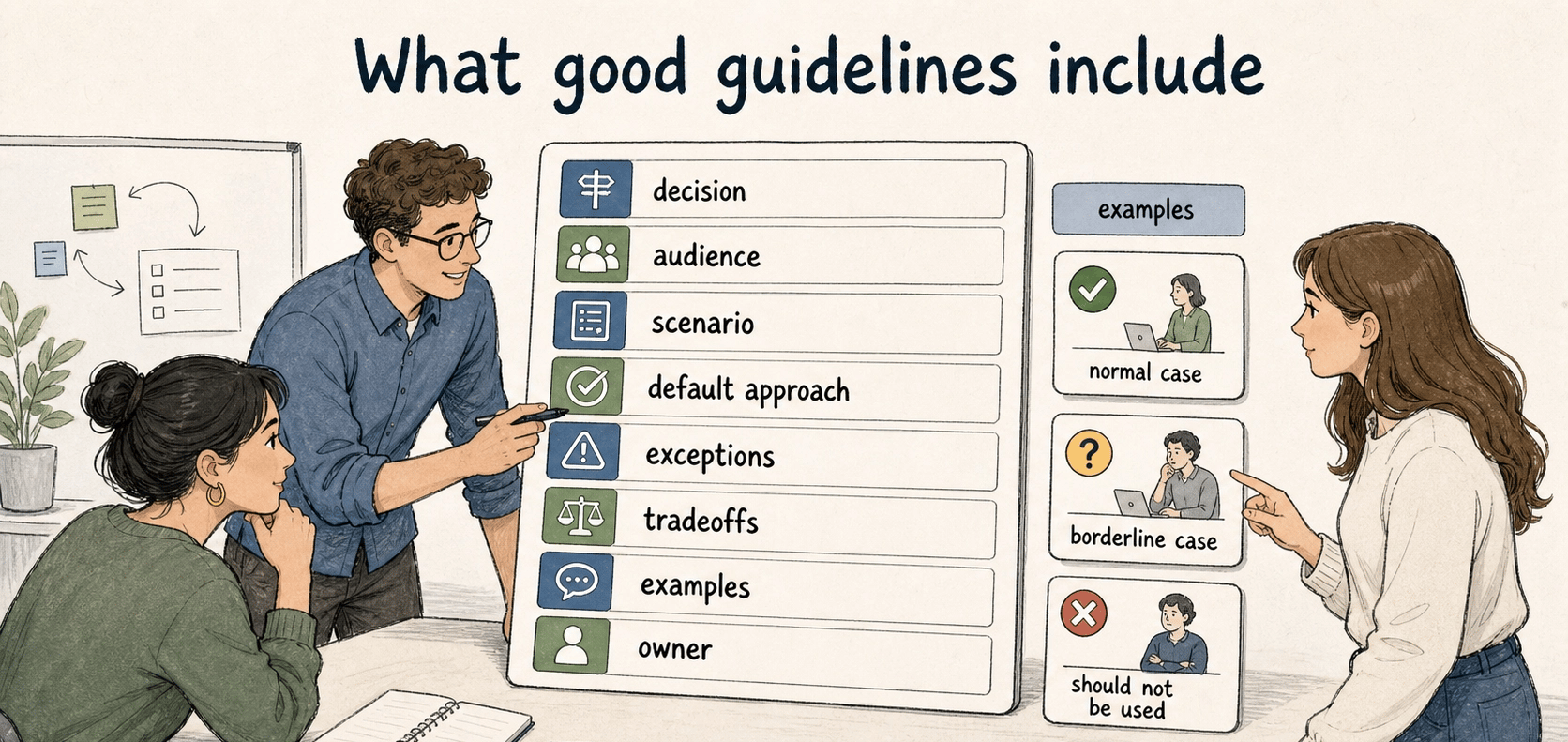
Good guidelines name the audience, scenario, default approach, and exceptions. NICE's guideline manual treats recommendation wording as part of helping readers understand what action is being recommended and why. 2
They make tradeoffs explicit, show acceptable variation through normal, borderline, and exception cases, and have an owner who keeps them current as the product, market, regulations, and team expectations change.
Common mistakes
- Using guidelines to avoid making a decision instead of naming a standard.
- Writing broad aspirations such as “write clear documentation” rather than an applicable decision rule.
- Treating a guideline as an enforcement tool when it should be a policy or requirement.
- Leaving the guideline disconnected from the SOP, template, checklist, or escalation path needed to act.
ISO's drafting guidance points toward documents that are clear, precise, and unambiguous. 3
Guideline template
## Guideline template

**Glossary term:** Guidelines
**Source:** Trails Glossary — trails.so/glossary/guidelines

---

### 01. Create practical guidelines

"Create guidelines for [decision or behavior] used by [team/audience].

Include:
- Purpose: what decision these guidelines should improve
- Audience: who should use them and who should not
- Default approach: what the team should usually do
- Judgment criteria: 3-5 signals that change the decision
- Examples: one normal case, one borderline case, and one exception
- Related procedures or policies: links or names of required documents
- Escalation path: when someone should ask for approval or expert review
- Owner and review cadence: who keeps the guidelines current

Write the guidelines as practical decision support, not a list of vague values."
How Trails helps
Trails helps teams connect guidelines to repeatable workflows. A team can capture how a process is performed, turn it into a step-by-step guide, and use guidelines to explain the judgment points inside that workflow. Trails can also create an AI-narrated video version for training.
FAQ
Are guidelines mandatory?
Not always. Guidelines usually describe a recommended approach, while policies and requirements describe what must happen. If a guideline is truly mandatory, name that clearly.
What is the difference between guidelines and best practices?
Best practices are commonly recommended ways of working. Guidelines are usually more local and decision-oriented: they explain how a specific team wants people to handle a recurring situation.
When should a guideline become a procedure?
Turn it into a procedure when the work needs a consistent sequence, clear ownership, required documentation, or auditability. Keep it as a guideline when the situation varies and judgment is the main challenge.
Sources
- 1
World Health Organization. WHO handbook for guideline development. www.who.int/publications/i/item/9789241548960.
- 2
NICE. Developing and wording recommendations. www.nice.org.uk/process/pmg20/chapter/9-developing-and-wording-recommendations-and-writing-the-guideline.
- 3
ISO. ISO House Style. www.iso.org/ISO-house-style.html.