
Glossary
Policy vs Procedure
 ChatGPT
 Perplexity
 Gemini
 Claude
What is the difference between a policy and a procedure?
A policy defines the rule, standard, or expectation an organization wants people to follow. A procedure explains the steps people take to carry out that policy or complete the related work.
A policy gives authority and boundaries. A procedure gives the operating path. Teams need both because a rule without execution guidance creates confusion, and instructions without a governing rule can feel arbitrary.
The core difference
The useful distinction is purpose.
A policy answers questions like "What is allowed?" "Who does this apply to?" "What standard are we enforcing?" and "Who can approve exceptions?" It should be stable enough to guide decisions across similar situations.
A procedure answers questions like "What do I do first?" "Which system do I use?" "What information do I enter?" "Who reviews this?" and "What record proves it was completed?" It should be specific enough that a trained employee can perform the work consistently.
For example, a data access policy might say employees can only access customer data when there is a valid business need. The access request procedure would show how to submit the request, what justification to include, who approves it, how access is granted, and when access should be removed.
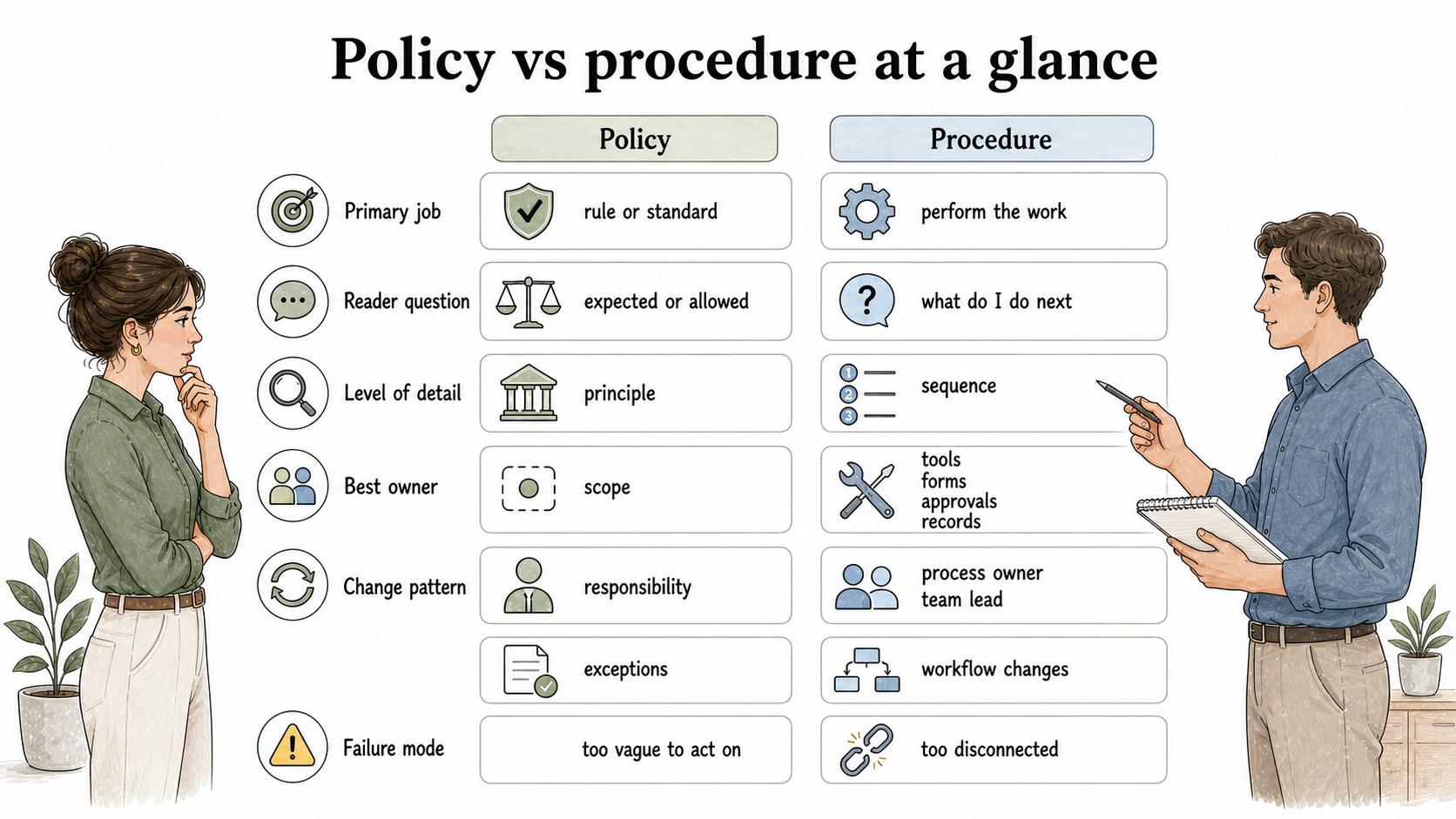
Policy vs procedure at a glance
| Dimension | Policy | Procedure |
|---|---|---|
| Primary job | Define a rule or standard | Explain how to perform the work |
| Reader question | "What is expected or allowed?" | "What do I do next?" |
| Level of detail | Principle, scope, responsibility, exceptions | Sequence, tools, forms, approvals, records |
| Best owner | Functional leader, compliance owner, executive sponsor, process owner | Process owner, team lead, operations owner, subject matter expert |
| Change pattern | Changes when the standard changes | Changes when the workflow, tool, or handoff changes |
| Failure mode | Too vague to act on | Too disconnected from the rule it supports |
When you need a policy
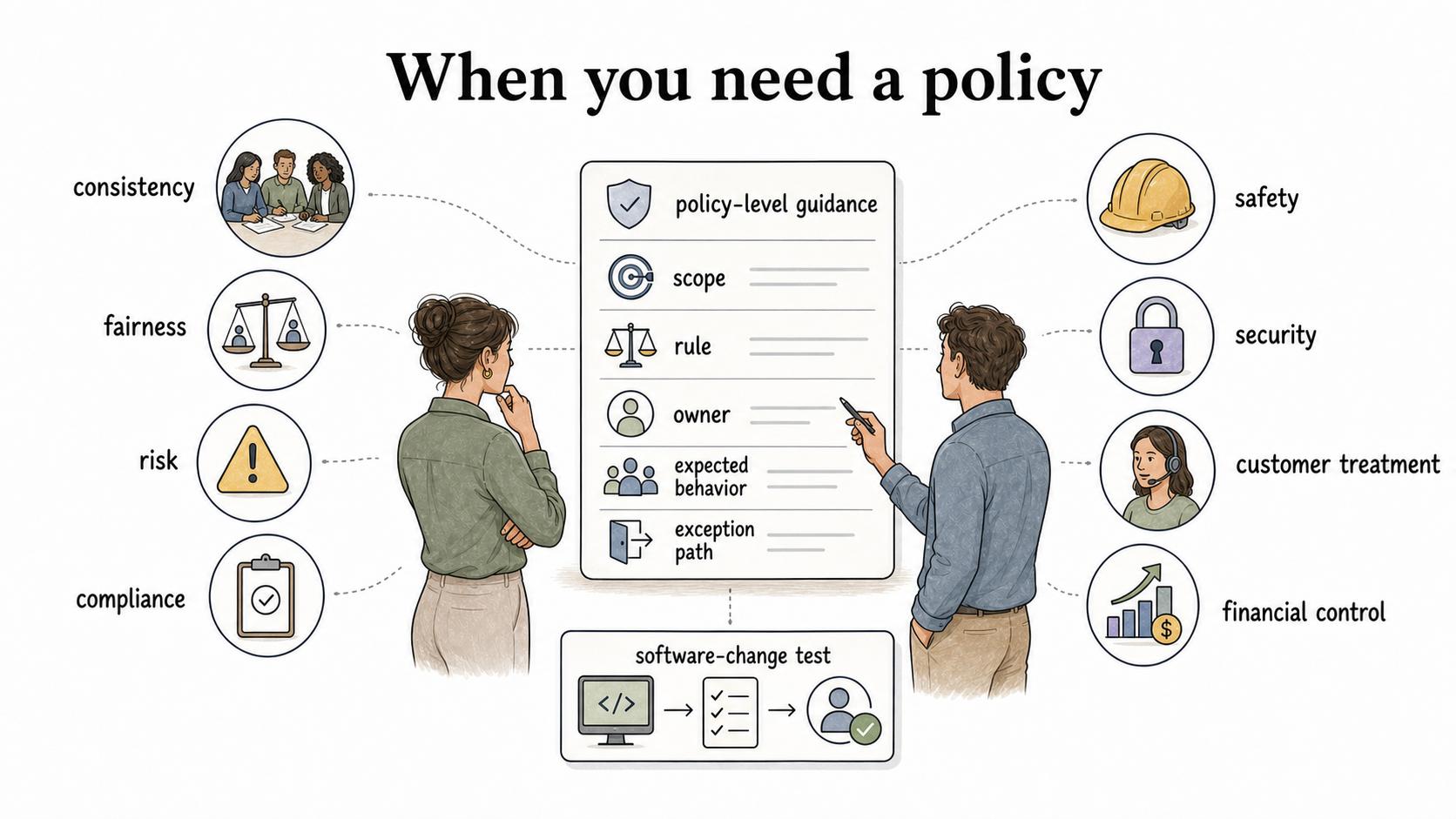
Create a policy when people need a decision standard that applies beyond one task. Policies are useful when consistency, fairness, risk, compliance, safety, security, customer treatment, or financial control matters.
A strong policy defines the scope, rule, owner, expected behavior, and exception path. It should avoid burying the reader in task instructions. If a policy includes fifteen steps for filling out a form, that section probably belongs in a procedure.
Use the software-change test: if the guidance should stay true when the tool changes, it is probably policy-level guidance.
When you need a procedure
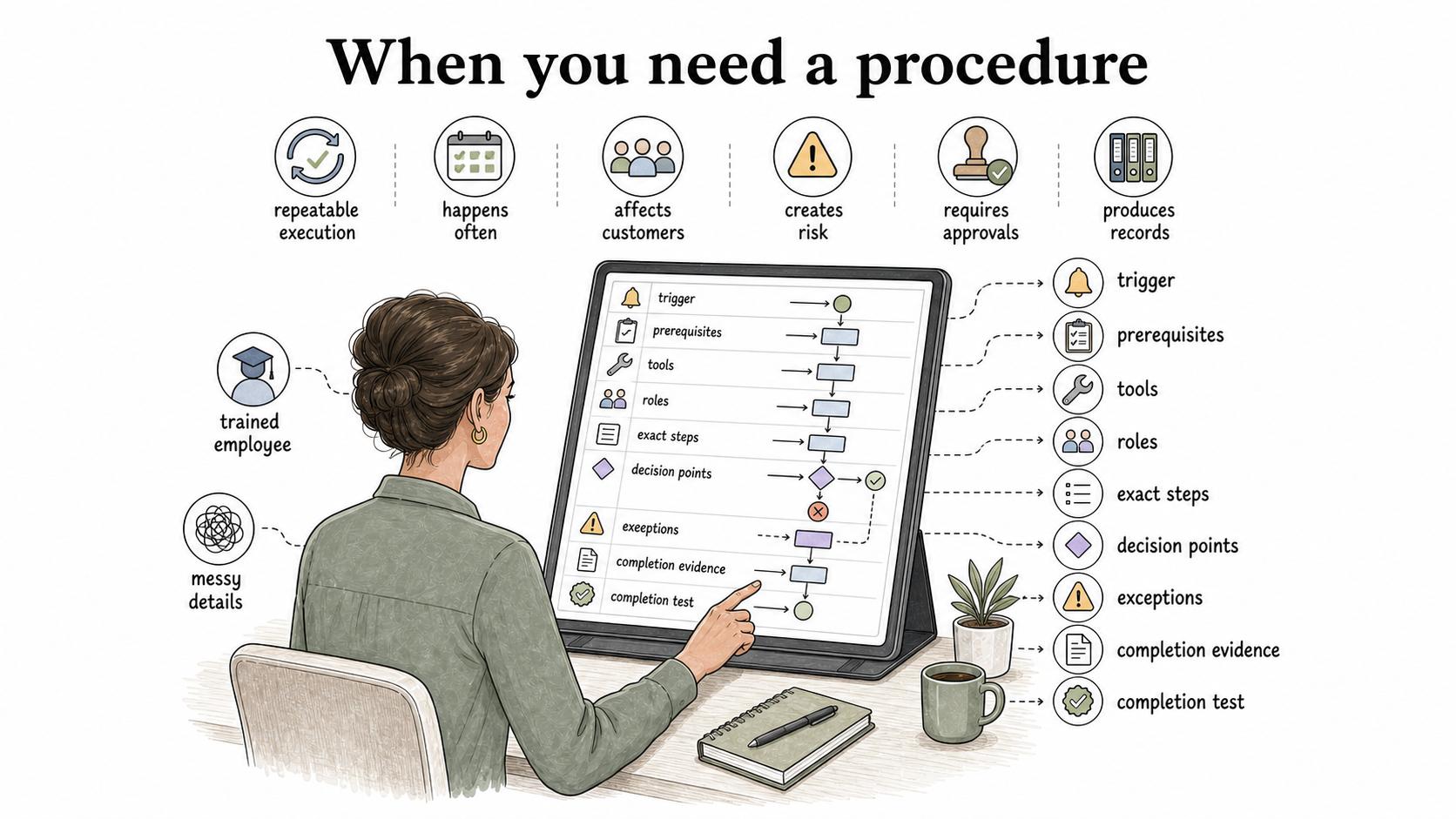
Create a procedure when people need repeatable execution. Procedures are especially useful for work that happens often, affects customers, creates risk when done inconsistently, requires approvals, or produces records someone may need later.
A strong procedure names the trigger, prerequisites, tools, roles, exact steps, decision points, exceptions, and completion evidence. It should not make the reader infer the policy from the steps. If the procedure exists because of a policy, link to that policy and explain the relevant rule in a short note.
Use the completion test: could a trained employee complete the work from the document? If the answer is no, the procedure is too broad, too stale, or missing the messy details where mistakes happen.
How policies and procedures work together
Keep policies and procedures linked but separate.
For example, an expense policy might define eligible expenses, spending limits, required receipts, and approval thresholds. The expense procedure would show how to submit the report, attach receipts, choose categories, handle missing information, and respond to rejection.
That separation makes maintenance easier. If the approval threshold changes, update the policy and any affected procedure. If the expense tool changes, update the procedure without rewriting the whole policy. The link between them tells employees both the rule and the route.
Common documentation mistakes
One mistake is writing policy language that sounds official but does not help anyone decide. Words like "appropriate," "timely," and "as needed" may be necessary, but they need criteria, examples, or a named exception owner.
Another mistake is turning procedures into policy debates. A procedure should explain how to operate within the rule and what to do when the standard path does not fit.
The most expensive mistake is drift. A policy changes, but the procedure still tells employees to follow the old path. Or the procedure changes in practice, but the policy never catches up. Once people notice the mismatch, they stop trusting the documentation.
A practical decision rule
Use this rule when deciding what to write:
- If the reader needs to know the standard, write or update a policy.
- If the reader needs to perform the work, write or update a procedure.
- If the standard affects daily work, link the policy and procedure in both directions.
For important topics, split the work. A short policy paired with a clear procedure is usually easier to govern than one bloated document that mixes rules, background, instructions, and exceptions.
How Trails helps
Trails helps with the procedure side of the pair. Once the policy defines what must happen, Trails can capture the actual workflow as someone performs it and turn it into a polished step-by-step guide. Teams can also create AI-narrated video versions for training or sharing.
That keeps procedures close to real work while policies stay focused on the standards behind the work.
FAQ
Is a procedure part of a policy?
Sometimes a policy links to one or more procedures, but the procedure should usually be maintained as its own document. That keeps the rule stable while the operating steps can change as tools and workflows change.
Which comes first, policy or procedure?
For governed work, define the policy first so the procedure has a clear standard to support. For messy existing workflows, teams may document the current procedure first, then use what they learn to clarify the policy.
Can a procedure exist without a policy?
Yes. Many routine procedures support internal consistency rather than formal policy. But if the task involves risk, approvals, customer commitments, safety, security, finance, or compliance, the procedure should usually point back to a policy or standard.