
Glossary
Upskilling
 ChatGPT
 Perplexity
 Gemini
 Claude
What is upskilling?
Upskilling is the process of helping employees build newer or stronger skills for work they already do or are growing toward. It improves capability without moving the person into an entirely different line of work.
In practice, upskilling works when a team identifies a real skill gap, connects it to work that needs to improve, and gives employees a way to practice, apply, and retain the new skill.
Why upskilling matters
Work changes faster than job descriptions. Tools change, customer expectations shift, workflows evolve, and teams take on new responsibilities. If employees keep using old habits, the team can fall behind even when everyone is working hard.1
Upskilling gives teams a deliberate way to close that gap.2
A support team might train agents on advanced billing cases. An operations team might teach managers how to interpret process data. A customer success team might help CSMs run stronger onboarding sessions for a more complex product.
The business case is practical: teams need people who can perform the work as it exists now. The employee case matters too. Upskilling makes growth visible and specific. Get better at operations is hard to act on. Learn how to diagnose delays in the onboarding workflow and propose a fix is trainable.
Upskilling vs reskilling vs onboarding
These terms are related, but they solve different problems.
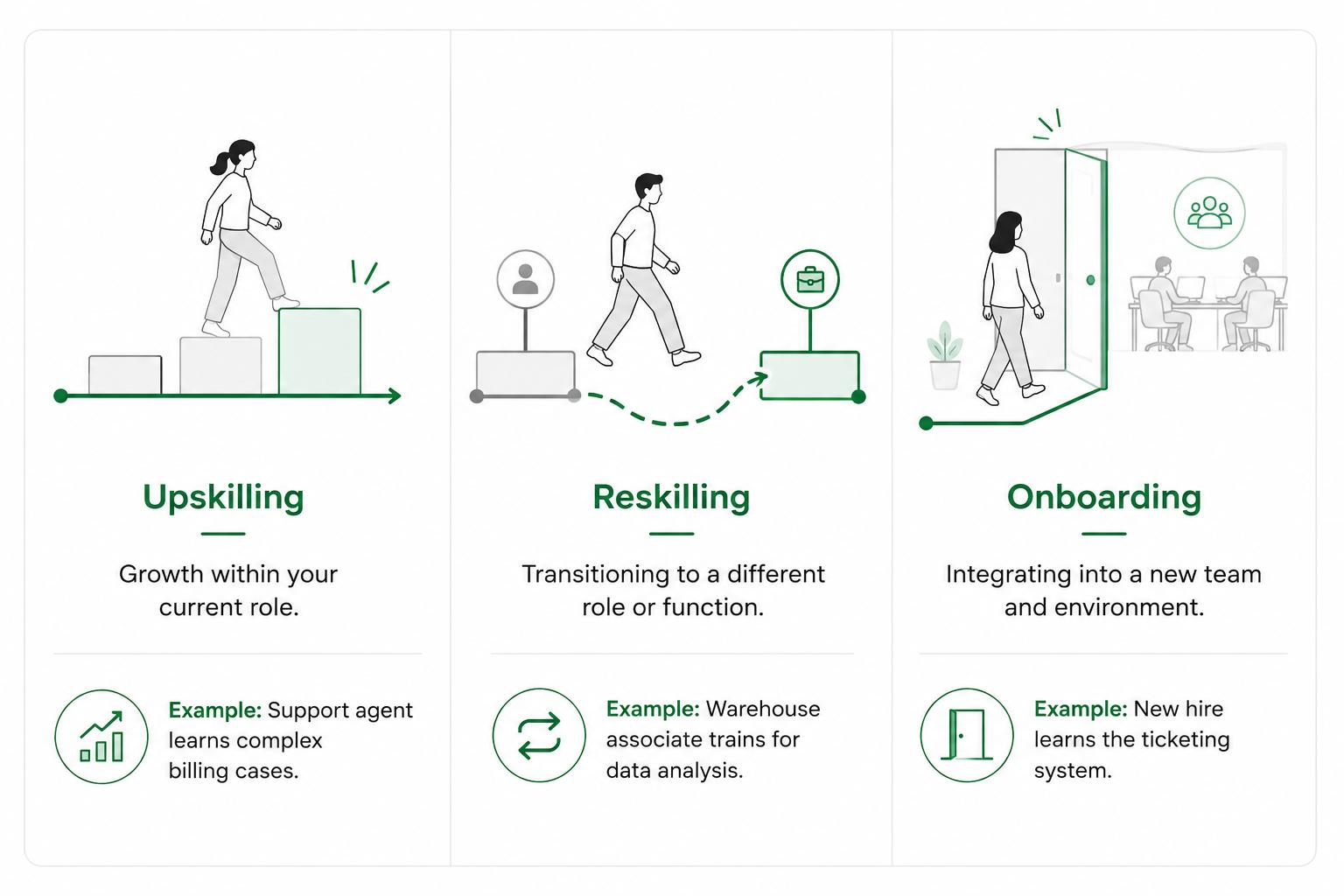
Upskilling improves skills for a role the person already has or is naturally growing toward. Reskilling prepares someone for a substantially different role. Onboarding helps someone become productive in a new company, team, or position.
For example, teaching support agents to handle complex billing exceptions is upskilling. Training a warehouse associate to become a data analyst is reskilling. Teaching a new support hire how the ticketing system works is onboarding.
The distinction matters because each one needs a different plan. Upskilling should start from the employee's current work and build toward a more capable version of that work.
What makes upskilling effective
The common mistake is treating upskilling as a content library problem. More courses do not automatically create more capability. People build skill when they understand the standard, practice the work, get feedback, and apply the skill in real situations.3
A strong upskilling effort usually includes:
- A clear skill gap: the specific capability the person or team needs.
- A work connection: the task, customer outcome, quality issue, or business need the skill affects.
- A performance standard: what good looks like in practice.
- Reusable training assets: SOPs, examples, videos, checklists, practice cases, or guides.
- Practice and feedback: realistic work reviewed by a manager, peer, or trainer.
- A success signal: observable behavior or output that shows the skill improved.
The success signal is the part teams often skip. If the team cannot describe what improved performance looks like, the training will be hard to evaluate.
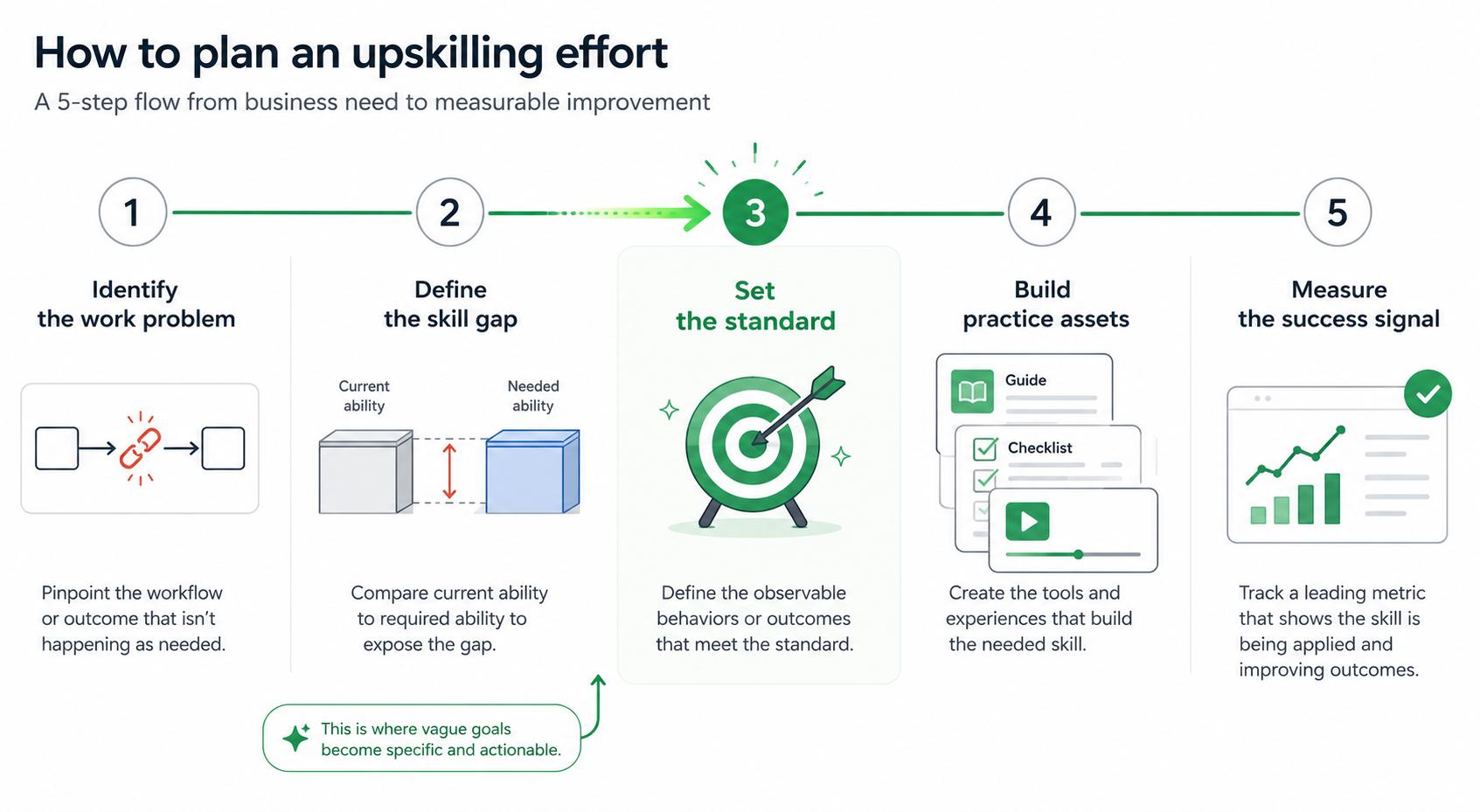
How to plan an upskilling effort
Start with the work, not the training format. Ask what the person needs to do better, faster, more safely, with more judgment, or with less supervision. Then choose the learning method that fits the skill.4
A practical upskilling plan should answer:
## Upskilling Plan Template

**Glossary term:** Upskilling
**Source:** Trails Glossary — trails.so/glossary/upskilling

---

### 01. Plan a practical upskilling effort

"Upskilling goal: [skill or capability]
Audience: [role or team]
Current gap: [what people struggle with today]
Work impact: [customer, quality, speed, compliance, or cost effect]
Standard of good performance: [what good looks like]
Training assets needed: [SOP, guide, video, checklist, examples]
Practice activity: [realistic task or scenario]
Feedback owner: [manager, peer, trainer]
Success signal: [observable behavior or output]
Review date: [when to revisit the skill]"
For example, if a team wants to upskill employees on a new refund process, the plan should not stop at a slide deck. It should include the decision rules, a documented workflow, sample cases, common mistakes, and practice scenarios that mirror the real work.
Common mistakes
One mistake is making upskilling too broad. Improve customer communication is a goal, but it is not yet a training plan. Write clear escalation notes for billing disputes is more concrete and easier to practice.
Another mistake is separating learning from the actual work. Employees may complete a course and still struggle when the workflow, systems, or edge cases show up in real life. Upskilling should include practice in the context where the skill will be used.
A third mistake is relying on one expert to explain everything live. That can work once, but it does not scale. Capture the expert's process, examples, and judgment so the next learner has a reusable path.
Documentation takeaway
Upskilling depends on reusable knowledge. If the best explanation lives only in one manager's head, every upskilling effort becomes a one-off conversation.
Documented workflows, examples, checklists, and training videos make skill-building more consistent. They also make coaching easier because managers can point to a shared standard instead of inventing feedback from scratch.
How Trails helps
Trails helps teams turn real work into upskilling assets. A skilled teammate can capture a workflow while performing it, and Trails turns that workflow into a polished step-by-step guide. Trails can also create an AI-narrated video version for training or sharing.
That helps teams preserve the practical know-how behind a skill: the order of work, the decision points, and the details experienced employees often forget to explain.
FAQ
Is upskilling the same as training?
Training is one method. Upskilling is the broader goal of building a specific capability that improves current or near-future work.
How is upskilling different from reskilling?
Upskilling strengthens skills for the current or adjacent role. Reskilling prepares someone for a substantially different role.
What should an upskilling plan include?
It should include the skill gap, work impact, performance standard, training assets, practice activity, feedback owner, and success signal.
- Reskilling
- Employee development
- Employee onboarding
- On-the-job training
- Training documentation
- Training manual
- Work instruction
- Work instruction software
Sources
- 1
World Economic Forum. The Future of Jobs Report 2025 - Skills Outlook. World Economic Forum. www.weforum.org/publications/the-future-of-jobs-report-2025/in-full/3-skills-outlook/. Accessed June 25, 2026.
- 2
Organisation for Economic Co-operation and Development. Adult Skills and Work. OECD. www.oecd.org/en/topics/policy-issues/adult-skills-and-work.html. Accessed June 25, 2026.
- 3
Centers for Disease Control and Prevention. Quality Training Standards. CDC. www.cdc.gov/training-development/php/qts/index.html. Accessed June 25, 2026.
- 4
Chartered Institute of Personnel and Development. Learning Value and Skills Development. CIPD. www.cipd.org/en/views-and-insights/thought-leadership/insight/learning-value-skills-development/. Accessed June 25, 2026.