
Glossary
Training Effectiveness
 ChatGPT
 Perplexity
 Gemini
 Claude
What is training effectiveness?
Training effectiveness is the degree to which a training program helps people learn, apply new skills, and perform work better. It looks beyond attendance and completion to ask whether training changed what employees can do on the job.1
Effective training helps people handle the real task more accurately, consistently, or confidently after the lesson ends.
Why training effectiveness matters
Training can look successful while failing the work. Employees may complete the module, rate the session highly, and still return to the job unsure how to apply the lesson in a messy real situation.
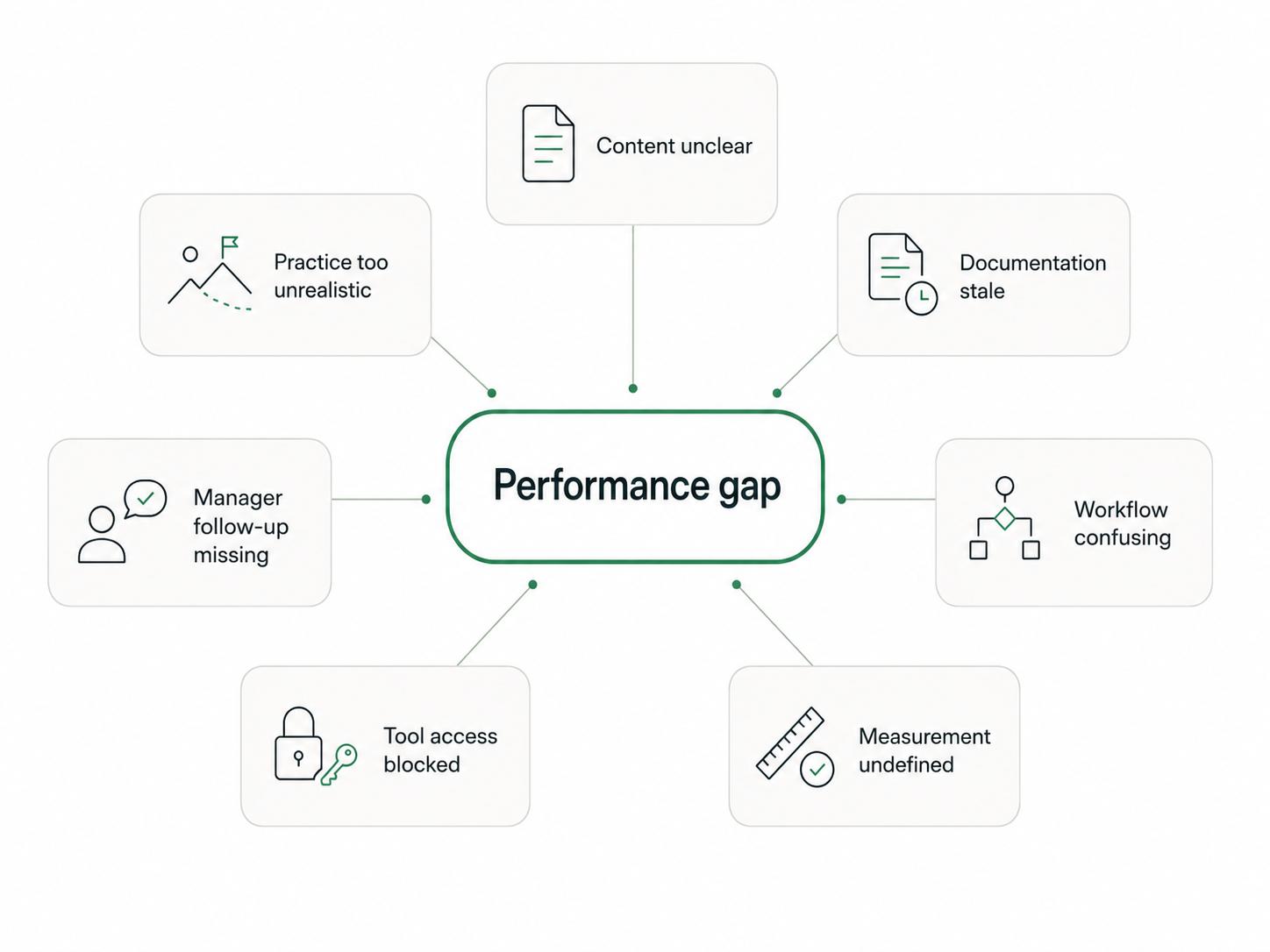
Evaluating effectiveness helps teams find the actual failure point. Did people understand the material? Did they practice the right task? Did managers reinforce the behavior? Was the process documented clearly? Did the tool or workflow make the desired behavior harder than expected?
More training is not always the answer. Sometimes the real problem is a confusing process, stale documentation, unclear ownership, poor manager follow-up, or missing system access. Effectiveness work should reveal whether the training needs improvement or whether the operating environment needs fixing.
What effective training changes
Effective training usually changes one or more of these things:
- Knowledge: People understand a concept, policy, product, or workflow.
- Skill: People can perform a task or make a decision with less help.
- Behavior: People apply the new approach during real work.
- Consistency: Different employees follow the same standard more reliably.
- Outcome: The work improves through fewer errors, faster ramp time, less rework, better quality, or smoother handoffs.
Define the expected change before the program launches. If the goal is vague, effectiveness becomes a post-training guessing exercise.
How to measure training effectiveness
Start with the job outcome: after this training, what should the learner be able to do that they could not do before?
Then choose evidence close to that outcome. For a support team, evidence might include scenario assessment quality, QA review, escalation rate, and manager observation. For process training, it might include correct step completion, fewer missed handoffs, and reduced rework. For new hire onboarding, it might include time to independent work, early task quality, and manager readiness ratings.
A balanced evaluation usually includes:2
- Learner feedback: Was the training relevant, clear, and usable?
- Learning evidence: Did the learner understand and practice the material?
- Behavior evidence: Did the learner apply it on the job?
- Outcome evidence: Did the work improve in the intended direction?
- Maintenance evidence: Is the training still current and supported by documentation?
The later signals are harder to collect, but they are more meaningful. Completion tells you the training happened. Behavior and outcome data tell you whether it mattered.3
Common mistakes
The first mistake is using satisfaction as the main proof. Learner feedback can improve delivery, but people can enjoy training that does not change behavior. They can also find difficult practice uncomfortable because it exposes real skill gaps.
The second mistake is measuring too late. If nobody defines success until after the session, the team hunts for convenient numbers instead of evaluating the intended behavior.
The third mistake is skipping manager reinforcement. People often return from training to the same pressures, shortcuts, and habits they had before. If managers do not observe, coach, and hold the standard, training can fade quickly.4
The fourth mistake is ignoring documentation quality. If the written process is outdated, scattered, or hard to use, employees may fail to apply the training even when the lesson itself was strong.
How to improve training effectiveness
Make the training specific. Broad awareness can be useful, but performance improvement usually requires a concrete task, realistic examples, practice, and follow-up.
A practical improvement loop is:
- Define the job outcome and the behavior that should change.
- Document the current process or skill clearly.
- Build training around the moments where people actually get stuck.
- Include practice that resembles real work, including exceptions.
- Give managers a standard for coaching and observation.
- Measure behavior after training, not just completion.
- Update the training when the workflow changes.
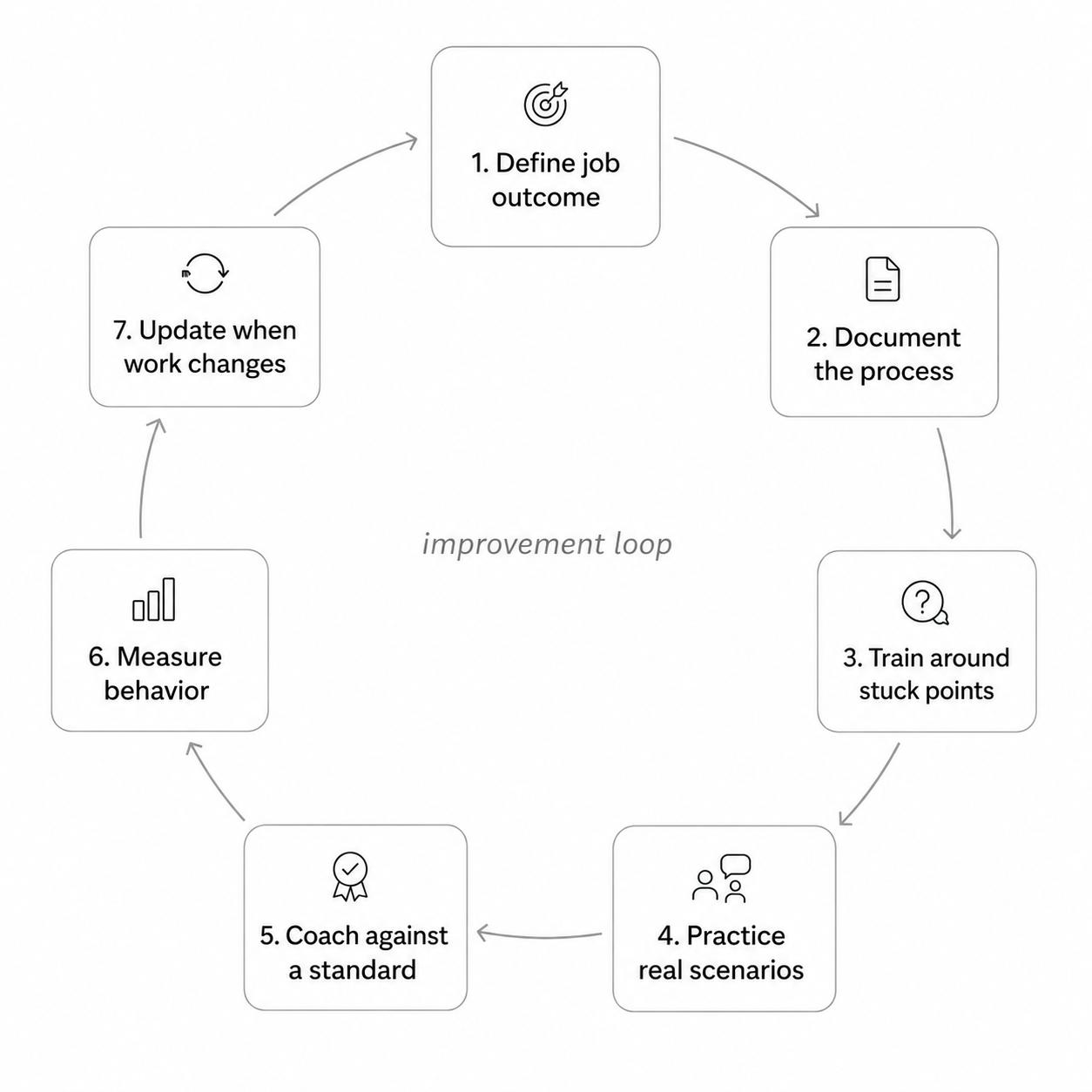
This turns training from a one-time event into a managed system that keeps people aligned as work changes.
A training effectiveness diagnostic prompt
Use this prompt when a program looks active but performance has not improved:
## Training Effectiveness Diagnostic Prompt

**Glossary term:** Training Effectiveness
**Source:** Trails Glossary — trails.so/glossary/training-effectiveness

---

### 01. Diagnose why training has not improved performance

"Evaluate the effectiveness of training for [audience] on [process, skill, or task].
Training goal: [what learners should be able to do]
Current evidence: [completion, assessment, observation, QA, outcome data]
Observed performance gap: [what is still going wrong]
Available documentation: [guides, SOPs, checklists, examples]
Manager reinforcement: [how behavior is coached or reviewed]
Identify whether the likely issue is content, practice, assessment, documentation, manager follow-up, workflow design, tooling, or measurement.
Recommend the next three improvements."
The prompt keeps the team from treating the course as the only lever. It forces a look at the whole system around the learner.
Training effectiveness vs. training ROI
Training effectiveness asks whether the training worked. Training ROI asks whether the measurable benefit was worth the cost.
Effectiveness should usually come first. If the program did not improve learning, behavior, or work performance, a financial ROI calculation will be weak. Once effectiveness is clear, ROI can help decide whether the investment should be expanded, revised, or retired.
Documentation takeaway
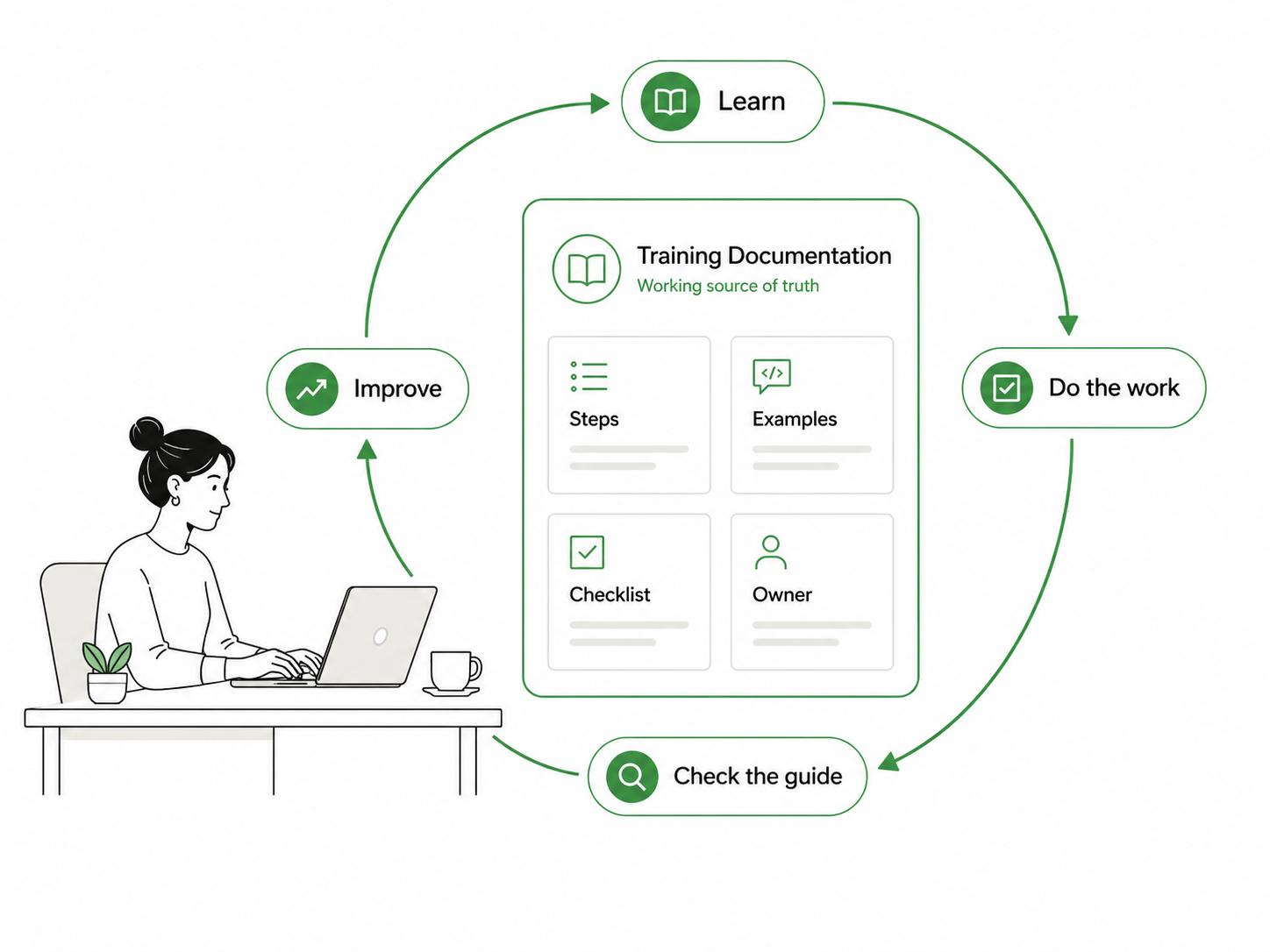
Training effectiveness depends heavily on what happens after the lesson. Employees need clear references, examples, and job aids when they are doing the work. Managers need a concrete standard to coach against.
When the source documentation is current, training can reinforce the real process. When it is stale, training teaches one version of the work while employees discover another version on the job.
How Trails helps
Trails helps teams capture real workflows, turn them into polished step-by-step guides, and create AI-narrated video versions for training or sharing. That supports training effectiveness by giving learners a clear reference after formal training and giving managers a practical standard to review.
Sources
- 1
Centers for Disease Control and Prevention. Measuring Training Effectiveness. CDC. www.cdc.gov/training-development/php/about/evaluate-training-measuring-effectiveness.html. Accessed July 1, 2026.
- 2
Centers for Disease Control and Prevention. Building a Training Evaluation Plan. CDC. www.cdc.gov/training-development/php/about/evaluate-training-building-an-evaluation-plan.html. Accessed July 1, 2026.
- 3
Kirkpatrick Partners. The Kirkpatrick Model. Kirkpatrick Partners. www.kirkpatrickpartners.com/the-kirkpatrick-model/. Accessed July 1, 2026.
- 4
ERIC. Transfer of Training. ERIC. eric.ed.gov/?id=ED551825. Accessed July 1, 2026.