
Glossary
Reskilling
 ChatGPT
 Perplexity
 Gemini
 Claude
What is reskilling?
Reskilling is the process of helping an employee learn a substantially different set of skills so they can move into new work. It is used when a role, team need, toolset, or business model changes enough that ordinary training inside the same job is not enough.
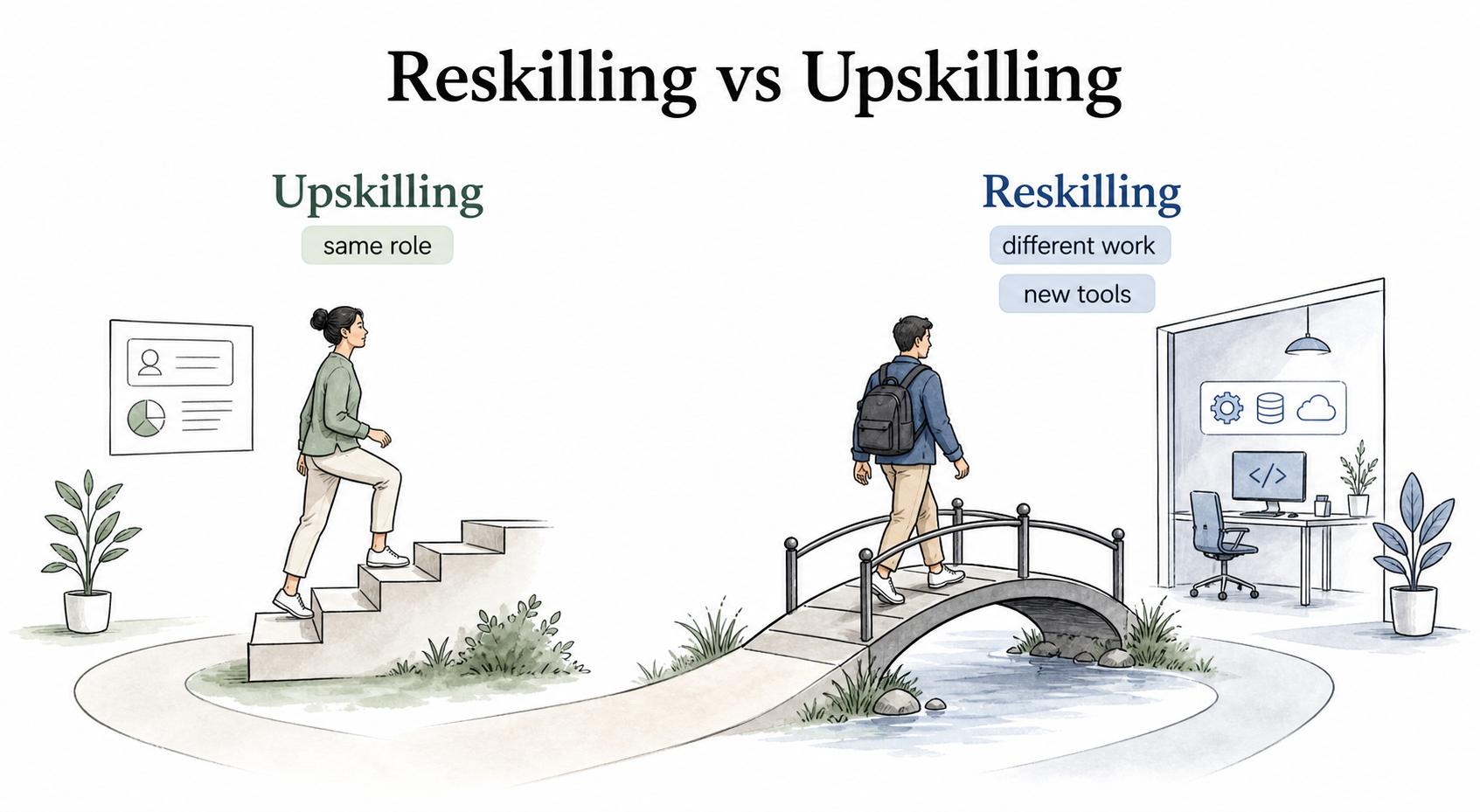
The practical test is whether the destination of the work changes. Reskilling prepares someone for a different job, workflow, or part of the business; upskilling makes them stronger in the work they already do.
Reskilling vs upskilling
Reskilling is often confused with upskilling because both involve employee development. The distinction matters because the training plan, manager support, and success criteria are different.
| Concept | What changes | Example | Success looks like |
|---|---|---|---|
| Reskilling | The employee prepares for different work | A customer support rep trains for implementation specialist work | They can perform core tasks in the new role |
| Upskilling | The employee deepens skills in current work | A support rep learns advanced troubleshooting | They perform the current role at a higher level |
| Cross-training | The employee learns adjacent coverage tasks | A warehouse associate learns cycle count steps | They can cover a defined task when needed |
| Onboarding | The employee enters a new company, team, or role | A new hire learns tools and team workflows | They reach expected productivity in the role |
If the training changes the destination of the person's work, it is reskilling. If it raises the level of the work they already do, it is upskilling.
Why reskilling matters
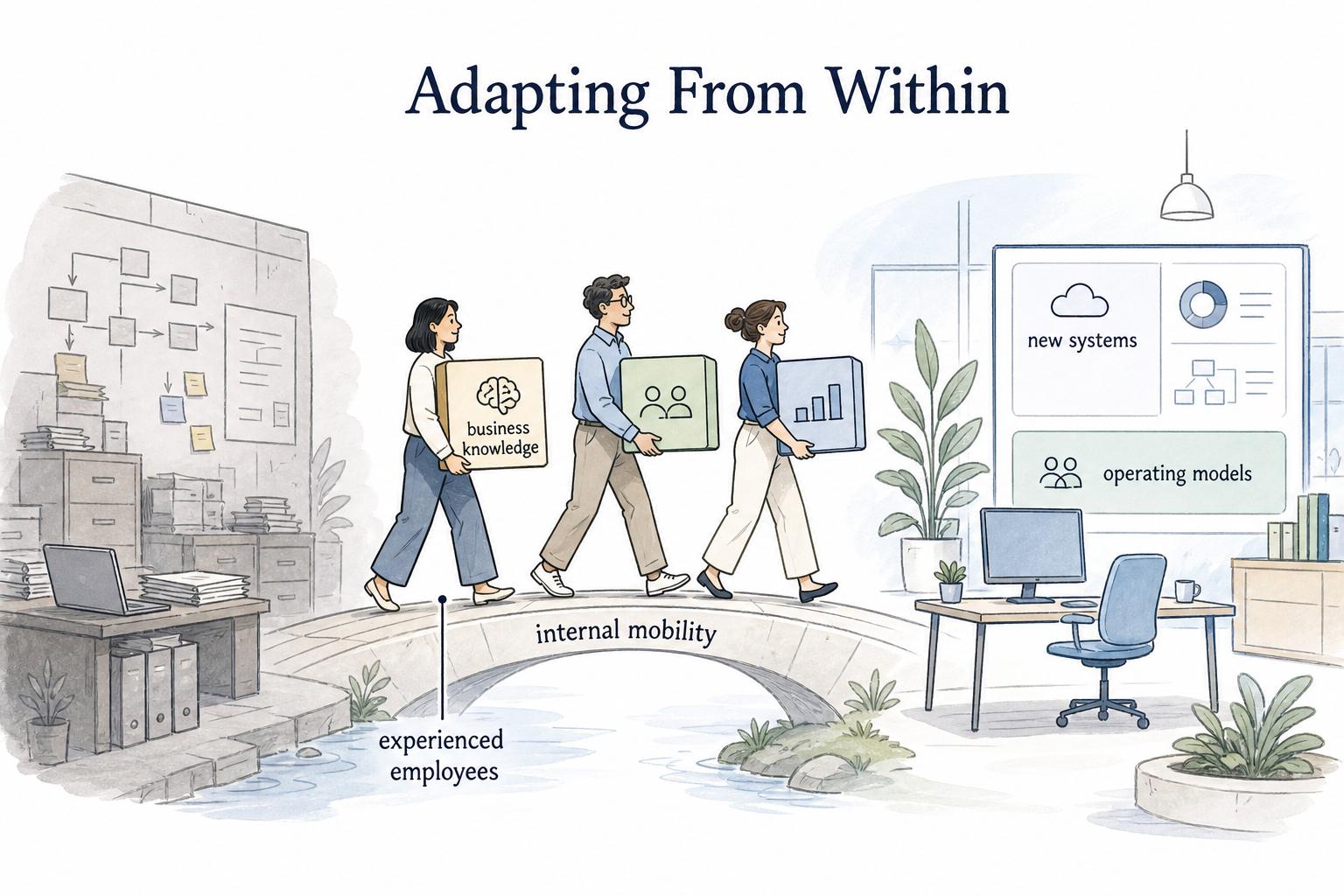
Reskilling helps organizations adapt without treating every new capability gap as an external hiring problem. The World Economic Forum's 2025 skills outlook reported that employers expect 39% of key skills required in the job market to change by 2030.1 That kind of shift makes internal skill transitions an operating problem, not only an L&D program.
Reskilling can support internal mobility, keep experienced employees engaged, and preserve business knowledge while teams move into new systems or operating models. It also gives employees a clearer path through change. When a role is shrinking, shifting, or being redesigned, vague encouragement to "learn new skills" is not enough. People need to know what new work they are moving toward, what existing experience still applies, and what proof will show they are ready.
OECD adult-learning research points to persistent participation gaps and access barriers, including time, cost, and suitable training options.2 That matters because reskilling asks employees to learn while they still have real work, family obligations, and performance expectations.
The hidden failure mode is funding learning activity without defining target performance. Employees finish courses, managers see attendance, and no one can say whether the person is ready to do the new work.
What a reskilling plan should include
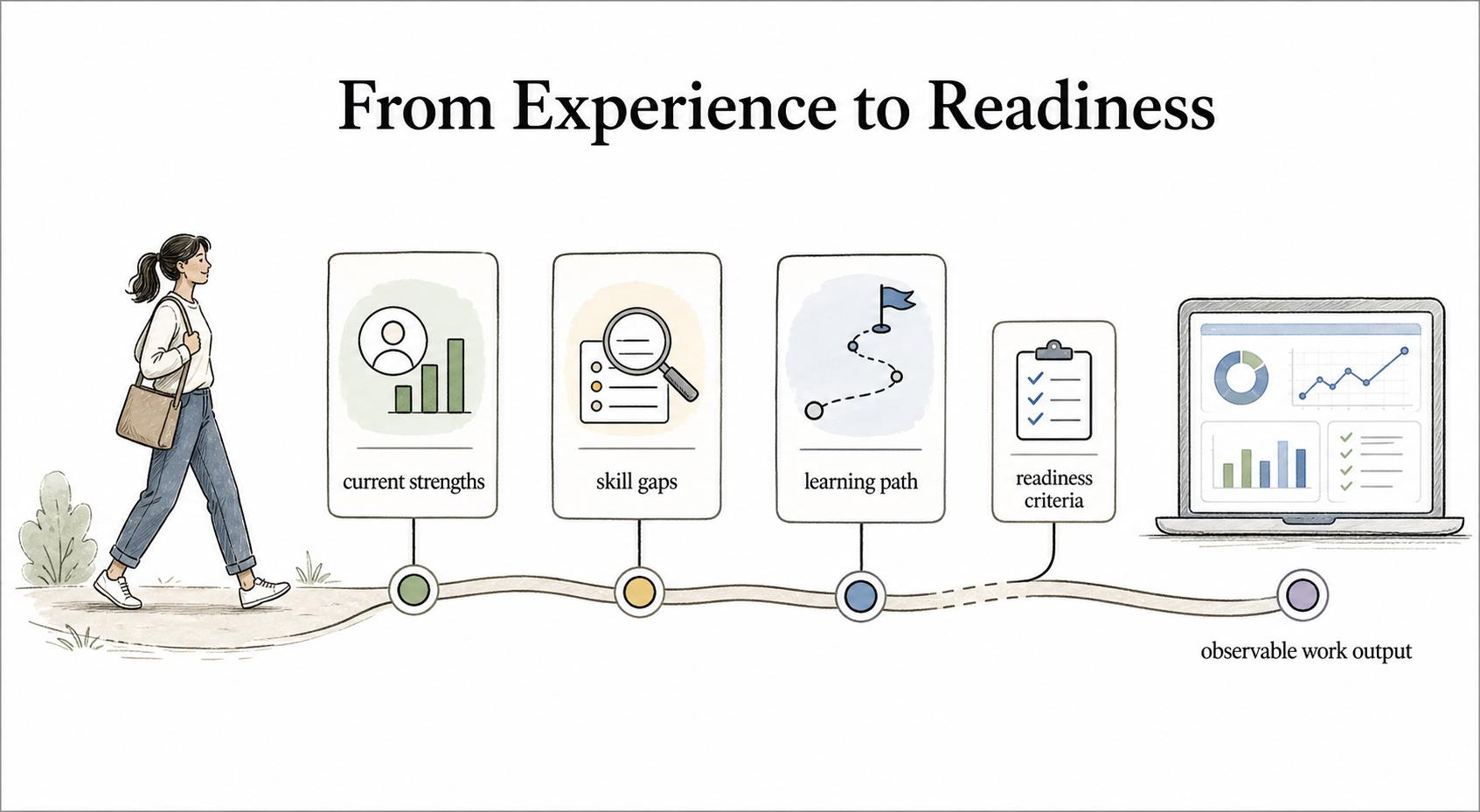
A reskilling plan should connect three things: the employee's current experience, the target work, and the performance standard for the new work. A course list can be part of the plan, but it should not be the whole plan; McKinsey's reskilling survey notes that companies use multiple tactics to close skill gaps, not just formal training.3
Strong reskilling plans usually include:
- Target work: the role, workflow, toolset, or responsibility the person is moving toward.
- Transferable strengths: the experience that still matters in the new context.
- Skill gaps: the knowledge, tools, judgment, habits, or domain fluency the person needs.
- Learning path: training, guides, job shadowing, practice tasks, and coaching.
- Practice work: realistic assignments that look like the new role, not only quizzes.
- Manager support: check-ins, feedback loops, and time protected for learning.
- Readiness criteria: observable evidence that the employee can perform the new work.
- Transition plan: when the employee begins taking on new responsibilities.
"Complete the analytics course" is a weak standard. "Build a weekly dashboard from approved data sources, explain the variance, and recommend one action" is stronger because it describes performance.
Reskilling example
Imagine a customer support team moving experienced agents into customer education roles. The agents already understand customer pain points, common questions, and product behavior. Those strengths matter. The new work also requires instructional writing, video scripting, content planning, and stakeholder review.
A useful reskilling plan would not stop at assigning a writing course. It would pair the employee with an education lead, show examples of strong help content, ask them to rewrite a common support workflow as a tutorial, review the draft against a rubric, and gradually assign real content work.
The employee is not starting from zero. They are translating existing knowledge into a different form of work.
Reskilling plan template
Use this prompt when you need to turn a reskilling goal into an actionable plan:
## Reskilling Plan Template

**Glossary term:** Reskilling
**Source:** Trails Glossary — trails.so/glossary/reskilling

---

### 01. Create a practical reskilling plan

"Create a reskilling plan for [employee or group] moving from [current role/workflow] to [target role/workflow].
Include:
- current strengths that transfer to the new work
- skill gaps by tool, domain knowledge, workflow, judgment, and communication
- learning path with training, shadowing, practice tasks, and documentation
- manager and mentor responsibilities
- readiness criteria based on observable work output
- timeline with milestones
- documentation or SOPs needed to support the transition
Write the plan for [manager/L&D/team lead] and make it practical enough to run over [timeframe]."
A good plan should make the next week of learning obvious, not just the long-term ambition.
Common mistakes
One mistake is treating reskilling as a morale program instead of an operating plan. Encouragement matters, but employees still need time, examples, tools, and feedback.
Another mistake is ignoring the receiving team. If the target manager has not defined competent performance, the training team may prepare people for the wrong version of the role.
A third mistake is leaving documentation until the end. Reskilling exposes gaps in SOPs, process guides, templates, and examples. If experienced employees need repeated verbal explanations to learn the new workflow, the process documentation is probably not ready.
Documentation takeaway
Reskilling works best when the new work is visible. That means documenting core workflows, examples, decision rules, tools, handoffs, and quality standards before expecting employees to infer them from scattered training.
For operations, support, enablement, and customer-facing teams, the practical question is not "Did this person take the training?" It is "Can this person perform the new workflow with the right judgment and support?"
How Trails helps
Trails helps teams capture workflows as people perform them and turn those workflows into step-by-step guides. For reskilling, that gives employees concrete references for unfamiliar tasks and gives managers a faster way to document the work people are moving into.
Trails can also create AI-narrated video guides, which can help employees see the new workflow before practicing it themselves.
Sources
- 1
World Economic Forum. Future of Jobs Report 2025: Skills Outlook. World Economic Forum. www.weforum.org/publications/the-future-of-jobs-report-2025/in-full/3-skills-outlook/. Accessed July 10, 2026.
- 2
Organisation for Economic Co-operation and Development. Trends in Adult Learning. OECD. www.oecd.org/en/publications/trends-in-adult-learning_ec0624a6-en.html. Accessed July 10, 2026.
- 3
McKinsey & Company. Beyond hiring: How companies are reskilling to address talent gaps. McKinsey & Company. www.mckinsey.com/capabilities/people-and-organizational-performance/our-insights/beyond-hiring-how-companies-are-reskilling-to-address-talent-gaps. Accessed July 10, 2026.