
Glossary
DMAIC
 ChatGPT
 Perplexity
 Gemini
 Claude
What is DMAIC?
DMAIC is a structured process improvement method used to define a problem, measure the current state, analyze causes, improve the process, and control the result. The acronym stands for Define, Measure, Analyze, Improve, and Control.
DMAIC is most closely associated with Six Sigma, but the basic discipline is useful anywhere a team needs to fix a repeatable process problem with evidence instead of opinion. 1 The discipline matters more than the acronym. DMAIC slows teams down at the points where rushed improvement work breaks: vague problem framing, lazy measurement, favorite-solution bias, and weak follow-through after launch.
Why DMAIC matters
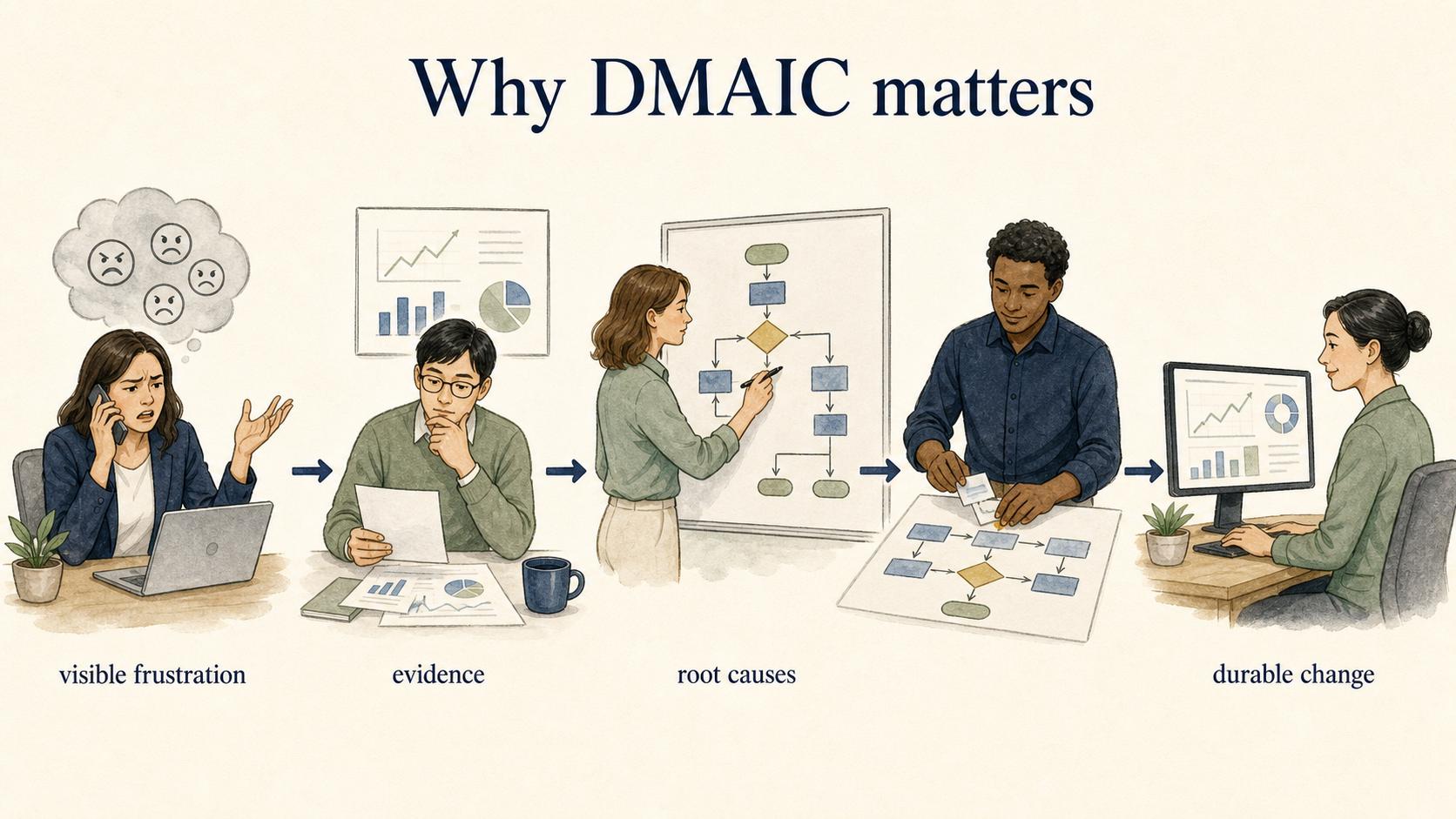
Most process improvement efforts start with a visible frustration: too many support escalations, inconsistent onboarding, late approvals, rework in a handoff, or a quality issue that keeps coming back. The tempting move is to fix the symptom directly. DMAIC forces a slower path from complaint to durable change.
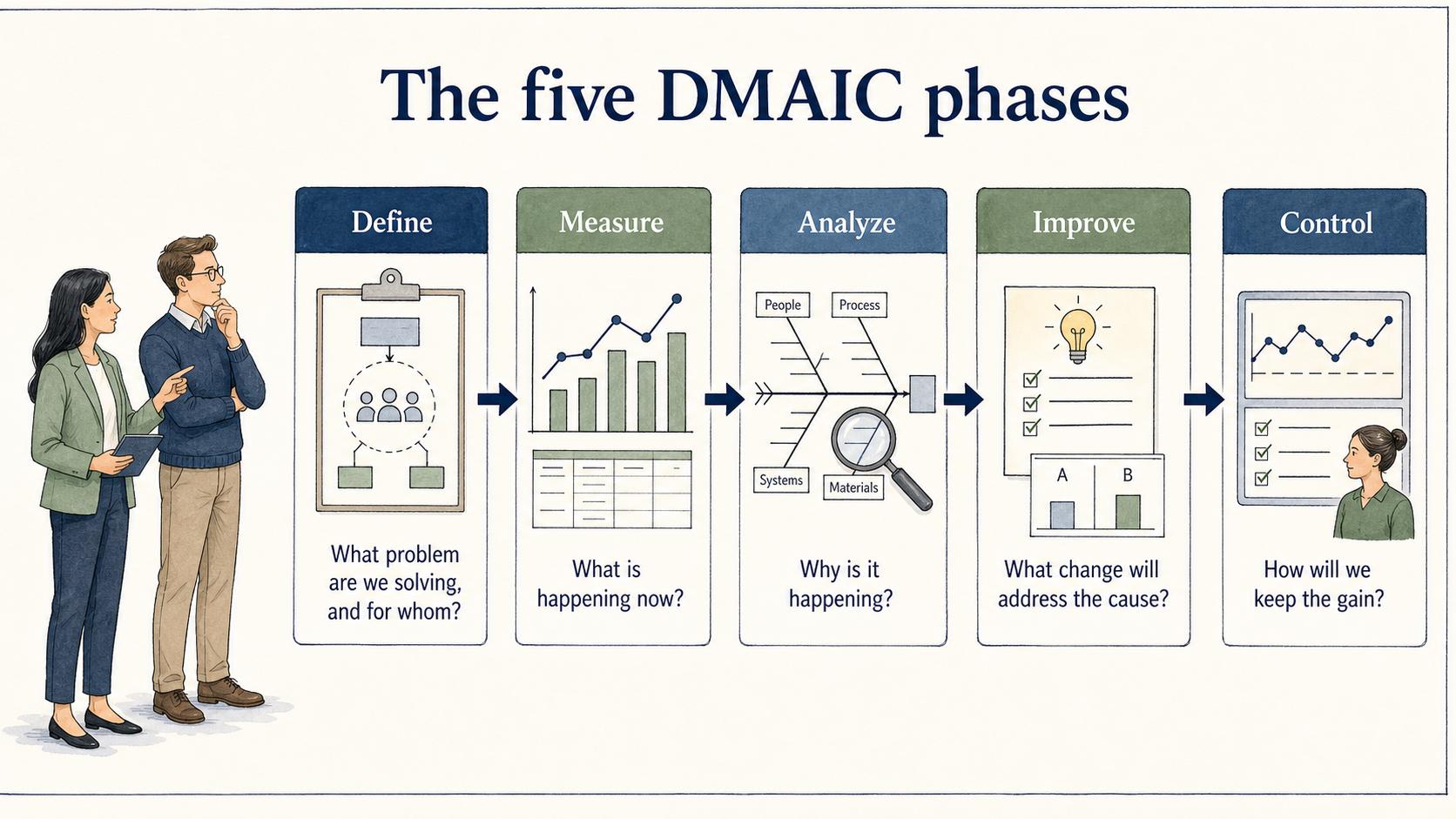
Each phase should earn the next one. Define narrows the problem. Measure shows what is happening before the fix. Analyze separates root causes from theories. Improve tests a specific change. Control makes the new way of working stick.
That sequence matters because process problems are rarely caused by one careless person or one missing tool. 2 They usually sit inside the design of the work: unclear inputs, hidden dependencies, inconsistent training, weak review points, or handoffs that no one owns.
The five DMAIC phases
Remembering the phase names is easy; respecting the handoff between them is the real work.
| Phase | Main question | Useful output |
|---|---|---|
| Define | What problem are we solving, and for whom? | Problem statement, scope, customer or stakeholder need |
| Measure | What is happening now? | Baseline data, process map, defect or delay measure |
| Analyze | Why is it happening? | Root cause hypothesis supported by evidence |
| Improve | What change will address the cause? | Tested solution, updated workflow, pilot results |
| Control | How will we keep the gain? | Standard work, owners, monitoring, documentation |
A team that defines a problem as "customers are unhappy" has not defined enough. A team that measures only the easiest metric may optimize the wrong thing. A team that jumps from Analyze to a large rollout may hide whether the fix actually worked.
Example of DMAIC in practice
Suppose a customer support team wants to reduce repeat escalations from new agents. A loose improvement effort might say, "Agents need more training," then add another training session. DMAIC would push the team to be more precise.
In Define, the team might narrow the problem to: "New agents escalate billing questions more than experienced agents during their first 30 days." In Measure, they might review escalation rates by issue type, agent tenure, and ticket source. In Analyze, they might discover that the issue is not general billing knowledge. The failure happens when agents cannot find the right refund exception rule during live customer conversations.
The Improve phase could test a tighter decision guide, a better internal search label, and a short practice scenario during onboarding. The Control phase would assign an owner for the guide, track escalation rates for the next two cohorts, and add the decision path to the team's standard onboarding documentation.
That shift is why DMAIC is useful. "More training" is a reasonable guess; DMAIC leaves an evidence trail from problem to control.
DMAIC vs PDCA
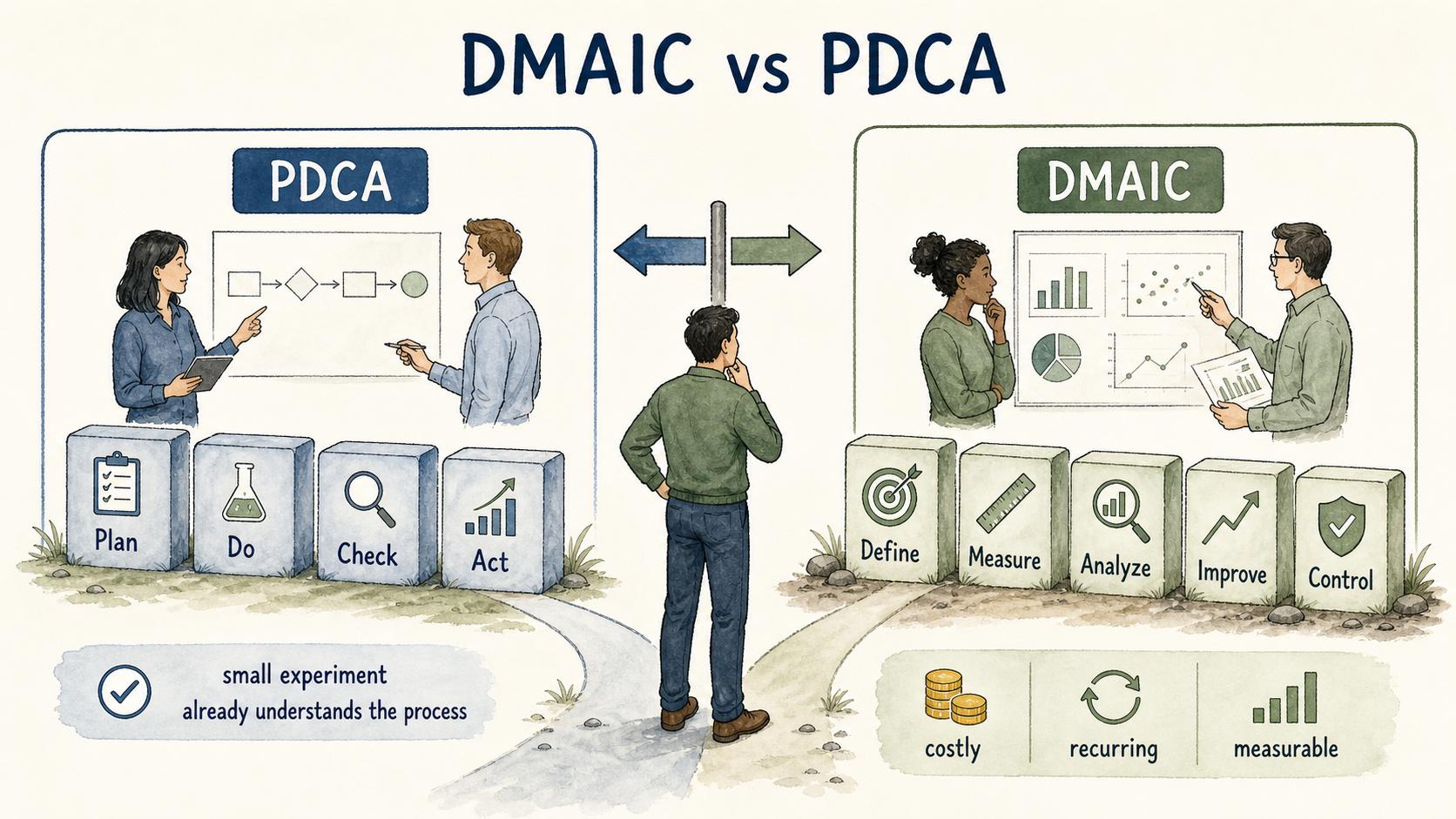
DMAIC and PDCA are both improvement cycles, but they fit different levels of rigor.
PDCA, or Plan-Do-Check-Act, is often lighter and more iterative. It is useful when a team needs to test a change, learn from it, and keep improving. DMAIC is more diagnostic. It is better when the problem is costly, recurring, measurable, or politically messy enough that the team needs a clearer fact base before changing the process.
A practical rule: use PDCA when the team already understands the process and needs a small experiment. Use DMAIC when the team does not yet trust its understanding of the problem.
Common mistakes with DMAIC
The most common DMAIC mistake is treating the method as paperwork after the real decision has already been made. If the solution is chosen before Measure or Analyze, the project may look disciplined while opinion is still driving the work.
Another mistake is measuring what is available instead of what matters. In the support example, total ticket volume may be easy to pull, but it would not explain why new agents escalate specific billing cases. A useful DMAIC measure is close enough to the pain that it can change the team's decision.
Teams also underinvest in Control. The improvement works during the project, then disappears when the project owner moves on, the dashboard stops being checked, or the updated workflow never makes it into training. 3 Control is where DMAIC becomes operational instead of episodic.
A practical DMAIC prompt
Use this prompt when you want an AI assistant to help structure a DMAIC project without skipping the thinking:
## DMAIC Improvement Project Prompt

**Glossary term:** DMAIC
**Source:** Trails Glossary — trails.so/glossary/dmaic

---

### 01. Structure a DMAIC improvement project

"Help us structure a DMAIC improvement project for [process or problem].
Team context: [team, customers, stakeholders]
Known pain: [observable issue]
Current evidence: [data, examples, complaints, cycle time, defects]
Constraints: [systems, compliance, staffing, timeline]

For each DMAIC phase, propose:
1. The question we should answer before moving on.
2. The evidence or artifact we need.
3. One likely failure mode if we rush this phase.
4. A practical next action for our team.

Do not recommend solutions until the Define, Measure, and Analyze sections are complete."
Documentation takeaway
DMAIC creates useful documentation because it makes the reasoning behind a process change visible. The final SOP or guide should not only describe the new workflow. It should preserve enough context for future teammates to understand what changed, why it changed, what metric proved the change helped, and how the team will know if the process starts drifting again.
That doesn't mean every DMAIC project needs a long report. For many teams, a concise project page, a current process map, an updated SOP, and a short control checklist are enough. 4 The goal is not documentation volume. The goal is making the improved way of working repeatable.
Sources
- 1
ASQ. Six Sigma tools: DMAIC. asq.org/quality-resources/sixsigma/tools.
- 2
AHRQ Patient Safety Network. Root cause analysis. psnet.ahrq.gov/primer/root-cause-analysis.
- 3
NIST/SEMATECH. Engineering Statistics Handbook: Process or Product Monitoring. www.nist.gov/publications/nistsematech-engineering-statistics-handbook-chapter-6-process-or-product-monitoring.
- 4
ISO. ISO 13053-1:2011 Six Sigma DMAIC methodology. www.iso.org/standard/52901.html.