
Glossary
Six Sigma
 ChatGPT
 Perplexity
 Gemini
 Claude
What is Six Sigma?
Six Sigma is a data-driven approach to improving processes by reducing variation, defects, errors, and rework. ASQ describes Lean Six Sigma as a fact-based, data-driven improvement philosophy focused on defect prevention over defect detection.1
It is used in quality management, operations, manufacturing, service delivery, healthcare, finance, and other environments where process problems can be measured.
In practical terms, Six Sigma helps teams stop guessing about recurring problems and improve them with evidence. It fits best when results are inconsistent and the cause is not obvious.
How Six Sigma works
Six Sigma projects usually focus on a defined process problem: too many defects, long cycle times, inconsistent outputs, customer complaints, missed handoffs, or avoidable rework. The team studies the current process, measures performance, identifies root causes, tests improvements, and creates controls so the gains do not disappear.
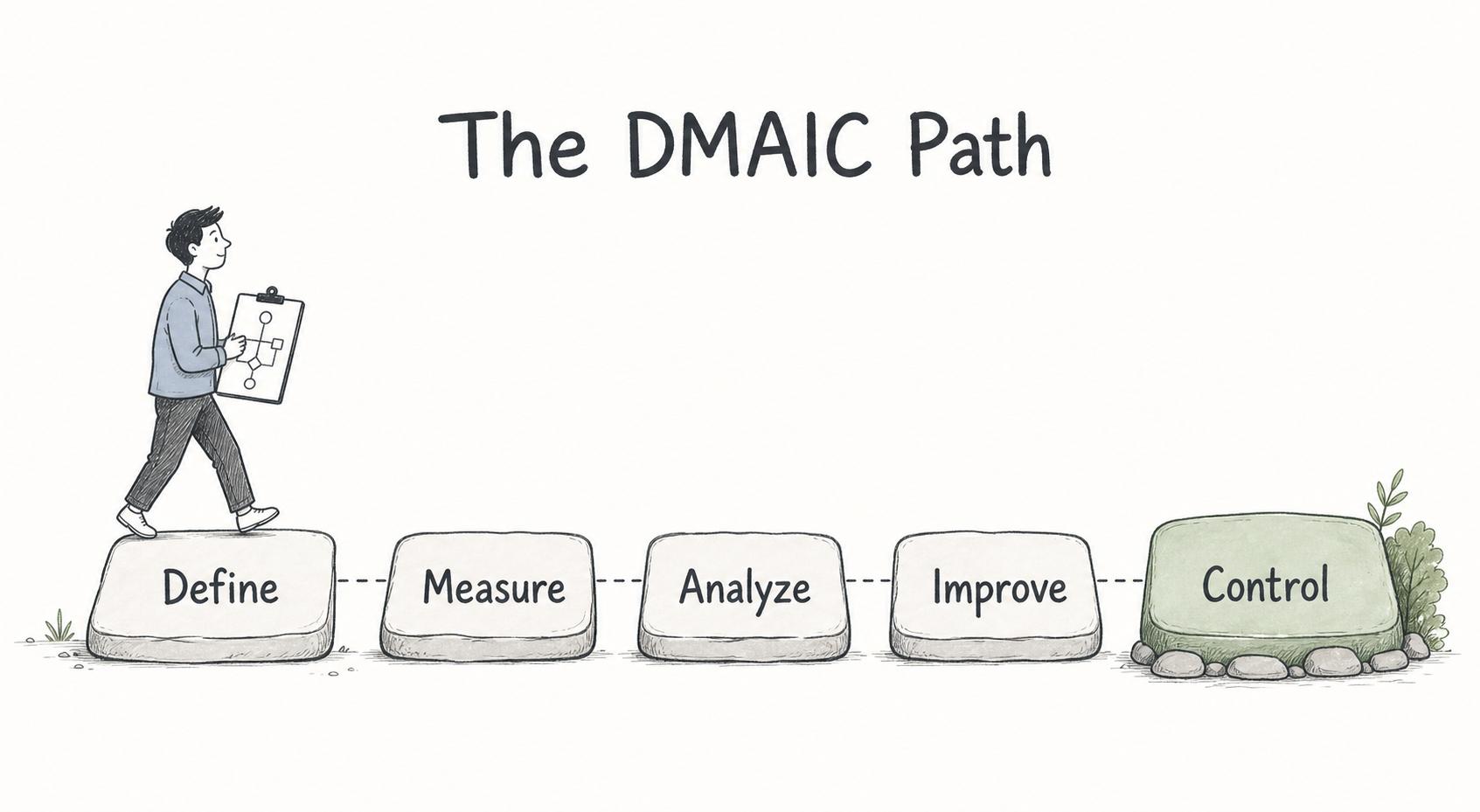
The most common improvement structure is DMAIC:
| Phase | Question it answers | Typical output |
|---|---|---|
| Define | What problem are we solving? | Problem statement, scope, customer impact, project goal |
| Measure | How does the process perform today? | Baseline metrics, data collection plan, current process map |
| Analyze | Why is the problem happening? | Root cause analysis, findings, validated causes |
| Improve | What change will fix or reduce the problem? | Tested solution, updated workflow, pilot results |
| Control | How will the improvement last? | Control plan, SOP updates, monitoring cadence |
DMAIC is useful because it slows teams down in the right places. ASQ describes DMAIC as a structured problem-solving approach for improving existing processes that miss performance standards or customer expectations.2 Instead of jumping from complaint to solution, the team defines the problem, checks the data, and tests whether the proposed fix addresses the actual cause.
Six Sigma examples
Six Sigma can be used anywhere work follows a repeatable process. Examples include reducing billing errors in accounts receivable, shortening customer onboarding cycle time, improving warehouse order accuracy, reducing manufacturing defects, decreasing support ticket reopen rates, standardizing healthcare handoffs, or improving data entry accuracy.
The method is not limited to factories. The same logic applies to office workflows, customer service, IT operations, and administrative processes when the problem can be measured and improved.
Six Sigma vs lean
Six Sigma and lean are often mentioned together, but they emphasize different things.
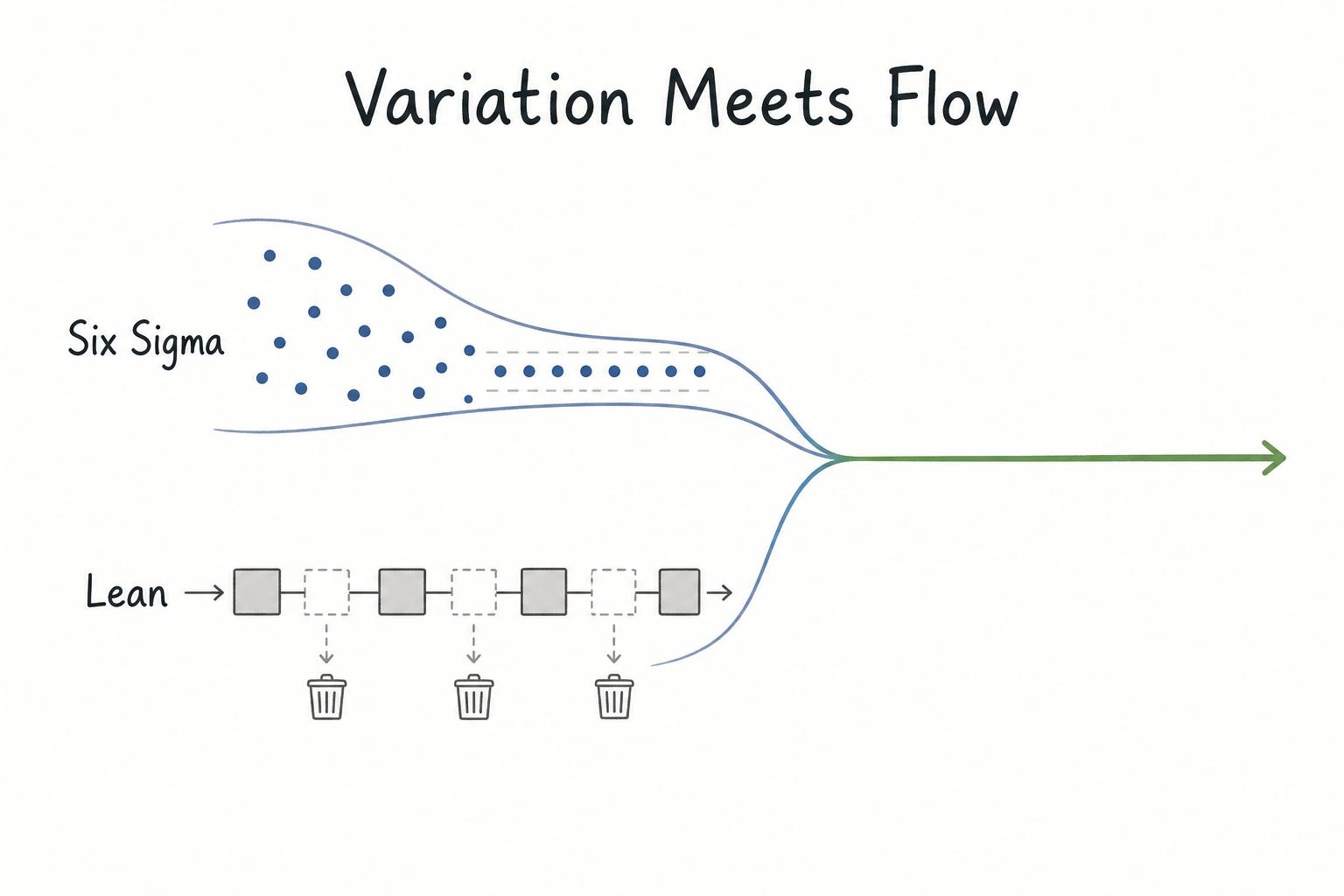
Six Sigma focuses on variation, defects, measurement, and root cause analysis. Lean focuses on flow, waste reduction, value, and unnecessary work. ASQ's Lean Six Sigma overview draws the same distinction: lean emphasizes waste reduction, while Six Sigma emphasizes variation reduction.3
Many organizations combine them as Lean Six Sigma because process performance often depends on both fewer errors and less waste. For example, a support team may use lean thinking to remove unnecessary handoffs and Six Sigma thinking to reduce error variation in case classification. The methods can complement each other, but neither should become jargon layered on top of an unclear problem.
When to use Six Sigma
Use Six Sigma when the process problem is measurable and important enough to justify structured analysis. It is especially useful when:
- The same issue keeps happening and the cause is not obvious.
- Variation is hurting quality, cost, cycle time, or customer experience.
- Leaders need evidence before changing a process that crosses teams.
- The improvement must be sustained after the project ends.
Do not use Six Sigma for every small annoyance. Some problems need a checklist, a clearer SOP, or a quick workflow fix. Six Sigma is strongest when the cost of guessing is high.
What documentation supports Six Sigma
Documentation is what turns a Six Sigma project into a lasting operating change. The project may identify the root cause and test a better process, but the new way of working still needs to be captured, taught, and maintained.
Useful Six Sigma documentation includes a project charter, current-state process map, baseline metrics, data definitions, root cause analysis notes, pilot results, updated process map, control plan, updated SOPs or work instructions, owner, and review cadence. NIST describes value stream mapping as a way to visualize process and information flows and identify waste and opportunities to streamline processes.4
A separate six sigma documentation page can preserve the project logic. The SOP or work instruction should preserve the new standard for daily work.
AI prompt for applying Six Sigma thinking
## Six Sigma Project Framing Prompt

**Glossary term:** Six Sigma
**Source:** Trails Glossary — trails.so/glossary/six-sigma

---

### 01. Frame a Six Sigma improvement project

"Help me frame a Six Sigma improvement project for [process].

Problem observed: [defect, delay, error, variation, complaint, rework]
Customer or stakeholder impact: [who is affected and how]
Current evidence: [metrics, examples, reports, tickets, observations]
Known constraints: [systems, staffing, policy, compliance, timing]

Create:
- A focused problem statement
- A draft DMAIC plan
- Metrics to collect during Measure
- Root cause hypotheses to test during Analyze
- Possible improvement experiments
- Documentation needed for the Control phase"
Use the output as a planning aid. The actual project should still be grounded in real process data and frontline input.
Common mistakes
The most common mistake is treating Six Sigma as a collection of tools instead of a disciplined problem-solving approach. Charts, maps, and templates help only when they clarify the problem and support better decisions.
Another mistake is skipping the control phase. Teams may celebrate an improvement, then fail to update the SOP, assign an owner, or monitor the new process. Without control, the old behavior often returns.
A third mistake is using Six Sigma language to make a simple problem look more sophisticated. If the issue is obvious and the fix is low-risk, solve it directly.
How Trails helps
Trails can help during the documentation and control side of Six Sigma work. When an improved workflow becomes the new standard, a teammate can capture the process, turn it into a step-by-step guide, and create an AI-narrated video for rollout or training.
That helps the improvement move from project file to daily behavior.
- Six Sigma documentation
- DMAIC
- SIPOC
- Process improvement
- Root cause analysis
- Voice of the Process
- Lean management
Sources
- 1
American Society for Quality. Ask the Standards Experts on Lean Six Sigma. ASQ Ask the Standards Experts. asqasktheexperts.org/2012/03/27/lean-six-sigma-2/.
- 2
American Society for Quality. DMAIC overview. ASQ. asq.org/quality-resources/dmaic.
- 3
American Society for Quality. Six Sigma. ASQ. asq.org/quality-resources/six-sigma.
- 4
National Institute of Standards and Technology. Value Stream Mapping. NIST. www.nist.gov/mep/value-stream-mapping.