
Glossary
PDCA Cycle
 ChatGPT
 Perplexity
 Gemini
 Claude
What is the PDCA cycle?
The PDCA cycle is a continuous improvement method built around four stages: Plan, Do, Check, and Act. Teams use it to test a change on a small scale, compare the result with the expected outcome, and decide whether to standardize, revise, or abandon the change. ASQ describes PDCA as a four-step model for carrying out change that should be repeated for continuous improvement. 1
The acronym matters less than the discipline behind it: learn before scaling. Instead of declaring that a new workflow is better because it sounds better, a team runs a controlled test and lets the evidence shape the next move. The Deming Institute frames the related PDSA cycle as a systematic process for gaining learning and knowledge for continual improvement. 2
How the PDCA cycle works
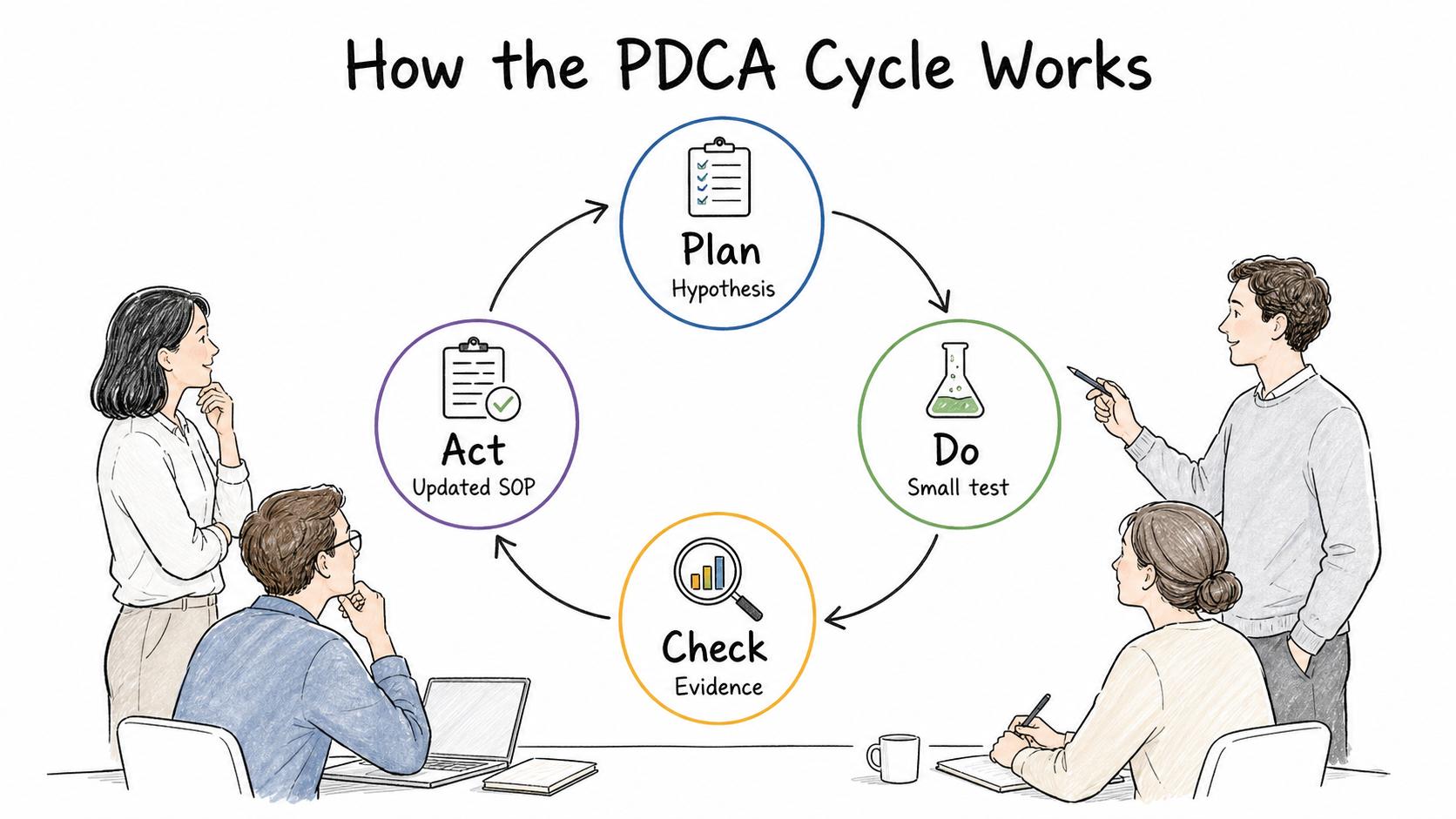
PDCA turns improvement into a loop. Each stage answers a different operating question:
| Stage | Question it answers | Practical output |
|---|---|---|
| Plan | What problem are we testing, and what result do we expect? | Hypothesis, baseline, scope, success criteria |
| Do | What happens when we try the change in a limited setting? | Small test, observed behavior, early issues |
| Check | Did the change improve the process, and what did we learn? | Comparison against baseline, feedback, evidence |
| Act | What should become the new standard, and what needs another test? | Updated SOP, revised test, rollback, or next cycle |
The loop matters because the first answer is rarely perfect. A support team may test a new escalation checklist and learn that it reduces missing context but slows agents down. That does not mean the idea failed. It means the next version should keep the useful parts and remove the friction.
When to use PDCA
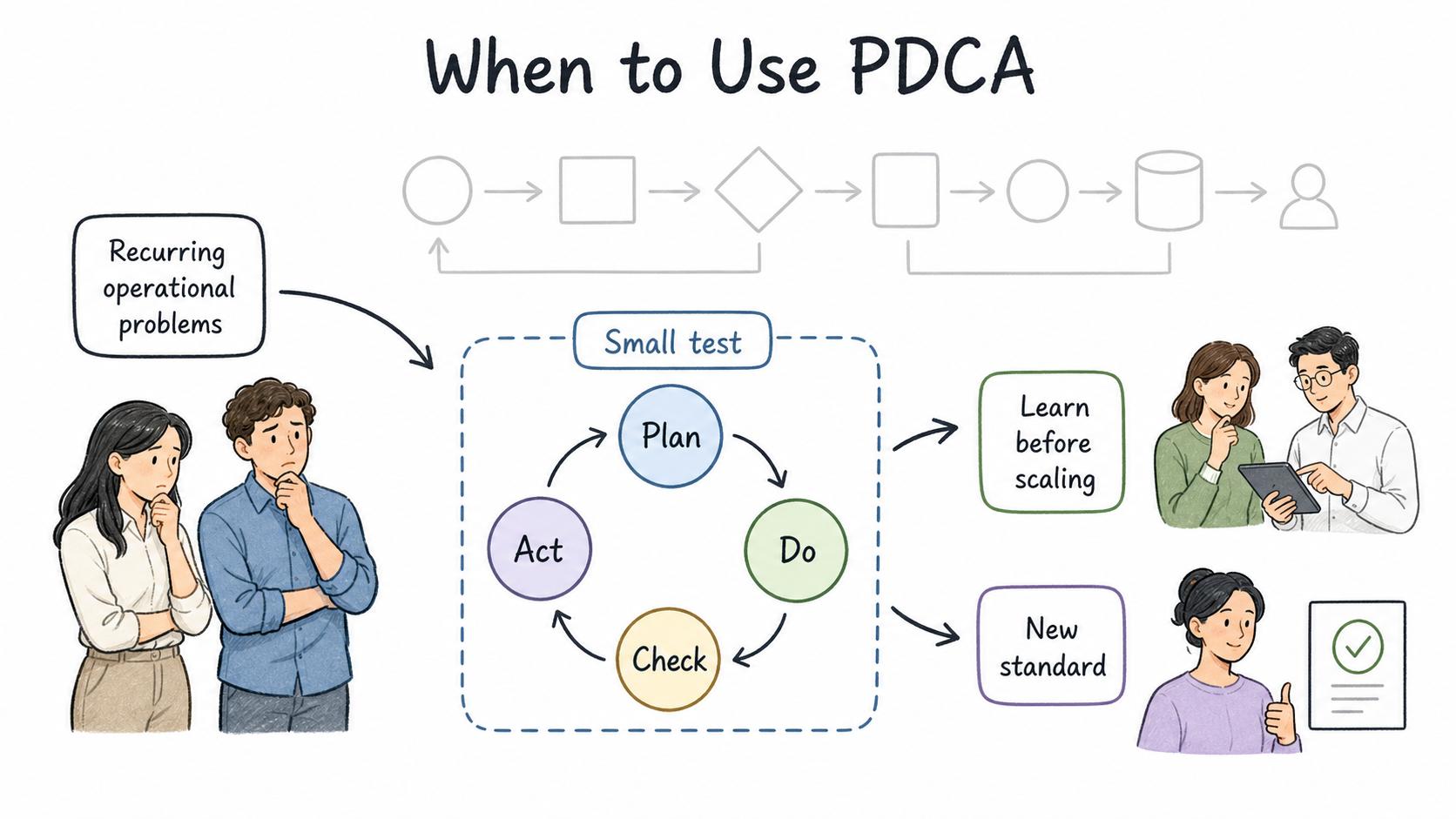
Use PDCA when the team can test a process change before committing to it everywhere. It works especially well for recurring operational problems: handoffs that break, errors that repeat, training gaps, inconsistent approvals, slow cycle times, or quality issues that show up after work is delivered.
PDCA is less useful when the team already knows the right fix and simply needs to execute it. It is also not a substitute for deeper analysis when the cause of a problem is unknown or the consequences of a bad change are high. In those cases, the Plan stage may need root cause analysis, process data, or a narrower test before anyone changes the workflow. AHRQ's PDSA guidance emphasizes writing down the steps, evaluating the outcome, improving the change, and testing again. 3
A good PDCA cycle is small enough to learn from. If the test touches five departments, three tools, and every customer segment at once, the team may not know what actually caused the result.
PDCA example
Imagine a customer success team that keeps missing key setup details during onboarding handoffs. The manager could announce a new handoff policy, but PDCA creates a cleaner path.
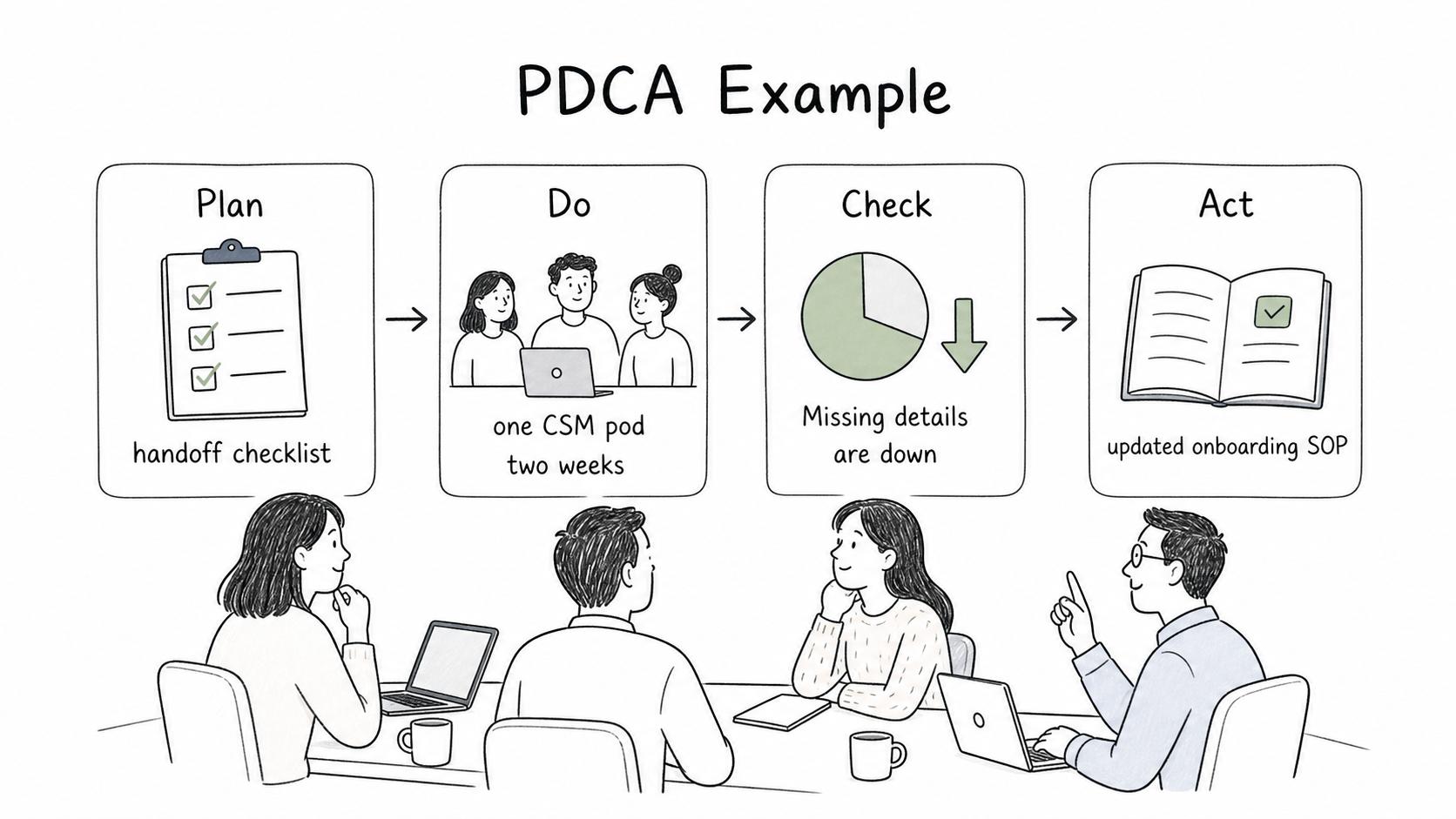
Plan: The team defines the problem: implementation calls often begin without complete account context. They decide to test a short handoff checklist with one CSM pod for two weeks. Success means fewer missing fields and no meaningful delay in scheduling the first call.
Do: The pod uses the checklist on new handoffs. The manager watches where people hesitate, which fields are confusing, and whether the checklist fits the actual sales-to-CS workflow.
Check: The team compares the test period with the baseline. Missing details are down, but one checklist item creates duplicate work because the same information already exists in the CRM.
Act: The team removes the duplicate item, updates the onboarding SOP, adds the checklist to the handoff workflow, and trains the rest of the team. If the results were mixed, they would run another cycle instead of rolling it out broadly.
The important finish is an updated standard, not a meeting note saying the test went well.
Common PDCA mistakes
The most common mistake is treating PDCA like a project wrapper. A team fills out a Plan-Do-Check-Act template after the fact, but the change was never tested in a way that could produce learning. That creates paperwork, not improvement.
Another mistake is skipping the Check stage because the change feels obviously better. Process work is full of local improvements that create downstream pain. A faster intake form may reduce admin time while creating more follow-up questions for the team doing the work.
The quietest failure is a weak Act stage. Teams often identify a better way to work but never update the SOP, checklist, training guide, tool configuration, or owner expectations. When the person who ran the test moves on, the improvement disappears with them.
A practical PDCA planning prompt
Use this prompt to turn a vague process complaint into a useful improvement cycle:
## PDCA Planning Prompt

**Glossary term:** PDCA Cycle
**Source:** Trails Glossary — trails.so/glossary/pdca-cycle

---

### 01. Create the improvement cycle

"Create a PDCA cycle for improving [process]. Include the current problem, baseline, proposed change, test scope, success criteria, risks, what data or feedback to collect, who owns each stage, and what documentation should be updated if the change becomes the new standard."
The most important placeholders are the baseline and the documentation update. Without a baseline, the team cannot judge improvement. Without documentation, the team cannot make the improvement repeatable.
Documentation takeaway
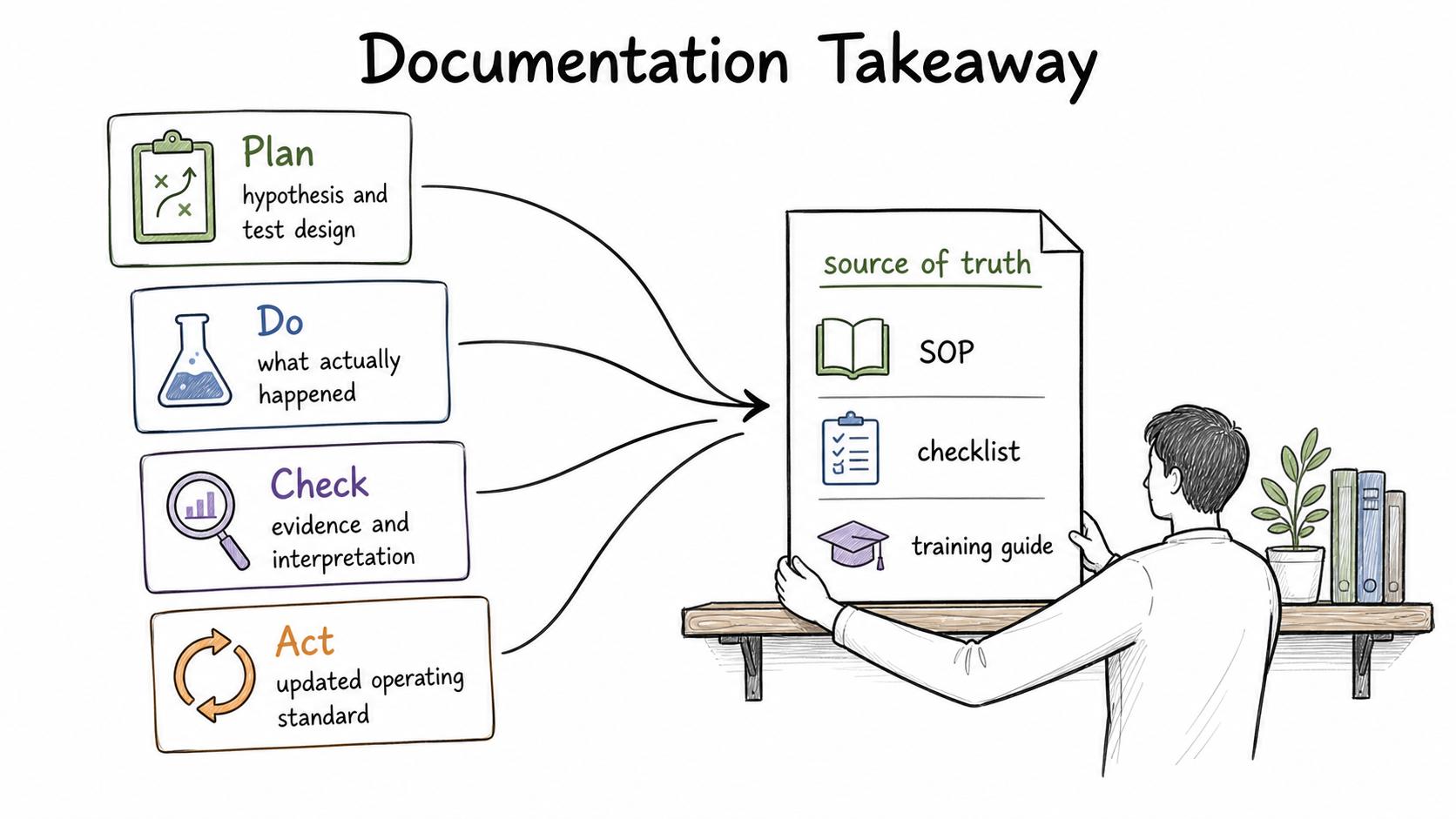
PDCA creates learning; documentation makes that learning durable. The Plan stage should capture the hypothesis and test design. The Do stage should capture what actually happened. The Check stage should capture evidence and interpretation. The Act stage should update the operating standard.
That standard might be an SOP, checklist, work instruction, process map, training guide, or operations manual entry. The format matters less than the behavior: if the team learned a better way to do repeatable work, the source of truth should change.
How Trails helps
Trails helps teams turn a successful PDCA result into usable process documentation. After a team validates a workflow change, they can capture the updated process as it is performed, turn it into a polished step-by-step guide, and create an AI-narrated video version for training or sharing.
Sources
- 1
ASQ. PDCA Cycle. asq.org/quality-resources/pdca-cycle.
- 2
The Deming Institute. PDSA Cycle. deming.org/explore/pdsa/.
- 3
Agency for Healthcare Research and Quality. Plan-Do-Study-Act (PDSA) Directions and Examples. www.ahrq.gov/health-literacy/improve/precautions/tool2b.html.