
Glossary
Digital Transformation
 ChatGPT
 Perplexity
 Gemini
 Claude
What is digital transformation?
Digital transformation is the redesign of how an organization works, serves customers, and makes decisions using digital tools and systems. It goes beyond moving paper forms into software or buying a new platform, though both may be part of the work.
Strong digital transformation changes the operating model: how information moves, how teams coordinate, how customers get value, and how leaders see the work. 1 Weak transformation is a technology rollout with a more impressive name. The practical test is whether the organization changes how the work runs after the tool is live.
Why digital transformation matters
Digital transformation matters because most organizations accumulate workarounds faster than they redesign the work itself. Teams use spreadsheets beside core systems. Managers rely on status meetings because the system of record is incomplete. Employees copy data between tools because handoffs were never designed end to end. Customers feel the result as delays, errors, or inconsistent answers.
A digital transformation effort tries to make the work more visible, connected, and adaptable. That may involve automation, self-service, analytics, new customer channels, better internal documentation, or new roles. The purpose is to make important work easier to perform, measure, improve, and scale.
The practical challenge is that digital transformation often touches the parts of a business that people have learned to survive around. The hidden process is usually stronger than the formal process. If the transformation ignores that reality, people will keep using the old workaround in a new tab.
Digital transformation vs digitization vs automation
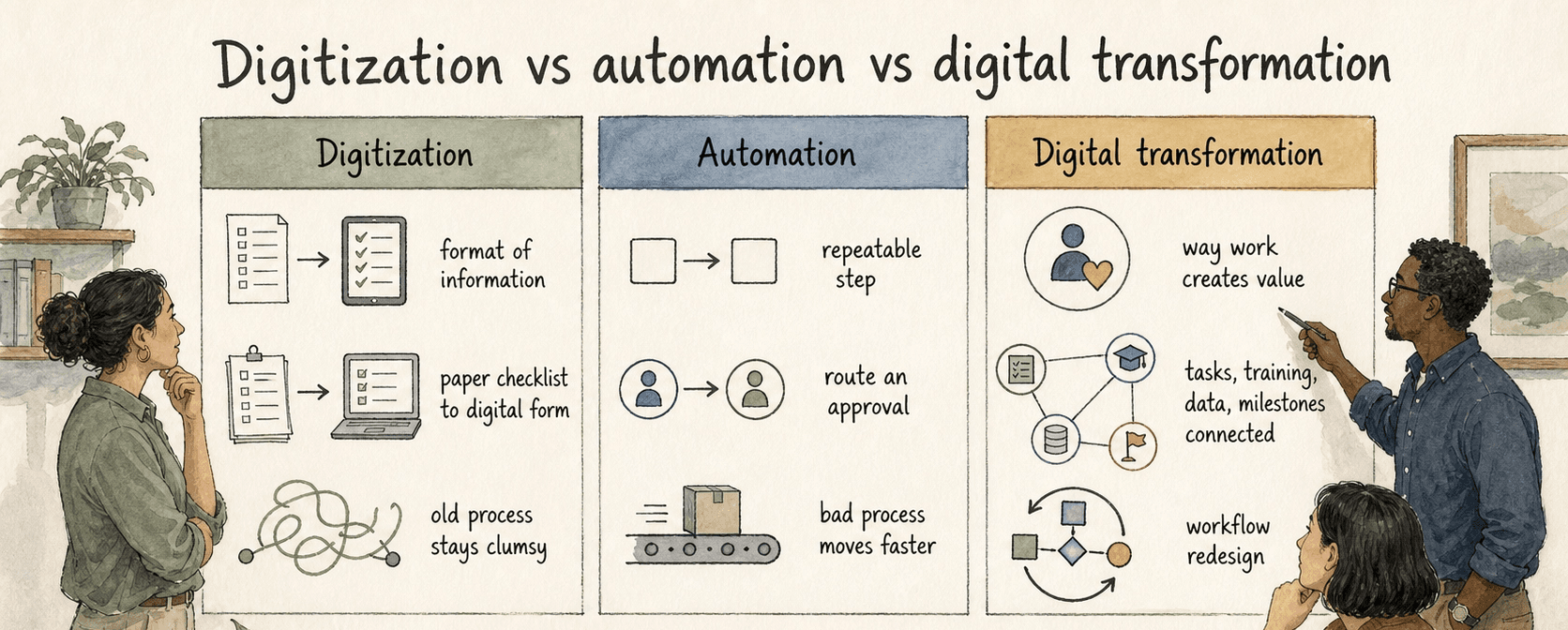
These terms are related, but they answer different questions.
| Term | What changes | Example | Common failure mode |
|---|---|---|---|
| Digitization | The format of information | Turning a paper checklist into a digital form | The old process stays just as clumsy |
| Automation | The execution of a repeatable step | Routing an approval after a form is submitted | A bad process moves faster |
| Digital transformation | The way work creates value | Redesigning onboarding so tasks, training, data, and customer milestones are connected | Tool rollout happens without workflow redesign |
Digitization and automation can support transformation, but they do not guarantee it. A team can digitize a procedure manual and still have unclear ownership. It can automate a handoff and still send the wrong information. Transformation asks a harder question: what should the work become now that better digital coordination is possible?
What digital transformation looks like in practice
Imagine a growing services company with a messy customer onboarding process. Sales promises are stored in the CRM, setup tasks live in project management software, training materials sit in a knowledge base, and customer success managers track risks in private notes. Everyone is working hard, but the customer experiences the process as fragmented.
A shallow digital transformation might buy a new onboarding tool and migrate the checklist. A stronger transformation would redesign the onboarding workflow around the customer's first value milestone. The team would define the critical handoffs, standardize the setup steps, connect customer data to internal tasks, document the repeatable parts, and make exceptions visible instead of hiding them in Slack.
The technology still matters, but the useful change is the operating discipline around it: shared definitions, fewer manual handoffs, clearer owners, better visibility, and training that matches the real workflow. 2
What makes digital transformation difficult
Digital transformation is difficult because it asks teams to change both systems and behavior. 3 Software can be configured in weeks; trust, habits, and cross-functional ownership take longer.
The first difficulty is scope. Transformation efforts often start too broad: "modernize operations" or "become more data-driven." Those goals are hard to act on. A better starting point is a specific business workflow where the current state is painful and measurable, such as customer onboarding cycle time, quote-to-cash errors, support escalation quality, or field training consistency.
The second difficulty is process debt. If a workflow is unclear before software is introduced, the new system will expose the confusion. That is uncomfortable but useful. Teams should treat that exposure as part of the work, not as a sign that the tool failed.
The third difficulty is adoption. People do not adopt a new system because it exists. They adopt it when it reduces friction, fits the moment of work, and becomes the easiest credible way to do the job. Digital adoption has to shape the design from the beginning, not wait for a launch announcement.
A practical transformation diagnostic
Before calling an initiative digital transformation, ask these questions:
- What customer, employee, or operational outcome will improve if this works?
- Which workflow will change after the tool is live?
- What manual handoff, duplicate entry, or hidden workaround will disappear?
- What will people do differently on day one after launch?
- What documentation or training will make the new workflow repeatable?
- What metric will show whether the change became normal operating practice?
If the answers mostly name software features, the initiative is probably a technology implementation. That may still be valuable. It just should not be confused with transformation.
Documentation takeaway
Digital transformation depends on documentation more than teams expect. When a process changes, people need a current explanation of how the new workflow works, why it changed, what exceptions look like, and where responsibility moves from one person or system to another.
Good transformation documentation belongs in the design process. 4 Process maps, decision rules, SOPs, onboarding guides, and training videos help the team turn a strategic change into repeatable daily behavior.
How Trails helps
Trails helps when digital transformation involves changing repeatable workflows, training people on a new process, or replacing informal know-how with clearer operating guides. Teams can capture a workflow as someone performs it, turn that workflow into a polished step-by-step guide, and create an AI-narrated video version for training or sharing.
That matters because transformation work often fails in the last mile: people understand the strategy but do not have a clear, current way to perform the new workflow. Trails helps teams document the actual work so the new process is easier to teach, inspect, and maintain.
Sources
- 1
MIT CISR. Building the Componentized Organization. cisr.mit.edu/publication/2020_0601_BuildingComponentizedOrganization_RossBeathNelson.
- 2
BCG. Increasing the Odds of Success in Digital Transformation. www.bcg.com/publications/2020/increasing-odds-of-success-in-digital-transformation.
- 3
McKinsey. Unlocking Success in Digital Transformations. www.mckinsey.com/capabilities/people-and-organizational-performance/our-insights/unlocking-success-in-digital-transformations.
- 4
Harvard Business Publishing. 5 Questions to Ask About Your Digital Transformation. www.harvardbusiness.org/insight/5-questions-to-ask-about-your-digital-transformation/.