
Glossary
Change Management
 ChatGPT
 Perplexity
 Gemini
 Claude
What is change management?
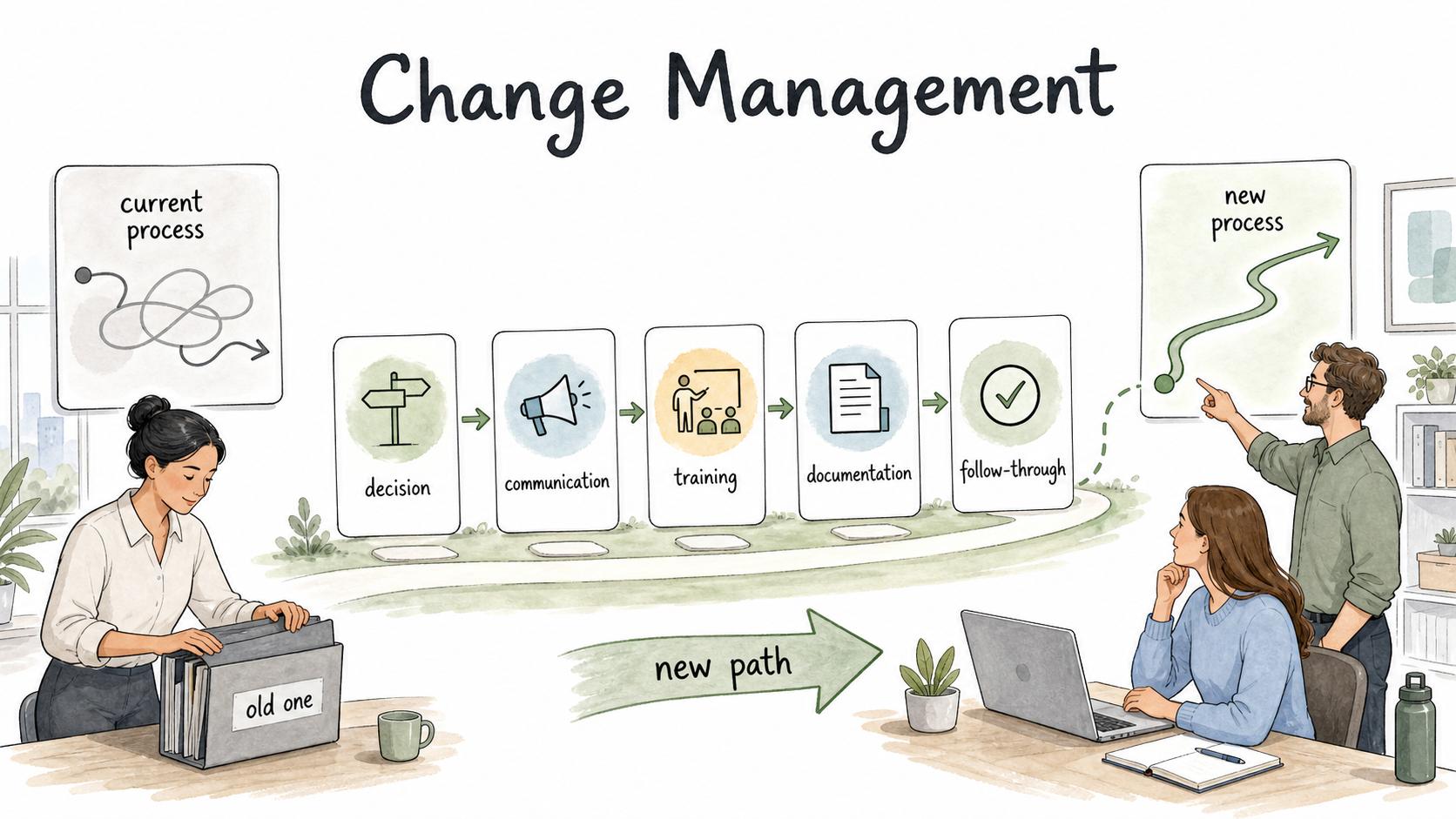
Change management is the structured work of helping people move from one way of working to another. It covers the decision, the communication, the training, the documentation, and the follow-through that make a new process stick.
In operations, change management shows up when a team rolls out new software, changes an approval path, updates compliance requirements, reorganizes a support workflow, or introduces a new operating model. The visible change may be a tool or policy. The hard part is usually behavioral: helping people trust the new path enough to stop relying on the old one.
Why change management matters
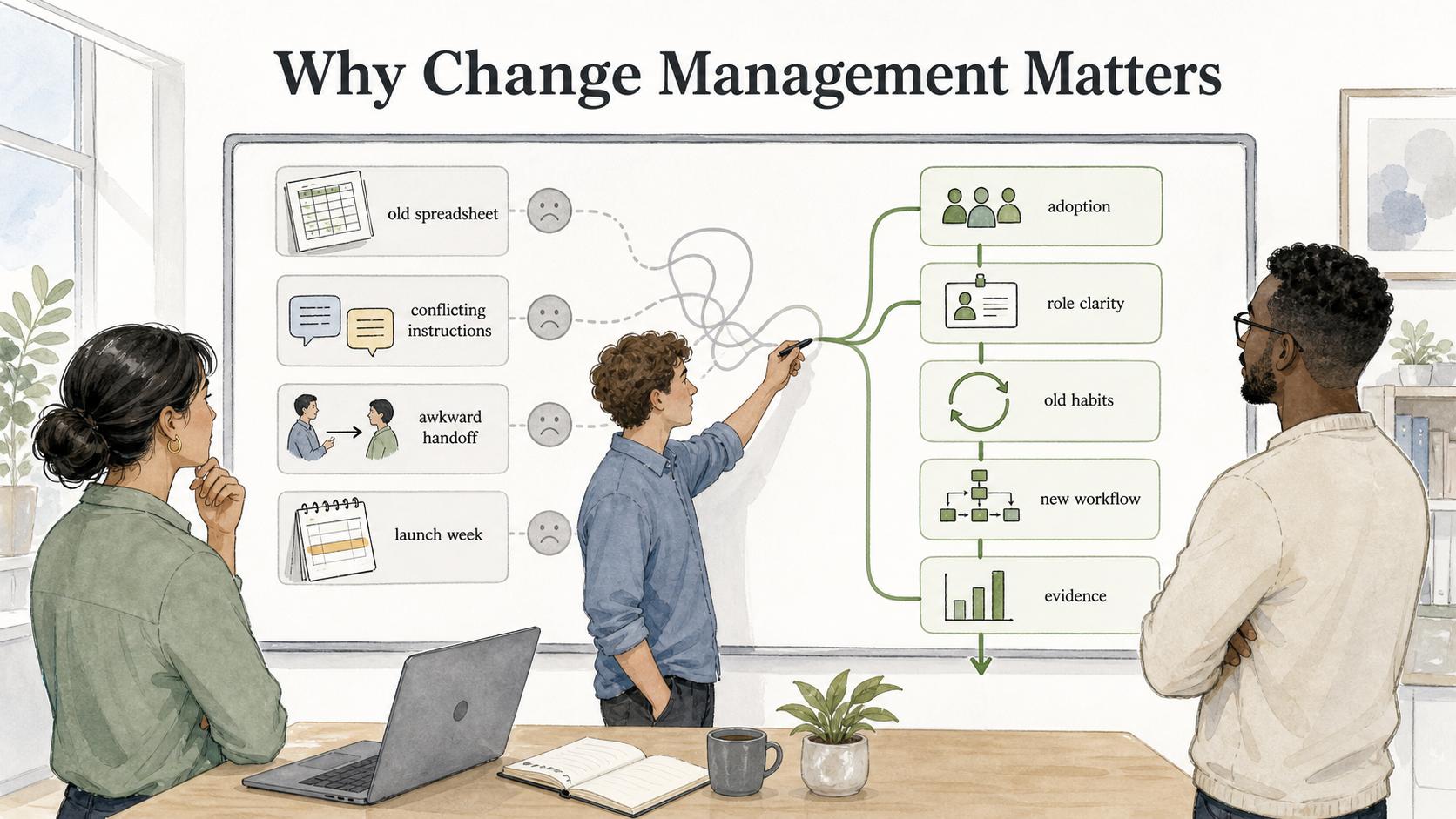
Most changes fail quietly first. The team hears the announcement, attends the meeting, and technically knows what to do. Then the old spreadsheet keeps circulating, a manager gives conflicting instructions, training skips the awkward handoff, or the reason for the change disappears after launch week.
Change management treats adoption as part of the work. Prosci's research on change success points to structured methodology, active sponsorship, and role clarity as contributors to stronger outcomes. A useful plan asks practical questions before the rollout gets messy: Who has to behave differently? What will be harder at first? Which old habits will compete with the new workflow? What evidence will show the change has landed? 1
The strongest change plans aren't oversized binders. They are clear operating agreements that connect the business reason for the change to the daily moments where employees will either adopt the new process or work around it.
How change management works in practice
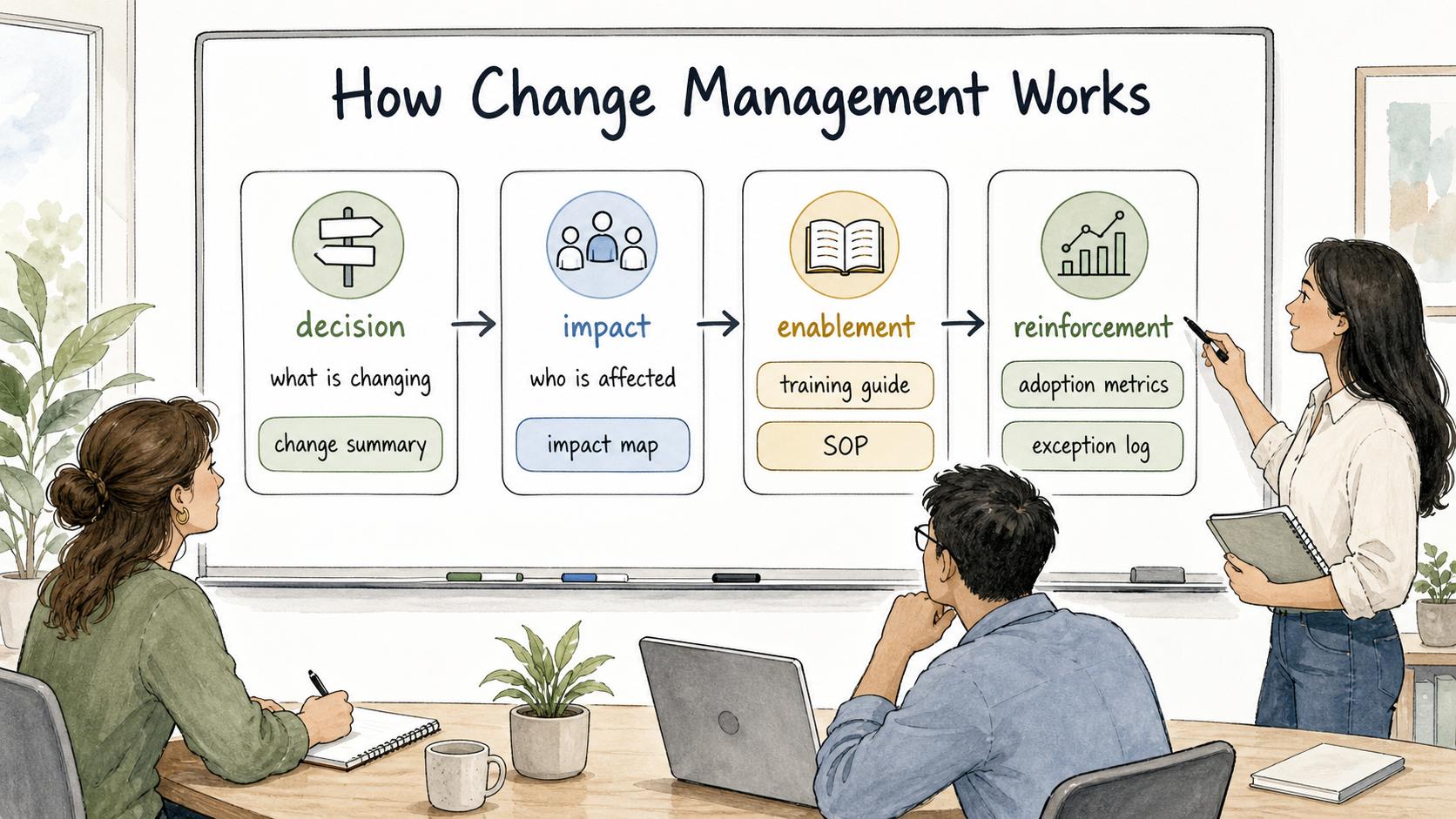
A practical change plan usually covers four layers: decision, impact, enablement, and reinforcement. Each layer prevents a different failure mode.
| Layer | Question it answers | Practical artifact |
|---|---|---|
| Decision | What is changing, and why now? | Change summary or decision brief |
| Impact | Who is affected, and what will feel different? | Stakeholder and workflow impact map |
| Enablement | What does the team need to do the new work correctly? | Training guide, SOP, job aid, or walkthrough |
| Reinforcement | How will leaders know the change is sticking? | Adoption metrics, manager check-ins, exception log |
The order matters. Training written before impact mapping often explains the new tool while missing the exact handoff where people get stuck. Metrics chosen before the decision is clear can reward rollout compliance instead of the outcome the change was supposed to produce.
Change management vs. change control
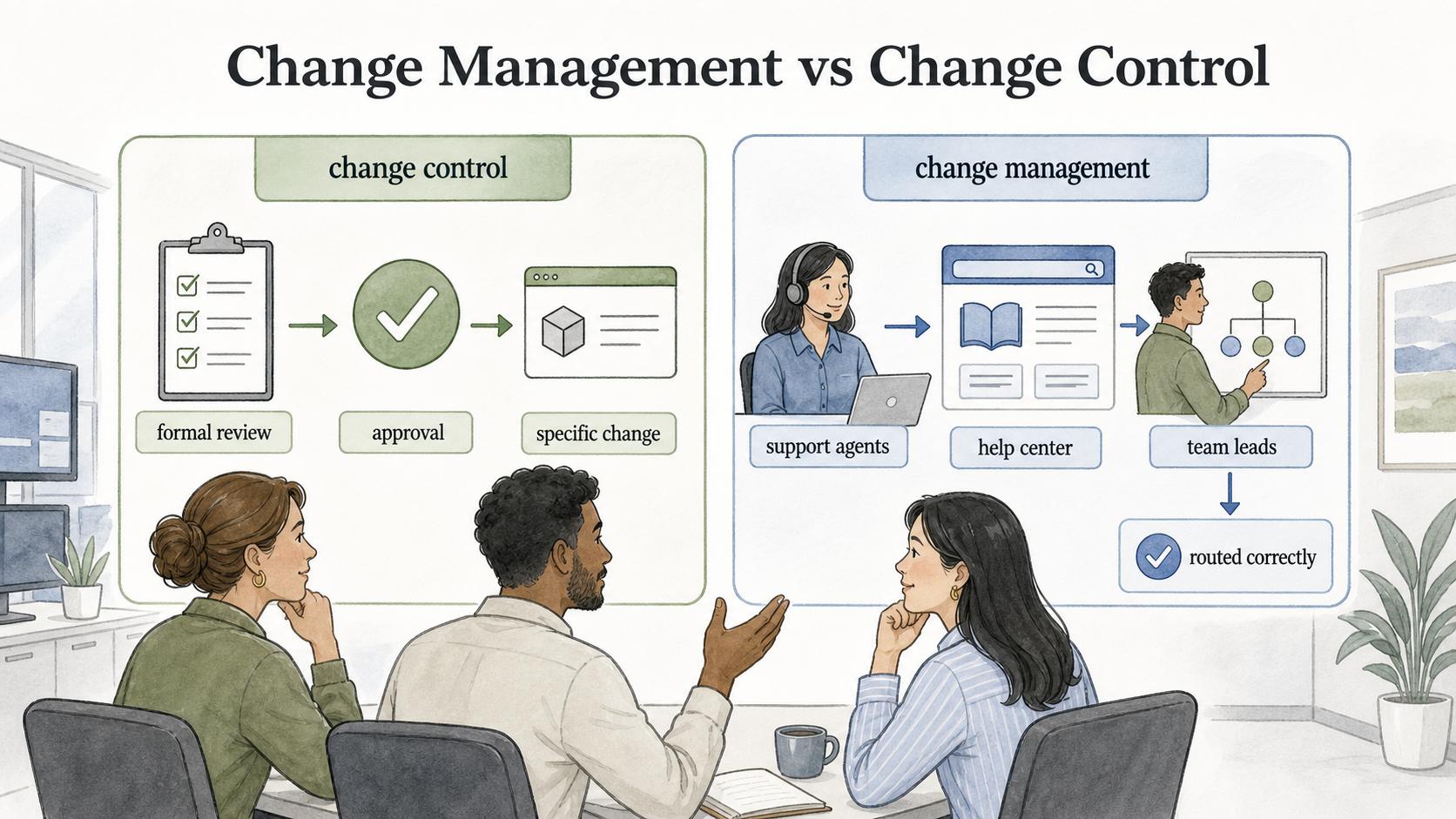
Change control is the formal review and approval of a specific change, especially in technical, regulated, or risk-sensitive environments. Change management is the broader adoption work that helps an approved change succeed.
For example, approving a new customer escalation workflow is change control. Helping support agents know when to use it, updating the help center, training team leads, and checking whether escalations are routed correctly are change management.
Common mistakes
Announcing the change before explaining the tradeoff. People don't need a perfect story, but they need an honest one. If the new process is slower at first because it reduces downstream errors, say that. Hidden tradeoffs turn into rumors.
Treating training as a one-time event. A launch session can introduce the change, but adoption usually happens during the first few real attempts. Prosci's ADKAR model separates knowledge from ability and reinforcement, a useful reminder that knowing about a change is different from performing it consistently. 3 Put support material close to the work: a short SOP, recorded walkthrough, or job aid people can use while doing the task.
Letting exceptions become the real process. Every change has edge cases. The risk is unmanaged exceptions. Keep an exception log early so the team can adjust intentionally instead of letting informal workarounds harden into the default process.
Measuring awareness instead of behavior. Attendance is easy to report. Correct usage in live work is harder and more useful. Prosci's guidance on change-management metrics includes adoption and usage measures alongside readiness and participation signals. 4
AI-ready change management prompt
Use this prompt to turn a proposed change into a practical adoption plan:
## Create a change management plan

**Glossary term:** Change Management
**Source:** Trails Glossary — trails.so/glossary/change-management

---

### 01. Prompt

"Create a change management plan for [team] as they move from [current process] to [new process].

Context:
- Why the change is happening: [business reason]
- People affected: [roles or teams]
- Workflows affected: [specific workflows]
- Known risks or resistance: [concerns]
- Launch date or target window: [timeline]

Include:
1. A plain-English change summary
2. A stakeholder impact map
3. The training or documentation each group needs
4. The first-week support plan
5. Adoption signals to review after launch
6. Likely exceptions or workarounds to watch for

Keep the plan practical and specific. Name the moments where people are most likely to revert to the old process."
How Trails helps
Change management depends on usable process documentation because people need to see the new way of working in context. McKinsey's transformation research links stronger transformation outcomes with line-manager and frontline engagement, which supports treating adoption as operating work rather than a launch announcement. 2
Trails captures a workflow as someone performs it, turns that workflow into a polished step-by-step guide, and can create an AI-narrated video version for training or sharing. That gives teams adoption materials that show the work, not just the decision.
FAQ
What is an example of change management?
A common example is rolling out a new support escalation workflow. The change management work includes explaining why the workflow is changing, documenting the new steps, training support agents and team leads, answering questions during the first week, and checking whether escalations are routed correctly.
Is change management only for large companies?
No. Smaller teams often need it because informal habits spread quickly. A lightweight change plan can prevent confusion without creating heavy bureaucracy.
Who owns change management?
Ownership depends on the change. Operations, HR, enablement, IT, customer support, or functional leaders may own different parts. The important move is to name one accountable owner for adoption, not only one owner for the announcement.
Sources
- 1
Prosci. Change Management Success. www.prosci.com/change-management-success.
- 2
McKinsey & Company. Losing from day one: Why even successful transformations fall short. www.mckinsey.com/capabilities/people-and-organizational-performance/our-insights/successful-transformations.
- 3
Prosci. The Prosci ADKAR Model. www.prosci.com/methodology/adkar.
- 4
Prosci. Change Management Metrics. www.prosci.com/resources/articles/change-management-metrics.