
Glossary
Department Head
 ChatGPT
 Perplexity
 Gemini
 Claude
What is a department head?
A department head is the person accountable for leading a specific department, function, or business unit. The role usually includes setting priorities, managing performance, allocating resources, approving key decisions, and making sure the department's work supports the broader organization. 1
The exact title varies by company. A department head might be called Head of Support, Head of Operations, Director of Finance, Engineering Lead, or VP of People. The important boundary is outcome ownership: this person is responsible for the conditions that let the function do good work.
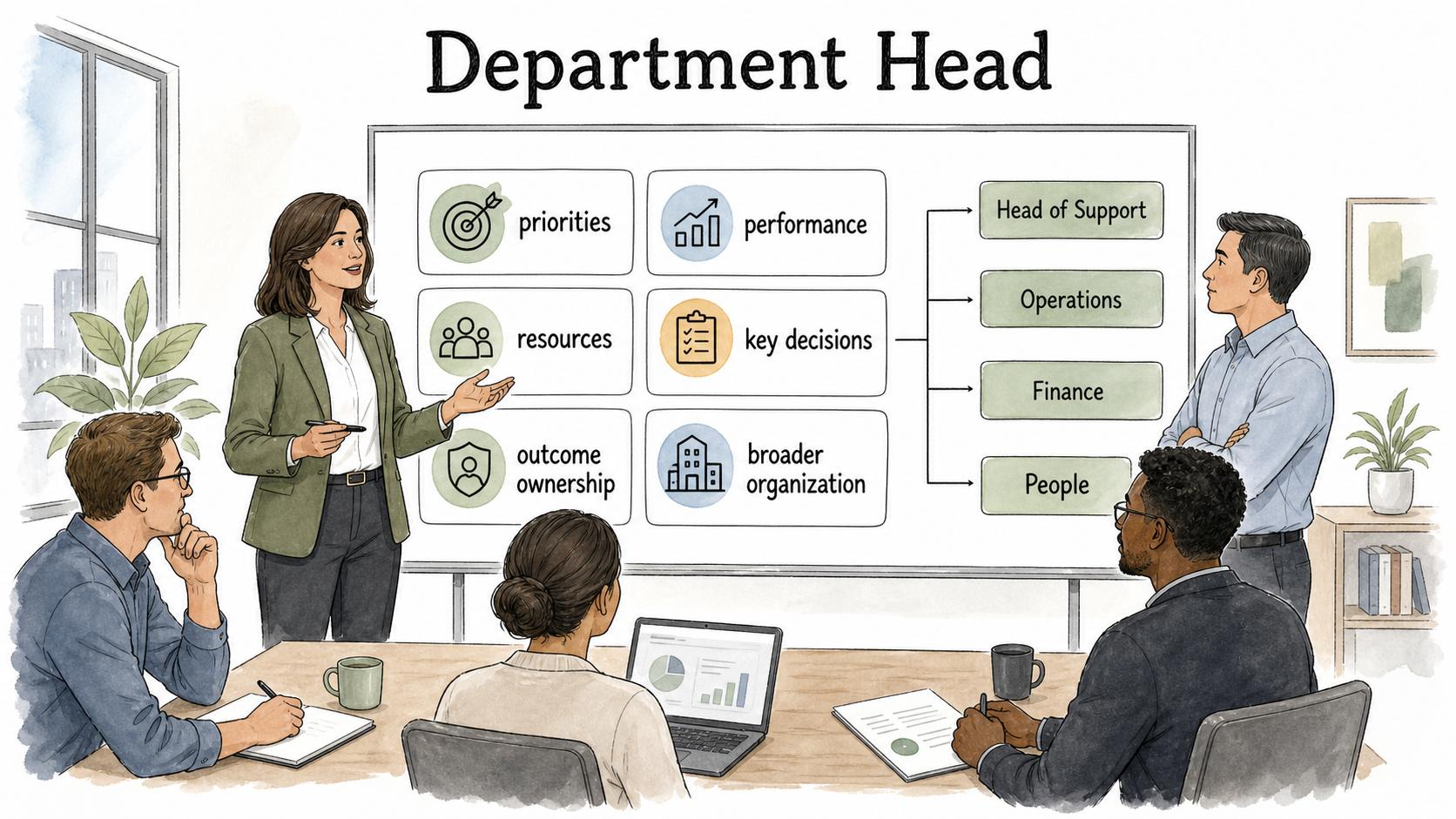
What a department head does
A department head turns company goals into practical operating choices for a team. That includes deciding what work matters most, who owns it, how success will be measured, and which tradeoffs the department will make when time, people, or budget are limited.
In small companies, a department head may still do hands-on work. In larger companies, the role shifts toward direction, coordination, hiring, coaching, and cross-functional alignment. Either way, the department head is expected to know whether the department is healthy, what risks are building, and what needs leadership attention. 2
The role is an accountability boundary. When a handoff breaks repeatedly, a team lacks clarity, or a process fails across the same step every month, the department head is usually responsible for improving the operating system around the work.
Department head vs manager vs team lead vs process owner
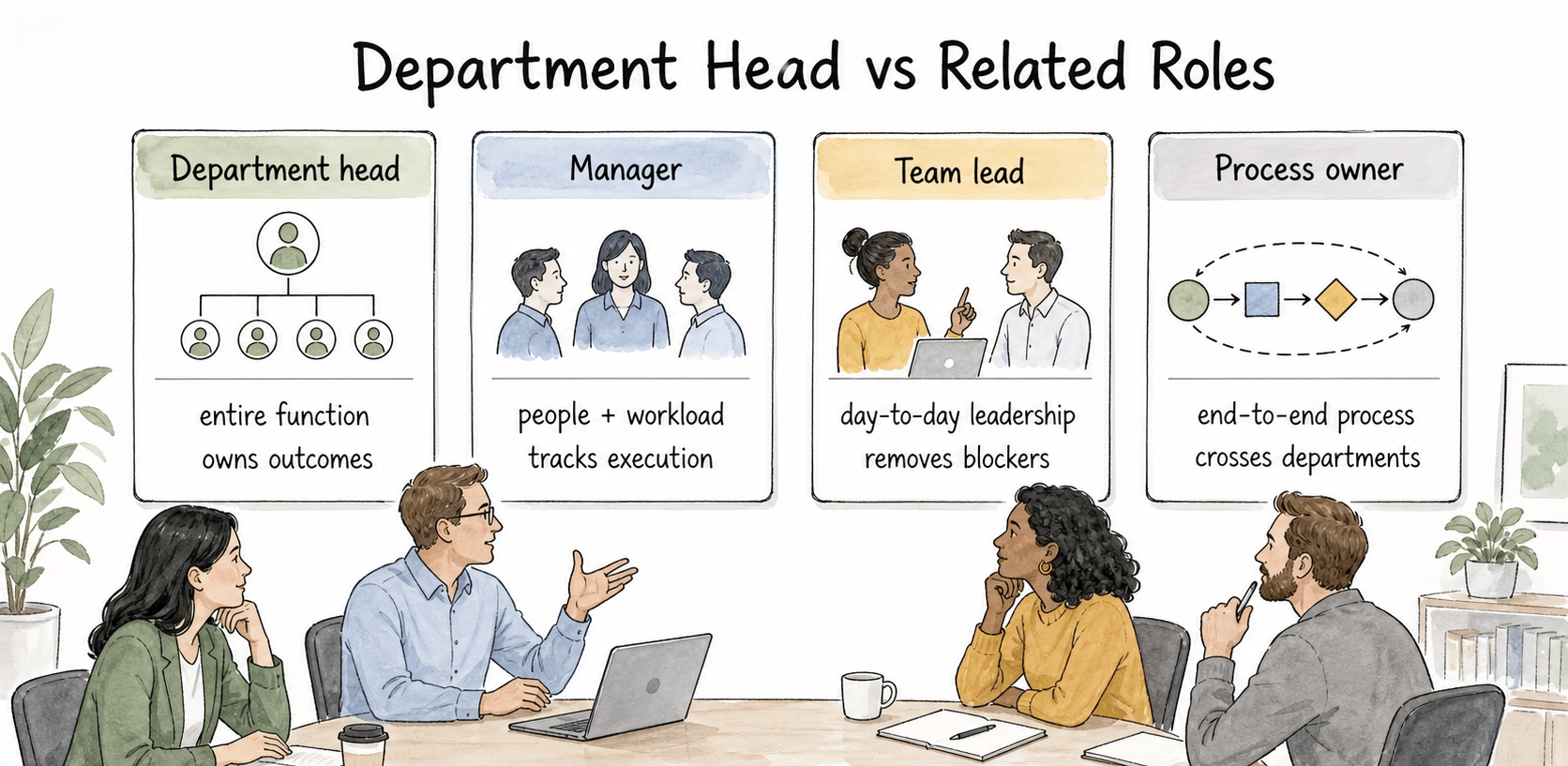
These roles can overlap, especially in smaller organizations. The distinction is scope and decision rights.
| Role | Primary scope | Typical responsibility |
|---|---|---|
| Department head | Entire function or department | Sets priorities, owns outcomes, allocates resources, resolves major tradeoffs |
| Manager | People, workload, and performance for a team | Coaches employees, assigns work, tracks execution, handles team operations |
| Team lead | Day-to-day technical or workflow leadership | Guides execution, removes blockers, supports peers, escalates issues |
| Process owner | End-to-end process performance | Defines how a process works across roles or departments |
A department head can also be a manager or process owner, but those responsibilities should be explicit. A Head of Support may own the support department while a separate process owner owns the customer escalation process that includes support, product, and engineering.
The common mistake is confusing department ownership with process ownership. Departments are vertical. Processes often cross those vertical lines.
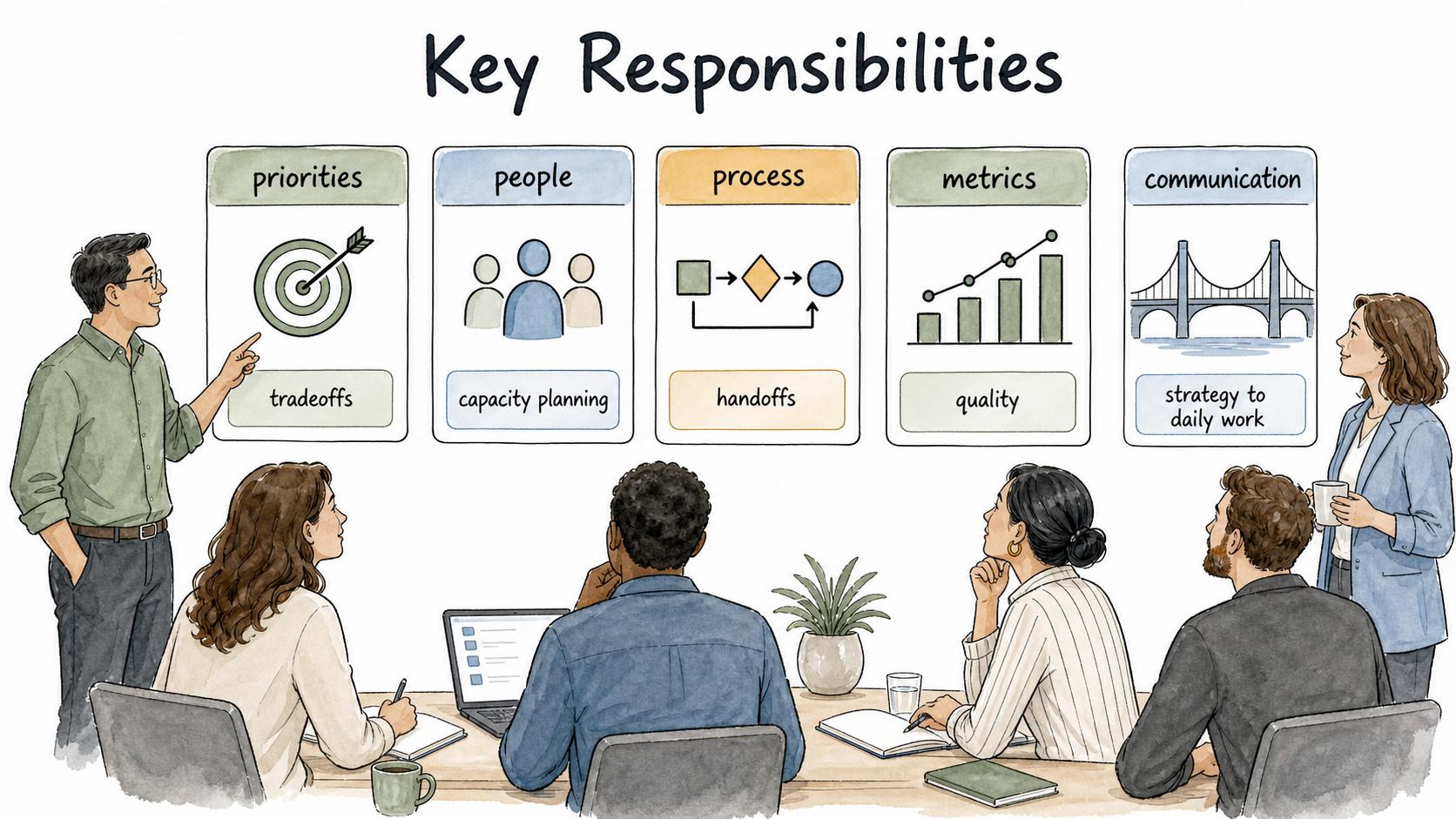
Key responsibilities of a department head
Department heads usually own priorities, people, process, metrics, and communication.
Priorities come first because a department cannot do everything. A good department head makes tradeoffs explicit: which initiatives matter now, which can wait, and what the team should stop doing.
People responsibilities include hiring, role clarity, coaching, performance management, succession planning, and skill development. The hidden issue is capacity planning. Many department problems are workload, skill, or unclear-ownership problems before they are motivation problems.
Process responsibilities include making sure routine work is repeatable, handoffs are clear, and exceptions have a path. A department head does not need to write every SOP personally, but they do need to make documentation part of normal department operations.
Metrics responsibilities include choosing measures that reflect actual performance. If a department only tracks output volume, it may miss quality, customer experience, rework, or risk.
Communication responsibilities include representing the department to leadership and translating leadership context back to the team. Department heads are often the bridge between strategy and daily work. 3
What department heads should document
A department head should make sure the department has documentation for repeatable work, risky decisions, and handoffs that affect other teams. Useful department-level documentation includes role responsibilities, onboarding paths, recurring operating cadences, SOPs for critical workflows, escalation rules, approval thresholds, tool ownership, reporting definitions, and cross-functional handoffs.
The practical test is dependency. If the same question gets answered in chat every week, it belongs in documentation. If a process breaks whenever one person is out, it needs ownership and a repeatable guide. Documented information also gives teams a way to communicate expectations and preserve evidence of how work should happen. 4
Practical decision rule
A department head should prioritize documentation when one of three things is true:
- The work affects customers, money, compliance, security, safety, or leadership reporting.
- The work depends on one person's memory or judgment.
- The work crosses teams and creates handoff risk.
This rule keeps documentation focused. Routine reference material can stay lightweight. Critical repeatable work needs enough structure that an experienced employee's absence does not stall the department.
Common mistakes
The first mistake is treating department-head responsibility as approval-only. If the department head only approves decisions after the work is already shaped, they may miss the system problems causing rework.
The second mistake is letting every team invent its own operating language. If one team says "ready," another says "approved," and a third says "done" without shared definitions, cross-functional work slows down.
The third mistake is delegating documentation without owning the standard. Team members can write the guides, but the department head should make sure the guides reflect how the department wants work to happen.
How Trails helps
Trails helps teams capture repeatable workflows as people perform them and turn those workflows into polished step-by-step guides. For department heads, that can make it easier to document critical processes without pulling high-performing employees away from the work for long writing sessions. Trails can also create AI-narrated video versions for onboarding, training, and cross-functional handoffs.
Sources
- 1
O*NET. General and Operations Managers. www.onetonline.org/link/summary/11-1021.00.
- 2
Gallup. What Great Managers Do Differently. www.gallup.com/workplace/266822/engaged-employees-differently.aspx.
- 3
McKinsey & Company. Stop wasting your most precious resource: Middle managers. www.mckinsey.com/capabilities/people-and-organizational-performance/our-insights/stop-wasting-your-most-precious-resource-middle-managers.
- 4
International Organization for Standardization. Guidance on documented information. ISO. www.iso.org/iso/documented_information.pdf.