
Glossary
Knowledge Manager
 ChatGPT
 Perplexity
 Gemini
 Claude
What is a knowledge manager?
A knowledge manager is responsible for making sure important organizational knowledge is captured, organized, maintained, and usable by the people who need it. The role often sits between operations, documentation, training, support, and subject-matter experts. 1
A good knowledge manager does more than keep company documents tidy. They create the conditions for people to find trusted answers, learn repeatable work, and avoid relying on hallway memory or one overloaded expert.
What a knowledge manager does
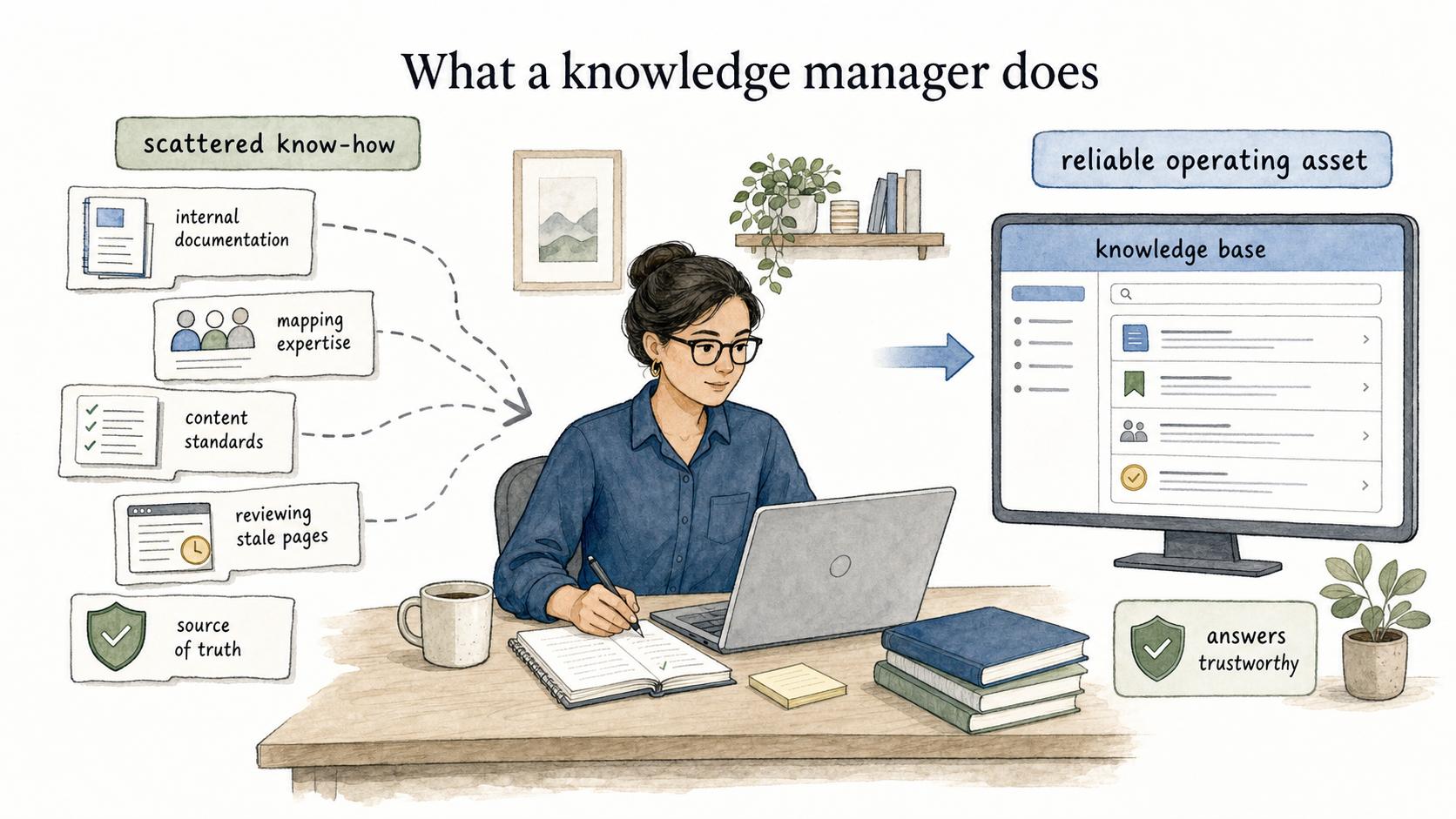
The knowledge manager's core job is to turn scattered know-how into a reliable operating asset. That can include maintaining a knowledge base, improving internal documentation, mapping expertise, setting content standards, reviewing stale pages, and helping teams decide what deserves to become a source of truth. 2
In practice, the role is less about owning every answer than owning the system that keeps answers trustworthy. Knowledge managers coordinate with experts, test whether content is still accurate, and notice when the team keeps solving the same problem because the answer is hard to find.
Strong knowledge managers are translators. They turn expert shorthand into usable guidance for new hires, frontline teams, managers, or customers.
Why the role matters
Knowledge problems rarely announce themselves as knowledge problems. They show up as slow onboarding, inconsistent support answers, repeated Slack questions, handoffs that depend on one person, or employees recreating work that already exists somewhere.
A knowledge manager gives those problems an owner. Without clear ownership, documentation becomes everyone's side project, which usually means it is no one's priority. Pages multiply, standards drift, and people stop trusting the knowledge system because they cannot tell what is current. 3
The role matters most when knowledge changes quickly or when the cost of a wrong answer is high. Customer-facing teams, regulated workflows, fast-growing operations, and distributed teams need someone paying attention to knowledge quality before the cracks become obvious. 4
Knowledge manager responsibilities
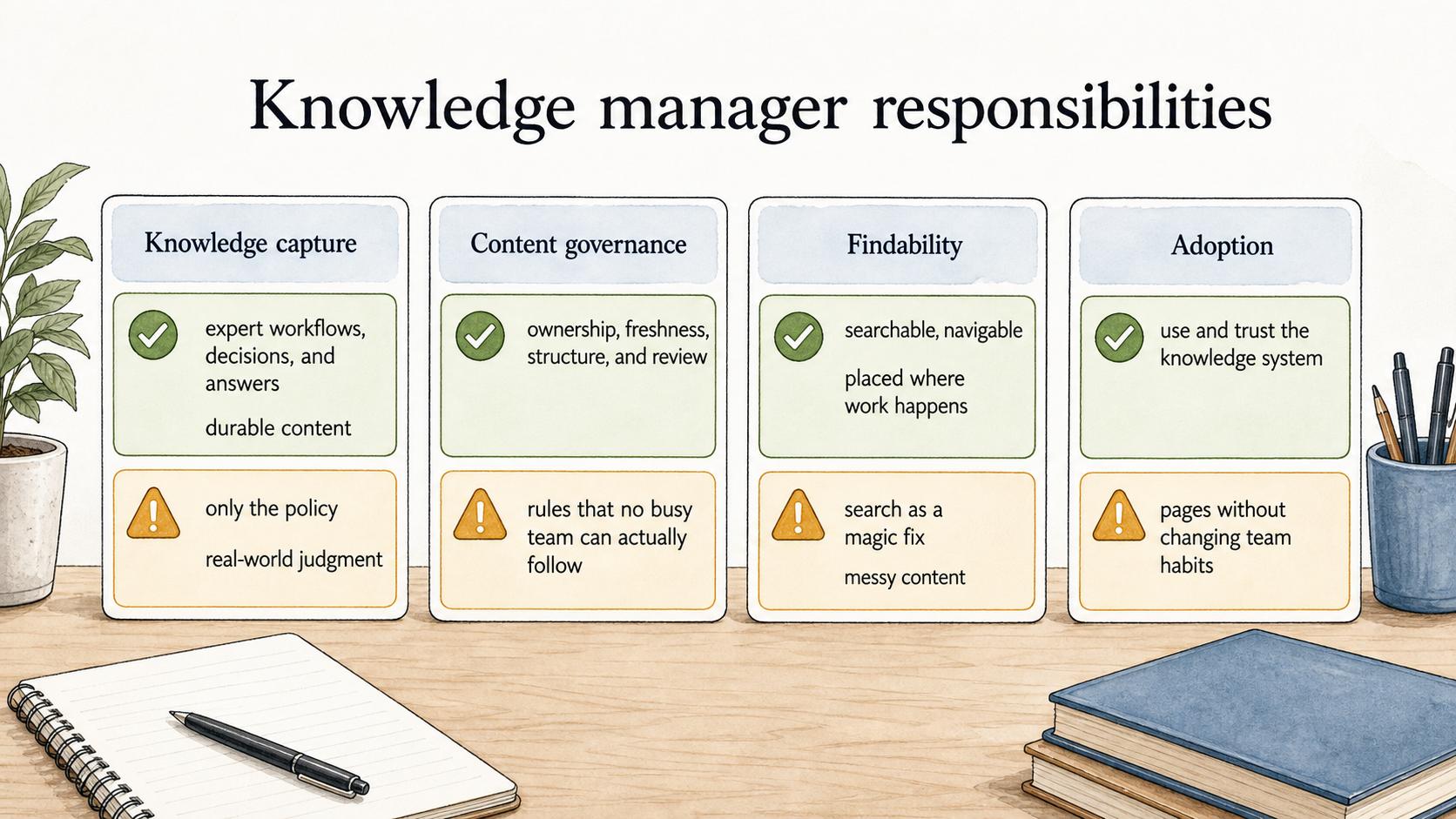
The exact responsibilities vary by company, but most knowledge managers touch four kinds of work.
| Responsibility | What it means | Common failure mode |
|---|---|---|
| Knowledge capture | Turning expert workflows, decisions, and answers into durable content | Capturing only the policy, not the real-world judgment |
| Content governance | Setting standards for ownership, freshness, structure, and review | Creating rules that no busy team can actually follow |
| Findability | Making knowledge searchable, navigable, and placed where work happens | Treating search as a magic fix for messy content |
| Adoption | Helping people use and trust the knowledge system | Publishing pages without changing team habits |
The role needs both operational judgment and editorial taste. A knowledge manager has to know when a quick guide is enough, when a deeper playbook is needed, and when the real fix is changing the workflow rather than writing another page.
Knowledge manager vs content manager
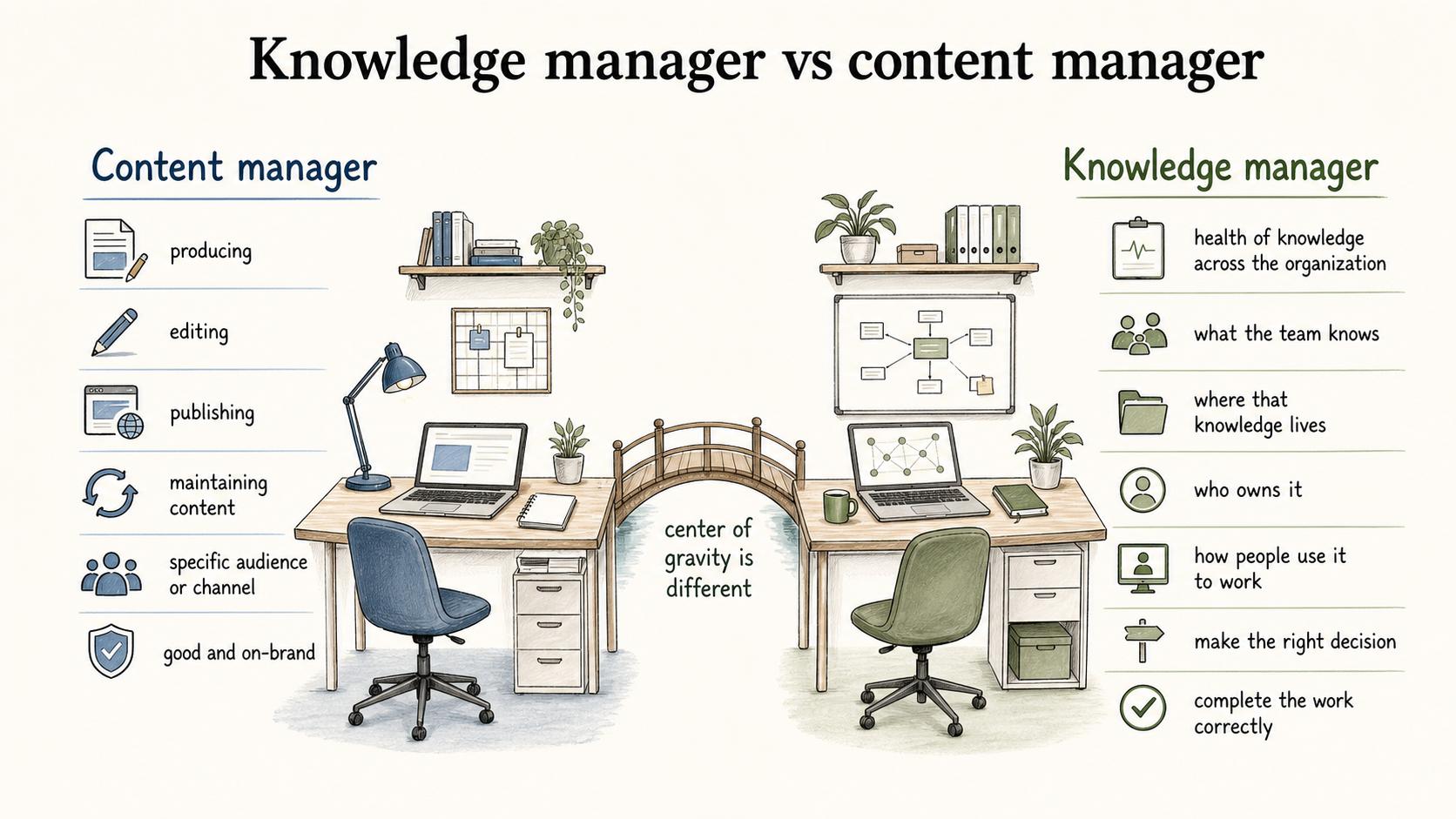
A content manager usually focuses on producing, editing, publishing, and maintaining content for a specific audience or channel. A knowledge manager focuses on the health of knowledge across the organization: what the team knows, where that knowledge lives, who owns it, and how people use it to work.
The roles can overlap, especially in smaller companies. Content management asks, Is this content good and on-brand? Knowledge management asks, Can people use this knowledge to make the right decision or complete the work correctly?
What makes a strong knowledge manager
Strong knowledge managers are comfortable with ambiguity. They know valuable knowledge rarely starts as a neat document. Some of it lives in support macros, onboarding calls, customer escalations, implementation notes, or one person's explanation of why the process has an exception.
They also know that more documentation is not always better. A bloated knowledge base can be worse than a small one if people cannot tell what to trust. The practical judgment is knowing what to consolidate, archive, rewrite, and leave alone.
A useful test for the role is simple: can a new employee, a frontline teammate, and a manager each find the right level of detail without asking the same expert for help?
How Trails helps
Trails helps knowledge managers capture repeatable workflows without turning every documentation request into a writing project. A team member can perform the workflow once, and Trails turns it into a polished step-by-step guide with an AI-narrated video version for training or sharing.
- Knowledge mapping
- Knowledge management
- Knowledge management system
- Knowledge gap
- Knowledge base
Sources
- 1
APQC. What is a Knowledge Manager?. www.apqc.org/resources/blog/what-knowledge-manager.
- 2
APQC. Managing Knowledge Starts with Knowledge Flow. www.apqc.org/blog/managing-knowledge-starts-knowledge-flow.
- 3
NASA. Knowledge Management. www.nasa.gov/learning-resources/for-professionals/appel-knowledge-management/.
- 4
APQC. What is Knowledge Management?. www.apqc.org/What-is-Knowledge-Management.