
Glossary
Team Lead
 ChatGPT
 Perplexity
 Gemini
 Claude
What is a team lead?
A team lead is the person who helps a team coordinate day-to-day work, answer practical questions, keep priorities clear, and support consistent execution. The role sits close to the work, often between individual contributors and a manager.
A team lead is not always a formal people manager. In many teams, the manager owns hiring, compensation, performance reviews, and staffing decisions, while the team lead helps the group run the work well each day.
What a team lead does
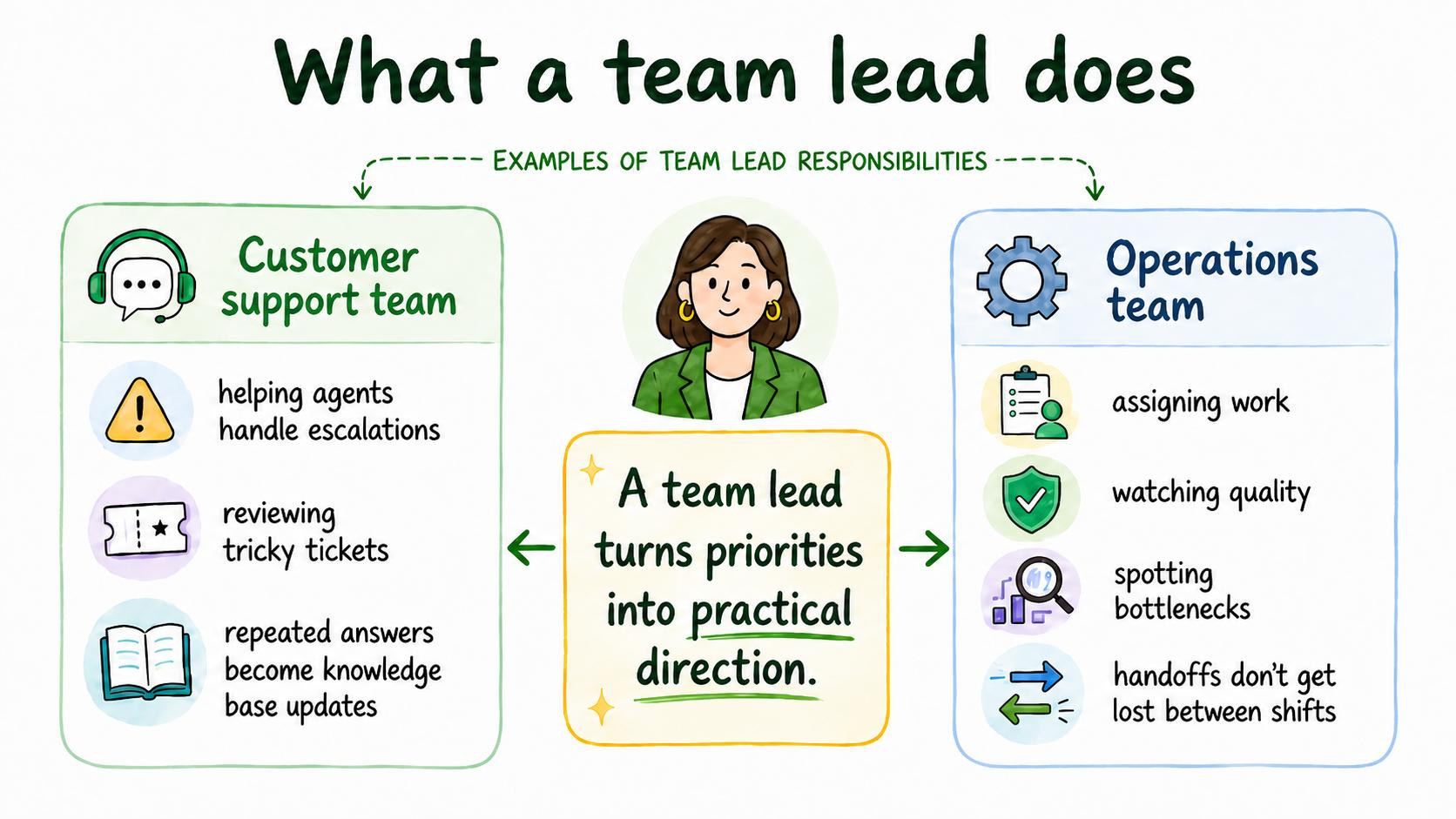
A team lead turns priorities into practical direction. In a customer support team, that might mean helping agents handle escalations, reviewing tricky tickets, and making sure repeated answers become knowledge base updates. In an operations team, it might mean assigning work, watching quality, spotting bottlenecks, and making sure handoffs don't get lost between shifts.
The role is valuable because most execution problems are small before they are large. Research summaries on team effectiveness emphasize shared cognition, communication, coordination, and adaptation as recurring ingredients in effective teams.1 A team lead often notices process drift, unanswered questions, unclear ownership, and training gaps before they become manager-level issues.
Common team lead responsibilities
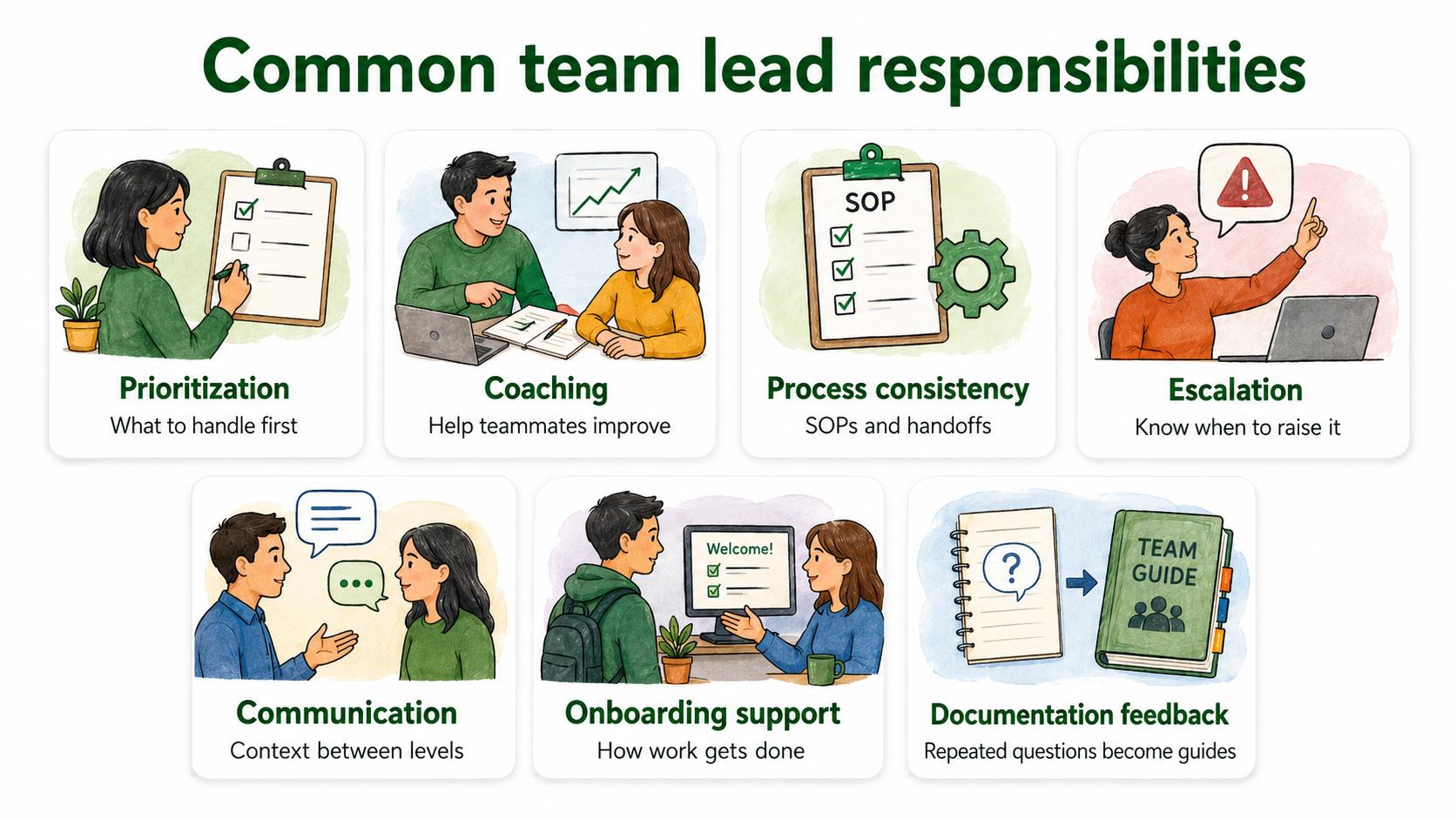
Team lead responsibilities vary by company, but they usually cluster around coordination, coaching, and process health.
| Responsibility | What it looks like in practice |
|---|---|
| Prioritization | Helping the team decide what to handle first when work competes |
| Coaching | Helping teammates improve without taking every hard task away from them |
| Process consistency | Reinforcing SOPs, checklists, quality standards, and handoff rules |
| Escalation | Knowing when an issue needs a manager, specialist, or another team |
| Communication | Passing useful context between frontline work and leadership |
| Onboarding support | Showing new teammates how work actually gets done |
| Documentation feedback | Turning repeated questions into clearer guides or training materials |
The strongest team leads don't become the team's search engine. They treat repeated questions as evidence that something needs to be documented, simplified, or taught differently.
Team lead vs. manager
A team lead usually focuses on daily execution. A manager usually owns formal people management and broader team outcomes. The boundary is not identical everywhere, but it should be explicit.
A useful rule: if the decision affects someone's role, pay, performance standing, workload capacity, employment path, or long-term development plan, it probably belongs with the manager. If the decision helps the team complete today's work more clearly, it may belong with the team lead.
The risky middle ground is an unofficial team lead who is expected to manage performance without authority. Google's team-effectiveness research highlights structure and clarity as one of the dynamics effective teams need, including clear goals, roles, and execution plans.2 A team should know whether the lead is acting as peer coach, shift coordinator, subject matter expert, supervisor, or manager proxy.
What makes a strong team lead
A strong team lead is more than the best individual contributor. Technical skill or output quality helps, but the role requires a different ability: helping other people perform reliably. Google's Project Oxygen research identified behaviors such as coaching, empowering the team, communicating effectively, and focusing on results as core behaviors of effective managers.3
Strong team leads translate context. They explain why a priority matters, what quality looks like, where to find the right reference, and when an issue should be escalated. They also know when another reminder will not fix the problem. If the same mistake keeps happening, the answer may be clearer documentation, better training, a simpler workflow, or a different quality check.
The underrated skill is calm specificity. A vague lead says, "Please be more careful." A useful lead says, "Before closing a refund ticket, check whether the order is inside the 30-day window and add the refund reason in the first line of the note." Specific guidance is easier to follow, coach, and document.
When a team needs a team lead
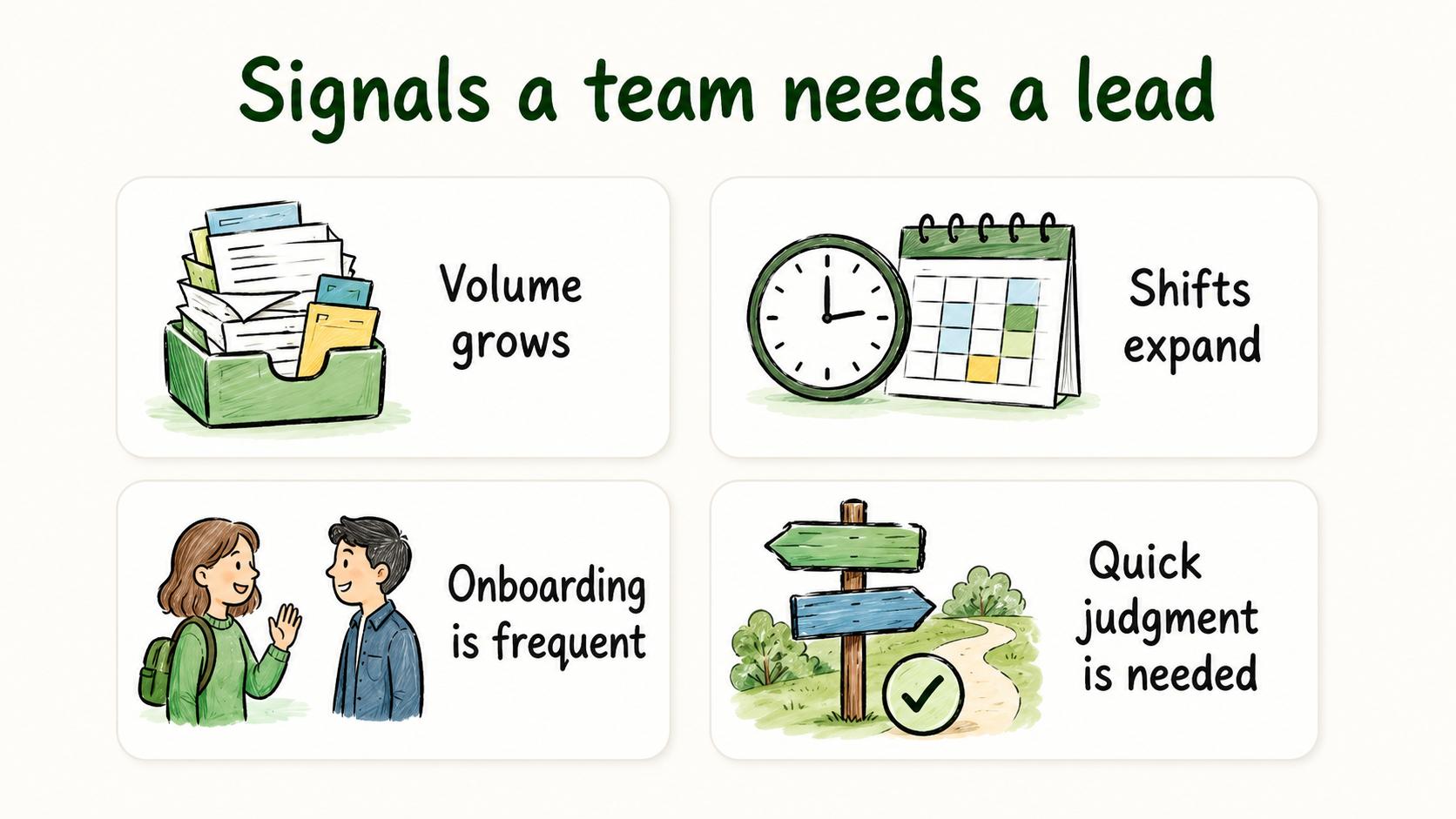
A team usually needs a team lead when the manager cannot stay close enough to every daily handoff, decision, and quality issue. That often happens when volume grows, shifts expand, onboarding becomes frequent, or work requires quick judgment.
Another signal is repeated dependency on one experienced teammate. If everyone already asks that person how to handle exceptions, the team may need to formalize the role, define decision rights, and document the knowledge that person carries.
The practical purpose is simple: keep daily work clear without making the manager the only person who can unblock the team.
Team lead role prompt
Use this prompt to define the role clearly:
## Team Lead Role Prompt

**Glossary term:** Team Lead
**Source:** Trails Glossary — trails.so/glossary/team-lead

---

### 01. Define a team lead role clearly

"Define the team lead role for [team].
Team purpose: [what the team is responsible for]
Daily work the lead coordinates: [tasks, queues, handoffs, shifts]
Decisions the lead can make: [prioritization, assignment, quality, escalation]
Decisions the manager keeps: [performance, compensation, staffing, policy]
Coaching responsibilities: [what the lead should help teammates improve]
Documentation responsibilities: [guides, SOPs, checklist updates, training notes]
Escalation rules: [what must go to a manager or specialist]
Success signals: [fewer blockers, faster onboarding, better quality, smoother handoffs]
Review cadence with manager: [weekly, biweekly, monthly]"
The output should make the role usable for the lead, the manager, and the team. Ambiguity is where resentment grows.
Common mistakes
The first mistake is making the team lead the team's only source of truth. That feels efficient until the lead becomes a bottleneck and the team never gets more independent.
The second mistake is leaving decision rights vague. A lead should know what they can decide, what they can recommend, and what they must escalate.
The third mistake is treating the role as a reward instead of a job. A high performer may deserve recognition, but leadership work needs expectations, training, feedback, and time to do the work well.
Documentation takeaway
Team leads are often closest to process reality. They see where SOPs are unclear, where onboarding breaks, where exceptions repeat, and where teammates rely on memory. That makes them important contributors to process documentation.
A strong team lead turns recurring answers into shared documentation. CIPD's evidence review on high-performing teams notes that collective memory helps team members know who knows what and supports information sharing.4
How Trails helps
Trails helps team leads capture repeatable workflows and turn them into polished step-by-step guides. Teams can also create AI-narrated video versions for training or sharing.
That is useful when the same explanation keeps coming up in tickets, onboarding, handoffs, or quality reviews. Instead of answering from memory every time, the team lead can give the team a shared process standard to use and improve.
- Leader standard work
- Team permissions
- Subject matter expert
- Training coordinator
- Training manager
- Shift lead
- Frontline manager
Sources
- 1
National Academies Press. Overview of Research on Team Effectiveness. NCBI Bookshelf. www.ncbi.nlm.nih.gov/books/NBK310384/. Accessed July 2, 2026.
- 2
Google re:Work. Guide: Understand team effectiveness. Google re:Work. rework.withgoogle.com/intl/en/guides/understand-team-effectiveness. Accessed July 2, 2026.
- 3
Google re:Work. Following the data: The research behind great managers. Google re:Work. rework.withgoogle.com/intl/en/guides/following-the-data-the-research-behind-great-managers. Accessed July 2, 2026.
- 4
CIPD. High-performing teams evidence review. CIPD. www.cipd.org/globalassets/media/knowledge/knowledge-hub/evidence-reviews/2023-pdfs/8388-high-performing-teams-practice-summary.pdf. Accessed July 2, 2026.