
Glossary
Documentation Owner
 ChatGPT
 Perplexity
 Gemini
 Claude
What is a documentation owner?
A documentation owner is the person accountable for keeping a specific document, guide, knowledge area, or documentation system accurate and useful. They may not write every word, but they make sure the content has a clear purpose, stays current, and reflects how the work actually happens.
The important word is accountable. Without an owner, documentation becomes everyone's job in theory and no one's job in practice. A good owner gives a document a place to land when the process changes, a reader finds a gap, or the team needs to know whether the page can still be trusted. Knowledge-management guidance treats clear responsibility and operating routines as part of making organizational knowledge usable, not just stored. 1
What a documentation owner actually owns
A documentation owner usually owns the health of the document, not every task around it. That distinction keeps ownership from turning into a bottleneck.
For example, a support team might assign one person as the owner of the refund policy guide. Product, finance, and support leads may all contribute changes, but the owner makes sure the guide is reviewed, approved, updated, and usable for frontline agents. Formal document-control rules in regulated settings make the same accountability concrete by requiring document review, approval, and controlled change processes. 2
The owner typically makes judgment calls about:
- Whether the document still matches the current process
- Who should review changes before publication
- When an outdated guide should be revised, archived, or merged
- Whether the document is written for the right audience
- How the page connects to related SOPs, onboarding materials, or training guides
That doesn't mean the owner has to be the subject matter expert. In many teams, the best owner is closest to the documentation workflow, while the subject matter expert supplies the facts.
Why documentation ownership matters
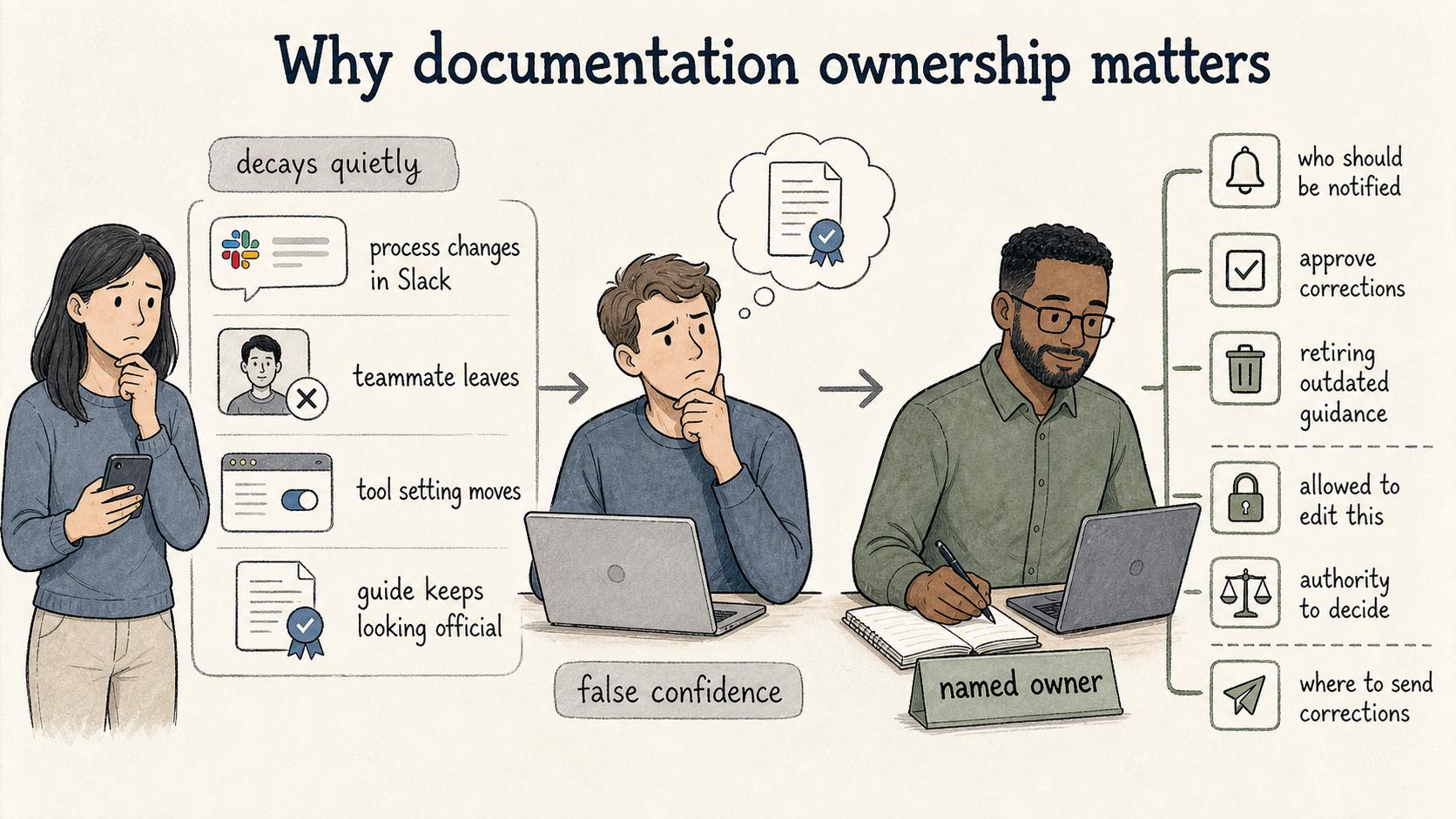
Documentation usually decays quietly. A process changes in Slack, a teammate leaves, a tool setting moves, and the guide keeps looking official even after it stops being reliable. Ownership is the operating control that catches that drift.
The hidden risk is false confidence. Teams are often less damaged by missing documentation than by documentation that looks current but is wrong. A named owner makes it clear who should be notified, who can approve corrections, and who is responsible for retiring outdated guidance.
Good ownership also lowers the social friction around updates. Instead of asking, "Who is allowed to edit this?" teammates know where to send corrections. Instead of debating whether a page is still valid, they know who has the authority to decide.
Documentation owner vs documentation manager
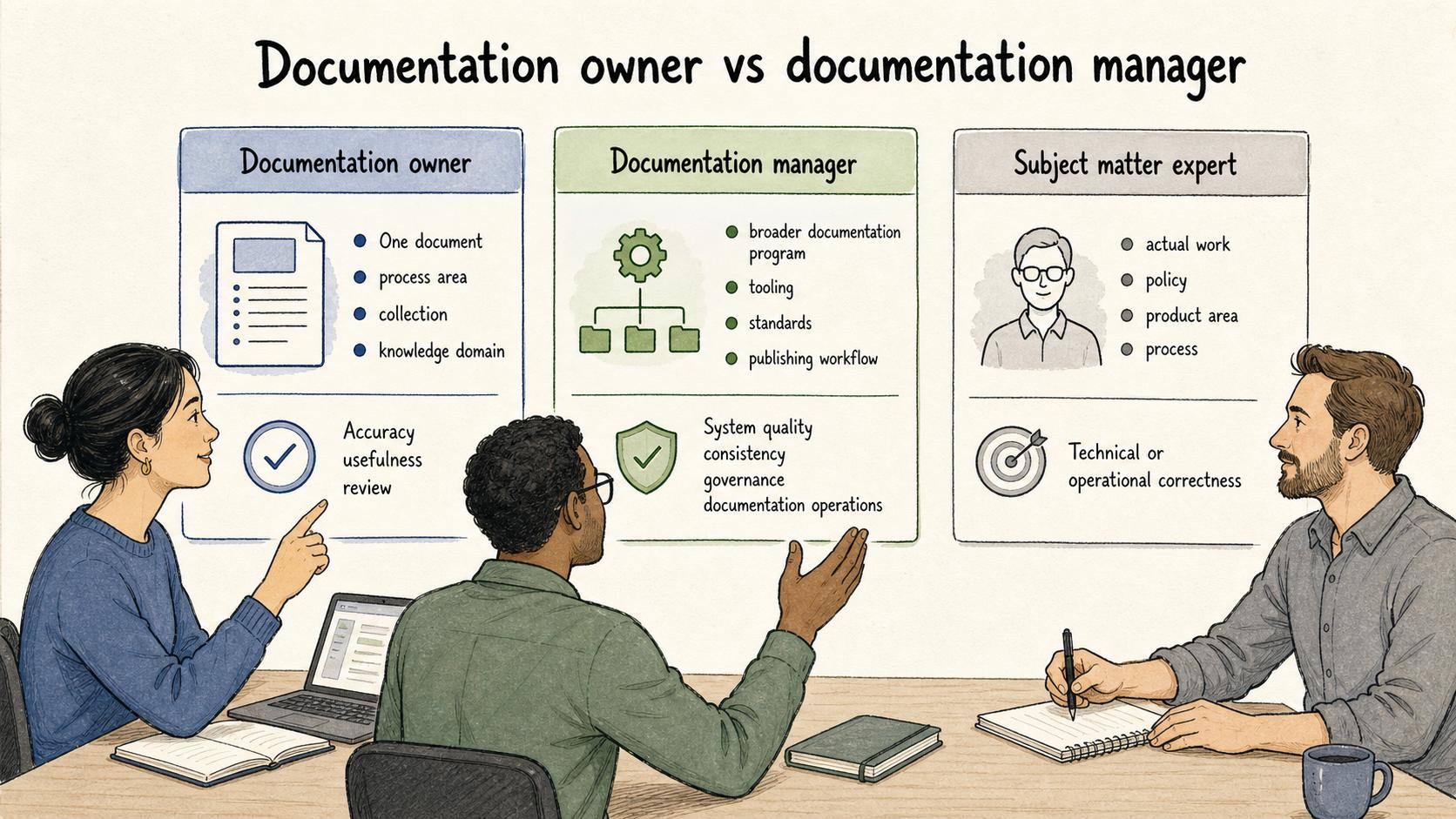
A documentation owner and a documentation manager are related roles, but they usually operate at different levels.
| Role | Typical scope | Main accountability |
|---|---|---|
| Documentation owner | One document, process area, collection, or knowledge domain | Accuracy, usefulness, and review of assigned content |
| Documentation manager | The broader documentation program, tooling, standards, and publishing workflow | System quality, consistency, governance, and documentation operations |
| Subject matter expert | The actual work, policy, product area, or process being documented | Technical or operational correctness |
In a small team, one person may play all three roles. In a larger organization, separating them helps: the documentation manager sets standards, while each owner keeps assigned content grounded in the real work.
How to assign a documentation owner
The strongest ownership model starts with the work, not the org chart. If the document explains a process, the owner should be close enough to notice when it changes. If it explains a policy, the owner should have access to the people who approve that policy. If it supports training, the owner should understand where new hires get stuck.
A practical assignment rule is: choose the person who can detect change earliest and coordinate correction fastest. Seniority matters less than proximity and authority.
A useful owner assignment should include:
- The page, collection, or topic area owned
- The review cadence, especially for compliance, customer, or operational risk
- The approving subject matter expert, when the owner is not the final authority
- The update path for small fixes versus material changes
- The archive rule for content that no longer reflects reality
The archive rule is often the missing piece. If owners can only add and edit, documentation keeps expanding. If they can retire stale pages, the system gets healthier over time.
Common mistakes
The most common mistake is naming an owner without giving them authority. If someone is responsible for accuracy but cannot get reviewers to respond, mark a page as deprecated, or resolve conflicting feedback, they are not really the owner. They're a reminder system.
Another mistake is assigning ownership to a team alias. A group can be accountable for a domain, but a document still needs a named person or role for day-to-day decisions. "Support owns this" is weaker than "The support operations lead owns this and routes product questions to the PM."
Teams also overuse ownership as a cleanup tactic. Naming owners for hundreds of stale pages won't fix the system by itself. Start with the documents people rely on to do work: onboarding guides, customer-facing procedures, recurring operational SOPs, and policy-adjacent pages. That priority is especially useful for onboarding materials, where structured onboarding has been linked to stronger retention and productivity outcomes. 3
AI-ready owner assignment prompt
Use this prompt when you need to assign ownership across a messy documentation set:
## Documentation Owner Assignment

**Glossary term:** Documentation Owner
**Source:** Trails Glossary — trails.so/glossary/documentation-owner

---

### 01. Assign documentation owners

"You are helping assign documentation owners for [team/company]. For each document below, recommend the best owner role, the subject matter reviewer, the review cadence, and whether the document should be kept, merged, revised, or archived.

Context:
- Team: [team]
- Documentation system: [tool/location]
- High-risk areas: [compliance/customer/security/operations]
- Available owner roles: [roles]

Documents:
[paste document titles, summaries, and last-updated dates]

Return a table with: document, owner role, reviewer, reason, review cadence, recommended action, and first follow-up."
How Trails helps
Trails is useful when a documentation owner needs to turn a real workflow into maintainable guidance. Instead of asking someone to reconstruct a process from memory, Trails captures the workflow as it happens, turns it into a polished step-by-step guide, and can create an AI-narrated video version for training or sharing. That gives the owner a stronger starting point and makes updates easier when the process changes.
When selecting tools for the documents you own, compare process documentation software by how easily subject matter experts can capture, review, and revise a real workflow.
FAQ
Is a documentation owner the same as an author?
Not necessarily. An author writes or edits content. A documentation owner is accountable for whether the content remains accurate, useful, and governed over time.
Should every document have an owner?
Every important document should. Low-value, obsolete, or duplicated pages may be better archived than assigned to someone for ongoing maintenance.
Can a team be the documentation owner?
A team can own a domain, but each important page still needs a named role or person for practical follow-through.
Sources
- 1
ISO. ISO 30401 knowledge management systems overview. www.iso.org/obp/ui/.
- 2
FDA. FDA 21 CFR 820 document control training. www.fda.gov/media/118202/download.
- 3
SHRM. Don't underestimate the importance of good onboarding. www.shrm.org/topics-tools/news/talent-acquisition/dont-underestimate-importance-good-onboarding.