
Glossary
Checklist
 ChatGPT
 Perplexity
 Gemini
 Claude
What is a checklist?
A checklist is a concise list of items someone confirms, completes, or reviews during a task. Teams use checklists to prevent missed steps, reduce variation, and make routine work easier to perform consistently. In surgical-safety research, a 19-item checklist was associated with lower complication and death rates across a diverse group of hospitals. 1
A checklist is different from a full procedure. A procedure explains how to do the work. A checklist helps someone confirm what must be true before, during, or after the work. The best checklists are short enough to use in the moment and specific enough to catch failures that matter.
Why checklists matter
Many operational mistakes are not caused by ignorance. They happen because people are interrupted, rushed, switching contexts, or relying on memory for a task with several small dependencies. Aviation human-factors guidance makes the same point: interrupted, deferred, or out-of-sequence tasks are especially vulnerable to prospective-memory errors. 2
A useful checklist protects the points where memory is weakest. A customer onboarding specialist may know how to launch a new account, but still need a launch checklist to confirm that billing is active, permissions are correct, training materials were sent, and the customer success owner is assigned. None of those checks are difficult. Missing one can still create a bad handoff.
The value is a guardrail for competent people doing repetitive, high-volume, or interruption-prone work.
When to use a checklist
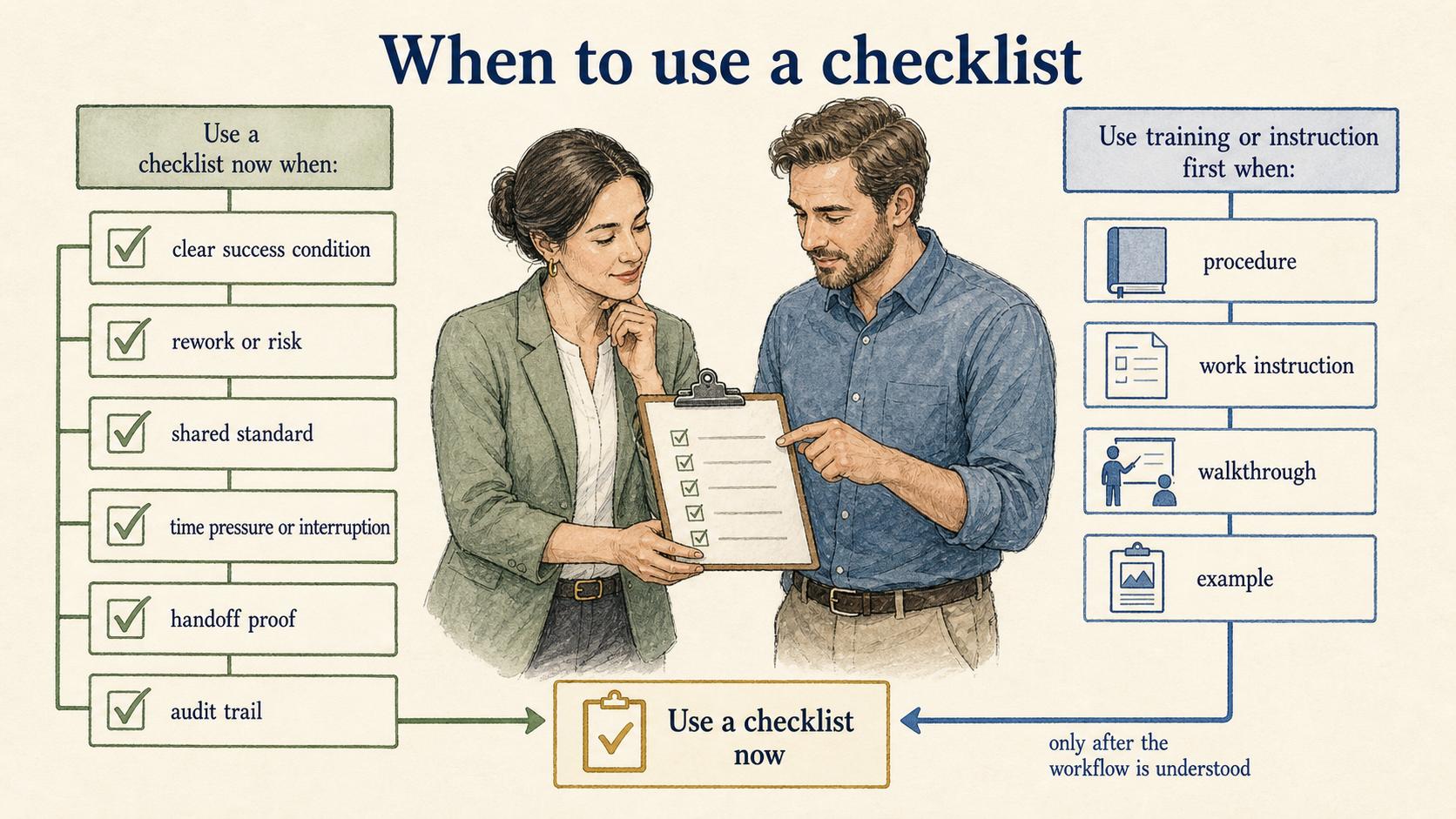
Use a checklist when the task has a clear success condition and a small number of important checks. It is especially helpful when:
- Skipping one step creates rework, risk, or customer pain.
- Multiple people perform the same task and need a shared standard.
- The task happens under time pressure or frequent interruption.
- A handoff requires proof that the work is ready for the next person.
- The team needs an audit trail that confirms completion.
A checklist should not substitute for training. If someone does not understand the work, a checklist can hide the gap instead of fixing it. Start with a procedure, work instruction, walkthrough, or example, then create the checklist once the workflow is understood.
Checklist vs procedure vs work instruction
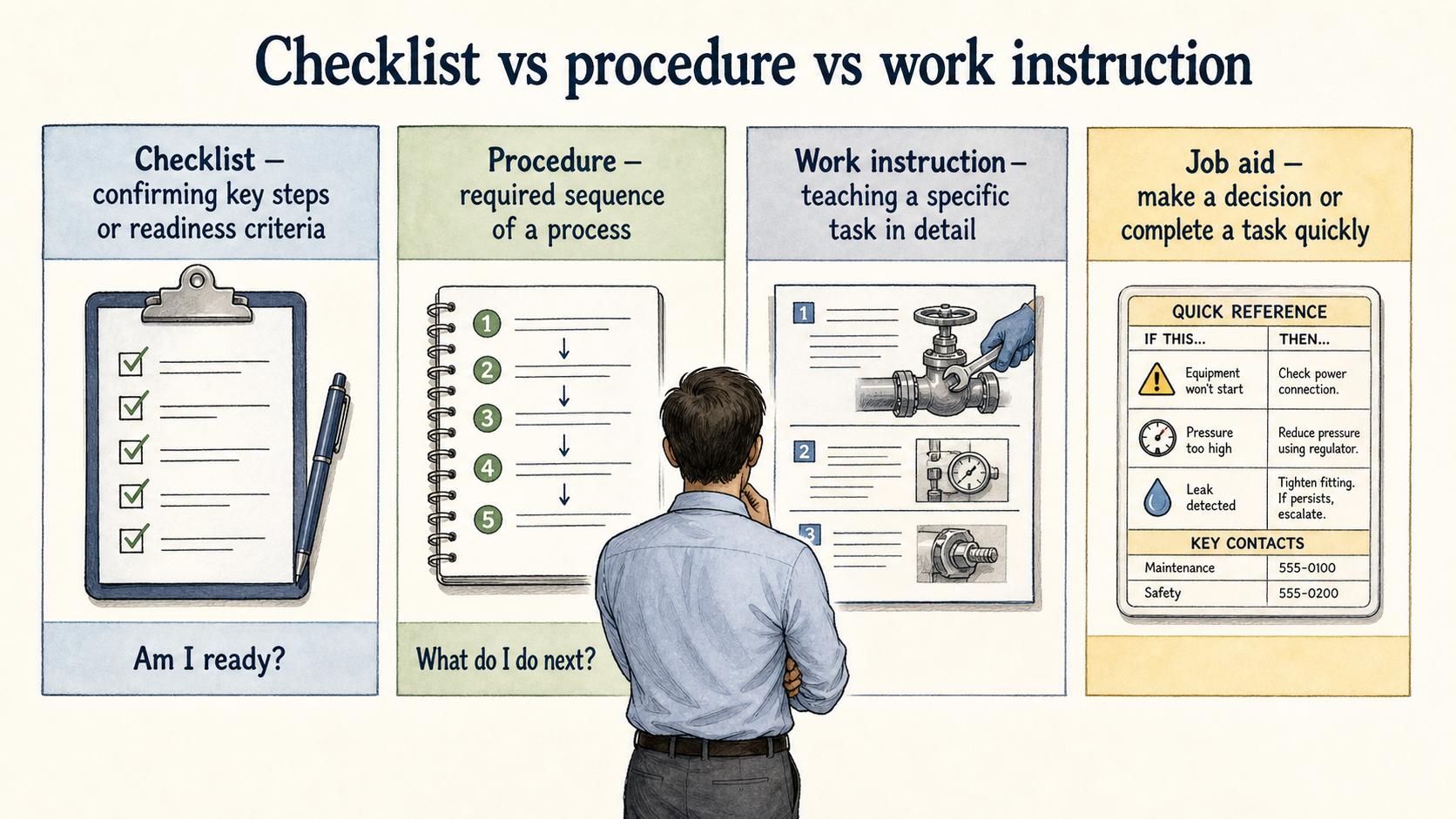
| Format | Best for | Common failure mode |
|---|---|---|
| Checklist | Confirming key steps or readiness criteria | Too many obvious items, so people stop paying attention |
| Procedure | Explaining the required sequence of a process | Too broad to use during the actual task |
| Work instruction | Teaching a specific task in detail | Too narrow to explain the larger workflow |
| Job aid | Helping someone make a decision or complete a task quickly | Helpful as a reference, but not tied to completion |
A simple rule: if the reader asks, "What do I do next?" they probably need a procedure or work instruction. If they ask, "Am I ready?" or "Did I miss anything important?" they probably need a checklist.
How to write a checklist people use
Start with the failure you are trying to prevent. A checklist for closing a support ticket should not list every support habit. It should name the checks that prevent reopened tickets, missing customer context, broken internal handoffs, or unresolved follow-up work.
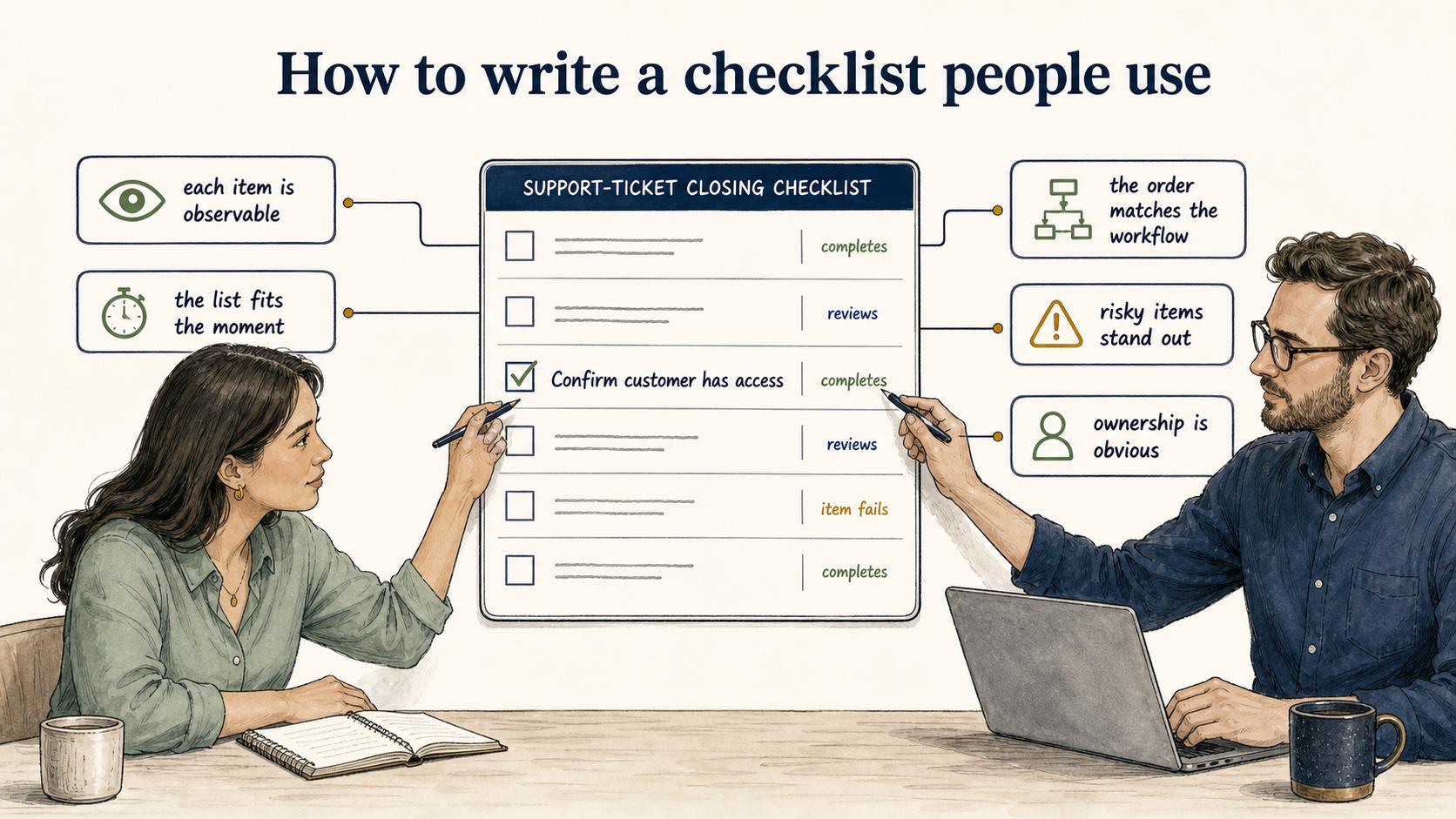
A strong checklist usually has these traits:
- Each item is observable. "Confirm customer has access" is stronger than "Ensure customer is set up" because someone can test it.
- The list fits the moment. If the person can't use it while doing the work, it becomes documentation theater.
- The order matches the workflow. Put checks where the person can act on them. A final review checklist should not contain items that needed to happen two hours earlier.
- Risky items stand out. If every item has equal weight, the most important control gets buried.
- Ownership is obvious. The checklist should show who completes it, who reviews it, and what happens when an item fails.
The easy mistake is adding items because they are true. The better move is adding items because forgetting them has a real consequence. A systematic review of surgical checklists found that effective checklists work through mechanisms such as ensuring critical tasks are completed and improving team communication, not by listing every possible detail. 3
A quick checklist quality test
Before publishing a checklist, ask four questions:
- Would a competent person ever skip this item by accident?
- Is the item specific enough to verify without debate?
- Does the item belong at the point where the checklist will be used?
- If this item fails, does the reader know what to do next?
If the answer is no, rewrite the item or remove it. A checklist earns trust by staying useful under real operating conditions.
How Trails helps
Checklists are stronger when they are connected to the workflow they support. Trails can capture a process as someone performs it, turn that workflow into a polished step-by-step guide, and create an AI-narrated video version for training or sharing. Teams can use the guide to teach the process and the checklist to confirm that the most important steps were completed.
That pairing keeps the checklist focused. The guide carries the instruction; the checklist protects execution.
Checklist FAQ
What is the purpose of a checklist?
The purpose of a checklist is to make important checks visible at the moment they matter. It helps people complete work consistently without relying only on memory.
How long should a checklist be?
A checklist should be as short as the task allows. If it becomes too long to use during the work, split it into stages or move explanatory detail into a procedure.
What makes a checklist bad?
A bad checklist is vague, bloated, out of sequence, or filled with items that have no consequence. People ignore checklists when they feel like compliance paperwork instead of practical help.
Sources
- 1
A Surgical Safety Checklist to Reduce Morbidity and Mortality in a Global Population. A Surgical Safety Checklist to Reduce Morbidity and Mortality in a Global Population. pubmed.ncbi.nlm.nih.gov/19144931/.
- 2
FAA. Human-factors material on checklists, monitoring, and multitasking. www.faasafety.gov/files/notices/2008/oct/checklists_and_monitoring_2.pdf.
- 3
BMJ Quality & Safety. Systematic review of surgical checklists. qualitysafety.bmj.com/content/23/4/299.