
Glossary
Tip Sheet
 ChatGPT
 Perplexity
 Gemini
 Claude
What is a tip sheet?
A tip sheet is a short reference document that gives practical advice, reminders, examples, or rules of thumb for a specific task or situation. It works best for someone who already understands the basics and needs help remembering what matters in the moment.
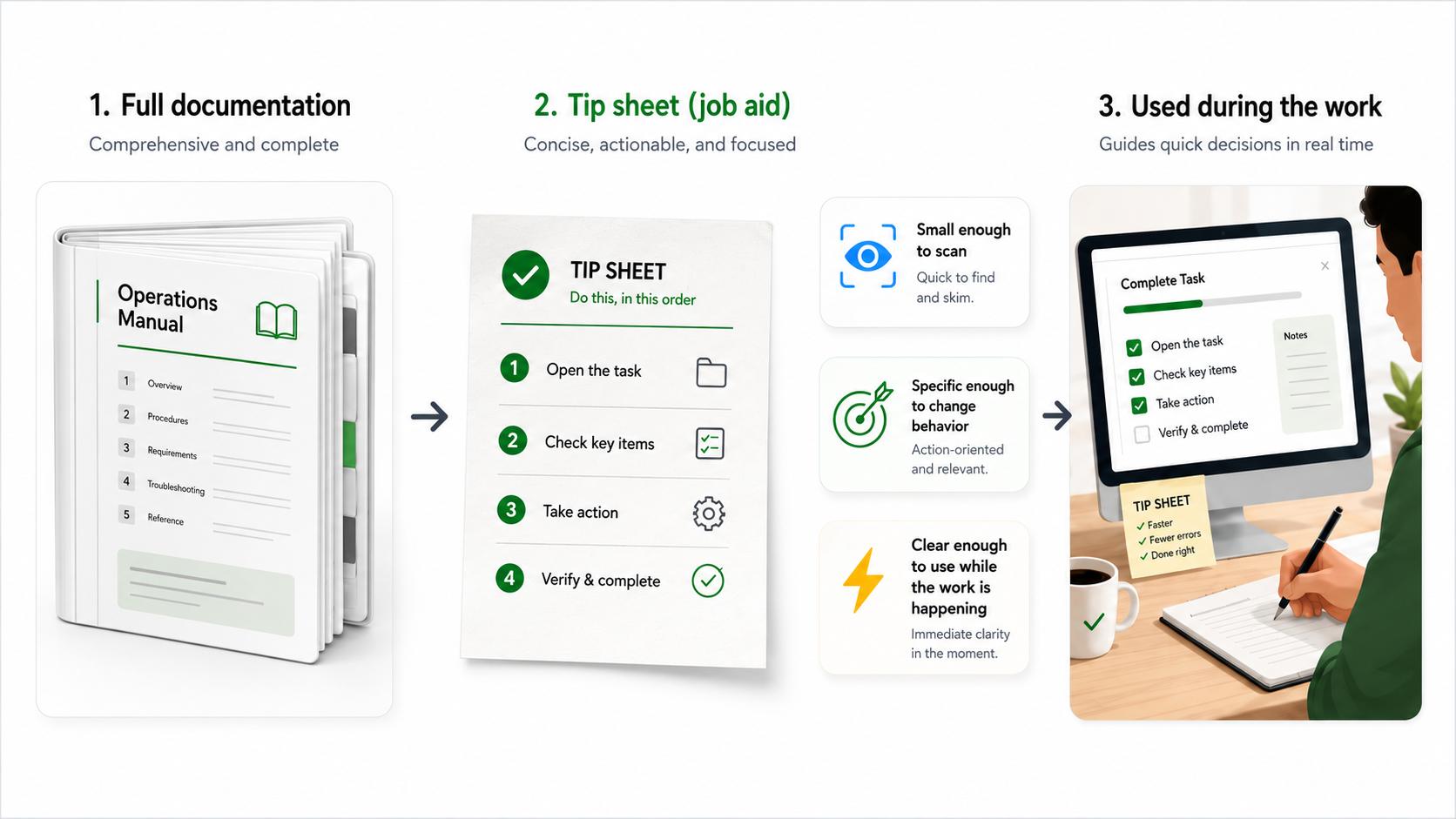
A good tip sheet is not a compressed manual. It is a job aid: small enough to scan, specific enough to change behavior, and clear enough to use while the work is happening. Performance-support guidance treats job aids as resources people use close to the moment of work, not as replacements for full training.1
When to use a tip sheet
Use a tip sheet when people need quick judgment, not a complete lesson. It can help a support agent write better ticket notes, a manager prepare for a sensitive conversation, or a new software user remember the few settings that matter before submitting a form.
The format is useful because it respects attention. Cognitive load theory argues that instructional material works better when it directs limited working-memory resources toward task-relevant activity.2 People do not always need a full training module. Sometimes they need the two or three reminders that prevent the most common mistake.
Tip sheet vs. similar formats
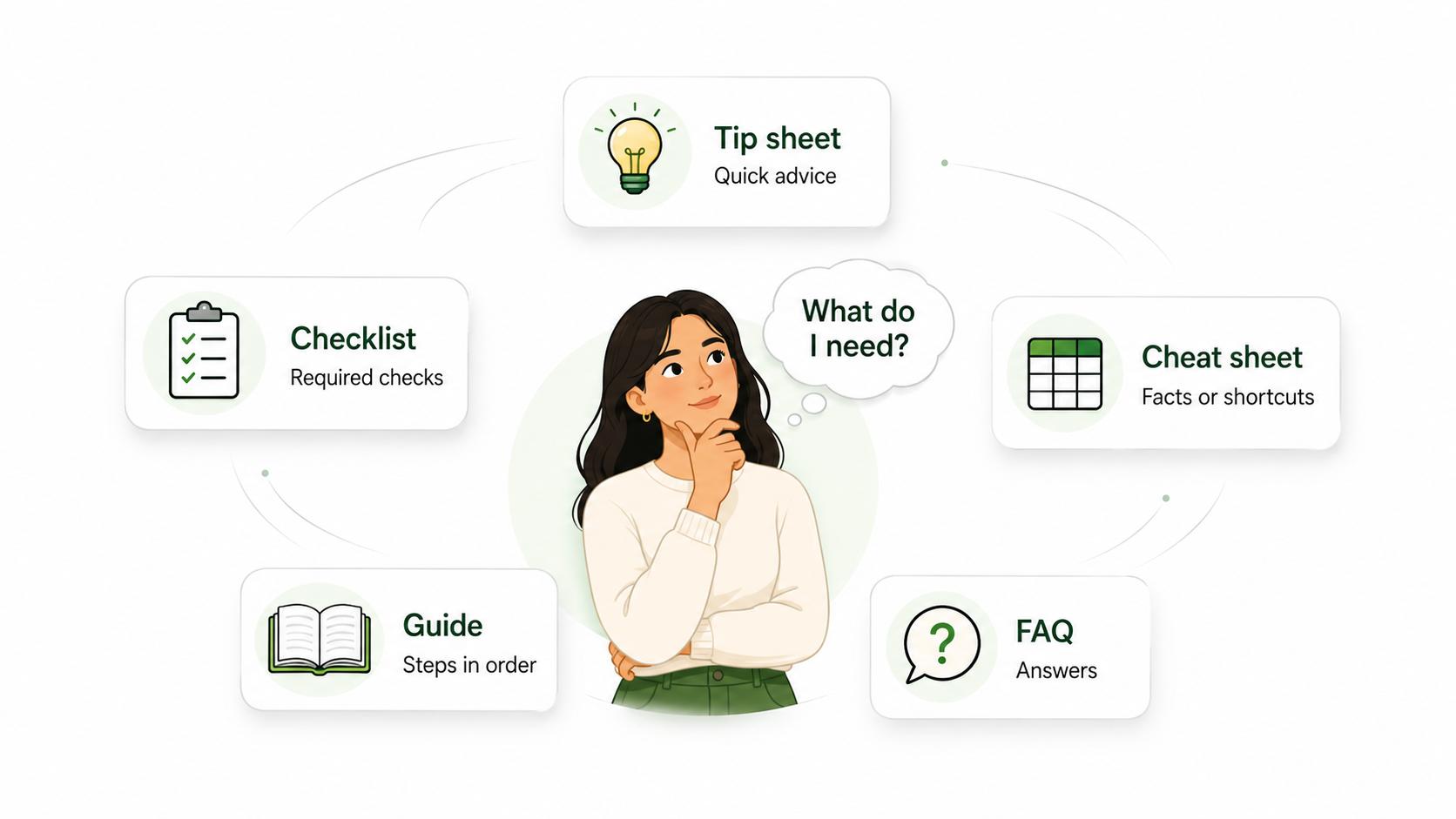
A tip sheet overlaps with other lightweight documentation formats, but the intended use is different.
| Format | Best for | Weak fit |
|---|---|---|
| Tip sheet | Practical reminders, best practices, and judgment calls | Teaching a full process from scratch |
| Checklist | Confirming required steps or criteria | Explaining why the steps matter |
| Cheat sheet | Compact facts, shortcuts, codes, or commands | Coaching behavior or decision-making |
| Step-by-step guide | Walking someone through a task in sequence | Quick reminders for people who already know the task |
| FAQ | Answering recurring questions | Guiding action during a live workflow |
The decision rule is simple: if the reader needs to complete steps in order, use a guide or checklist. If the reader needs quick advice while doing familiar work, a tip sheet is often the better fit.
What a tip sheet should include
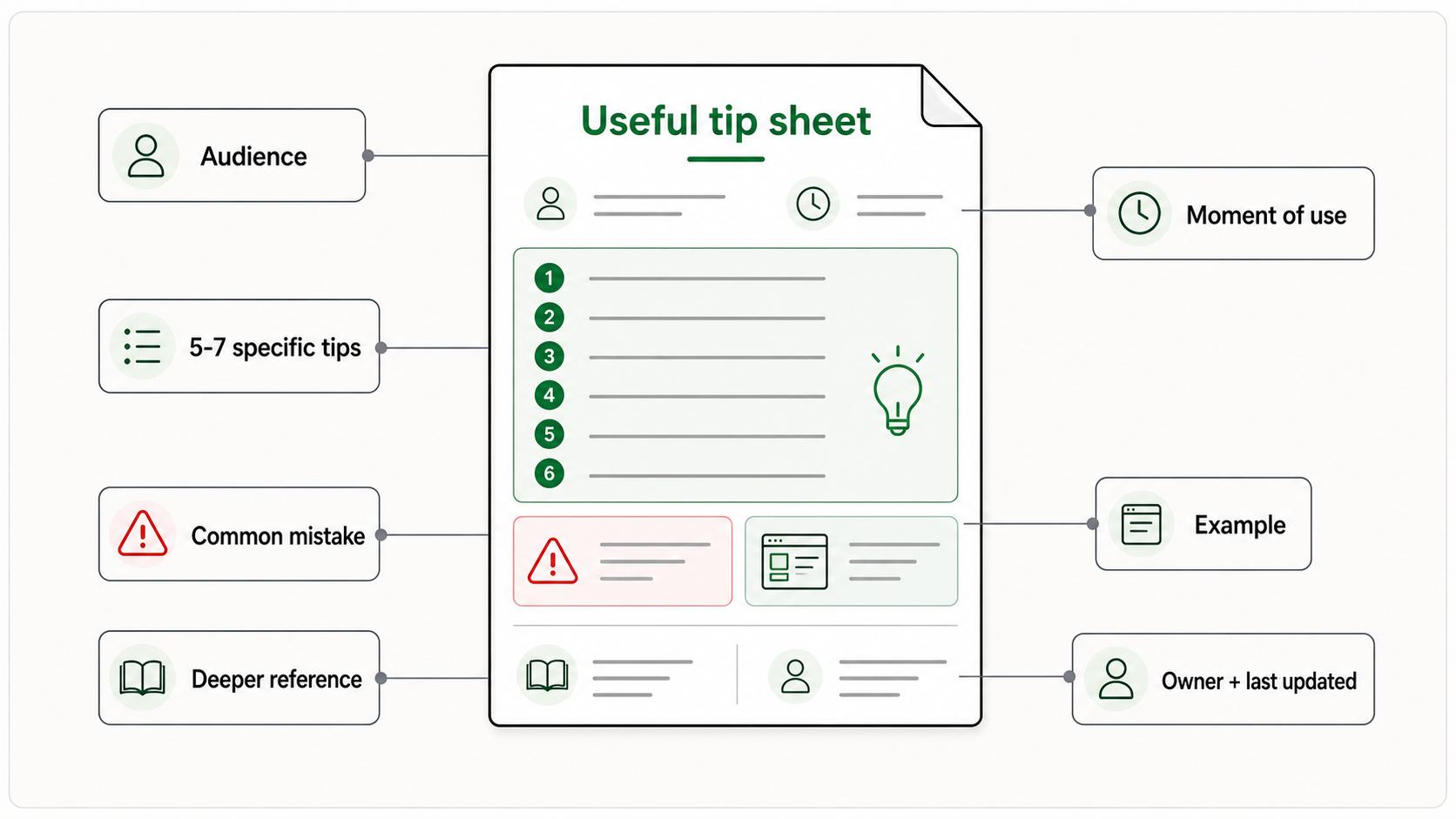
A useful tip sheet usually includes a title, audience, moment of use, five to seven high-value tips, one example or common mistake, and a link to deeper reference material. CDC's Clear Communication Index similarly asks authors to identify the audience, main message, and action the reader should take.3
The hard part is prioritization. A tip sheet should not include every detail the author knows. It should include the information that helps the reader make a better decision or avoid the most likely failure.
"Be clear" is weak. "Put the customer request in the first sentence of the ticket note" is useful. "Follow policy" is weak. "Escalate refund requests above $500 before promising an outcome" is useful. If a tip sounds like something a competent person could already guess, sharpen it until it names an action, threshold, phrase, or decision point.
Example of a tip sheet
Imagine a customer support team wants better escalation notes. A long policy document exists, but agents still hand off tickets without the context the next team needs.
A tip sheet titled "Escalation Notes: 6 Reminders Before You Hand Off a Ticket" might tell agents to summarize the customer's requested outcome, name what has already been tried, include relevant account details, state the decision needed from the next team, flag urgency without exaggerating it, and link the exact policy or conversation thread.
That tip sheet does not replace the escalation SOP. It makes the SOP easier to follow during a real ticket handoff.
How to create a tip sheet
Start with the moment of need. Ask when someone will use this, what they are trying to do, and what mistake the sheet should prevent.
Then choose the smallest useful set of tips. If you have more than seven, group them or change formats. Federal plain-language guidance recommends headings, white space, and reader-centered structure so people can scan and find what they need quickly.4 A tip sheet with fifteen reminders often becomes a document people mean to read later and never do.
Finally, connect the tip sheet to the source of truth. A tip sheet should not become a separate policy universe. It should point to the full SOP, guide, manual, or training material so readers know where to go when the situation is more complex.
Tip sheet template
Use this prompt to draft a practical tip sheet:
## Tip Sheet Template

**Glossary term:** Tip Sheet
**Source:** Trails Glossary — trails.so/glossary/tip-sheet

---

### 01. Draft a practical tip sheet

"Create a tip sheet for [task or situation].
Audience: [role or team]
Moment of use: [when the reader will use it]
Primary risk or mistake to prevent: [specific issue]
Source material: [SOP, guide, policy, training, or examples]
Tone: [direct, supportive, formal, conversational]

Include:
- A clear title
- A one-sentence purpose
- 5 to 7 specific tips in priority order
- One common mistake and how to avoid it
- One short example if useful
- A link or reference to the full documentation
- Owner and last-updated fields"
The template works best when the source material is already known. If the process itself is unclear, write the guide or SOP first.
Common mistakes
The most common mistake is using a tip sheet as a substitute for training. A tip sheet can reinforce learning, but it cannot carry the full burden of teaching a complex process.
Another mistake is making the page too generic. Tips like "communicate clearly," "stay organized," and "ask questions" sound helpful but rarely change behavior. Better tips name the exact action, threshold, phrase, or decision point.
A third mistake is failing to maintain it. Because tip sheets are small, teams sometimes forget they still need ownership. If the policy, process, or tool changes, the tip sheet needs to change too.
Documentation takeaway
Tip sheets are strongest when they live beside fuller documentation. The detailed guide explains the process. The tip sheet reinforces the moments where people forget, hesitate, or make common mistakes.
That relationship keeps the tip sheet short without making it shallow.
How Trails helps
Trails helps teams capture workflows as they happen and turn them into polished step-by-step guides. Teams can also create AI-narrated video versions for training or sharing.
Those full guides give tip sheets a reliable source of truth. Once the detailed process is documented, a team can pull out the highest-value reminders into a short tip sheet for day-to-day use.
- Template
- Training materials
- Training documentation
- Training manual
- Technical manual
- Job aid
- Cheat sheet
Sources
- 1
Learning Guild. Performance Support in the Flow of Work--Now and Going Forward. Learning Guild. www.learningguild.com/articles/performance-support-in-the-flow-of-worknow-and-going-forward. Accessed July 1, 2026.
- 2
John Sweller. Cognitive load theory as an aid for instructional design. Australasian Journal of Educational Technology. ajet.org.au/index.php/AJET/article/view/2322/1146. Accessed July 1, 2026.
- 3
Centers for Disease Control and Prevention. CDC Clear Communication Index. CDC. www.cdc.gov/ccindex/index.html. Accessed July 1, 2026.
- 4
U.S. Office of Personnel Management. Plain Language. OPM. www.opm.gov/information-management/plain-language/. Accessed July 1, 2026.