
Glossary
Change Management SOP
 ChatGPT
 Perplexity
 Gemini
 Claude
What is a change management SOP?
A change management SOP is a standard operating procedure that defines how an organization plans, approves, communicates, trains, and supports a change. It turns change management into a repeatable workflow with clear roles, checkpoints, documentation, and follow-up. California's OCM readiness guide groups readiness work around sponsorship, stakeholder management, communication, readiness, and training. 1
The SOP does not replace judgment. It gives teams a shared path for changes that affect people, processes, systems, customers, compliance, or daily operations.
Why a change management SOP matters
Many changes fail quietly. The project ships, the announcement goes out, and the new process technically exists, but people keep using the old workaround. A change management SOP reduces that risk by forcing the team to define what adoption requires before launch.
A good SOP answers questions like:
- Who decides whether a change needs formal review?
- What information must be documented before approval?
- Who needs to be informed, trained, or consulted?
- What materials must exist before rollout?
- How will the team confirm readiness?
- What happens after launch if adoption is uneven or issues appear?
The point is not to slow every change down. It is to make important changes visible enough that the team can manage risk, prepare affected users, and avoid messy handoffs. NIST configuration-management guidance makes a similar control point for system changes: organizations should review, approve or disapprove, document, implement, and retain records for controlled changes. 2
What a change management SOP should include
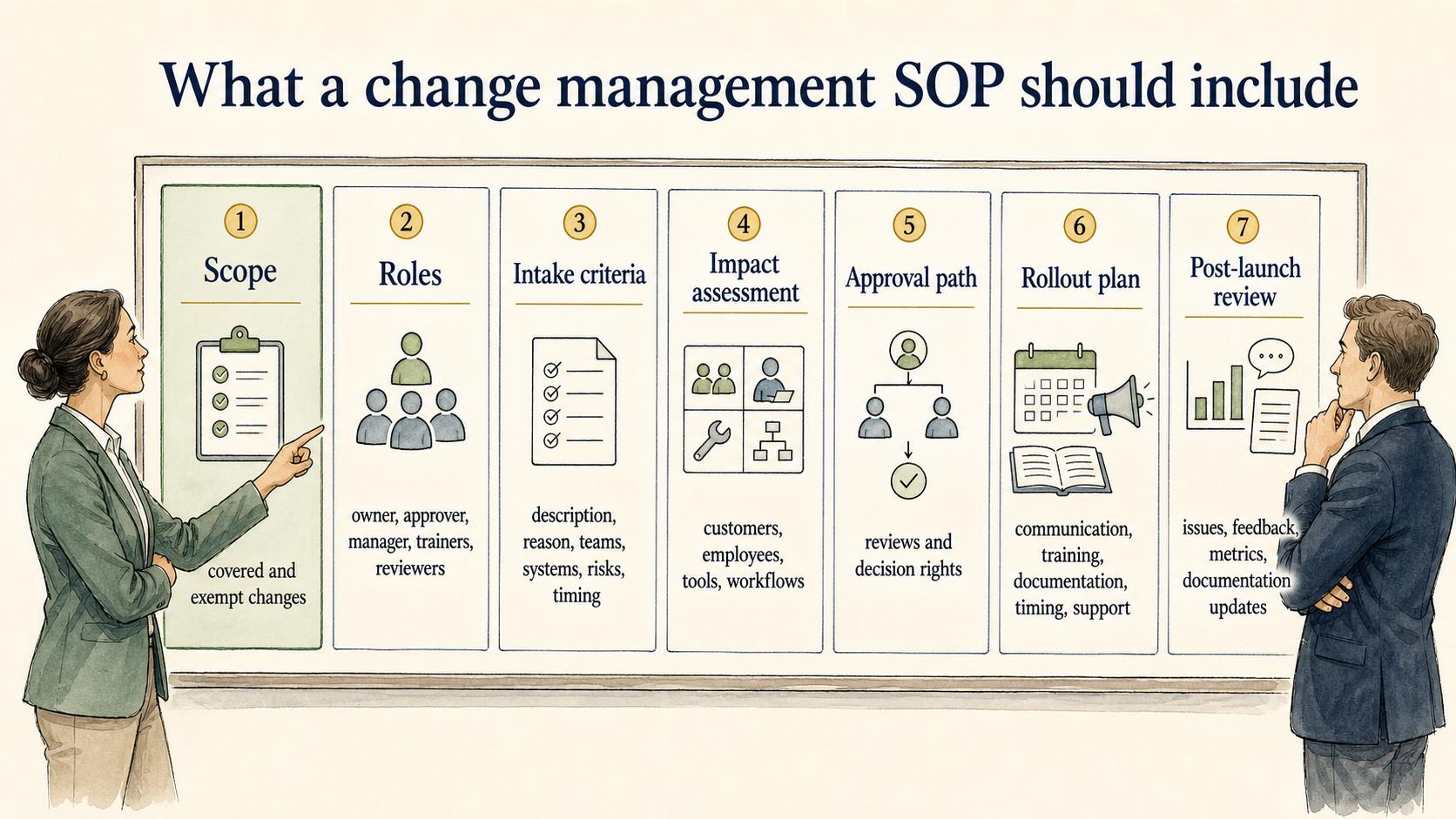
| SOP section | What it should define | Why it matters |
|---|---|---|
| Scope | Which changes follow the SOP and which are exempt | Prevents over-processing small changes and under-processing risky ones |
| Roles | Change owner, approver, change manager, process owner, trainers, reviewers | Makes accountability clear before launch pressure hits |
| Intake criteria | Required description, reason, affected teams, systems, risks, and timing | Forces a concrete view of the change instead of a vague request |
| Impact assessment | Who and what will change, including customers, employees, tools, and workflows | Shows where communication and training are needed |
| Approval path | Required reviews and decision rights | Prevents changes from moving forward without the right sign-off |
| Rollout plan | Communication, training, documentation, timing, and support steps | Turns approval into adoption work |
| Post-launch review | How issues, feedback, metrics, and documentation updates are handled | Keeps the SOP from ending at the announcement |
The most important section is usually scope. If the SOP treats every change the same way, people will bypass it. If it only applies to visible projects, smaller process changes can still create confusion. Strong scope rules separate low-risk updates from changes that affect behavior, customer experience, security, compliance, or cross-functional work. PMI's change-readiness guidance emphasizes assessing readiness for a specific program or project because readiness decisions shape whether the organization is prepared to execute the change. 3
Change management SOP vs change management plan
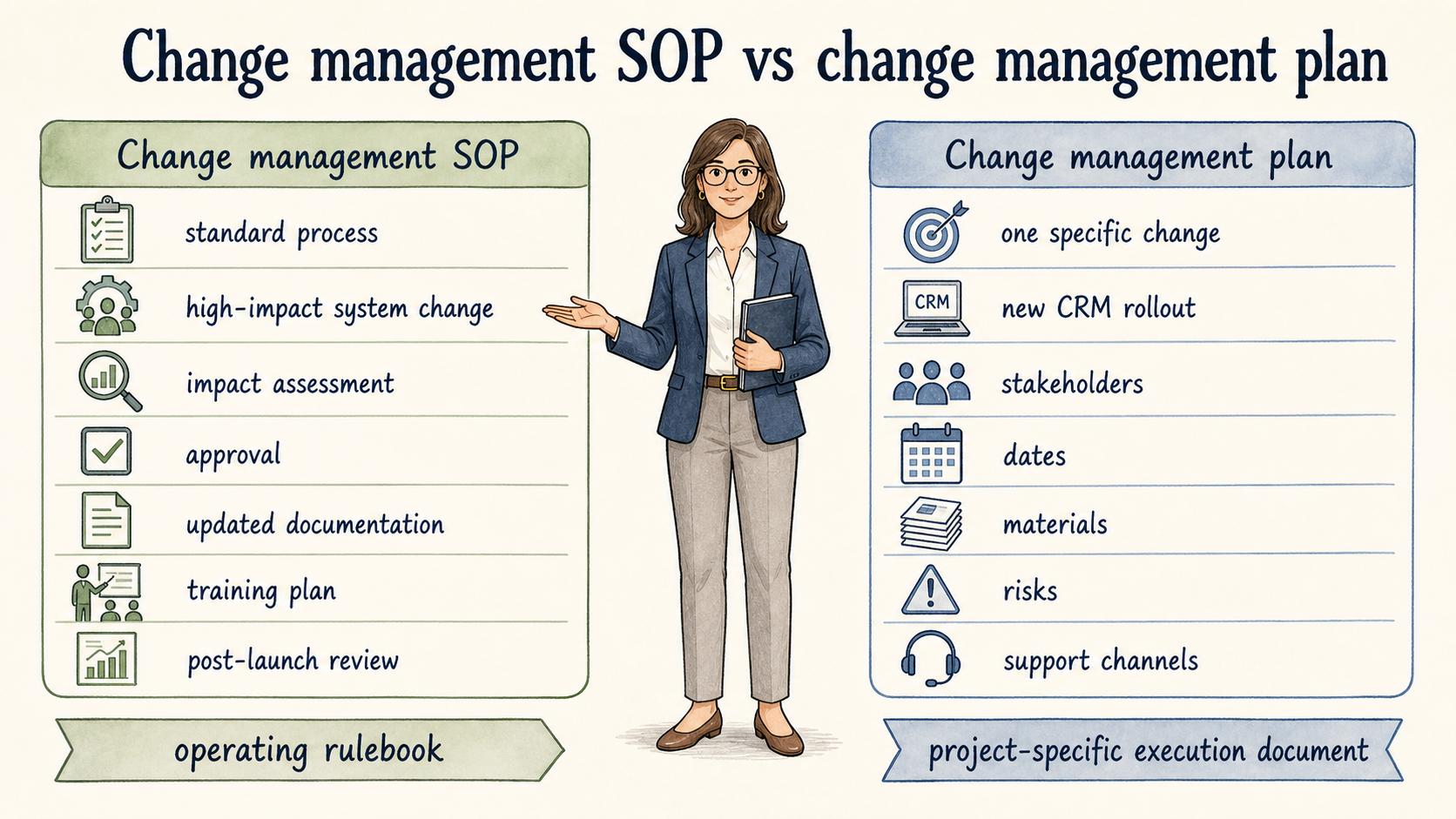
A change management SOP defines the standard process for handling change across the organization. A change management plan applies that process to one specific change.
For example, the SOP might say every high-impact system change needs an impact assessment, approval from the process owner, updated documentation, a training plan, and a post-launch review. The plan for a new CRM rollout would name the exact stakeholders, dates, materials, risks, and support channels for that rollout.
Think of the SOP as the operating rulebook and the plan as the project-specific execution document.
A practical change management SOP outline
Use this outline as a starting point for an internal SOP:
## Change management SOP outline

**Glossary term:** Change Management SOP
**Source:** Trails Glossary — trails.so/glossary/change-management-sop

---

### 01. Template

"Change Management SOP for [team/company]

1. Purpose
Define why this SOP exists and what risks it is meant to control.

2. Scope
List the types of changes covered, exempt changes, and escalation rules for uncertain cases.

3. Roles and decision rights
Name the change owner, change manager, approver, process owner, subject-matter experts, trainers, and support contacts.

4. Change intake
Require a short description, business reason, affected teams, affected systems, customer impact, timeline, dependencies, and known risks.

5. Impact assessment
Document what will change in the workflow, what users must stop/start/do differently, and what support they will need.

6. Approval
Define required reviews, approval criteria, and what happens when approval is denied or delayed.

7. Rollout preparation
Require updated SOPs, guides, checklists, training materials, communications, and support paths before launch.

8. Launch and support
Define launch steps, owner availability, issue triage, escalation, and rollback or mitigation rules.

9. Post-launch review
Capture feedback, adoption signals, open issues, documentation updates, and lessons for the next change."
This outline is intentionally artifact-heavy. A change management SOP gets weak when it only says to “communicate with stakeholders” or “provide training.” Better SOPs name the material that must exist and the decision that material supports.
Common mistakes
The most common mistake is making the SOP too heavy. If the process feels like a formality for every minor update, teams will route around it. Use tiers: low-risk changes may only need a brief record, while high-impact changes need deeper assessment and approval.
Another mistake is ending the SOP at launch. Change management is not complete when the email is sent. The SOP should include support, feedback, adoption checks, and documentation updates after people start using the new process.
A third mistake is treating communication as proof of readiness. People can be informed and still be unprepared. Readiness means the affected team knows what changes, has the right documentation, can practice or ask questions, and knows where to get help when the first real exception appears.
How Trails helps
A change management SOP often depends on clear process documentation: what is changing, how the new workflow works, and what people should do differently. Trails can capture a workflow as someone performs it, turn that workflow into a polished step-by-step guide, and create an AI-narrated video version for training or sharing.
That makes it easier for change owners to produce rollout materials that show the real process, not just describe it. It also gives teams a concrete artifact to attach to the SOP: a guide that helps people adopt the new workflow after approval.
FAQ
Who owns a change management SOP?
Ownership usually sits with operations, transformation, IT, compliance, or the process owner responsible for the affected workflow. The important point is that one role must maintain the SOP and ensure teams actually follow it.
Is a change management SOP only for IT changes?
No. IT changes are common, but the same SOP pattern can apply to operational processes, customer-facing workflows, compliance updates, HR programs, training changes, and cross-functional handoffs.
What is the difference between change management and change control?
Change management focuses on helping people and teams adopt a change. Change control focuses on reviewing, approving, and tracking changes in a controlled way. A mature SOP often includes both, but they are not the same thing.
- Change management
- Change manager
- Standard operating procedure
- Checklist
- Work instruction
- Process owner
- Project manager
- Version history
Sources
- 1
California Department of Technology. Organizational Change Management Readiness Guide. cdt.ca.gov/wp-content/uploads/2017/02/OCM-Readiness-Guide.pdf.
- 2
NIST. SP 800-128: Guide for Security-Focused Configuration Management of Information Systems. nvlpubs.nist.gov/nistpubs/SpecialPublications/NIST.SP.800-128.pdf.
- 3
Project Management Institute. Change readiness guidance. www.pmi.org/learning/library/change-readiness-11126.