
Glossary
Change Manager
 ChatGPT
 Perplexity
 Gemini
 Claude
What is a change manager?
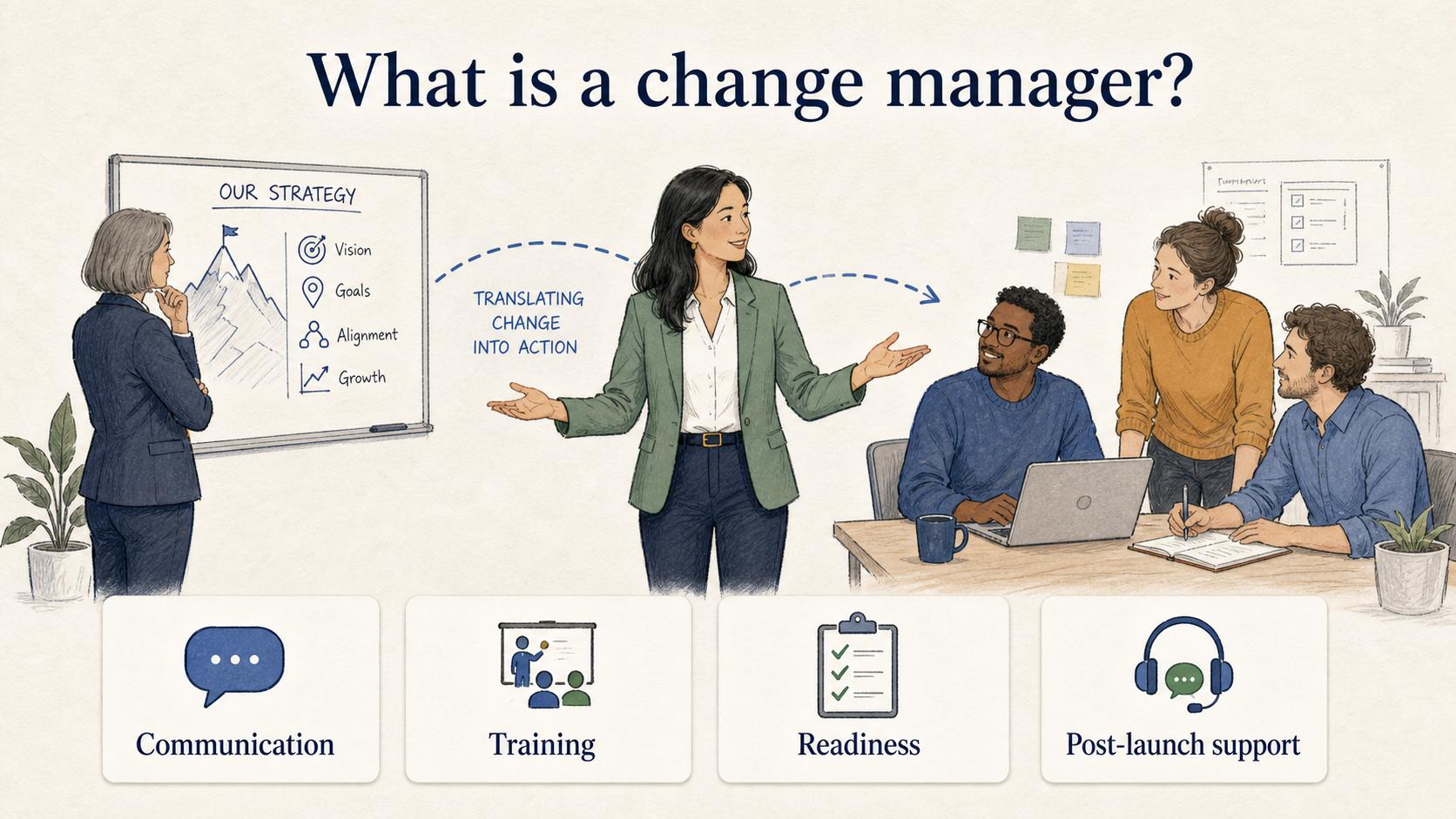
A change manager is the person responsible for helping people adopt a new process, system, policy, structure, or way of working. The role turns a business change into communication, training, stakeholder engagement, readiness checks, and post-launch support.
In practice, a change manager sits between strategy and day-to-day behavior. California's organizational change management readiness guide frames OCM around preparing people and organizations for transition, not just delivering the technical change. 1
What a change manager does
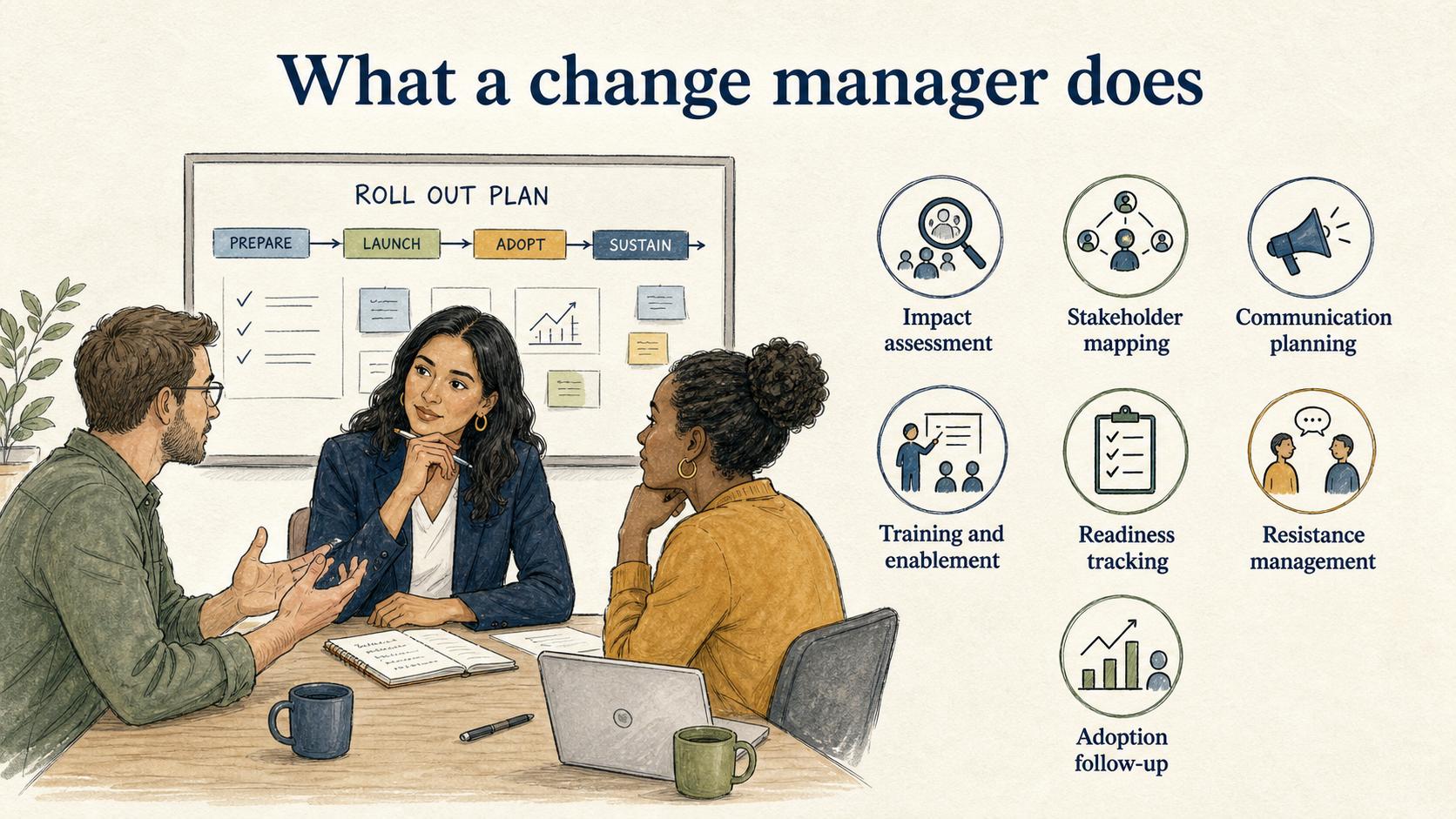
A change manager's core job is to close the gap between launch and actual behavior change. A new tool can go live, a process can be approved, or a reorg can be announced while the real work still happens the old way. PMI treats rigorous change management as a complement to project, program, and portfolio delivery practices. 2
Common responsibilities include:
- Impact assessment: identifying which teams, roles, systems, customers, or routines will be affected.
- Stakeholder mapping: figuring out whose support is required, who will be disrupted, and who can influence adoption.
- Communication planning: deciding what each audience needs to hear, when they need to hear it, and which questions they are likely to ask.
- Training and enablement: preparing the guides, sessions, examples, FAQs, and job aids people need to do the new thing correctly.
- Readiness tracking: checking whether teams are prepared before launch instead of assuming awareness equals adoption.
- Resistance management: diagnosing whether friction comes from confusion, workload, incentives, trust, or a flaw in the change.
- Adoption follow-up: supporting the messy period after launch, when people test the new process against real work.
Resistance is useful data. A weak change manager treats pushback as a messaging problem. A strong one asks whether the change is unclear, unrealistic, poorly timed, under-supported, or colliding with another priority. Research on organizational change success identifies communication, participation, leadership, and readiness factors as recurring determinants, which is why resistance should be diagnosed rather than dismissed. 3
Change manager vs project manager vs process owner
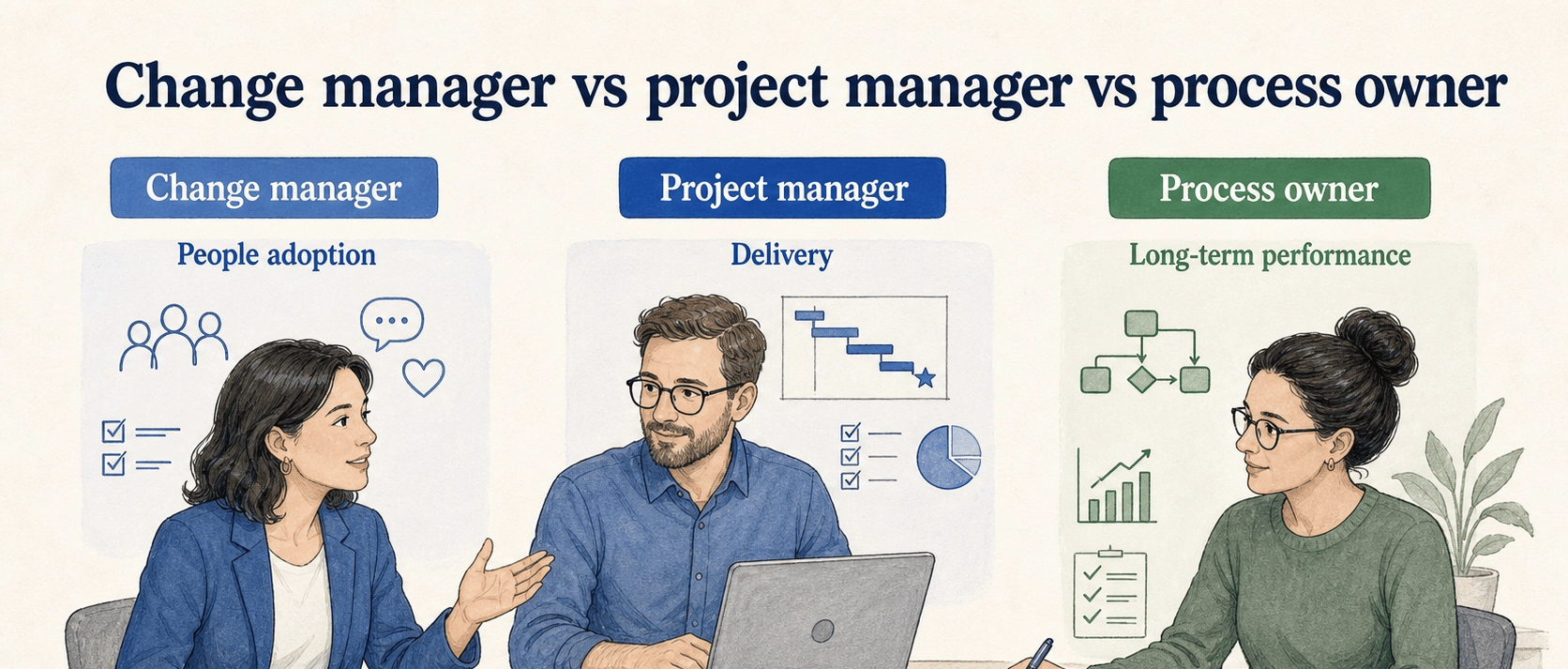
| Role | Primary focus | Success looks like |
|---|---|---|
| Change manager | People adoption and behavior change | Affected teams understand, accept, and use the new way of working |
| Project manager | Delivery plan, timeline, scope, and dependencies | The change is delivered on time with known risks managed |
| Process owner | Long-term performance of a process | The process remains clear, measured, improved, and accountable |
These roles overlap, especially in smaller organizations. The useful distinction is attention. A project manager asks, "Will we deliver?" A process owner asks, "Will this process keep working?" A change manager asks, "Will people actually change how they work?"
When one person owns all three responsibilities, adoption work is often the first thing squeezed. Naming the change manager role can matter even when it is not a full-time position.
When a change manager is needed
Not every update needs formal change management. A small UI tweak, internal policy clarification, or low-risk process improvement may only need a clear announcement and updated documentation.
A change manager becomes more useful when the change affects habits, incentives, customer experience, compliance, or multiple teams. Common examples include:
- Rolling out a new CRM, help desk, ERP, HRIS, or internal knowledge system.
- Changing how customer onboarding, support escalation, or finance approval works.
- Introducing a new compliance process or quality standard.
- Consolidating teams after a reorganization or acquisition.
- Moving from informal founder-led work to standardized operations.
The key question is not project size. It is how much behavior has to change for the work to succeed.
A practical change-readiness diagnostic
Before launch, a change manager should be able to answer these questions without hand-waving:
- Who has to work differently on day one?
- What will they stop doing, start doing, or do in a different order?
- What will make the change feel harder than the current way?
- What documentation or training proves the new behavior is teachable?
- Who will answer questions after launch?
- What signal will show adoption is real rather than announced?
If those answers are vague, the change is probably not ready. The risk is quiet workaround behavior: people nod during rollout, then keep using the old spreadsheet, old approval path, old escalation habit, or old customer script.
How documentation supports a change manager
Documentation is one of the change manager's most practical tools when it is tied to behavior. A launch deck may create awareness. A step-by-step guide, job aid, FAQ, checklist, or SOP helps people perform the new work when the change reaches their desk.
Useful change documentation names the new workflow, the old workflow it replaces, the moments where people are likely to hesitate, and the support path when something does not fit the standard case. That is more helpful than a broad announcement that explains why the change matters but leaves people guessing how to operate tomorrow.
How Trails helps
Change managers often need to turn expert knowledge into training material quickly. Trails can capture a workflow as someone performs it, turn that workflow into a polished step-by-step guide, and create an AI-narrated video version for training or sharing. That makes it easier to document the new process before launch and keep the rollout grounded in the work people need to do.
For change management, the point is clearer adoption support at the moment people switch from the old way to the new one.
Change manager FAQ
Is a change manager the same as a project manager?
No. A project manager manages delivery; a change manager manages adoption. In smaller teams, one person may do both, but the responsibilities are different.
What skills does a change manager need?
A change manager needs communication, stakeholder management, process understanding, facilitation, training design, and the ability to diagnose resistance without dismissing it.
What does a change manager do after launch?
After launch, the change manager tracks adoption, gathers feedback, updates training material, supports managers, and helps remove the friction that prevents people from using the new process consistently.
Sources
- 1
California Department of Technology. Organizational Change Management Readiness Guide. cdt.ca.gov/wp-content/uploads/2017/02/OCM-Readiness-Guide.pdf.
- 2
Project Management Institute. Change management essentials. www.pmi.org/learning/change-management.
- 3
SAGE Open. The determinants of organizational change management success. journals.sagepub.com/doi/10.1177/18479790211016273.