
Glossary
Business Analyst
 ChatGPT
 Perplexity
 Gemini
 Claude
What is a business analyst?
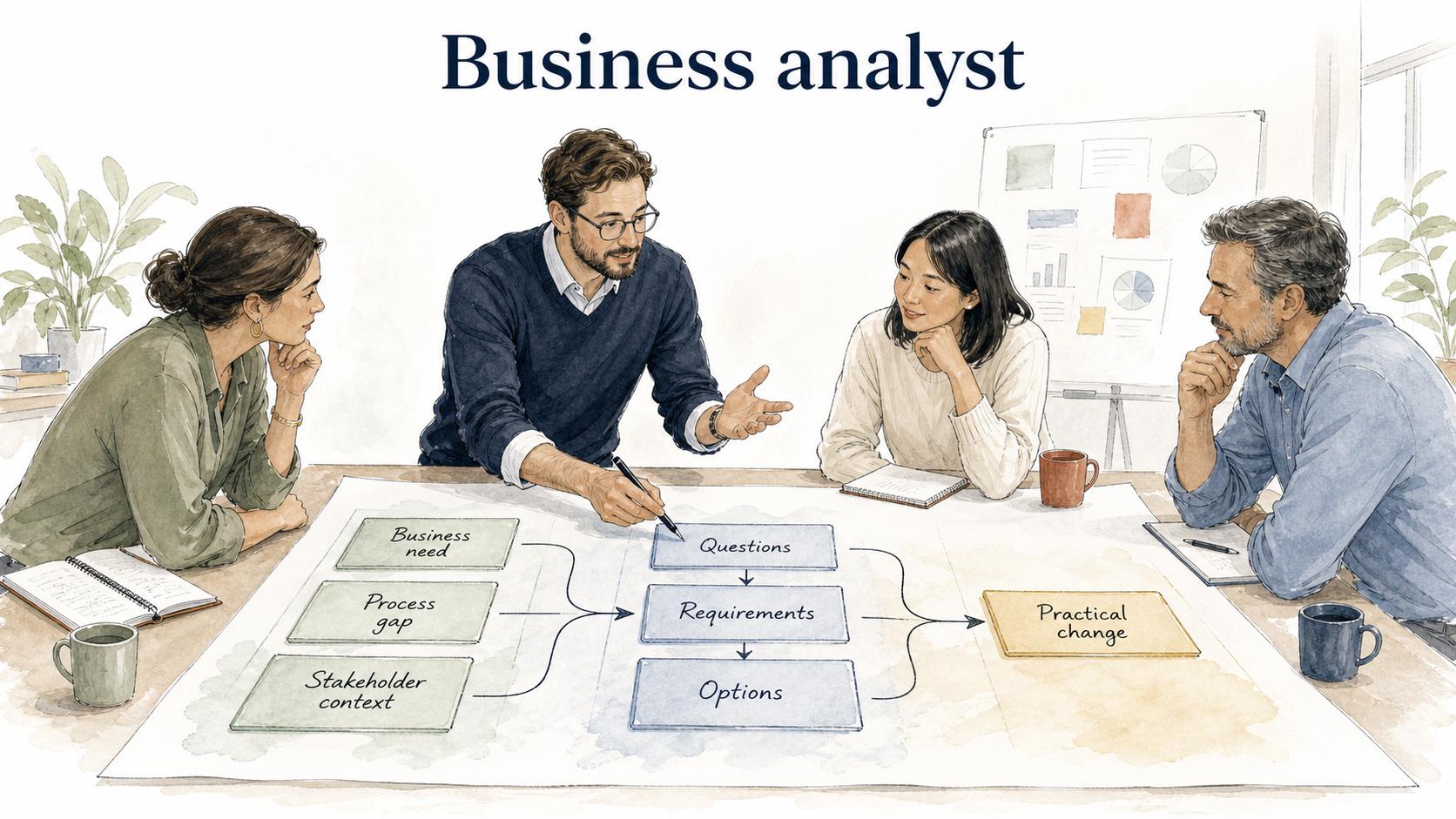
A business analyst helps teams understand business needs, process gaps, requirements, and practical options for change. IIBA's BABOK Guide describes generally accepted practices for business analysis and the skills and knowledge business analysis professionals use, which supports treating this as a distinct analysis discipline.1
The role often sits between business stakeholders and delivery teams. IIBA's Business Analysis Standard centers business analysis on concepts such as change, need, solution, value, stakeholder, and context, which fits this translation role between problem and solution.2 A business analyst might interview users, map a current process, document requirements for a new system, clarify why a workflow is breaking, or help leaders decide whether a change is worth making.
The best business analysts don't simply collect requests. They test whether the request solves the real problem.
What a business analyst does
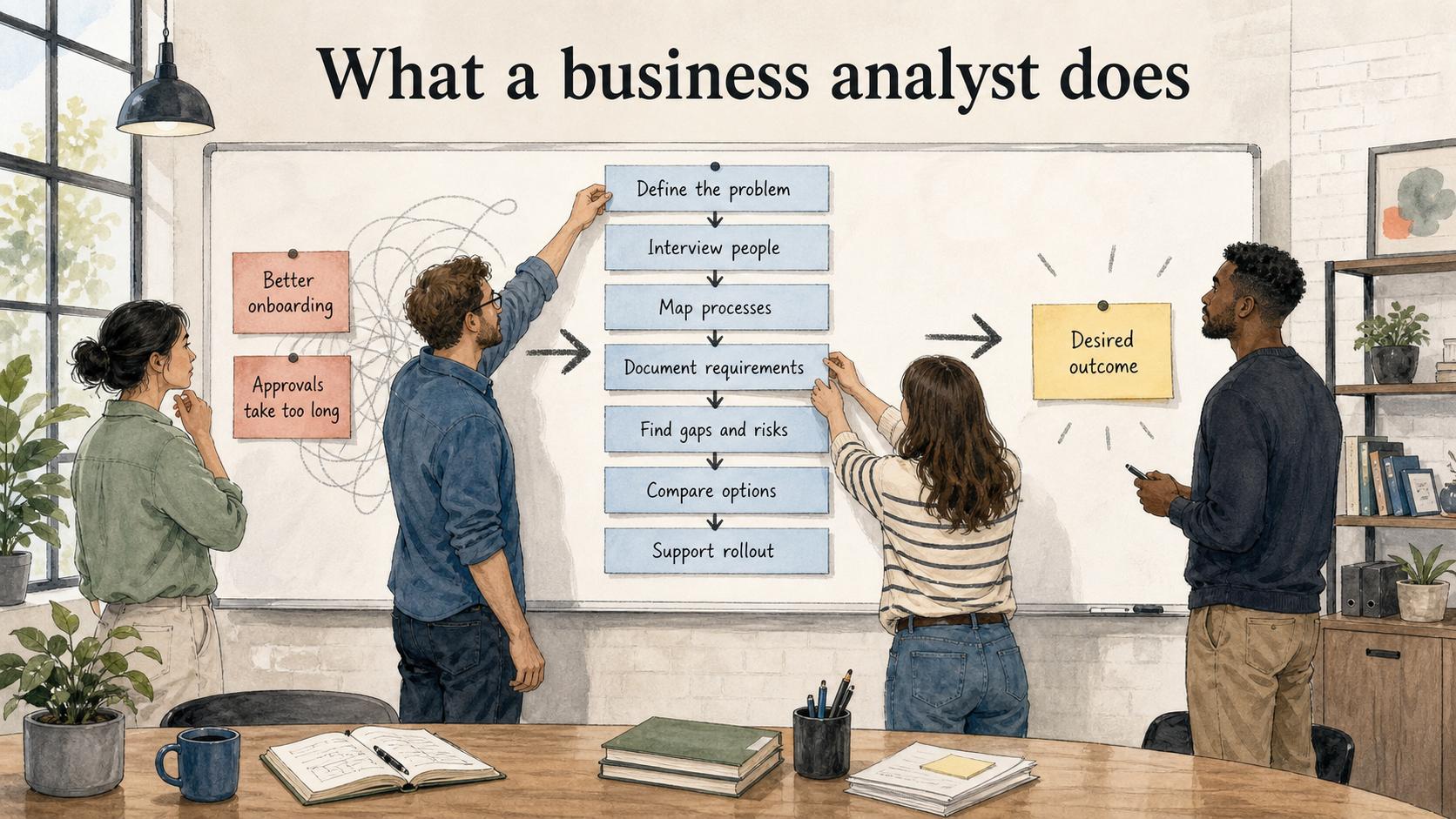
A business analyst brings structure to ambiguity. When a team says, "We need a better onboarding workflow" or "Finance approvals take too long," the analyst turns the complaint into something the team can evaluate and act on.
- Naming the business problem and desired outcome
- Interviewing stakeholders and users
- Mapping current and future-state processes
- Documenting requirements, rules, and constraints
- Finding gaps, risks, dependencies, and edge cases
- Comparing solution options
- Supporting testing, rollout, and change management
The practical value is the judgment between those activities. PMI's business analysis practice guide frames business analysis as investigation and discovery work aimed at outcomes, which supports separating the business need from an assumed solution.3 A business analyst has to know when a stakeholder is describing a symptom, when a requirement is actually a preferred solution, and when a process issue needs documentation rather than new software.
Business analyst example
Imagine a customer support team wants a new escalation tool because urgent tickets are being missed. A business analyst would first investigate how escalations work today: when agents escalate, what information they include, who approves the escalation, what happens in the ticketing system, and where delays appear.
The analyst might find that the tool is only part of the issue. The real problem could be inconsistent escalation criteria, unclear ownership after handoff, missing manager notifications, and no documented procedure for high-risk cases. In that situation, the analyst's output might include a process map, clearer decision rules, revised requirements for the tool, and a draft SOP for the new escalation workflow.
The request was "new tool." The business need was "reliable escalation." The analyst helps the team avoid solving the wrong problem carefully.
What makes a good business analyst effective
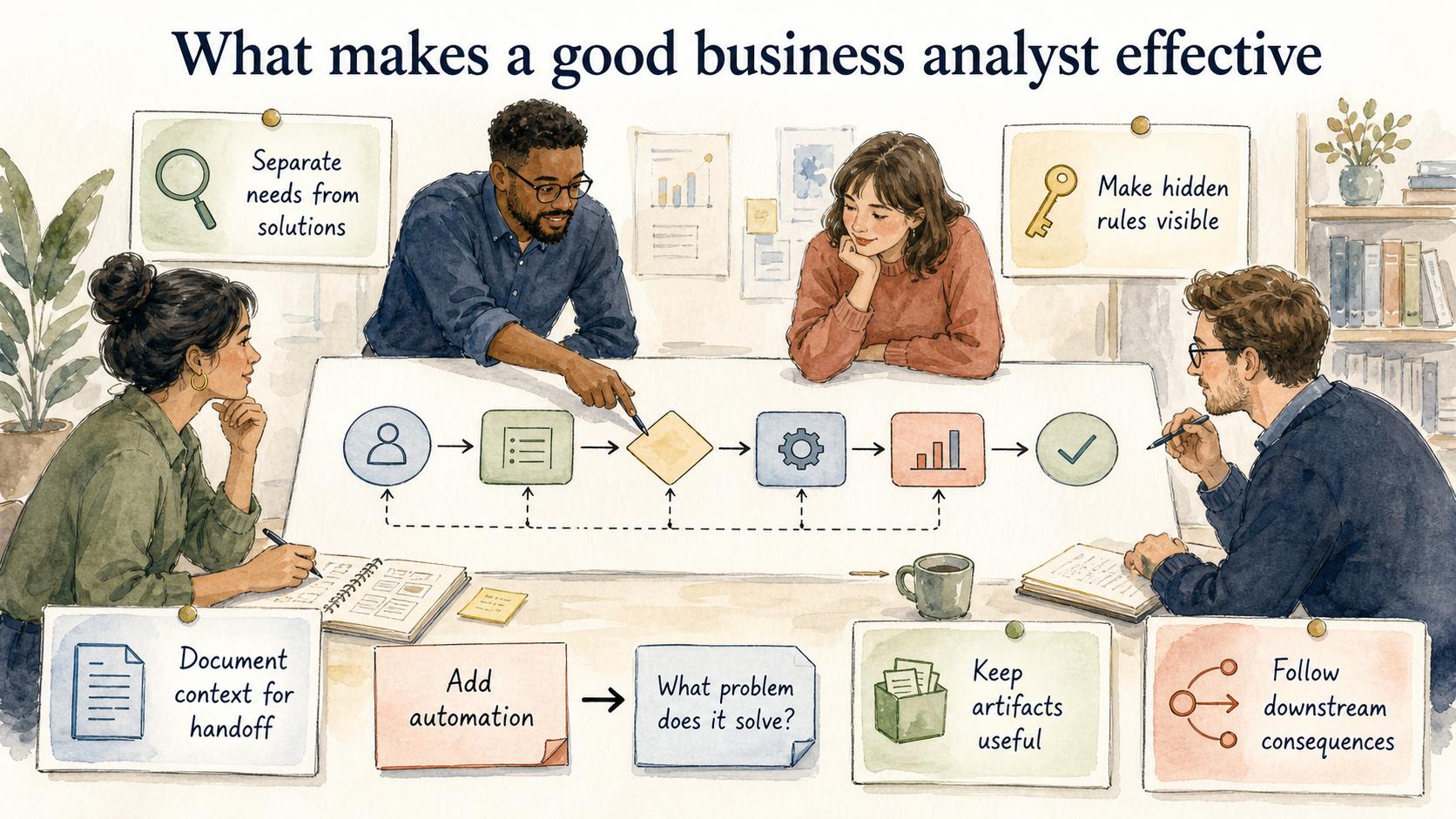
They separate needs from requested solutions. Stakeholders often ask for a dashboard, automation, approval step, or new field. The analyst asks what decision, delay, error, or risk the request is meant to address.
They make hidden rules visible. Many business processes rely on rules that experienced employees know but never write down. A business analyst should surface those rules before a team builds, automates, or trains around the process.
They document enough context for handoff. Requirements without context can become brittle. Delivery teams need to know the outcome, constraints, users, edge cases, and examples that shaped the requirement.
They look for downstream consequences. A change that makes one team's work easier may push complexity to another team. Good analysis follows the handoff until the end-to-end outcome is clear.
They keep artifacts useful. Process maps, requirements documents, and decision logs should help people make better decisions. If an artifact exists only because a template required it, it is probably too heavy.
Useful business analyst artifacts
A business analyst's output depends on the problem, but common artifacts include process maps, current-state and future-state descriptions, requirements documents, user stories, stakeholder maps, decision logs, gap analyses, acceptance criteria, and test scenarios.
The artifact should match the uncertainty. If the team doesn't understand the process, start with a process map. If the process is understood but the solution is unclear, use requirements and decision criteria. If the solution is being built, focus on acceptance criteria, examples, and edge cases. IIBA describes business analysis knowledge areas that include elicitation, requirements analysis, solution evaluation, and stakeholder collaboration, which helps explain why the artifact should follow the question being clarified.4
A strong rule of thumb: choose the artifact that will reduce the next expensive misunderstanding.
AI-ready business analyst prompt
Use this prompt to structure an early analysis pass:
## Business Analyst Prompt

**Glossary term:** Business Analyst
**Source:** Trails Glossary — trails.so/glossary/business-analyst

---

### 01. Run an early analysis pass

"Act as a business analyst helping [team] improve [process or problem area].

Context:
- Business problem: [describe the issue]
- Desired outcome: [what should improve]
- Stakeholders: [roles or teams]
- Current workflow: [known steps or gaps]
- Constraints: [systems, policy, timing, compliance, budget]

Create:
1. Clarifying questions to ask stakeholders
2. Current-state process assumptions to verify
3. Likely hidden business rules
4. Requirements that should not be confused with solution ideas
5. Risks, handoffs, and edge cases to document
6. Recommended artifacts for the next step

Keep the analysis practical and point out where the team may be solving a symptom instead of the real problem."
How Trails helps
Business analysts often need to capture how work is actually done before they can improve or specify it. Trails records a workflow as someone performs it, turns that workflow into a polished step-by-step guide, and can create an AI-narrated video version for training or sharing. That gives analysts a concrete starting point for process discovery, documentation, and handoff conversations.
FAQ
What is a business analyst in simple terms?
A business analyst helps teams understand what the business needs, how work happens today, what should change, and what requirements or process improvements are needed to reach the desired outcome.
Is a business analyst the same as a project manager?
No. A project manager focuses on planning and coordinating delivery. A business analyst focuses on understanding the business problem, requirements, process gaps, and solution options. The roles often work closely together.
Does a business analyst need technical skills?
It depends on the role. Some business analysts work heavily with software teams and need technical fluency. Others focus more on operations, process improvement, reporting, or stakeholder analysis. In either case, they need enough systems understanding to ask useful questions.
What documents does a business analyst create?
Common documents include process maps, requirements documents, user stories, acceptance criteria, gap analyses, decision logs, stakeholder notes, and test scenarios. The right document depends on the problem the team is trying to clarify.
- Business process
- Process analyst
- Process mapping
- Process improvement
- Workflow
- Project manager
- Documentation specialist
- Technical writer
- Requirements gathering
- Business requirements document
- Stakeholder management
Sources
- 1
IIBA. A Guide to the Business Analysis Body of Knowledge. www.iiba.org/career-resources/a-business-analysis-professionals-foundation-for-success/babok/.
- 2
IIBA. The Business Analysis Standard. www.iiba.org/knowledgehub/the-business-analysis-standard/.
- 3
PMI. Business Analysis for Practitioners: A Practice Guide - Second Edition. www.pmi.org/standards/business-analysis-second-edition.
- 4
IIBA KnowledgeHub. BABOK Guide. www.iiba.org/knowledgehub/business-analysis-body-of-knowledge-babok-guide/.